Showing posts with label weeds. Show all posts

Monday, October 2, 2023

Becoming Drought Resistant

In normal times, this simple blog contains the ramblings of a simple guy that likes the agrarian life and simpler times. I am partial to old fashioned values and a Biblical worldview.  Sometimes, we depart from that theme, but not often.  

Before Benjamin's accident, we were in the middle of a long drought.  What made it worse is that it was during the peak summer months where temperatures exceed 100 degrees for days on end.  To give you an illustration of exactly how dry it is, I'll share some numbers with you.  We have a rain gauge that we watch and tally the numbers.  Yes, it's kind of nerdy but we've done that for a while.  In fact we have 10 years of rainfall data.  Our ten year average annual rainfall is 65.89 inches.  I added up the numbers through September and for 2023 we've had 32 inches of rain.  Granted, we have 3 months left in the year, but October and November traditionally are two of the driest months.  We have 10 years of data to back that up.  We're almost 3 feet short of rainfall.  That's hard to imagine.

I've been looking up different techniques of drilling my own water well in the back yard, just to perhaps be self-sufficient in terms of water for the animals and for irrigation.  We do have about 500 gallons of rainfall catchment capacity coming off of our roof, but in order to sequester rainwater, you've got to have rain.  The drought has made me think of water more than I normally do.  Water is usually so prevalent in south Louisiana.  In hindsight, when building our house, I wish that I had sunk concrete cisterns and piped all of the greywater into them to use for irrigation of the garden and fruit trees.

The other day, we made a short trip to our church to water the landscaping.  In the spring we had put in some new plants and we have tried to water three times a week to keep the plants alive.  Here is a photo of the grass in the church yard.  It's dead, brown, crispy when you walk on it.  Normally it's lush and green.

Our little country church has parking on both sides.  On one side, we call it the 'country side,' because it's just grass with a limestone base.  On the side closest to the main road, we call it the 'city side,' because it has a concrete parking lot.  We parked our vehicle on the city side and walked around the corner to begin watering the box woods and knockout roses.

And then I looked down at the concrete.  This concrete bakes in the summer sun.  And yet, there's weeds growing through small cracks in the surface!  How can this be?  If this was something good like a vegetable plant, it would have withered up and died a long time ago.  But these weeds are as healthy and lush as ever.  

The weeds aren't stressed.  They aren't brown.  They are thriving.

Okay, I know I'm being overly dramatic.  I'm bad about that sometimes, but this blog is a therapeutic thing - a journal of sorts.  How does one become drought resistant?  What lessons can we learn from the weeds thriving in cracks on the city side of the parking lot in the middle of a drought?

First is determination.  These weeds have an absolute will to live.  Their prognosis is not good.  Even in times of rainfall and good conditions, they don't stand much of a chance of survival.  The odds are stacked against them.  They don't listen to all that.  They just survive.  

The next is some wisdom I learned from an old-timer I was talking to the other day.  He told me, "Kyle, even though it it dry, try not to water your garden too much.  Give it just enough to keep it alive.  You see, if you water too much, the plant's root system will be shallow and when the rainfall stops, they suffer.  But, if there's not a lot of water, it forces the plant's root system to grow down deep to get to the water."  That's what these weeds in the parking lot have done.  Their root system has grown down through the four inches of concrete and deep into the soil below where it finds water to keep it nourished - even in the midst of a drought.

Sometimes we miss it, but if we slow down, there is knowledge we can learn most anywhere we look.  We can learn a lot from the bahia grass growing in the cracks of the city side of the parking lot at Cornerstone Baptist Church in Jennings.  There's some great spiritual principles there as well.  Be determined.  Even in tough times, when things aren't going your way, persevere.  In times of adversity or even persecution, stand fast in your faith.  Grow your roots deep in God's Word and be nourished on his daily provision.  Drink the Living Water and never thirst again.  But the Good Book says best:

7 Blessed is the man that trusteth in the LORD, and whose hope the LORD is.  8 For he shall be as a tree planted by the waters, and that spreadeth out her roots by the river, and shall not see when heat cometh, but her leaf shall be green; and shall not be careful in the year of drought, neither shall cease from yielding fruit.  Jeremiah 17:7-8

That's how you become drought resistant in a dry and thirsty land.


Monday, August 28, 2023

Wrapping Up a Garden/Chicken Project

We butchered all the roosters over a month ago.  We've been eating them and the taste is superb.  They are not as big as the Cornish Cross meat birds, but they taste better, we think.  The downside is that the Cornish Cross birds are ready for slaughter in only 8 weeks, while the birds we hatch from our own eggs take about 6 months to mature. 

Now that all the roosters but two are in the freezer, mostly hens remain in the chicken tractor.  I push them to new grass everyday and bring food and water.  I'm ready to make things easier.  It is time to incorporate this flock into the free-ranging flock out in the pasture.  It's always tricky trying to get the flocks to assimilate.  Birds of a feather, do indeed, flock together.  Before doing so, I'll trim the pullet's wings.

One project must be completed, first, though.  From past experience, I learned that young pullets can squeeze through the 4x4 mesh of the fencing that surrounds the garden.  Chickens get into the garden, scratch up seeds I have planted and eat the plants.  Worse than that, those that can't get in the garden, stick their heads through the fence and scratch away all the wood chip mulch, exposing the ground.  The exposed soil soon sprouts weeds that spread across the garden.  Not good!  

So I embarked on a labor intensive project.   I cut a 1 foot strip of 2x4 welded wire fence and wired it over the 4x4 fencing.  This will, I hope, bar entry into the garden of any pullets.  No way they can get through there.

Then I backfill with wood chip mulch to cover over and choke out any weeds that might try to grow from the previously exposed soil.  I pushed it right up against the fence and packed it in good.  Once it settles, I'll add even more.

I got mostly all of the garden fence complete.  I'm lacking a 6 foot portion on the east side and a 15 foot section against the south side.  I wanted to finish, but it got dark on me.

Once i have that finished, I'll release the chickens that are currently in the chicken tractor, into the pasture to roam - just not to roam in our garden.  Before I do that, I'll clip their wings so that they can't fly out.  Letting them loose on the pasture will save roughly 20 minutes a day in feeding, watering and pushing the tractor.  Always looking to make things more efficient.  We'll see if this time-consuming project pays dividends.

Tuesday, February 18, 2020

A Quick Walk Through the Garden in February

Just a short walk through the garden tonight to talk about how things are going with the Back to Eden Gardening Method.  So far, so good.  Really, not much 'winter grass' this year.  The only thing that pops up is oxalis.  A couple of days ago I showed you the sugar snap peas.  Let's walk a few rows over.  Next week we'll look a few rows over from that.

First we have broccoli.  Nice, big heads of broccoli coming out of the garden right now.  We'll continue to harvest the little florets for quite a while now.  Tricia roasts the broccoli in the oven (with some cauliflower) in a little olive oil and minced garlic.  Scrumptious!


Speaking of cauliflower, here's a nice head of purple cauliflower.  Nice to look at and delicious to eat.


On February 15th, I planted two 15 foot rows of sweet corn.  I scraped back the wood chips from either side of some spinach that is finishing up.  I' allowing the spinach to go to seed so that I can save lots of seed from them.  We liked it.  The variety was Galilee Spinach, and it comes from Israel.  To the left, you can see the garlic and to the right, you can see several rows of carrots.  The carrots are about ready to be harvested.  We pulled a fat Cosmic Purple Carrot and ate it in a fresh garden salad Saturday night. 


I planted corn on either side of the spinach.  By the time I've harvested the spinach seeds, the corn will be up and growing.  At that point I will rake the wood chips around the corn to discourage weeds and preserve soil moisture.  I planted Stowell's Evergreen and Country Gentleman varieties this year.


In this row we have Swiss Chard - Rainbow Chard, to be precise.  First is a nice yellow-ribbed one.


And next we have a dark red-ribbed one.  Swiss chard is in the beet family but doesn't produce a big edible root like beets do.  We either eat it raw in salads or cook it like regular greens.  Lately, we've been cooking a mixture of turnip greens, mustard greens, chard, and Brussels sprout leaves.  It makes a nice side dish.


Finally, here is a pink ribbed chard in the foreground.  These are a cool-season crop and quickly fade away once the hot weather hits.  Until then it produces a multitude of leave to eat on.  When one gets eaten by a bug or damaged on the ground, we toss them to the cows, goats, and chickens.


Overall, so far I really like the Back to Eden Gardening method.  No more turning soil over.  It is pretty much no-till.  No more pulling up rows.  No more watering the garden.  Although you still have to weed the garden, it is not nearly as much as before.  Last year, I spent much time weeding.  The chickens always gathered on the outside of the garden fence as I'd throw the weeds over for them to eat.  Other than oxalis (fake clover) there's not many weeds to throw the chickens.  Our hens give the Back to Eden Gardening Method a thumbs-down rating!

Monday, June 10, 2019

I Have Some Work Left to do in the Garden

I made a list of things that I still need to plant in the garden this year:  More green beans, more corn, sunflower seeds, buckwheat, luffa gourds, birdhouse gourds, zinnias, black-eyed peas, cantaloupes, spaghetti squash, butternut squash, and watermelons.  It sounds like a lot.  Due to long hours at work and rain, the rest of the garden has been delayed.  A lot of what was planted in the spring has suffered with the weather.

No worries, though.  We'll get it done.  The southernmost part of the garden has grown up in weeds.  I put some "metal mulch" (tin) down, but I didn't have enough to cover the rest of the garden.  The remaining weeds are tall and lush.  It all has to come down before planting.  Well, all except for the sugar cane you see growing in the top left-hand side of the photo.  We'll make syrup with that this fall.


Without a tiller, you might think that is a tough job, but if you get the weeds off, the ground is soft and rich and arable.  The metal mulch stops a lot of the weeds.  Once you remove the tin, it can be turned over with a shovel, worked with a hoe and planted in one day with a little elbow grease.  Here's my plan.  I'll let the goats and cows mow the grass down.  I don't want them eating what's growing in the other three-quarters of the garden, so I put up an electric netting fence you see below.  I don't have it electrified, but the animals have been shocked by it before, so they respect it, even if it's not "hot."


Then I put the animals in the garden.  First, Annie the goat, and then Clarabelle.  They've both most recently had babies, so they'll appreciate the fresh grass and be able to convert it all to milk for their babies... and us!  Here is Annie hard at work working the garden.


Of course I'll only let them in the garden to eat while I am working in the other side of the garden.  If they intend on testing the non-electrified fencing and realize they can go right through it, I want to be nearby to stop them before they cause damage.  I see them longingly eyeing the vegetables.  Those are for us!  I'll be sure to post a photo to show their work in cutting the grass and preparing the remaining land for planting.  With their help, I still have time to get everything else planting and it is truly an win-win situation for all involved.

Monday, March 18, 2019

Time To Start Mowing the Yard Again

The birds are chirping.  Flowers are blooming.  Pollen is in the air.  The live oak trees are shedding their leaves and quickly replacing with new growth.  Spring has arrived.  I would say that grass is growing, but it is not really grass.  Not yet.  First weeds grow in the yard.  A weed in this case is anything but St. Augustine grass.  Lots of people buy Weed and Feed which will kill the weeds in your yard while providing food for your real grass.  Those weeds, however, have a purpose.  The cows will absolutely devour them.

Before I mow, I'll let the cows mow the grass.  We do this each and every year like clockwork.  I have a Gallagher Solar Fence charger and a reel full of wire rope.  It carries a charge and has gained the respect of the cows.  I simply set it up in the yard with step in posts and bring the cows from the pasture and into the yard.  They look forward to this each year, believe it or not.

Harnessing the Power of the Sun
Clarabelle has found a tall patch of weeds growing near the air conditioning units.  She'll mow that all down in short order.  You can see the strand of electric fencing to the right of her head.  The cows, while certainly respecting the "pop" they get if they touch the electric fence, have figured out just how far they can go without getting popped.  You'll see them craning their necks way under the strand of fencing to get to some fresh grass.  Pay particular attention to the grass in the photo below as this is the "before" shot.


Here you can see Luna running to a patch of White Dutch Clover.  That is the cows' favorite.  They'll eat all of that first and then eat the other stuff.  White Dutch Clover is like Alaskan King Crab Legs at a buffet line.


This, my friends, is the "after" shot.  The cows have really cleaned up the yard!  They mowed down the tall grass.


I took this picture so you can see the difference between where the cows ate versus where I had the yard cordoned off by the electric fence.  If you look at the bottom left of the picture and run a diagonal line to the top right, you can trace out where the cows grazed.  I had to block them from the fruit trees as I've learned from previous years that they'll eat the leaves and break the branches.


I'd like to be able to tell you that putting the cows in the yard to mow the grass was positive since they produce no emissions.  That, however, would be a lie!

Foul emissions - You must be careful in the back yard when walking.  It is like a mine field.
Once the backyard was done, I moved the fencing to the front yard and then moved the cows to the front to mow.  They especially like eating right near the road in the front as that is where most of the clover grows.


I watched them eat while sitting on the front porch.  As cars would pass, they would slow down and stare, at first not seeing the strand of electric fencing.  They would think the cows were out!  Once I have let the cows cycle through the back yard, the front yard and the side yard, I get on my mechanical mower to cut down the grass the cows didn't eat and to mulch up the leaves that have fallen. 


Sunday, December 30, 2018

Preparing For the Spring Garden with... Metal Mulch

Several years ago I watched The Back To Eden Film to learn about a neat gardening technique.  The Back To Eden Gardening method is one that Paul Gautschi tells about in the Back to Eden Film link I provided above.  You can watch an informative free movie that explains it by clicking the link, but essentially, the gardening method seeks to re-create the habitat and environment that naturally occurs in the forest.  (Created by God, of course) 

Ever notice how you don't have to water (or weed) the wild berries that you pick each year?  That's because God takes care of it.  Paul Gautschi explains how to use wood chips and mulch in your garden to preserve moisture in the soil and crowd out weeds.  I don't have a readily accessible source of wood chips, but I've used hay to mulch to pretty much achieve the same effect in our garden. 

This fall, however, with no wood chips and no hay, I've resorted to using another mulching material, not so much to plant crops in, but to prepare the soil for spring planting.  This mulching material is not biodegradable, but it does serve a purpose.  It's "metal mulch!"  Let me explain...

After building our barn, we had a lot of leftover tin, consisting of 3 foot sections of tin that we didn't have a use for.  I'll be the first to admit it's not aesthetically pleasing,but it works.  Below you can see how I'm using it.


I've spread out the tin to be used as a ground covering.  The barrier cover of tin on the ground will crowd out any weeds, smother and kill them, and not allow any sunshine through to allow weed seeds to germinate.

Below is an example of the soil condition you'll find beneath the tin when you pick it up after a few weeks:


See how there are no weeds underneath?  Another bonus is that the soil beneath the metal mulch is moist and arable.  The soil can be easily turned over with a shovel and worked into rows for planting.


The photo above shows the area in the walkway of the garden that we picked up the tin from to place in the center of the garden where we'll be planting onions.  If we didn't have the tin laid out, rhizomes from bermuda grass would have run into the garden and created a situation that would have made preparing the seed beds exceedingly difficult.

Come springtime, we'll compare the area covered with metal mulch to the area that has grown up in winter grass.  It will be evident which method is superior.  Even if you don't have leftover tin to use, you can do this with leaves, wood chips, a tarp, cardboard, newspapers, or any other item to re-create the same situation.

Tuesday, September 12, 2017

The Mind's Garden

“A man's mind may be likened to a garden, which may be intelligently cultivated or allowed to run wild; but whether cultivated or neglected, it must, and will, bring forth. If no useful seeds are put into it, then an abundance of useless weed seeds will fall therein, and will continue to produce their kind.”  ― James AllenAs a Man Thinketh

That's a pretty good quote, right there!  It is a great visual to compare your mind to a garden.  This past weekend, the weather was as lovely as it has ever been at the first of September.  I worked up the garden in the side yard, turning over the hay ground cover and weeds with a shovel and working it in the ground.  When I was done the seed bed was void of any weeds as you can see in the photo below.

This is part of that instant gratification thing about farming that really revs up my engine.  You get in a field in the morning that has weeds waist high and after plowing and then hitting it at a diagonal, in the afternoon when you pull out of the field, the weeds are gone.  The field is beautiful.  You feel like you accomplished something.


As the quote above so eloquently says, the land can be intelligently cultivated or weeds can run wild, choking out growth of productive crops like my poor New England Sugar Pie Pumpkins below.  Darn weeds just grow.  I don't plant them, but they grow nonetheless.  Funny how that happens.


You see, the land is going to bring forth a bountiful crop, regardless.  It can be a crop of good stuff or it can be a bumper crop of weeds.  That beautiful seedbed above, if left alone will yield a stunning, mind-numbing bumper crop of weeds.  Oh, the goats will enjoy it when I pull the weeds like I did below and toss them over the fence, but that's not what we're trying to raise here on Our Maker's Acres Family Farm.


Here's the other thing.  Those weeds left alone will produce after their kind.  That is a Biblical mandate from Genesis 1:11.  Except we don't want the weeds to produce in our garden, building a perpetual seed bank in our garden soil that guarantees hours and hours of back-breaking labor.  We want order and production of wholesome foods for our family.

Getting back to the quote, that's why the garden is such an appropriate comparison to the human mind.  Our minds are like that clean seed bed that we can either sow good seed into or we can leave it fallow and let all sorts of things grow in it.  It is amazing what sort of bad seed gets blown into our minds.  Seeds of doubt and fear. Of low self-worth and regret and pessimism.  Of envy and bitterness and sorrow. Those seeds can choke out the good seed that is struggling to extend its leaves to the sunlight, but is shaded out, stunted and finally dies, becoming the detritus beneath the healthy weeds in our minds.  Before long, the garden of your mind that was once fertile and clean has now become a toxic field that is unproductive and results in total crop failure.

But there is hope.  The remedy is not easy, but there is hope.  It takes back-breaking, diligent work. One must cultivate the mind, pulling out the weeds of negative thought and turning them under before they go to seed, replacing them with positive thoughts.  Tending your mind's garden is a daily task.  Many times weeding my mind's garden seems to be a fruitless pursuit with the weeds growing as fast as I can pull them out.  Of course, there is a lot of bad seed being scattered today and our minds must be carefully tended, especially with the good seed from His Word, ensuring an eternal harvest:
Philippians 4:8 King James Version (KJV)

Finally, brethren, whatsoever things are true, whatsoever things are honest, whatsoever things are just, whatsoever things are pure, whatsoever things are lovely, whatsoever things are of good report; if there be any virtue, and if there be any praise, think on these things.

Thursday, May 7, 2015

Looking on the Bright Side

"A man of words and not of deeds,Is like a garden full of weeds." - Benjamin Franklin
That statement by old Benjamin is pretty convicting.  How many times do we say, "I'll pray for you," and then we forget?  How many times, although our words and intentions might be good, we just don't follow through with actions?  Sadly, I have to admit that I am guilty of that.  Sometimes my life is like a garden full of weeds.

A garden full of weeds is not a good thing - neither figurative weeds or literal ones. The day before yesterday, I was bending over in the garden pulling weeds, mainly nutsedge or coco-grass.  It's not a fun job, but one that must be done.  In a few days I'll show you a technique that I employ that helps make weeding a thing of the past, but the downside to that method is that your vegetable plants must be at least 4 or 5 inches tall.  Some of my yellow squash and zucchini aren't quite that tall yet, so there I was, pulling weeds and trying to make sure that I pulled them up by the roots.

I was throwing the weeds over the fence and a group of hens were gobbling down the tender young leaves of the weeds.  Hens look forward to my weeds.  They thing weeds are a good thing.  I was about to pull a particularly healthy 'weed,' but then I stopped when I realized what it was.  Do you know what type of plant this is in the photo that follows?

Sweet Potato
That is a young sweet potato plant!  Notice the thick, heart-shaped leaves.  This is definitely NOT a weed, but it comes up year after year in the garden.  Actually many of them do.  Years ago we composted the remains of a Beauregard Sweet Potato in the garden and each year offspring from that original plant comes up in the garden providing us with bushels of delicious sweet potatoes that we normally harvest in the September - October time frame.

This sweet potato plant (I think they are called 'slips'), and three others like it that I spotted in the garden will send out numerous vines that run along the ground.  In various locations, they'll send down roots.  Those roots will become the tubers, or sweet potatoes that we all enjoy.  Many times I lament the numerous weeds that grow up year after year, but looking on the bright side, there are other things that pop up in the garden on their own that aren't weeds - they're good things to eat.

Here are a couple of other examples I saw just today:

First we have this strange looking plant with thick leaves and a purplish-stem coming up by the bunches.  Know what it is?

Purple-colored stems

It is Malabar spinach.  I diligently worked to save lots of seed last year to replant this year.  Well, I really didn't need to.  The Malabar spinach re-seeded itself.  I stood in the garden and snapped off the tender leaves, snacking on them while I worked.
Tender young leaves of the Malabar spinach
 Here is one of two seedlings that has come up on its own so far.  The leaves of this herb will probably be very recognizable to you.  Know what it is?


It is the  Genovese Basil.  I have 12 basil plants that are about an inch tall that I am growing in seed pots that I started from basil seed that I saved from last year.  I have lots of basil seed saved.  We make quarts and quarts of basil pesto.  I should have known better than to plant the seeds, knowing that they come up volunteer every year.  But you cannot always be sure.  Normally cilantro comes up volunteer each winter, so I didn't plant any from seed.  To our dismay, none came up this year for the first time ever.  I'm assuming it was due to the fact that I had mulched so thick with hay, that it crowded out the cilantro.

If I'm looking at the glass half empty, I've got to say that the weeds that come up each year cause me a lot of work and frustration.  Looking on the bright side, we do have things that come up each year that we get to eat, that require no planting or tending to.  All you gotta do is harvest and eat.  I'm always up to that task.

Tuesday, February 3, 2015

The Garden of Weedin'

Saturday was a good day to be in the garden.  I had a number of things on my list to get done and it started with weeding.  In the winter, we have a lot of winter weeds that come up.  I try to pull them, shake off the dirt, and throw them over the fence to the cows.  They are grateful beneficiaries of the winter weeding task.  Even the chickens absolutely LOVE to eat the weeds I throw over the fence. They must stay on their toes, though, to avoid being trampled by 900 pound cows.

One of the things growing between the rows of the garden that many people call weeds is clover. Clover is actually a legume that is working hard setting nitrogen in the soil that will be used by our Spring garden crops to grow.  It also shades the rows, preserving moisture in the soil and shading out other pernicious weeds.  Of course the cows and chickens love to eat it, so I'll pull off some of the tops to give them a little snack while leaving the roots and enough of the plant to continue growing.

White Dutch Clover
This is a great cover crop.  Best of all, it's one we don't need to buy seed and sow.  It comes up on its own in the garden each year.  It's the gift the keeps on giving.


We do have other things growing in the garden around this time that are not beneficial like clover. I'm almost embarrassed to show you the next picture.  This is my garlic patch that was planted back in October.
There's garlic in my weed patch
I have a 30 foot row of garlic, planted 3 wide.  Over the course of the winter, weeds pop up and crowd out the garlic.  Garlic doesn't do well with weed pressure. Today's the day to get something done about it.  There's no easy way to do this.  It is a job done on your knees pulling weeds out by hand.  You must be careful pulling the weeds so you don't uproot the garlic plants.

I pulled a nice pile of weeds that the cows promptly disposed of and then proceeded to beg for more. Once done, I broadcast some composted chicken manure by hand on the newly weed-free garlic row to feed the garlic. Then I went around the hay ring and picked up a bunch of hay that the wasteful cows were trampling instead of eating.  I mulched all around the garlic, making a thick mat of hay to crowd out and discourage any weed growth, while pulling the garlic leaves up through the hay.

After the weeds are gone...
What a difference, huh?  I like things like this where you can immediately see the fruits of your labors.  A nice soaking rain will activate the chicken litter and make the garlic jump out of the ground and get a nice dark green color.  The weeds beneath the thick mat of hay won't get sunlight and won't be able to penetrate the canopy of mulched hay and cause future problems for our garlic.  We normally harvest it in the June-July time frame.

Weeding is a necessary evil - one that only the cows really enjoy.  Once that was out of the way, it was time to do some harvesting.  We'll talk about that tomorrow.  It was a bumper crop!


Thursday, July 17, 2014

Nothing goes to Waste!

Growing up in a farming family, we were always taught to "clean our plates." Sometimes we were told to finish all the food on our plates because there were "starving kids in China or Africa."  I think the point being made is that it is not a good thing to waste food.  That life lesson has stuck with me over the years.  We always eat leftovers until they are gone OR until we get tired of them.  Then we freeze them and will eat them at a later time.

For some reason when I'm in restaurants, it causes me discomfort to see people pick around at their plates, pushing food from side to side and then at the end of the meal, the waiter or waitress will remove their half eaten plate, throwing the contents away.  We'll ask for a 'doggie bag' and bring anything home that we don't eat.

Bottom line, I just don't like to waste things.  Being a farmer, I understand all too well how much work, how many resources and energy and time went into planting, growing, harvesting, butchering, packaging, transporting, and preparing of the food until it got to your plate.  If you know about the work involved in producing food or were involved in producing it, I think you are less likely to waste it.

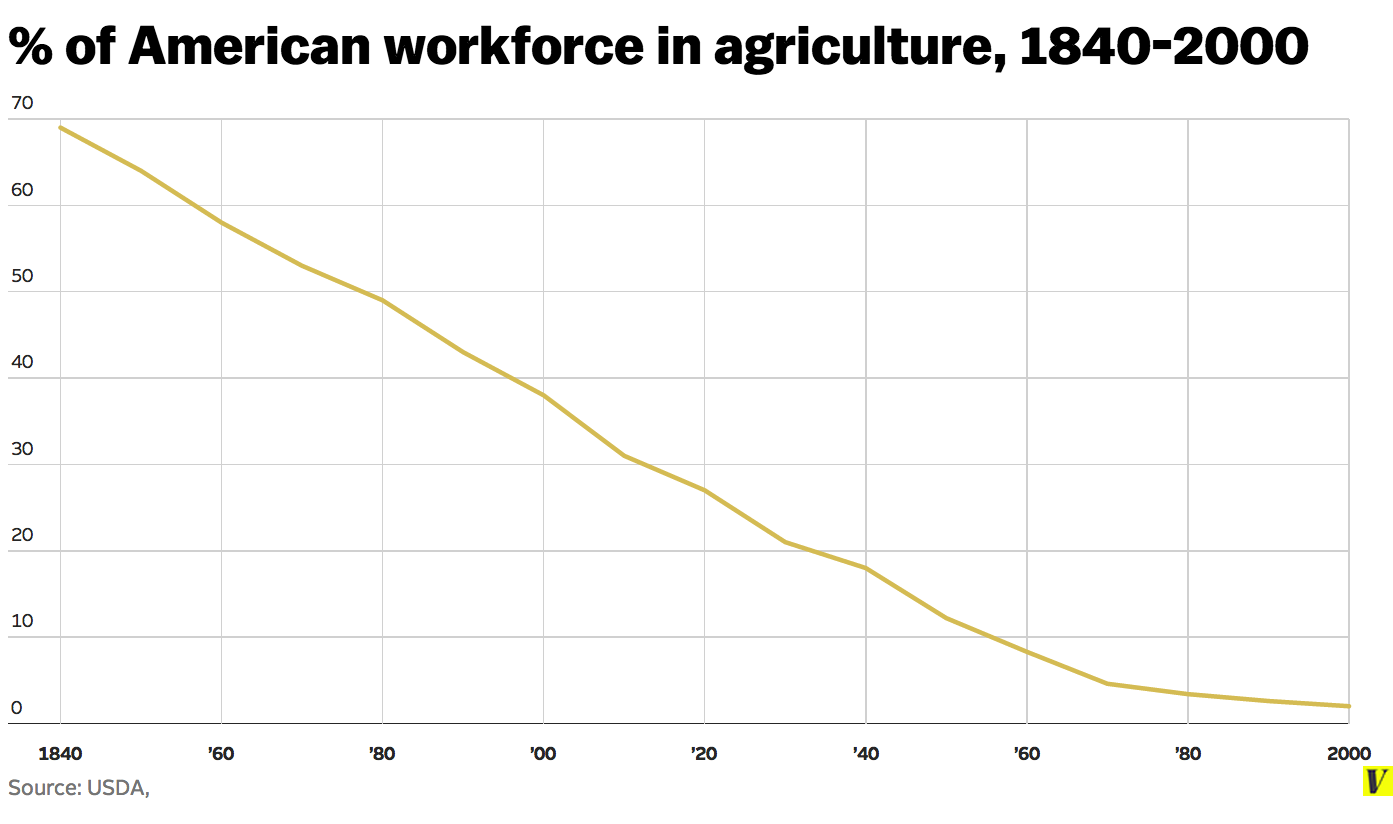
As the graph from the USDA below illustrates, we've seen a wholesale change in the American labor force. In 1840, almost 70% of the workforce was involved in agriculture.  In 2000, less than 2% are involved in agriculture.  That's a huge drop and one of the reasons (I think) for how wasteful people can be.  We changed from being a society of producers to a society of consumers.  I think that is tragic.
Image Credit
At Our Makers' Acres Family Farm, we don't waste things.  That speaks for the humans that live on our farm and the animals, too.  Nothing goes to waste.  Just take a look at the chickens below.  This Saturday I weeded the bean patch.  I have a second crop of Contender Green Beans and Roma Italian Green Beans blooming now and there was a strong crop of weeds coming up.  Once I weeded the four rows of weeds, I tossed the weeds to the chickens.  They love to eat the weeds.  They'll convert that 'trash' into beautiful eggs. Nothing goes to waste!

One man's trash is another chicken's treasure!
The other afternoon we harvested our crop of sweet corn.  Well, after you remove the ears, there is still a big corn stalk.  What do you do with that?  Well, we toss it over to the fence and the cows come a runnin'!  They'll first eat all the green leaves off of the corn.  Then they'll pick around and eat anything else that is left.  Usually there will be a few hard stalks remaining and I'll scoop that up and put on the compost pile, where it will be eventually worked back into the soil.  Nothing goes to waste!

"Second harvest"
It's not only the chickens and cows that get involved.  Old Nellie will eat the cornstalks as well.  She just keeps turning her head from side to side looking out for the cows as they don't like to share with her and will come head butt her away.

Nellie's fair share
Jesus Christ didn't like to waste food either.  Notice what He did after He fed the 5,000:

John 6:12New International Version (NIV)

12 When they had all had enough to eat, he said to his disciples, “Gather the pieces that are left over. Let nothing be wasted.”
Clean your plate.  Don't waste your food.  Tenets leaned as a child, passed on to our children, and our animals as well.


Wednesday, June 25, 2014

Vigilance

While we grow lots of vegetables and all sorts of fruit and other plants, the primary crop we're growing on our little 5 acre piece of land is grass.  That makes us grass farmers.  It is mostly Bahia mixed with some Bermuda grass.  The cows eat it up and convert the green grass to rich milk that has a thick layer of yellow cream on top. There are other grasses that will pop up and grow and we watch them closely.  Joel Salatin calls the mixture of grasses a "salad bar" for the cows and goats to enjoy as they do exactly as we do at a salad bar - they pick out a little here and a little there.

One thing we keep an eye on in the pasture is invasive weeds.  There are some particularly bad weeds that will crowd out the good grass and take over a pasture in a skinny minute.  We rotational graze and so I'm constantly walking across the pasture moving the animals from one paddock to another every few days.  As I'm walking, I'm careful gazing across the landscape looking for weeds.  When I see them, I walk over and pull them out by the roots and leave them on the ground.  The goal is to get them pulled out before they've gone to seed.

Today I spotted some bitterweed in the pasture.  Under normal conditions cows won't eat this stuff.  I have heard that if they do, it gives the milk a distinct bitter flavor, but we've never experienced that as the cows have plenty of other good grasses to eat. Bitterweed will take over a pasture if it is not controlled early. Below you can see a bitterweed plant growing in an ant mound in the pasture.  

Bitter weed growing in an ant mound
We have an infestation of fire ants and as I looked across the pasture I noticed many ant mounds.  A closer examination showed young bitterweed plants growing out of almost every single ant pile.  I have a theory about that.  I think that I've been successful in rouging out most of the weeds from our pasture; however, the ground holds a vast bank of seeds within it.  When those seeds that might have been dormant for years come into exposure of sunlight and water, they sprout.  My theory is that the ants unearth bitterweed seeds that may have been buried for a long time and bring it to the surface when constructing the mound.  Then those seeds germinate and start the process again.

That's why I'm vigilant in pulling them out before they become a problem.  I lay them on the ground and let the sun dry out the weed and kill it.  It is a never ending job, but one, if properly managed, that yields great results.  All I need to do is look across the road at a field that is overgrown with weeds in comparison to our pasture to know and appreciate the fruits of our labors.  Dealing with a weed infestation early saves time and work, because if you wait until things are overgrown and out of control, much more effort must be expended to get the result you're after.  I make it a point to pull bad weeds almost every day.

Die Bitterweed - Scourge of the Cajun Prairie
I guess this is not only a good pasture management technique, but there's a little parable in there as well.  We all have "little weeds" in our lives that must be dealt with.  Maybe it is a bad attitude, negativity, unforgiveness or perhaps a bad habit.  We must 'pull those out' every day while they are still young.  If not, pretty soon things are out of control and the 'weeds' will have crowded out the 'good crop' you're trying to grow.  Pull all that out the first chance you get to avoid more serious problems down the road.  Keep a watchful eye and be ever so vigilant for Bitter Weeds!

Sunday, March 23, 2014

So I fired up our 3 Lawn Mowers Today...

With the warmer Spring weather, the grass is really starting to grow in our yard. I heard the roar of the zero-turn radius lawnmower as my neighbor fired his up and quickly mowed his lawn to Country Club Golf Course-like specifications.  This only highlighted my unkempt, unruly winter weed/clover yard accented with live oak leaves strewn about as contrasted to his.  (You can see his yard in the upper right hand side of the photo below)  So I fired up my three lawnmowers as well...

3 Lawn Mowers/Weed eaters gettin' the job done
Our mowers don't need gas - they produce it.  In order to get them mowing down this portion of the yard, I set up a temporary paddock using some electric wire that I unrolled and place on some step-in posts.  I then went and got our solar power electric fence charger and hooked up the hot wire to the fence and the ground wire to a stake.  I then used a tester (hanging) to ensure that the fence was 'hot' and it was. Then I went and retrieved Daisy, Rosie and Maggie, our 3 lawnmowers who were all too happy to mow down the grass and clover in the paddock.

The Electric Fence set-up
Although Daisy doesn't smile as humans smile and actually always has a long face, I think she was happy to get in there and eat up the clover.  She was the first one in the paddock and ate the best, most succulent clover before I introduced Rosie and Maggie to the paddock.

Daisy in the clover patch
While they ate in the yard, the other animals left in the pasture bemoaned the fact that they were left behind, because the grass in the pasture is slower coming in.


Eating her fill
White Dutch Clover is a favorite of our cows and they'll pass up other items in the salad bar to go park themselves smack dab in the middle of a clover patch and eat.

Cleaning up the Clover
Now while they ate, I worked in the garden, BUT I kept a sharp eye on them.  I learned a lesson the hard way that when our cows finish eating all the grass and clover in a particular paddock, they'll start looking at the grass on the other side of the fence.  Whereas before, it was heads-down eating, now that they've eaten all the grass, they're ready to roam to find greener pastures and they will run right through that hot wire.  

When you see a scene like below, you want to quickly go retrieve the cows and put them back in the pasture or they'll be running down the road, being honked at by passing motorists as they seek out other grass to eat. If it sounds like I learned this lesson by experience, it is because I have. 

The 'After' Shot
Notice the difference between the first picture in this blog entry and the last.  Daisy, Rosie and Maggie have really done a good job mowing the yard.  Our yard crew is second to none!  Now I'll take down the fence, mow the leaves into a row, rake up the leaves and put them in the garden for mulch and to be composted.
Related Posts Plugin for WordPress, Blogger...