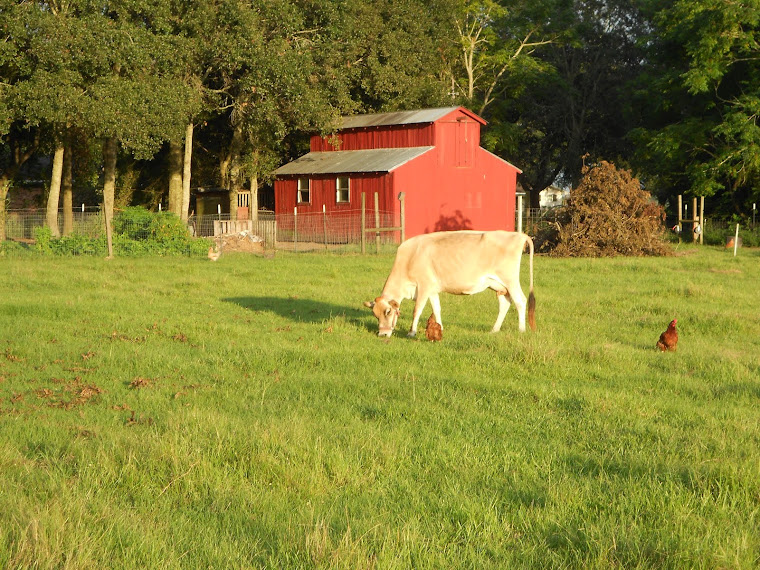
Showing posts with label pasture. Show all posts

Monday, September 7, 2026

Soil Cover - An Important Consideration in Soil Health

Covering the soil is one of the most basic things you can do in soil conservation.  If you walk in the woods, you always see the ground covered with decomposing logs, leaves and understory.  Small trees thrive under the canopy followed by grasses.  Bugs and worms thrive beneath the rotting organic matter as rich moist topsoil is being formed.

The photo below just west of our barn was taken five years ago.  There is one tiny patch of grass seen on the bottom right.  What Happened?!  This entire area was once covered with bahia grass and bermuda grass and now this...  It's all dirt.  In the summer, the sun heats up the dirt and dries it out.  When rains come, the soil is washed away.  When winds blow, the dust (our topsoil) is blown away.

In trying to figure the genesis of this problem out, I think it all started with bonfires.  When winds would blow limbs out of the trees, I would stack up a big burn pile.  The pile would continue to grow, and when it got HUGE, especially in the winter, I would light it up and we'd sit around it and enjoy its warmth.  The fires were so big, one time the neighbors called the fire department thinking that our barn was on fire!

I love sitting around a fire, staring into the coals, but the fires killed the grass, exposing the dirt.  The chickens scratched holes in the exposed dirt to take their dust baths.  When tiny grasses started to grow, they dried up quickly in the heat and chickens plucked out the grasses to eat.  The situation went from bad to worse.  I had to change this!

A barren wasteland

We have cows, goats and chickens all grazing on 3 acres.  Soil health aside, this barren wasteland needs to have grass growing on it to feed all the hungry barnyard critters.  I stopped burning the big bonfires and then planted sprigs of bermuda grass in the dirt taken from cuttings.  Our chicken population, due to the minks, was cut in half, taking pressure off of the barren area and allowing the grass to take root and grow.  Moreover, and I can't quite explain it, but for some reason the spring after a very hard freeze, the grass started coming back - first gradually and then quickly.

I took a photo of the same area yesterday.  Although there is still work to be done in bringing this area back to its former glory, a good start has been made.  Grass almost completely covers the old desert-like area.  The animals and the humans are happy with the progress.  Imagine how it would look if we hadn't been in a drought!

A return of our grass pasture

The grassland now gives additional grazing capacity to our animals.  The roots hold the soil together, reducing erosion.  The grass keeps the soil cooler, and gives bugs and worms a place to hide and do their work.  As organic matter decomposes, the soil and its microorganisms thrive, doing their job.  We'll continue to do our part to rehabilitate the area that I negatively affected by unwise choices.  More work to do, but I like before/after photos that show evidence of good stewardship of the land.

Sunday, March 30, 2025

A "Twist" of Lime

About a year ago, I collected soil samples from various spots in our pasture as well as in the garden and in the side yard where the potato patch was.  All in all, especially in the garden, the soil tests looked pretty darn good.  I attribute that to composting and soil amendments we've made in the garden.  However, we haven't composted in the pasture obviously and one thing that was low was pH.

A low reading in pH tells you that your soil is acidic.  Here's the thing to know about low pH as it pertains to trying to grow grass or many crops.  It doesn't matter how high your NPK is, all your fertility, everything good in the soil is locked up and the plants cannot use it.  What do you do to rectify this situation?  You must do what you can to raise your soil pH - make it more alkaline.

To do that, you'll want to apply lime to your soil.  I went to our local Helena Chemical office and ordered a ton of pelletized (fast acting) lime.  I borrowed a spreader cart from them and selected a day to broadcast it right before a light rain.  Here is what the pelletized lime looks like.  As opposed to Ag Lime, this will go right to work.

Since Dad has a 4WD truck, he graciously drove his truck to spread the lime in the pasture.

His tire tracks were a little hard to see in the grass, but he tried to line up 5 feet outside of the tracks to ensure an overlapping coverage.  I walked behind him to see that the lime was coming out fine and we were getting it put out.  It is not an exact science, but we were trying to get about 650 pounds to the acre.  My pasture is about 3 acres.

I walked behind the truck for a bit until the bees started buzzing around me.  I don't think they appreciated all the racket, so I got out of the way.

Once he finished, Dad dressed the corners and then entered the "bull pen."  It's a smaller pasture where we segregate the bull because, well, he's trouble.  This pasture is narrow and it was still a little wet.  I was a bit concerned that Dad would bog down, but his truck did a good job.  There's only one little spot where it was wet and his tire spun.

We got all the lime put out and returned the spreader cart.  The very next day we got a nice, slow, soaking rainfall of 0.9 inches and the following day, we got 0.9 inches again.  Not enough to cause run off, but enough to dissolve the pellets and send into the soil.  Now we'll patiently wait to see if the lime releases the NPK that was tied up to allow the grass to grow in the pasture.

Wednesday, January 1, 2025

First Round Bale of the Year

Normally, we start feeding hay around Thanksgiving, but not this year.  Somehow, the pasture has held up and allowed the cows and goats to continue feeding on the grass.  I think the rains coupled with moderate temperatures (no freezes as of yet) helped the pasture grass provide some forage for the livestock.  Perhaps the hay lasting longer was The Good Lord allowing things to last longer than it ordinarily does.  It wouldn't be the first time:

Your clothing did not wear out on you, nor did your foot swell these forty years. So you are to know in your heart that the Lord your God was disciplining you just as a man disciplines his son. Therefore, you shall keep the commandments of the Lord your God, to walk in His ways and to fear Him. For the Lord your God is bringing you into a good land, a land of streams of water, of fountains and springs, flowing out in valleys and hills; a land of wheat and barley, of vines, fig trees, and pomegranates, a land of olive oil and honey; a land where you will eat food without shortage, in which you will not lack anything; a land whose stones are iron, and out of whose hills you can dig copper. When you have eaten and are satisfied, you shall bless the Lord your God for the good land which He has given you. Be careful that you do not forget the Lord your God by failing to keep His commandments, His ordinances, and His statutes which I am commanding you today; Deuteronomy 8:4-11

The Providential grass ended toward the latter part of last week.  All the animals' heads were down, and they were finding things to eat, but they were looking for more.  Sort of like I do when I eat a meal, but am looking around for a little something sweet like pie or ice cream once the main course is gone.

January 1st seemed as good a day as any to roll out the first round bale for them to eat.  These are bales that I purchased back on March 29, 2024.  It is good quality hay, but cost me $40 per bale delivered.  I think that is a very fair price.  We kept it covered by tarpaulins, so it is still in very good shape.

A couple of things to notice in the photo above.  LuLu is in the barn being milked so she hasn't seen the bale yet.  Rosie and Elsie are eating a little sweet feed.  You can see their rear ends at the barn.  They didn't hear me as I stealthily pushed the bale out.  The goats are in the corral and the bull is in a separate pasture.  It would be only a few short minutes after this photo was taken that all the livestock discovered their New Year's bounty.  

Cows and especially goats waste a lot of hay.  I'm going to experiment with something this year to mitigate that.  If you look to the right of the barn in the background, you'll see a cattle panel.  I'm going to allow the animals to eat the hay in the morning, but in the evenings, I'll run the animals out of the hay area and close the cattle panel behind them.  If you leave them all day, they begin "playing with their food," stepping on, and pooping on the good hay.  We'll see if that works.

Last year it took the animals 6 days to eat one round bale.  I have 9 round bales in inventory.  Those 9 should get me through the coldest of the weather.  I still have about 70 square bales of hay up in the hay loft to feed them and I have lots of turnips planted.  I feed them the roots as I'm not a big fan of turnip roots.  I do like turnip greens, however.  The cows will have to fight me for those!

Thursday, August 15, 2024

Grass Farmer

I've been told for a long time that if you're intending to raise cattle, or goats, or chickens, like we are, you'd better consider yourself a grass farmer first.  For grass is the one thing that you must grow in order to have healthy livestock roaming on your pasture.  While it might seem like an easy thing, sometimes it's not.  Our soil pH is low and this means that a lot of the fertility in the soil is locked up, unusable to the grass.  I really need to lime.

Sometimes you don't get the rainfall that you need.  Last year we got very little rainfall and the grass was virtually non-existent.  Sometimes you get too much.  The photo below shows a view of the pasture.  You can see the four boxes of bees and a dead willow tree that I need to fell before it falls over the fence.

You can also see the grass in various stages of growth.  The pasture is made up of a bermuda and bahai mix.  Much of the grass has matured and has seed heads on it.  The cows aren't fired up about eating that and it doesn't have the nutritional load that lush spring grass packs.  But they'll eventually eat it.

The grass, looking back the other direction, is thick.  It has grown up also because it's gotten real hot.  Instead of eating grass all day, the cows lay up in the shade all day and only go out to graze in the late afternoon/night.  As you walk through the tall grass, mosquitoes, horse flies and deer flies hover around giving us and the livestock fits.

There's more than bermuda and bahia grass out there and I've always got my head on a swivel.  I don't want invasive weed species to invade.  This afternoon I looked around and saw some of this coming up.  We always called it bitterweed.  Supposedly, if your cows get into this and eat it, it makes their milk taste bitter.  For that reason, I don't want tot let it get a foothold.

I promptly pull this up by the roots, making several passes to ensure I don't see any more.

I'm okay with different grasses and even weeds growing out in the pasture.  It lets the animals free-range and eat what they like, but I'll always be on the lookout for those species of weeds that I don't want on the homestead.

Sunday, May 5, 2024

Improving the Soil

One of our projects on Our Maker's Acres Family Farm has been a work to improve the soil in our garden and side garden.  We've used cover crops.  We've made biochar and inoculated it with cow manure and worked it in the soil.  We've done hugelkutur.  We've composted for years and amended literally tons of organic matter into the soil.  We've used only composted (cow and chicken) manure and fish emulsion for fertilizer and planted plenty of crops that set nitrogen.  Finally, we've incorporated the "Back to Eden" gardening technique which is no-till and uses layers of wood chips to always keep the soil covered.

The soil was in poor shape when we started, however.  I have a soil test from about a decade ago and figured it was time to do another soil test just to see where we are and how we might improve.  We went to the LSU AgCenter Extension office here in Jennings and got a soil sample kit.  We followed the directions found within and took soil samples.

We took three separate samples.  One was from the garden.  Another from the garden in the side yard.  Finally one from the pasture.  Each sample was put in separate bags and labeled.


Each test costs $11.  I labeled the samples by putting the crop grown on the outside.

All the samples were taken on the five acre piece of land where we live.  I want to show you something that was obvious at first glance.  Look at the color of the soil in the three samples.  Starting from the left is the garden soil.  We've been working on improving that soil for the longest time - maybe 20 years.  Then the sample in the middle is from the side yard garden.  We've been improving that soil for about 5 or 6 years.  The last sample, on the right, is the soil sample from the pasture.  Other than cows and chickens pooping on it, we've done nothing to it, although I had intended on putting lime down, but never followed through.

Quite a difference in color!  It appears that the amendments have improved the soil in color, at least.  We'll wait and see what the soil test analysis shows.  Once we get the tests back, we will have a good idea of what we need to do.

Monday, February 12, 2024

(Finally) Moving Pastured Hens to the Pasture

For way too long we've had 23 laying hens and two roosters in our chicken tractor in the yard.  Each day I would push the tractor to fresh grass and the chickens would promptly eat it all, plowing the ground rivaling any farm implement John Deere could imagine.  You can see the trail here in the side yard facing north.

The photo below shows the trail of the tractor facing east.  The chickens denuded the ground, creating an erosion problem in the yard.  They should have been out free-ranging in the pasture months ago.  What happened?  These are some chickens we hatched out in our incubator and then raised until they began laying eggs.  We butchered the roosters and then next step was to move the hens out to the pasture.

And then minks started killing our birds out in the pasture.  The population dropped from 60-something birds to 9.  It was a hen genocide.  We were reluctant to move our hens out to the killing fields after taking care of them for so long.  So we delayed moving them until we ran out of excuses.  Last week we pushed the tractor into the pasture, toward the barn and right beside the hen house.

The hens were confused.  They didn't know where to roost or where to lay eggs.  They got out of the pasture and collecting eggs became an easter egg hunt.  In the evenings, we would lock them up in the rabbit hutches that are lined with hardware cloth.  Up to this point, it has proved to be safe from minks.  Over the period of about a week, the hens learned to lay eggs in the laying boxes and get into the roosting spot in the rabbit hutch.

You can see the chicken tractor pushed right next to the hen house on the western side of the barn.  The photo also shows Belle keeping a sharp eye for her birds.

Today we folded up the tarp and put it away, now that the hens have made their long-awaited transition to the pasture.  We began to talk and plan about hatching out some new hens from our eggs and/or raising some meat birds in the now empty chicken tractor.

Monday, August 21, 2023

Hot & Dry

Summer is always hot, but this summer we're hot AND dry.  Below I've taken a photo of the log that I track daily rainfall.  Tomorrow it will have been a month since it rained.  Everyday high temperatures have exceeded 100 and with no rainfall, well, it's getting serious.  We normally average almost 9 inches of rain in August.  We are at a serious deficit.

The grass is dying and the dirt is now dust.  Apparently there is a high pressure system sitting over the south that won't let up.  Normal afternoon thunderstorms are non-existent.  We have been praying for rain for weeks.  The forecast has not looked promising.

The cows and goats have eaten all of the remaining grass down to the ground.  We're supplementing with hay.  That hay is normally reserved for the fall, however.  Never had we begun haying the cows this early.  Now that I've gotten the chainsaw blade sharpened, I've been lopping off live oak branches that need pruning and tossing them over the fence for the animals to eat on.

Not only is the drought concerning for the pasture that the cows, goats, and chickens depend upon, but it is delaying getting the fall garden in.  We normally have fall Irish Potatoes planted by now as well as getting the cole crops planted by seed.  I haven't even begun any of that.  Afternoons are spent watering sweet potatoes, peppers, okra, butterbeans, etc. that are struggling in the garden.  Five of our Seven pumpkin plants waved a white flag and withered into the dust.

We'll continue to pray for showers of blessing that will bring a refreshing to the land.

Thursday, June 8, 2023

I'll Probably Regret it

The Watering Hole

It hasn't rained on the homestead in 3 weeks.  The grass is getting parched.  Here we are a week into June and I've only mowed the yard one time.  The lawn mower has cobwebs on it.  I'd be pulling your leg if I told you that it was only the drought that's kept me from mowing - it's not only the drought.  Each spring I have a little competition to see how long I can go without mowing.  I put up temporary fencing and let the cows cycle through the yard several times.  They do an adequate job of mowing.  My new excuse for not mowing is our honeybees.  Why would I want to chop up all the white dutch clover and other flowers that the pollinators love?  

The photo at the head of this article shows our water trough.  It's really a repurposed molasses tub that I have fitted with a float valve.  It holds about 35 gallons.  Two cows can fit their heads in at one time to drink.  The others must patiently wait their turn.  Do you remember waiting in line to drink from the water hose after a backyard football game?  You'd be so thirsty!  But you would have to let the hose run for a minute until it got cold.  That's the general idea of the water trough.

If you look at the picture, there is shade over the water.  It is peaceful.  A veritable oasis in an otherwise arid land.  If I was of the bovine persuasion, I'd stand there and swish my tail, chew my cud, and take long slow sips of clear water to wash down the fermented grass I was chewing on.  The water hole is a sacred spot.  When cows are drinking, I never want to disturb them or rush them.  Lots of important things happen by the 'well.'  In the Bible, the woman at the well experienced a life changing event.  She found living water at that well and never thirsted again.

You'll notice the nice shade over the blue tub of water.  It wasn't always there.  I am big on planting trees.  A fox squirrel buried a pecan one year and forgot where he buried it in our yard.  It grew.  I transplanted it in a pot and then planted it at the corner of the pasture and the garden.  Now that I think about it, I didn't think that all the way through.  The tree has grown.  It does cast nice shade over the water hole.  There are some downsides, though.  The tree will send out roots that will compete with the vegetables for rainwater.  The shade will, later on, cast shade over the garden, blocking out sunlight.  

I'll probably regret it.  But at the same time, the cows enjoy the shade.

“A society grows great when old men plant trees in whose shade they shall never sit.” — Greek Proverb


Wednesday, March 29, 2023

The Horses Next Door

"I can't think of nothing better than riding a fine horse into a new country." - Capt. Augustus McCrae

About 100 yards to the east of our home, is a beautiful pasture bordered with a white fence, filled with green grass, yellow flowers, with red barns as a backdrop.  There's also four beautiful horses that call that place Home.  They aren't our horses (unfortunately).  Our five acres is just not big enough for a horse, although we've always wanted one.

Now that the days are getting longer and the weather is still quite nice, we've been walking every afternoon along the road that runs east.  Rice fields and crawfish ponds border the road.  Ducks fly over the road as we walk and splash down in a pond with cypress trees growing on the edges.  It is a truly peaceful time.

The horses are curious with our presence and come to greet us.  They are big and strong and they gallop up to the fence.  We pet their soft noses and smell their "horse" smells.  

We had our dog, Belle, with us and they were very interested in her.  She's always been the biggest animal around.  I think she was intimidated by their size and didn't want to come near them.

For a very long time we watched the show, "Heartland" on TV.  It's about a girl up in Canada named Amy Fleming who had a gift with horses.  She had a keen ability to connect with them and train them. 

Of the four, the one with the white stripe was the most friendly.  Seems like the buckskin took a particular liking to Tricia.

The sun was setting so we needed to get home.  We promised them that tomorrow we'd bring some carrot tops for them to eat from some carrots that we need to harvest.  Maybe one day if we could get just a little more land, we could get a horse of our own.  Who knows?

Monday, November 21, 2022

Tucked In For The Night

I might have told you that about a year ago when I began new employment, I started on a self-directed health program.  Here's why.  I just turned 56.  Although I'm not on any medication, my doctor was telling me to watch my blood sugar.  The numbers had been increasing.  Despite us eating very healthy eating mainly things we grow on our little homestead, I've never met a sweet that I don't like.  Snacking on sweets was going to hurt me sooner rather than later if I didn't make a change.

I don't like lifting weights.  I don't have time to go to a gym and don't like running.  So what could I do?  I could walk.  I set a step goal of 10,000 steps a day.  That seemed simple enough.  So a year later, I hit my goal 99% of the time, going out at night and walking the perimeter of our 5 acres and have lost 20 pounds.  I listen to podcasts while I walk.  My favorites are: Art of Manliness podcast, Victor Davis Hanson podcast, and Jordan Peterson podcast.  

I also look up at the sky.  It is peaceful and serene.  At least once or twice a week I see shooting stars.  It's unfathomable to try to understand in my little pea brain that when I see a shooting star, I'm looking at something that happened many, many, many years ago.  But I don't just keep my head in the stars, I look around, too.  Tonight, I saw the cows sitting down and resting in the pasture.

After a full day of eating grass and hay, Rosie, Elsie, and LuLu are taking it easy.  As we discussed last night, Nick is gone.  Hopefully, all three of them are bred.  I was looking at them sitting peacefully in the pasture, I began to fast forward my thoughts 8 or 9 months from now.  Right now it is crisp and cool.  When the calves come, it will be hot, humid, and the landscape will be swarming with mosquitoes and deer flies.  I welcome the cool weather we're experiencing now.

I began to think about the possibility of having three more calves.  What would they be?  Bulls or heifers?  Heifers are nice because there is a demand for registered Jerseys.  More people are seeing the benefits of having a family milk cow.  We could sell the heifers.  However, bull calves would be fine, too.  Our deep freeze is almost empty.  Raising a bull calf for a year and a half and then sending him to slaughter would refill our stores of fresh meat.  We wouldn't complain about that either.

We will watch them closely for the next month to ensure they don't come back into heat, signaling that they weren't bred.  During the winter we keep them fed with hay and a little bit of sweet feed.  We supplement with some of the smaller sweet potatoes from the garden.  This weekend I'll be planting some turnips, too.  Toward the end of January and February, I like to pull up turnips and cut them up with a pocketknife and feed them to the cows.  They love turnips.  Me?  Not so much, but I love turnip greens.

Well, the podcast is over.  As I look down at my step counter, I'm at 11,348 steps.  Time to go in and get tucked in for the night, sort of like the cows.


Monday, June 20, 2022

The Cattle Guard

I was driving on a back road near my house the other day and pulled in to a road leading in to a pasture.  There was a cattle guard that you had to cross to enter the property.  For those not familiar, a cattle guard is a means of keeping cattle from leaving the property.  It is normally constructed by a placing a grid of pipes welded across a grid over a ditch.  There is a fence on either side of the cattle guard.

The idea is that livestock walk up to the cattle guard and see that there isn't a way for them to cross it, so they stay in the pasture.  This particular cattle guard is constructed with railroad rails welded across some I-beams.  Cattle guards are a relatively old thing.  The first patent for one was issued back on January 15, 1915 in Nevada.  I read that you can even make a 'virtual' cattle guard by painting alternating dark and light lines across a road.  However, they say that once one animal discovers that they are being faked out and cross, all the other animals will as well.  Probably not safe to try to trick them.

You can drive across it with no problem.  Your vehicle's tires make a bumping noise as you go across.  Humans can walk across it with not much of a problem.  I remember as a kid trying to balance as I crossed a cattle guard.  Being small, I was a little scared that I'd lose my balance and fall, breaking my ankles in the process.  I made it across safely, however.

I vaguely remember a cattle guard somewhere at our farm, but don't remember where it was located.  It's long since been removed.  It may have been at the entrance to the old home place in front of the big live oak tree and pecan orchard.

Aside from keeping livestock from getting out, cattle guards are also great in one other regard.  If you are riding "shotgun" in a pickup truck, one of your duties is to get out and open the gate.  When the truck drives through, then you close the gate behind the truck and get back in the passenger seat.  Cattle guards make that job obsolete.  There's no need to close the gate.  You drive right on through.

Thursday, March 4, 2021

Birds of A Feather Flock Together (In the Pasture Now)

Since late August (right before Hurricane Laura), the pullets have lived in the chicken tractor in the back yard.  Correction: The day before the hurricane blew in, we moved the chicks and chicken tractor into the garage.  Shortly thereafter, we moved them out into the backyard.  We would roll the tractor each day, or every two or three days, to fresh grass.  The pullets foraged and scratched for bugs, worms, and tender grass to eat.  In fact, they denuded portions of the back yard.  The barren wasteland below was thriving with clover and winter grass.  No more.  The voracious birds turned it into mud and dirt.


So we figured, now that they are laying eggs, it is time to move them out to the pasture.  We had best move them out, lest our back yard turn into the dust bowl days come summer.  It is no small task.  First, we had to remove Belle, our Great Pyrenees, out of the pasture.  We don't trust her yet.  She may eat them all.  Next, we brought the young hens out to the pasture in a blue tub, five at a time.  

Before setting them free, we clipped one of their wings.  You don't want them flying over the fence and into the mouth of neighborhood dogs, possums, raccoons, or other predators.  You really don't need to clip both wings - clipping one will do.  It will keep them off balance.  A funny story about clipping wings, about 10 years ago, I set out to clip the wings of some pullets.  Somehow, I was holding the (very dull) scissors oddly and the repetition of the process and the pressure of the scissors against my finger caused a weird phenomenon.  My middle finger went numb.  It stayed numb for days!  I was concerned that I had damaged my middle finger - not that I use it that much...  But after a week or so the feeling came back.  Needless to say, I was very careful this time.  Slow and steady is the game plan.

The hens didn't like that much.  They would cackle and shriek and flap their wings.  This would incite the rooster to come nearby in threatening fashion for messing with his harem.  I was poised with the scissors should he be tempted enough to try to spur me.  We'd have a fresh rooster gumbo, for sure.  In the end, we finished the task.  

The hens and the rooster were rewarded with freedom.  A wise man once made a wise quote about freedom.  The context wasn't about chickens, but I guess you could say that we were happy to give our birds freedom.

Those who deny freedom to others deserve it not for themselves; and under the rule of a just God, cannot long retain it.  - Abraham Lincoln

After months of being cooped up, in the literal sense of the word, the birds are free to roam on the pasture and be birds.  They were happy.  The bottom door of our chicken tractor that a great friend of mine built, is left open so that they can go inside and lay their eggs, leave and forage for food and then return at night to roost.  We are a little concerned about the hawks.  Tricia has been counting them every day and so far, all of them are still accounted for.


Pretty soon, the rich spring grass will grow and the hens will have lots to eat.  The yolks of their eggs will get a dark yellow color not present in store bought eggs due to their diet.  The taste of spring eggs are second to none.

Green grass will once again fill the pasture.  Hopefully, green grass will fill our back yard again now that these girls are off of it!

Monday, December 21, 2020

And Then There Were Two...

Now that Aussie and Clarabull are gone, that leaves only two cows left on our homestead farm - Rosie and Clarabelle.  For the past couple of years we've have five Jersey cows on our little pasture.  To be honest, that was a strain - a strain on us and a strain on the land.  By employing rotational grazing you can increase the number of head of livestock on a pasture, but we have learned that five animals is too much, especially when that pasture is also shared by a flock of goats and chickens.

Feeding time now is less of a 'rodeo,' trying to separate animals all trying to eat at once.  It is just the two old faithful milk cows, still bossy, but overall gentle and easy-going.


Both Rosie and Clarabelle should be bred.  We haven't had them palpated yet, but we're pretty sure that they'll both be dropping calves next year.  With fewer animals on the pasture, the carrying capacity will greatly improve, leaving more green grass for all.  Additionally, the animals won't eat the grass down as far to the ground.  This will reduce the parasite load and eliminate or greatly reduce the need for worming.  The pasture will be healthier and, as a result, the cows will be overall better conditioned and healthier.

Since November when we started feeding hay, the five cows and four goats were consuming a round bale of hay anywhere between 4 - 6 days.  Now, the bales of hay will last longer!  We buy a minimal amount of feed (just sweet feed - we buy no dairy ration when the cows are dry), but our feed bill will go down.  Overall, things will be more manageable, and for that, we are happy.

Pasture management is key.  We may like to think that we are raising animals, but what we really are, when you think about it, is grass farmers.  For the health of the pasture is what the health of the cattle is dependent upon.  This upcoming year, with fewer cows on the pasture, I want to aim to improve the health of the soil of the pasture so that we can grow better grass and sustain our animals.  I have got to figure a way to lime the soil.  

That'll be on the list for 2021.  I wonder how many other people have "Lime the pasture soil" as a New Year's Resolution?  Crazy, I know.


Sunday, November 22, 2020

Simple Saturday in the South

On Saturday in Late November 2020, we woke up to a beautiful day.  We took care of a couple of items on our project list that we've been wanting to knock off the list.  Although the weather was beautiful, it was still a little warm with the temperature being 77 degrees.  That doesn't exactly seem like fall, but oh well.

Right after lunch we decided to get in the pickup truck and drive out to the farm.  It's a 30 minute drive to the farm.  We live in the country on our little homestead, but Oberlin, Louisiana is even further in the country.  On the way, we stopped off in a small town called Elton.  Elton boasts a good little specialty meat market called "Mr. T's."  We got some smoked boudin and boudin balls and some root beer and continued on our journey.

Upon arriving at the farm, we filled the water trough for the cows and walked across the pasture to the gully and watched a bunch of striped-head turtles swim in the muddy water.  The irrigation well droned on in the background, pumping water to fill the crawfish ponds.  It was quiet.  We walked through the old pecan orchard that my great-grandfather planted.  One of the old pecan trees succumbed to Hurricane Laura.

It lay tragically on its side, uprooted by the strong south winds of the hurricane's fury.  I have on my list of things to buy is a good chainsaw.  Once I make that purchase, we'll cut the tree up and split the wood for firewood.  It'll keep us stocked up for years.  Sad, though.  These trees stood tall and strong for years and years.

There is another old tree, however, that remains standing - the old live oak tree.  It is literally hundreds of years old.  I reckon this tree could probably tell some stories about the changes it's seen and storms it has weathered.  Its strong limbs stretch out, coming close to the ground and then reach back upward again.  Some of the limbs have bark that is smooth like grass.  The cows like to rub their backs on the limbs, polishing the bark in the process to a glossy shine.

Benjamin had climbed high up into the tree like I used to do when I was his age and much younger.

The live oak has a hole on one side and has been like this for as long as I can remember.  It doesn't appear to have weakened the tree.  At one time, I remember, a momma red fox had a den at the base of this tree and raised some little ones.


The cows came running to meet us - all 16 momma cows and 15 calves.  They're pretty tame.  They were expecting some feed, but we didn't bring any with us.  Mom and Dad drove up in Dad's pickup truck.  We let the tailgates down and sat down and visited for a long time, waving as people drove by slowly on the country road in front of the old home place.  It seemed everyone had the same idea.  It was a nice afternoon to relax and not do anything in particular.

As the afternoon faded into late afternoon, the sun cast long shadows across the landscape, taking in the beauty of God's creation made me thankful a full five days prior to Thanksgiving.

I'm thankful for a simple country life - thankful for a place to enjoy the afternoon without Covid, without politics, without stress, without phones ringing - just peace, quiet, and simplicity.  My kinda place.

Tuesday, May 26, 2020

When the Bough Breaks...

If the clouds are full, they pour out rain upon the earth; and whether a tree falls toward the south or toward the northwherever the tree fallsthere it lies.  Ecclesiastes 11:3
When I came home the other evening from work, I found that this tree had fallen toward the north, and as the Bible verse says, "wherever the tree falls, there it lies."  The China Berry tree snapped off and fell during a thunderstorm.  Thunderstorms roll through bringing torrential rain and straight-line winds that leave behind visible evidence of its power.


The tree fell across the fence from the patch of woods south of the property and in so doing, it trapped the two young bulls on the east side of the 'bull-pen,' their pasture.  We keep them separated from the cows.  If we didn't their amorous shenanigans would make it nearly impossible to walk to the barn.  The bulls had obviously been trapped for quite some time during the day.  They had paced back and forth, leaving the pasture looking like a muddy soup.


When I first pulled into the drive, I thought that a DEAD tree had fallen across the fence, but when I inspected closer, I realized that the tree was ALIVE and HAD BEEN full of leaves.  Those leaves had been all eaten!


The cows and the goats completely demolished every leaf that was on the tree.  This wouldn't have been a problem except in numerous searches on the Internet, I have found that the leaves, bark and berries of the Chinaberry tree are toxic to livestock!  This was quite troubling, but the animals had polished off all of the leaves prior to me getting home.  Eating "the forbidden fruit" had no ill effects, however.  The cows, goats, and chickens exhibited no symptoms of sickness.  For that, I was glad.


I got my double-bladed ax and went to work, chopping up pieces of the tree and tossing it over the fence.  The bulls kept getting in my way as they were tired of being cordoned off on the muddy stretch of pasture.  Finally I finished the job and the bulls joyously kicked up their heels and headed off into the grass to eat. 

The goats had other plans.  Seeing that the fence was broken, they breached the break and entered the bull-pen.  It took some doing, but I finally caught the nosy goats and deposited them on the right side of the fence.  I will have to get my come-along and pull the fence back out straight and staple it to the 4x4 when I have some time.  As darkness approached, I fixed it in true red-neck fashion - I used tie-wire to temporarily patch up the torn fence.


It wasn't a pretty job, but by-golly, it worked.  If you can't get it done right, at least temporarily get it done.
Related Posts Plugin for WordPress, Blogger...