This afternoon was a busy one. When I got home from work, I weeded the three rows of green beans. All the weeds were thrown over the fence and the chickens and goats happily disposed of them for me! This green bean experiment may be an exercise in futility. I was told by a master gardener at church that you aren't supposed to plant green beans until mid-August as green beans don't like hot weather. Since our spring green beans didn't produce well due to excessive rain, I'm hoping that these produce. If not, I'll plant again in a month.
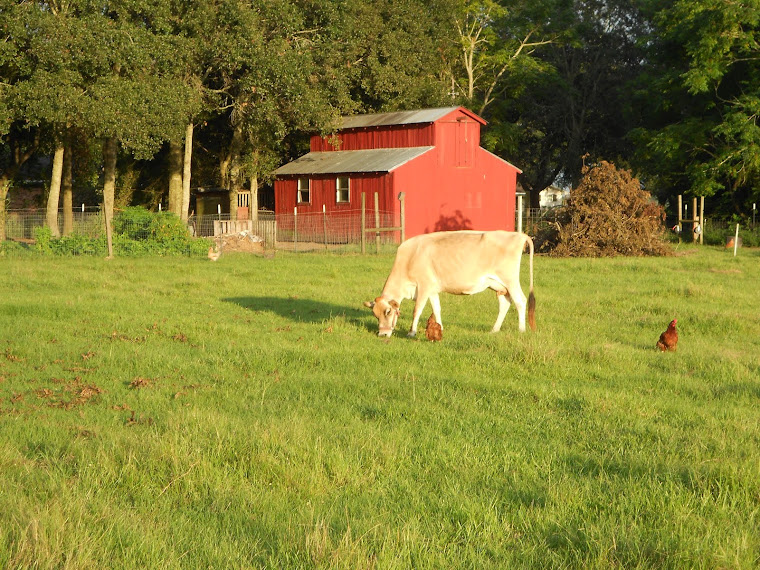
I moved the cows to the next paddock in the pasture. Every two days I move them into the next paddock and close off the one they were just eating on. This gives it a little over a week to "rest up" and re-grow. The paddock on the right below has been eaten down. The side on the left has tender growth. The cows recognize the sound of the electric fence reel. They equate it to fresh grass and come running.
Then I walked out to the barn to get my small animal trap. Last night I spotted a possum in the yard, but by the time I went inside to get my rifle, the possum was gone! I'll set the trap in the yard and hopefully catch him. I baited the trap with dog food and will check in the morning. I hope I don't catch our cat in the trap. In the past I've caught many possums, but have also caught the neighbor's cats from time to time.
While I was at the barn, Oreo's two baby twins, Salt and Pepper, were playing in the wagon. I tell you, these goats get into everything. They were playing in the wagon!
Pepper figured the wagon was as good a place as any t take a nap. Salt was too antsy to rest.
As it turns out, it was a good thing I went back out to the barn to get the trap. I discovered that after we separated the bulls from the mommas, Clarabull had escaped and had rejoined the herd in the pasture. It is a good thing we noticed or we would have gotten no milk at all tomorrow! Crisis averted. We captured the escapee and put her back in the corral.
Make it your ambition to lead a quiet life and attend to your own business and work with your hands, just as we commanded you. - 1 Thessalonians 4:11
Showing posts with label weeding. Show all posts
Thursday, July 18, 2019
Monday, December 10, 2018
A Few Things to Knock Out in the Garden
The short days of winter mean that by the time I get home, it's dark. Due to darkness, there's not really anything to do until the weekends because you can't see anything. When weekends come, there's a lot of catching up to do. This past weekend I had a big on-going project that I've been working on for years now. Each year a good family friend rakes up her yard and gives us roughly 20 BIG garbage bags full of leaves. Instead of taking them to the dump, I take them to the garden.
Each year I dig trenches about a foot and a half deep in the garden and pour the leaves into the trench. I stomp the leaves down into the bottom of the trench, throw some cow manure in the trench so that the bacteria begins to decompose the leaves, and then I pour more leaves into the hole. Finally, I cover the leaf filled trench with soil. A couple of things happen here: First the organic matter loosens the soil, adding fertility and a habitat for earthworms. You ought to see the earthworms in the areas that I filled with last year's leaves! Adding the leaves and manure and covering with soil raises the level of the garden, leaving it high and dry when it rains. The buried leaves act as a storehouse for moisture during drought, giving the plants sustenance during dry times.
My next area of work was one I am not crazy about doing- WEEDING! The winter weeds and grasses will take over the garden very quickly, especially if I can only work the garden on weekends. One must remain vigilant to stay on top of things. In the photo below you can see a few carrot plants on rows dominated by weeds. Time to get busy!
Weeding is a tedious job. Due to the close proximity of the weeds next to the plants, it is a task that is done by hand. You have to be real careful not to uproot vegetable seedlings. In the photo above, the carrots are almost completely hidden by the leaves. In the photo below, the weeds have been removed, leaving only the carrot seedlings.
Now that we've removed the grasses, the seedling has no competition for soil nutrients and water. The plant is also able to let the sun's rays reach it, which results in faster growth.
While pulling weeds, I happened across some seedlings growing in the garden that were NOT weeds. There were seven nice tomato seedlings that came up volunteer ~ perhaps from compost? Anyway, I dug them up and potted them.
All of the tomato plants are very healthy. I will attempt to keep them alive during the winter months and then transplant in the garden once it warms up.
I normally plant my tomato, pepper, and eggplant seedlings on January 1st and then transplant in the spring. Finding these plants was a great gift. If I can successfully get these plants through the winter, I'll have a great head start and hopefully, early tomatoes.
Each year I dig trenches about a foot and a half deep in the garden and pour the leaves into the trench. I stomp the leaves down into the bottom of the trench, throw some cow manure in the trench so that the bacteria begins to decompose the leaves, and then I pour more leaves into the hole. Finally, I cover the leaf filled trench with soil. A couple of things happen here: First the organic matter loosens the soil, adding fertility and a habitat for earthworms. You ought to see the earthworms in the areas that I filled with last year's leaves! Adding the leaves and manure and covering with soil raises the level of the garden, leaving it high and dry when it rains. The buried leaves act as a storehouse for moisture during drought, giving the plants sustenance during dry times.
My next area of work was one I am not crazy about doing- WEEDING! The winter weeds and grasses will take over the garden very quickly, especially if I can only work the garden on weekends. One must remain vigilant to stay on top of things. In the photo below you can see a few carrot plants on rows dominated by weeds. Time to get busy!
Weeding is a tedious job. Due to the close proximity of the weeds next to the plants, it is a task that is done by hand. You have to be real careful not to uproot vegetable seedlings. In the photo above, the carrots are almost completely hidden by the leaves. In the photo below, the weeds have been removed, leaving only the carrot seedlings.
Now that we've removed the grasses, the seedling has no competition for soil nutrients and water. The plant is also able to let the sun's rays reach it, which results in faster growth.
While pulling weeds, I happened across some seedlings growing in the garden that were NOT weeds. There were seven nice tomato seedlings that came up volunteer ~ perhaps from compost? Anyway, I dug them up and potted them.
All of the tomato plants are very healthy. I will attempt to keep them alive during the winter months and then transplant in the garden once it warms up.
I normally plant my tomato, pepper, and eggplant seedlings on January 1st and then transplant in the spring. Finding these plants was a great gift. If I can successfully get these plants through the winter, I'll have a great head start and hopefully, early tomatoes.
Tuesday, September 12, 2017
The Mind's Garden
That's a pretty good quote, right there! It is a great visual to compare your mind to a garden. This past weekend, the weather was as lovely as it has ever been at the first of September. I worked up the garden in the side yard, turning over the hay ground cover and weeds with a shovel and working it in the ground. When I was done the seed bed was void of any weeds as you can see in the photo below.“A man's mind may be likened to a garden, which may be intelligently cultivated or allowed to run wild; but whether cultivated or neglected, it must, and will, bring forth. If no useful seeds are put into it, then an abundance of useless weed seeds will fall therein, and will continue to produce their kind.” ― James Allen, As a Man Thinketh
This is part of that instant gratification thing about farming that really revs up my engine. You get in a field in the morning that has weeds waist high and after plowing and then hitting it at a diagonal, in the afternoon when you pull out of the field, the weeds are gone. The field is beautiful. You feel like you accomplished something.
As the quote above so eloquently says, the land can be intelligently cultivated or weeds can run wild, choking out growth of productive crops like my poor New England Sugar Pie Pumpkins below. Darn weeds just grow. I don't plant them, but they grow nonetheless. Funny how that happens.
You see, the land is going to bring forth a bountiful crop, regardless. It can be a crop of good stuff or it can be a bumper crop of weeds. That beautiful seedbed above, if left alone will yield a stunning, mind-numbing bumper crop of weeds. Oh, the goats will enjoy it when I pull the weeds like I did below and toss them over the fence, but that's not what we're trying to raise here on Our Maker's Acres Family Farm.
Here's the other thing. Those weeds left alone will produce after their kind. That is a Biblical mandate from Genesis 1:11. Except we don't want the weeds to produce in our garden, building a perpetual seed bank in our garden soil that guarantees hours and hours of back-breaking labor. We want order and production of wholesome foods for our family.
Getting back to the quote, that's why the garden is such an appropriate comparison to the human mind. Our minds are like that clean seed bed that we can either sow good seed into or we can leave it fallow and let all sorts of things grow in it. It is amazing what sort of bad seed gets blown into our minds. Seeds of doubt and fear. Of low self-worth and regret and pessimism. Of envy and bitterness and sorrow. Those seeds can choke out the good seed that is struggling to extend its leaves to the sunlight, but is shaded out, stunted and finally dies, becoming the detritus beneath the healthy weeds in our minds. Before long, the garden of your mind that was once fertile and clean has now become a toxic field that is unproductive and results in total crop failure.
But there is hope. The remedy is not easy, but there is hope. It takes back-breaking, diligent work. One must cultivate the mind, pulling out the weeds of negative thought and turning them under before they go to seed, replacing them with positive thoughts. Tending your mind's garden is a daily task. Many times weeding my mind's garden seems to be a fruitless pursuit with the weeds growing as fast as I can pull them out. Of course, there is a lot of bad seed being scattered today and our minds must be carefully tended, especially with the good seed from His Word, ensuring an eternal harvest:
Philippians 4:8 King James Version (KJV)
Finally, brethren, whatsoever things are true, whatsoever things are honest, whatsoever things are just, whatsoever things are pure, whatsoever things are lovely, whatsoever things are of good report; if there be any virtue, and if there be any praise, think on these things.
Tuesday, September 29, 2015
A Moral to The Story
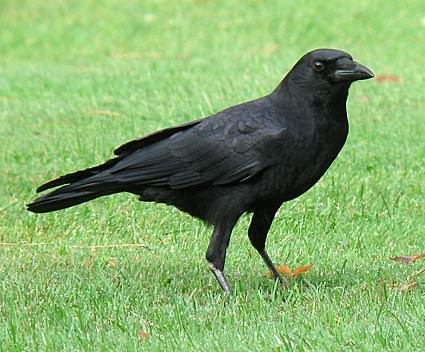
Almost a week ago, we moved from summer into autumn, and according to the weatherman, we'll be seeing some mild weather here shortly with lower temperatures and humidity. In addition to nicer weather, autumn means that pecans will be ripening and falling and when I think of that, I think of a couple of things - pecan pies and Crows!
Although we don't get many crows competing for our pecans here at our house, we do at the farm. The pecan orchard at the farm was planted by my great-grandfather and to be honest, the crows probably consume more of the pecans than we do. You can hear them with their incessant, "Caw, Caw, Caw" echoing across the pasture as they alert all their feathered friends that there are pecans to be eaten. Apart from being a complete nuisance in the pecan orchard, crows are pretty intelligent creatures. In fact, they are one of the world's most intelligent creatures, approaching the intelligence of apes.
In thinking about crows, it reminds me of a favorite storybook of mine when I was a kid - Aesop's Book of Fables. It was a big book and beautifully illustrated, but more than that, the stories all had morals. There was a fable about crows called "The Crow and the Pitcher" that I remember.
This Link recounts the fable that came from a poem by Bianor, a Greek poet from the First Century:
![]() |
| Image Credit |
In thinking about crows, it reminds me of a favorite storybook of mine when I was a kid - Aesop's Book of Fables. It was a big book and beautifully illustrated, but more than that, the stories all had morals. There was a fable about crows called "The Crow and the Pitcher" that I remember.
![]() |
| Image Credit |
A Crow, half-dead with thirst, came upon a Pitcher which had once been full of water; but when the Crow put its beak into the mouth of the Pitcher he found that only very little water was left in it, and that he could not reach far enough down to get at it. He tried, and he tried, but at last had to give up in despair. Then a thought came to him, and he took a pebble and dropped it into the Pitcher. Then he took another pebble and dropped it into the Pitcher. Then he took another pebble and dropped that into the Pitcher. Then he took another pebble and dropped that into the Pitcher. Then he took another pebble and dropped that into the Pitcher. Then he took another pebble and dropped that into the Pitcher. At last, at last, he saw the water mount up near him, and after casting in a few more pebbles he was able to quench his thirst and save his life.Depending on which book you read, there are several morals to the story:
- Little by Little does the trick, or as we say it, "Inch by inch, it's a cinch!" or
- Thoughtfulness is better than brute strength, or
- Necessity is the Mother of invention, or
- Where there's a will, there's a way.
Of course any of those morals are good to know and employ in our everyday lives. I hate to get out-smarted by a bird, but I'll admit I often fail at the second bullet point below. I try to just work hard to solve things instead of taking time to think things through, when there is an easier way. I'm a 'roll up your sleeves' type guy.
Yesterday, while straddling over rows of recently planted fall vegetable crops, pulling out weeds that were crowding out the seedlings, I began thinking and I had an epiphany of sorts, not unlike the crow in the fable mentioned above. "There's got to be a better way!" I hate weeding. It is back breaking work and monopolizes time I could spend elsewhere. Once the plants have grown, I mulch around them with hay and it acts as a pretty good barrier against weeds, but when the plants are young and less than two inches tall, hay mulch is useless.
So I emailed a horticulture professor from LSU about an idea that would make weeding the garden an obsolete task and he answered me today, saying that the idea would work, but would require a little tweaking to work in our growing zone. I'm going to experiment with that idea for my spring garden, because it is too late now for that fall garden. I'll gather some information and will post a little later about the idea. Thank you, crows, for the inspiration!
Yesterday, while straddling over rows of recently planted fall vegetable crops, pulling out weeds that were crowding out the seedlings, I began thinking and I had an epiphany of sorts, not unlike the crow in the fable mentioned above. "There's got to be a better way!" I hate weeding. It is back breaking work and monopolizes time I could spend elsewhere. Once the plants have grown, I mulch around them with hay and it acts as a pretty good barrier against weeds, but when the plants are young and less than two inches tall, hay mulch is useless.
So I emailed a horticulture professor from LSU about an idea that would make weeding the garden an obsolete task and he answered me today, saying that the idea would work, but would require a little tweaking to work in our growing zone. I'm going to experiment with that idea for my spring garden, because it is too late now for that fall garden. I'll gather some information and will post a little later about the idea. Thank you, crows, for the inspiration!
![]() |
| Image Credit |
Tuesday, February 3, 2015
The Garden of Weedin'
Saturday was a good day to be in the garden. I had a number of things on my list to get done and it started with weeding. In the winter, we have a lot of winter weeds that come up. I try to pull them, shake off the dirt, and throw them over the fence to the cows. They are grateful beneficiaries of the winter weeding task. Even the chickens absolutely LOVE to eat the weeds I throw over the fence. They must stay on their toes, though, to avoid being trampled by 900 pound cows.
One of the things growing between the rows of the garden that many people call weeds is clover. Clover is actually a legume that is working hard setting nitrogen in the soil that will be used by our Spring garden crops to grow. It also shades the rows, preserving moisture in the soil and shading out other pernicious weeds. Of course the cows and chickens love to eat it, so I'll pull off some of the tops to give them a little snack while leaving the roots and enough of the plant to continue growing.
This is a great cover crop. Best of all, it's one we don't need to buy seed and sow. It comes up on its own in the garden each year. It's the gift the keeps on giving.
One of the things growing between the rows of the garden that many people call weeds is clover. Clover is actually a legume that is working hard setting nitrogen in the soil that will be used by our Spring garden crops to grow. It also shades the rows, preserving moisture in the soil and shading out other pernicious weeds. Of course the cows and chickens love to eat it, so I'll pull off some of the tops to give them a little snack while leaving the roots and enough of the plant to continue growing.
| White Dutch Clover |
We do have other things growing in the garden around this time that are not beneficial like clover. I'm almost embarrassed to show you the next picture. This is my garlic patch that was planted back in October.
| There's garlic in my weed patch |
I have a 30 foot row of garlic, planted 3 wide. Over the course of the winter, weeds pop up and crowd out the garlic. Garlic doesn't do well with weed pressure. Today's the day to get something done about it. There's no easy way to do this. It is a job done on your knees pulling weeds out by hand. You must be careful pulling the weeds so you don't uproot the garlic plants.
I pulled a nice pile of weeds that the cows promptly disposed of and then proceeded to beg for more. Once done, I broadcast some composted chicken manure by hand on the newly weed-free garlic row to feed the garlic. Then I went around the hay ring and picked up a bunch of hay that the wasteful cows were trampling instead of eating. I mulched all around the garlic, making a thick mat of hay to crowd out and discourage any weed growth, while pulling the garlic leaves up through the hay.
| After the weeds are gone... |
What a difference, huh? I like things like this where you can immediately see the fruits of your labors. A nice soaking rain will activate the chicken litter and make the garlic jump out of the ground and get a nice dark green color. The weeds beneath the thick mat of hay won't get sunlight and won't be able to penetrate the canopy of mulched hay and cause future problems for our garlic. We normally harvest it in the June-July time frame.
Weeding is a necessary evil - one that only the cows really enjoy. Once that was out of the way, it was time to do some harvesting. We'll talk about that tomorrow. It was a bumper crop!
Monday, April 28, 2014
Mulching with Hay
Yesterday we were talking about the backbreaking discipline of weeding and how it seems to be a never ending job. Wouldn't it be great if vegetables grew with the vigor and stamina that weeds did? You never have to 'baby' weeds. They grow on their own and are healthy regardless the amount of rain, heat or cold, are other adverse weather condition. Vegetables and plants that provide food on the other hand...
Well, I'll show you a practice that has worked for me so far in the war I'm waging against weeds. Mulch. When the live oaks put on their new Spring leaves, I mow all the leaves and grass into piles and fill up the areas between the rows with leaves. Then as the vegetables start growing, I'll apply a thick, liberal coating of hay to the entire area.
In addition to effectively blocking out the growth of weeds, the hay provides a nice 'bed' for vegetables. In the picture below, you'll notice that my green beans are about to bloom. I've positioned a nice blanket of hay beneath the plants for the green beans to rest upon. In years past, I've noticed that the beans that sat on the moist ground for any length of time.get spots on them and spoil. The same thing happens with yellow squash. Hay used as mulch is effective in stopping this spoilage as the beans/squash stay high and dry, nestled in a nice dry bed of hay.
Well, I'll show you a practice that has worked for me so far in the war I'm waging against weeds. Mulch. When the live oaks put on their new Spring leaves, I mow all the leaves and grass into piles and fill up the areas between the rows with leaves. Then as the vegetables start growing, I'll apply a thick, liberal coating of hay to the entire area.
| Hay used as mulch |
| A blanket for the beans |
Mulching vegetables like this really helps the plants during the hot summers, too, as the hay provides a layer of protection from the sun's evaporative power that saps the soil of its moisture. Underneath that bed of hay is a multitude of microbial action going on along with beneficial bugs and earthworms enriching the soil.
| Mulch around beans, tomatoes, and peppers |
I wrap the hay securely around the base of the plants. Any little gap that allows sunlight to penetrate to the soil level will encourage weed growth, so you've got to be vigilant. One negative consequence of mulching with hay is the seeds that come along with the hay that becomes part of the weed seed bank in your garden for next year. That is a significant downside to doing this, but it just means that you continue to add mulch year after year to block off each years' weeds that are waiting to germinate. But I don't want to linger on the negative. Hay used as mulch year after year decomposes and adds plenty of organic matter to your garden's soil and reduces compaction of the soil. To me the benefits outweigh the negative aspects.
| Hay is an effective barrier for weeds |
I did a lot of reading about how people use mulch. This process is modeled after what happens naturally in the forest as each year leaves fall and trees fall to the forest floor and decompose, building soil. No one (but God) tends the garden of the forest, and things grow magnificently. Using mulch just mimics the Creator's process.
| Hay around young pepper plants |
Admittedly, wood chips are one of the very best types of mulch to use, but I don't have access to wood chips. Hay is a by-product of having cows. Cows are extremely wasteful and will knock good hay to the ground, even with a hay ring, and trample it, poop and pee on it, rendering it useless for eating. But that type hay is raked up and re-purposed for use in the garden. Nothing goes to waste. That's the way I like it.
Saturday, December 21, 2013
Weeding - A never ending task
Weeds are something else! It doesn't take them long to take over the garden. It is amazing, really. One day everything looks fine and under control and then you look again and the weeds are crowding out the good crops. I wish edible crops would grow with the vigor that weeds do!
Below you can see a couple of rows that are overgrown with weeds. The row on the left contains Swiss Chard and the row in the middle has Bull's Blood Beets growing on it. The beets really stand out against the green weeds. Those weeds have got to go.
So I straddled the rows and began to pull the weeds while bent over. One must be very careful, because if you aren't paying attention, you'll end up pulling up good crops along with the weeds since the weeds are growing intertwined with the good crops. I inadvertently pulled up some carrots today while weeding. It's okay - we'll eat them. Nothing goes to waste. Not even the weeds. I chunk them over the fence and Daisy, Rosie, and Maggie are all too happy to eat the weeds.
Below you can see a couple of rows that are overgrown with weeds. The row on the left contains Swiss Chard and the row in the middle has Bull's Blood Beets growing on it. The beets really stand out against the green weeds. Those weeds have got to go.
| Weeds in the Winter Garden (Before) |
| One man's trash is another cow's treasure |
The chickens like eating the green winter grass and weeds and will compete with the cows for a free meal. It didn't take me all that long until I was finished weeding the couple rows that I set my mind on getting done this morning.
| Weeded rows (after) |
Russ had helped someone rake leaves the other day and they bagged them up and were going to throw them away, but Russ asked if he could take the bags of leaves. We opened the bags of leaves and poured them between the rows that we had weeded. This serves a couple of purposes: First it will suppress additional weed growth as it keeps sunlight from hitting the ground. The leaves will decompose and soon become part of the soil, adding organic matter and nutrients to the garden soil.
| Mulching the weeded rows with leaves |
I'm always trying to amend the soil and add as much as I can to it to build the soil. I'm so glad that Russ thought to ask for the leaves. It is better that they go in my garden than be sent to the landfill.
Subscribe to:
Posts (Atom)