Showing posts with label privet. Show all posts

Sunday, February 1, 2026

Just Browsing...

Directly behind our 5 acres is a little patch of overgrown woods with live oaks, willow, China Berry and Chinese Tallow trees.  It's also filled with privet.  Even though this land is not ours, I have to keep it in check as the invasive trees want to take over our fence line.  I do pray each day that this land stays "wild," though.  I like it even though it harbors more than its fair share of possums, minks, squirrels, rabbits and numerous other wildlife.

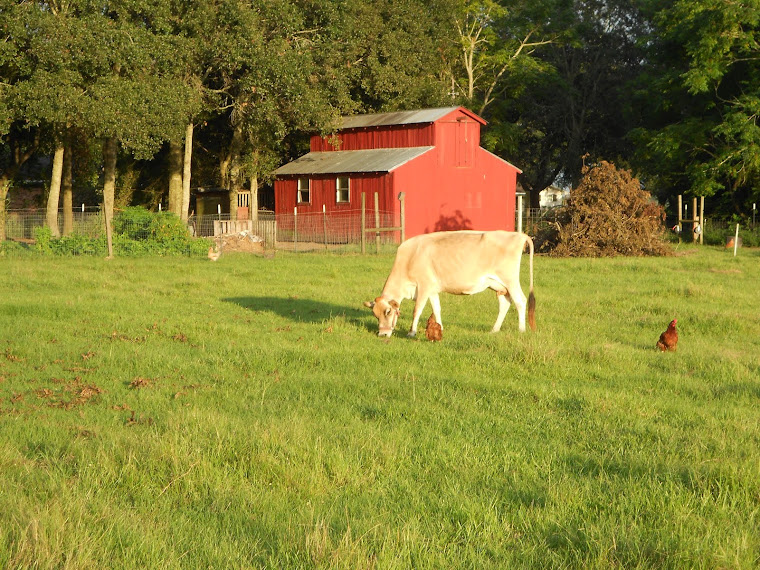
The hard freezes this week finally killed any grasses that were growing in the pasture and the animals are living off of hay that we have stockpiled.  This jungle behind us contains something that the goats simply love - privet.  Privet spreads like an infectious disease and it grows so fast, you can almost watch it put on new branches and leaves.  Fortunately, our goats can eat it almost as fast as it grows.

The wild jungle behind us

To harvest the privet I use some heavy duty pruners like you see below.  It has to be big, as some of the privet is about two inches in diameter.


Woody shrubs like privet is called browse, and goats simply LOVE browsing.  I clip the privet, throw it over the fence and the goats clip the leaves off the branches quicker than you could imagine.  This gives them a little variety in their diets and it also keeps the wild woods somewhat tamed.  In just a short while the woods will be teeming with dewberries that we'll harvest.  Cleaning up the woods will make dew berry picking easier, allowing grass to grow, and discourage varmints from wandering into our property.

Every once in a while I have to gather up the privet branches that have been denuded by the ravenous goats.  I stack the "bones" up in a big pile to eventually decay in the same woods where they grew.  I call 'em bones because they resemble the plate of bones after you've eaten your fill at a rib joint.

There's plenty more privet where that came from, and I'll gladly keep clipping it and throwing over the fence to keep those old goats happy.

One housekeeping item before I sign off tonight: We'll be going 'radio silent' until Sunday night, February 8th when I'll post again as we are spending some good family time together.  See ya Sunday!


Tuesday, May 12, 2020

A Discovery Just Past the Fence

Just over our fence to the south is a piece of property that is undeveloped, unruly, and unkempt.  You know what?  We like it that way.  It is a wild little patch of woods.  The owners are absentee and never mow.  The only problem with this is the critters.  The woods are full of rats, possums, snakes and other varmints.  Those spill over to our land and we have to deal with them.

One very positive part of that wild little patch of woods is the overgrowth of bushes.  As it turns out goats love to eat this "browse."  I mean, they tear it up.  As it threatens to encroach our perimeter fence, I chop it down with a machete and throw it over to the goats to munch on.  Lately, we've taken a tie-down for a dog and clipped one of the goats to it and put them over the fence and allowed them to eat on the browse.

Agnes eating in the woods
We stood there and watched her eat non-stop.  She drifted into the woods and the undergrowth almost engulfed her.


I glanced just to the west of where she was eating and something caught my eye.  It was a plant with different leaves than we're accustomed to seeing in the woods.  I immediately recognized what it was by its leaves - A Mulberry Tree!  Where did it come from?


About four years ago, IN THIS POST I talked about a friend who gave me some mulberries to plant.  In that post, I talk about scattering out the mulberries in the woods behind the house.  Well, lo and behold, we have success!  I can remember as a kid I would eat mulberries right off the tree at my grandmother's house.  The berries were sweet and they would stain your hands purple!  We loved them.  The birds loved them.

The problem that this small mulberry tree will encounter is competition.  It is growing beneath the canopy of privet, Chinese Tallow, and China berry tree - all invasive imports from China.  Sound familiar?

The Canopy
I have to chop down some of that canopy to allow some sunshine to reach the tree.  This will allow it to grow.  It will reach upward and outward and its limbs will bear fruit that we'll enjoy.  For that to happen, I have to get my machete and start chopping.  The goats in the pasture will enjoy eating it.


In no time, I had cleared away a lot of the overgrowth and the mulberry tree was free from some of the competition.


The mulberry tree was actually getting some sunshine on its leaves.  I will keep it cleaned up around the tree and will also spread some chicken litter around the base to give it some 'food' to boost its growth.


I'm so excited that we have had success in our own "Johnny Appleseed" project.  We will report when we have our first mulberry harvest.

Sunday, March 29, 2020

Persevering Under Trial

James 1:12 New American Standard Bible (NASB)Blessed is a man who perseveres under trial; for once he has been approved, he will receive the crown of life which the Lord has promised to those who love Him.
A few months ago I embarked upon a project that I normally do on the property that borders ours.  This is not a fun job.  It is done with a machete, will, and determination.  Privet is an invasive shrub that threatens to overtake the fence that runs east and west on our property's southern border. I cannot let the privet overtake the fence or it will ground out the 'hot wire' and encroach into our pasture.

With my machete, I chop the privet and try my best to pull it up from the roots.  Since this was done a few months ago, the privet was lush, green, full of leaves.  As I would chop, I'd throw the cut pieces over the fence for the goats to eat.  Goats love browse!  This afternoon I caught up on my other chores and intended to walk along the southern fence and toss all the privet branches back over into the woods.  The cut privet branches had sat for the entire winter in the muddy area on the south side of the property.  The goats and bulls had immediately eaten all the leaves off months ago.  Today I needed to toss the old, dead branches over to make way for spring grass.  Here's one of those branches now:


The ground is indeed muddy and barren.  The soft, moist soil is littered with flowers that have fallen from Chinaberrry trees.  You can see the work of my sharpened machete on one end of the privet branch below:


As I reached down to pick it up and toss it, something odd caught my eye.  The dead stick had fresh, green growth coming out.  New leaves, despite no roots.  New growth, despite being cut from the tree months ago.  This is semi-miraculous.  How does this happen?


I'd say it happened for several reasons.  An abnormally wet winter ensured that the ground stayed muddy.  The bulls and goats pressed the cut branches into the mud, resulting in the branch never drying out.  Primarily, though, God's remarkable creation is resilient, complex, and strong.  His plants and animals have a desire to live, to reproduce, even in formidable situations.

What a beautiful illustration of perseverance lying in the southern end of my pasture.  As I stood there looking at the green leaves growing from a seemingly dead branch, I first thought of the Biblical account of Moses' rod that budded.  But then I began to think about how much perseverance, how much will, how much desire to live, that the privet branch exhibited.  And I thought that this is how we should be, especially in the time we're in now.

In the book of James, the Bible tells us that the man who endures testing and trial and perseveres and is found worthy by God, will receive the crown of life (eternal life) to those who love Him.  Everyone who truly loves God will experience trials and tribulations in this world.  This we are promised.  But those trials will be recompensed by our Creator.  May we be found faithful.  May we endure.  May we have dogged perseverance in the midst of our trials!

Thursday, December 12, 2019

Cleaning Up the Fencerow

In South Louisiana hard jobs are best left to a brief sliver of time when the temperature is bearable.  This weekend was one of those weekends.  My To Do List has been cluttered by an item that I kept putting off and it was high time to scratch it off the list.  I'm talking about cleaning up the fencerow that borders the south perimeter of our property. 

Just over the property line is a wooded area that we don't own.  It is a jungle of sorts - filled with Live Oak trees, China Berry trees, Chinese tallow trees, Willow trees, and finally, privet.  Privet is in the ligustrum family and bears small white flowers in the spring.  The other thing they do is take over the land.  If you turn your head for five minutes, its encroached upon your land. 

Every couple of years I have to sharpen my ax and machete, put on gloves, and clean the privet out.  I have an electric wire that runs along the perimeter fence powered by a solar charger.  I tie into that wire to run cross-wires to partition the pasture into 7 paddocks to control the cows' grazing.  The doggone privet will grow into the fence, touching the wires and grounding out the electrical current.

Here is a look of the overgrown fencerow after I began chopping and had gotten about a third of it cleaned up:  You can see how overgrown the fencerow has become.


As I chop the privet, I toss the branches over for the cows and goats to eat.  They really like to eat it.  The photo below shows the third of the fencerow that was cleaned.


I try to clear out an area roughly five yards wide to provide a buffer zone to my back fence.  I do realize I am on my neighbor's property, but they are absentee owners and if I didn't do this job every couple of years, my fence would be in ruin.  I've learned that if you merely chop the privet at ground level, many shoots of new growth sprout from the trunk as if angered by the chopping and proliferate toward our property with a vengeance.  My technique involves chopping below the ground surface to clip the roots, and then pull the plant up.

I'm not going to sit idly by as the privet moves forward.  Chop!  Chop! Chop!  As I go I pick up fallen trees and throw them back into the forest.  I can see animal trails in the fencerow where countless nocturnal animals travel.  I'm sure one of those travelers was the possum I killed in the hen house the other night.  You can see below that I am three-quarters of the way done.


At last I made the final chop, opening up the overgrown fencerow.


I backed up and took a photo from the beginning of the fence to the end.  You can compare the first photo of this post to the last and see what a difference it makes.  Oh, that is the hen house in the foreground.


It looks nice, but as with anything, it takes maintenance.  In another couple of years, I'll be out doing this same job once more.  Privet doesn't sleep.  As I type this, privet is out there re-grouping, plotting, strategizing to launch an offensive and lay siege to our fence.  We will stay watchful and vigilant against the onslaught of the privet.

Monday, July 24, 2017

Blazing a Trail With my Machete

So he went with them; and when they came to the Jordan, they cut down trees.  II Kings 6:4

I watched from afar day after day as the darkness encroached.  Slowly, gradually, almost imperceptibly, the forest crept closer and closer until one day, the forest was threatening to overtake the fence.  The fence is right on the southernmost property line.  To the right is our property, and to the left is property that is owned by folks we've never seen.  Quite often we'll let our cows quickly graze down the jungle that is contiguous to our property in order to destroy some of the tall grass that harbors mosquitoes.

I should have taken some before and after shots, but I was focused on the task at hand - cutting down trees.  Well, they aren't really trees.  Most of the jungle consists of privet. It was time for the privet to go.


With a sharpened blade humming through the air, I chopped privet, Chinese tallow, China berry, pecan, oak, ragweed, and briar with reckless abandon. My machete and I blazed a trail in that jungle 8 feet wide and cleared anything we could reach growing down.


I tossed some of the browse to Annie, the Nubian goat.  Annie is just finished with a 7 day cycle of injections of penicillin as she had a foot infection (foot rot) and a touch of mastitis after we quickly dried her up when Tricia was in the hospital. Annie was thrilled with the browse and ate to her heart's content.  She is feeling so much better now - much better than a week ago.


I tossed some browse to Annie's 3 kids - Buckwheat, Jane, and Darla.  They were not interested at first, but soon got up, stretched, and began eating all the leaves off of the plants.  If you look at the bottom of the photo, you'll see a vine growing.


That vine is honeysuckle and while honeysuckle looks great and smells even better, it is not a good thing to have growing on your fence.  Honeysuckle will wrap around the electric fence wire that runs along the perimeter fence.  You can see it if you look closely. If honeysuckle wraps around the wire, it can ground out the current and then the cows will enter paddocks that they aren't supposed to be in yet.


As I cut down the jungle, I threw some to the goats, but for the majority of the cuttings, I used the "chop and drop" practice.  All cuttings get thrown into a pile where they will decompose and become part of the forest soil.


The encroaching jungle is habitat for all sorts of critters that like to eat chickens.  I like to have a nice clearing between the fence and the woods so that I can better see the enemy. While hacking away, I could see their trails alongside the fence.  I have caught many a possum along this fence.  

Working with a machete is therapeutic and a great stress reliever!  It doesn't take long in the humid weather to completely wet your shirt with sweat.  I hacked down quite  few spider webs, twirling the huge banana spiders with my machete and tossing them to our chickens who were waiting patiently for  a spider snack. At last I was done.  I turned around to walk back, nursing a few blisters on my right hand and regretting that I didn't wear gloves during this undertaking.


This is immediate gratification.  Seeing the product of your labor and knowing that the work you put in paid dividends.  But the forest never stops trespassing and I know we'll do this exercise again next year.  In fact, as I slowly walked back toward the barn, I think I could see the privet growing...
Sunday, April 17, 2016

A Natural Privacy Hedge Out Back

At the southernmost border of our property on our little 5 acre homestead is a fence that we put up on our property line.  It keeps the animals in and hopefully keeps critters out that have an appetite for chickens.  There is a little patch of woods behind the property line.  During the spring and summer, even though it is not my property, I like to keep a 96 inch mowed strip to separate the fence (our land) from the "jungle."

Don't get me wrong, I like the "jungle."  It is shady and cool, providing an overhang onto our property that the cows, goats, and chickens enjoy - especially during the summer.  As I walked along the fence line today, bringing a bucket of water to the pullets in the chicken tractor, my nose picked up a familiar, sweet scent.  The smell was that of the blooms of Chinese Privet.

Privet
Chinese privet is in the Ligustrum family.  THIS ARTICLE tells us that this plant was brought over to the US in 1852 as an ornamental shrub and, like other things (nutria!), escaped and became an invasive species, taking over the understory in many Louisiana forests and across the south.  Its presence has been documented in every Louisiana parish.  It thrives in the shade and grows so quickly you can almost watch it increase in size as it expands its scope.  I will need to mow the little boundary strip quickly to stop its encroachment onto our land.

It makes beautiful, fragrant white flowers that fill the spring air with sweet fragrance.  That's one positive feature, I guess, but many are allergic to it.  After the blooms fade a small purple-black fruit appears that birds eat.  Another positive is that it serves as a great privacy hedge.  I can remember as a young boy making many forts and camps amidst the branches of sprawling privet and wax myrtle trees.  I can also remember not so good memories about the privet. The leaves of the branches can be stripped off, leaving a switch that whirs through the air and can be used to introduce discipline to an unruly boy's rear end.  As a recipient of such instruction, I can testify to the efficacy the privet switch as a tool to bring about sudden attitude adjustment!

Privet Blooms
In reading a little more about Chinese Privet HERE, I learned that it is used as an herbal medicine by boiling and making tea to treat diarrhea, stomach ulcers, bowel problems, chapped lips, and sore throats.  The leaves and bark can be boiled to make a tea to help chemotherapy patients regain their appetites - although it is very bitter.  I guess the thought is if you drink it, the taste is so bad, you'll want to eat something to get the taste out of your mouth!  Good to know that the privacy hedge out back also is a pharmacy should we ever need it.

   
Related Posts Plugin for WordPress, Blogger...