Showing posts with label chicken tractor. Show all posts

Wednesday, March 6, 2024

The Quarantined Hen

Our chickens don't have Covid.  Or the flu.  Or any other ailment.  But we do have one hen that is in quarantine.  The reason is strange.  The other birds were cannibalizing her.  Chickens can be bad about that.  If one gets picked on and blood appears, the other birds will peck and peck at it.  We found this poor hen with a hole the size of a golf ball between her back and her rear end and a bunch of feathers missing to expose her pink backside.  Blood everywhere!  I thought that she was a goner.

We put her in the chicken tractor by herself to get her away from the cannibals.  She survived!  In about a week the wound mostly healed up.  We set her free.  Lo and behold, the same thing happened again.  It's as if we had Hannibal Lector in the barnyard.  We put the poor hen back in quarantine.  She's been there for a couple of weeks.  You can see that new feathers are growing in to cover her exposed rear end.  You can also see the hole.  Gruesome.

She is free to talk and socialize with the other chickens while quarantined in the chicken tractor, but they cannot get to her through the (appropriately named) chicken wire.


She is getting more and more active and has a healthy appetite.  She's healing up.  

Since her injury she hasn't laid an egg.  I don't know if her egg laying mechanical infrastructure is still in place or if it has been damaged.  Tricia and I were just discussing yesterday what we were going to do with her if she doesn't lay eggs anymore.  I told Tricia, within ear shot of the injured hen, "We'll just put her in the freezer and eat her if her egg laying days are behind her."

Well look what was on the ground in the corner of her quarantined enclosure:

It's either the first egg she's laid in weeks OR she heard my comment about butchering her and paid one of her hens on the outside to smuggle in a contraband egg.

Either way, we'll let her heal up for another week or two and finish growing her feathers in to completely cover her wound, and then we'll re-release her into the general population of hens.  Hopefully, this will result in a favorable result.

Monday, February 12, 2024

(Finally) Moving Pastured Hens to the Pasture

For way too long we've had 23 laying hens and two roosters in our chicken tractor in the yard.  Each day I would push the tractor to fresh grass and the chickens would promptly eat it all, plowing the ground rivaling any farm implement John Deere could imagine.  You can see the trail here in the side yard facing north.

The photo below shows the trail of the tractor facing east.  The chickens denuded the ground, creating an erosion problem in the yard.  They should have been out free-ranging in the pasture months ago.  What happened?  These are some chickens we hatched out in our incubator and then raised until they began laying eggs.  We butchered the roosters and then next step was to move the hens out to the pasture.

And then minks started killing our birds out in the pasture.  The population dropped from 60-something birds to 9.  It was a hen genocide.  We were reluctant to move our hens out to the killing fields after taking care of them for so long.  So we delayed moving them until we ran out of excuses.  Last week we pushed the tractor into the pasture, toward the barn and right beside the hen house.

The hens were confused.  They didn't know where to roost or where to lay eggs.  They got out of the pasture and collecting eggs became an easter egg hunt.  In the evenings, we would lock them up in the rabbit hutches that are lined with hardware cloth.  Up to this point, it has proved to be safe from minks.  Over the period of about a week, the hens learned to lay eggs in the laying boxes and get into the roosting spot in the rabbit hutch.

You can see the chicken tractor pushed right next to the hen house on the western side of the barn.  The photo also shows Belle keeping a sharp eye for her birds.

Today we folded up the tarp and put it away, now that the hens have made their long-awaited transition to the pasture.  We began to talk and plan about hatching out some new hens from our eggs and/or raising some meat birds in the now empty chicken tractor.

Thursday, July 27, 2023

The Cock's Clock is Ticking

The drama in the chicken tractor is impossible to ignore.  The crowing (loudly) commences at first light.  Then, the romance starts.  The pullets outnumber the cockerels, but they are mighty amorous.  The squawking and carrying on leads to fights between roosters for their 'harem."  Feathers fly.  Tempers flare.  The pullets seem stressed.  It's past time to do something.

I'll talk about that in a minute.  Each day we're picking up three to five eggs from the pullets.  I tried to put a nesting box in the chicken tractor, but they scratch all the hay out of it and lay on the ground.  It's time to move the hens to the pasture.  The eggs the pullets are laying are small.  It takes two pullet eggs to equal one regular egg.


I was talking to my wife about thinning out the herd (or flock in this situation).  You need 1 rooster to service 10 hens.  We have about 30 pullets and to the best of my ciphering, I think we have 8 roosters.  We plan to pick out three of the best looking roosters for keeping.  We'll introduce them to the flock in the pasture along with the biggest of the hens.  The five roosters that didn't make the cut will be butchered this weekend and we'll put them in the freezer for the upcoming gumbo weather this winter.  You can see some of the roosters in this photo whose days are numbered.  Who am I kidding?  All our days are numbered.

Once the excess roosters are processed, things will be more serene on Our Maker's Acres Family Farm.  There will be peace in the valley.

There will be peace in the valley for me some day

There will be peace in the valley for me, oh, Lord, I pray

There'll be no sadness, no sorrow, no trouble I see

There will be peace in the valley for me

Monday, December 13, 2021

Moving Out on the Grass Three Days Later

I wasn't prepared for the chicks the day they came in.  I had my dates mixed up.  Normally, we'd have the brooder all set up and it would be a quick transition from the shipping box to the brooder.  Needless to say, that didn't happen.  Tricia had to pick them up, water each one, go to the barn, get the brooder, set it up, get out the heat lamp, pour feed for them, and unload them into the brooder.  The wife was not too happy with me!

One of the things we like to do is to get the birds out on grass as quickly as possible.  We find they are just more healthy and natural when they are out on the ground versus being inside the garage.  On the grass, in addition to eating feed, they forage for bugs and worms and eat clover and grass.  It's good for them.

Here is a glamour shot of one of the chicks.  Cute, but they don't stay cute for long.  This guy is about to transform.  You can see a white feather about to come out on his wing.  Pretty soon, he won't have any yellow fuzz.

Moving the birds out on grass is easier said than done.  We have a nice chicken tractor, but I had to get it and push it all the way to the house.  Then we needed to fit it out for the winter.  Chicks are susceptible to the cold and the rain.  We need to shield them from that, so we began affixing tarpaulins to the chicken tractor.

Once done, we have a tractor that is protected on the inside from cold wind and rain.  Those two weather events are chick killers, for sure.  We have one side not permanently attached so that on nice days we can roll up the tarp and let the chicks enjoy sunshine and clear skies.

We set up the brooder inside the chicken tractor and ran the extension cord and set up the heat lamps.  We moved the water and the feed inside.  Now, we are all ready to go.  Except, we need the birds!

We picked them up out of the garage and put them in a wagon for transport out to their new home.  I think they enjoyed the ride.

We put them down on the ground and they immediately began running around pecking at the grass - just what chickens are supposed to do.  As the birds grow, we'll extend the size of the brooder to give them more room.  In a couple weeks, we'll remove the brooder completely.

Enough on the chicks this week.  We'll have another progress report next week.

Thursday, March 4, 2021

Birds of A Feather Flock Together (In the Pasture Now)

Since late August (right before Hurricane Laura), the pullets have lived in the chicken tractor in the back yard.  Correction: The day before the hurricane blew in, we moved the chicks and chicken tractor into the garage.  Shortly thereafter, we moved them out into the backyard.  We would roll the tractor each day, or every two or three days, to fresh grass.  The pullets foraged and scratched for bugs, worms, and tender grass to eat.  In fact, they denuded portions of the back yard.  The barren wasteland below was thriving with clover and winter grass.  No more.  The voracious birds turned it into mud and dirt.


So we figured, now that they are laying eggs, it is time to move them out to the pasture.  We had best move them out, lest our back yard turn into the dust bowl days come summer.  It is no small task.  First, we had to remove Belle, our Great Pyrenees, out of the pasture.  We don't trust her yet.  She may eat them all.  Next, we brought the young hens out to the pasture in a blue tub, five at a time.  

Before setting them free, we clipped one of their wings.  You don't want them flying over the fence and into the mouth of neighborhood dogs, possums, raccoons, or other predators.  You really don't need to clip both wings - clipping one will do.  It will keep them off balance.  A funny story about clipping wings, about 10 years ago, I set out to clip the wings of some pullets.  Somehow, I was holding the (very dull) scissors oddly and the repetition of the process and the pressure of the scissors against my finger caused a weird phenomenon.  My middle finger went numb.  It stayed numb for days!  I was concerned that I had damaged my middle finger - not that I use it that much...  But after a week or so the feeling came back.  Needless to say, I was very careful this time.  Slow and steady is the game plan.

The hens didn't like that much.  They would cackle and shriek and flap their wings.  This would incite the rooster to come nearby in threatening fashion for messing with his harem.  I was poised with the scissors should he be tempted enough to try to spur me.  We'd have a fresh rooster gumbo, for sure.  In the end, we finished the task.  

The hens and the rooster were rewarded with freedom.  A wise man once made a wise quote about freedom.  The context wasn't about chickens, but I guess you could say that we were happy to give our birds freedom.

Those who deny freedom to others deserve it not for themselves; and under the rule of a just God, cannot long retain it.  - Abraham Lincoln

After months of being cooped up, in the literal sense of the word, the birds are free to roam on the pasture and be birds.  They were happy.  The bottom door of our chicken tractor that a great friend of mine built, is left open so that they can go inside and lay their eggs, leave and forage for food and then return at night to roost.  We are a little concerned about the hawks.  Tricia has been counting them every day and so far, all of them are still accounted for.


Pretty soon, the rich spring grass will grow and the hens will have lots to eat.  The yolks of their eggs will get a dark yellow color not present in store bought eggs due to their diet.  The taste of spring eggs are second to none.

Green grass will once again fill the pasture.  Hopefully, green grass will fill our back yard again now that these girls are off of it!

Sunday, February 7, 2021

Pullet Bullets

Here are most of our pullets that currently reside in our chicken tractor.  We've shown them to you before.  Barred Rocks and Rhode Island Reds lay the brown eggs and the Easter Eggers lay blue, green and pink eggs.  On January 25th, we posted about how they started to lay their first eggs.  Tiny eggs slightly larger than a golf ball at first, but they'll get to normal size soon.  I call these first eggs, "Pullet Bullets."

I tried to put some nesting boxes in the tractor full of hay, but the pullets (young hens) would have nothing to do with them.  In fact, they scratched all the hay out of the boxes and now they just lay their eggs all over the ground.  I'll have to work on a solution for this.  You can see the four brown eggs from either the barred rocks or Rhode Island Reds lying on the grass.

And there is a blue egg from an Easter Egger near the nesting box (egg crate).  I had a nice nest of soft hay for them to lay their eggs in, but nope.  She said, I'll just lay it straight on the ground, she says.

Take a look at the photo below.  This is a zoom-in of the door to the chicken tractor.  You can see the latch on the outside.  It is hanging down right underneath the leaf caught in the chicken wire.  That latch is the door latch on the outside that must be opened to enter.  Let me tell you the reason for the installation of the new shiny latch on the INSIDE of the tractor.

One afternoon last week, Tricia went out to feed the pullets.  She entered the door like she always does and began to feed them.  The Easter Egger birds are wild.  They get spooked easily and they fly about the cage in a rampage.  Tricia had closed the door, but there was no way to latch it from the inside.  The wild birds flew into the door knocking it wide open.  Then every single bird escaped.  

Tricia was by herself.  She went and got a net and trying to corral them back in.  She got a few in, but then she had to open the door to let others in and they all got out again.  Tricia told me that she was convinced that the neighbors were watching her and laughing at her follies, running about like a chicken with her head cut off.  Finally, Benjamin showed up and was able to help his Mom get them back in.  Tricia asked me to see if I could figure out something to fix the problem.  I installed a latch on the inside and now the hens, though they mount up with wings like eagles, they won't be able to escape!

But those who wait on the Lord Shall renew their strength; They shall mount up with wings like eagles, They shall run and not be weary, They shall walk and not faint.  Isaiah 40:31


Monday, January 25, 2021

A Couple of Startling Events in the Pullet Tractor

In late August in what my wife would tell you was the WORST possible time, we added to the number of our egg-layers by ordering 30 day-old chicks from Ideal Poultry.  They came in the mail and we put them in the chicken tractor outside.  A week later we were pummeled by the first of two hurricanes.  We pushed the chicken tractor in the garage, and they weathered the storm beautifully.  If it had been cold outside at that time, we would have lost all of them as we lost power for weeks.  With no heat lamp, they would have died.

The birds thrived despite our hardship.  They stunk up the garage in spectacular fashion.  We moved them outside and over the resulting weeks they have grown and grown.  They are pushed to fresh grass almost daily.  We have three types of pullets - Rhode Island Reds - they are the most prolific brown-egg layers.  Next, we have Barred Rocks - another productive brown-egg layer.  Finally, we have Easter-Eggers.  These are a breed that lay blue, green, and pink eggs.  According to publications, these pullets begin laying eggs between weeks 18 - 24.  Well, Saturday we found a green egg and again today.  The first eggs that pullets lay are small.  They are 'working the kinks out.'  But it won't take long until the rest are laying and the sizes will get normal.  The photo below shows the two Easter Egger green eggs.  I placed an adult laying hen's brown egg beside them for comparative purposes to show the size.


The photo below shows the different breeds a little better.  The dark gray and white (salt and pepper) bird you see in the foreground is the Barred Rock.  The reddish brown bird is the Rhode Island Red.  The other oddly colored (but beautiful) birds are the Easter Eggers.  Do you notice something strange about one of the "pullets" in the photo below?

In the event you didn't pick it out, they aren't all pullets - one is a cockrel!  Can you see him below?  He is the one in the far right corner with the big, beautiful comb.  His size was the first giveaway, but then he began crowing!  Hens don't crow.

Someone at the chicken hatchery made an honest mistake.  You can order a 'straight run' which means as-hatched.  They'll generally be 50-50 hens and roosters.  You can pay a little more and get pullets, which is what we did.  The chick sexers separate the day old hens from roosters.  There is a science to it.  I am not 100% sure how they do it, but they are usually perfect - Except for this time!  One rooster slipped through.  That's okay.  We actually need another rooster on the flock.

Wednesday, April 29, 2020

2020 Meat Birds - Week Five

Week 5 in the annual 8 week meat bird project was an interesting one.  We lost one bird.  It was a runt.  After its death, Tricia did an autopsy on it, wondering if it had parasites or something to keep it from growing.  She found nothing.  Doctor Tricia's lab report was inconclusive.  That brings our total fatalities so far to 3.  If we can hold that figure, we will have a 6% mortality rate.  Normally, the hatchery sends an extra 2 or 3 as lagniappe to account for things like this, but not this time.  Oh well.

The other notable event this week was the weather.  We had two consecutive days of thunderstorms bringing lots of rain and lots of straight-line winds.  The chickens are in a chicken tractor that we push to fresh grass several times a day.  You can see the tractor below:


It is made with a 2x4 frame on wheels with PVC frame, covered with lightweight welded wire and a tarp.  We have learned from prior calamities to tie down the corners with stakes driven in the ground or the chicken tractor will flip.  We always check the weather and plan accordingly.  The weather report showed wind gusts of 9-10 mph.  We got gusts much higher than that.  Tricia estimates 60 mph!  Here are my stakes.  Only one was remaining secured, but it saved us:


Tricia ran to the tractor in the pouring rain when she saw it about to flip.  She stood on the frame for 30 minutes holding it down while torrential winds blew, shifting the tractor's location.  Tricia held it all together and saved all the birds.  When I got home, she had quite a story to tell!  I call her my pioneer woman.  She was soaking wet and not too happy...  You know the old saying, "She was madder than a wet hen?"

So it is Wednesday Weigh Day.  I brought the bird in the garage in a bucket.


And then I put it on the scale...


And at week five, here are the results:


We have five years' documentation of the Cornish Cross Meat Birds' weight for comparative purposes:

Week Five 2020: 3 pounds 12 ounces, a weight gain of 10 ounces over last week.  I think if you average it out, we are right where we need to be at this stage of their development.
Week Five 2019: 3 pounds 4 ounces
Week Five 2018: 3 pounds 14 ounces.
Week Five 2017: 2 pounds 15 ounces.
Week Five 2016: 4 pounds

As I read more and more about possible meat shortages due to the reaction to the virus, we are happy to have our own meat right here at the house.  In 3 short weeks, we'll process them.  Our slaughterhouse will be fully staffed and transportation to 'market' involves walking the carcasses in from the backyard and into the deep freeze.

We'll meet here again next week to see results of the meat birds' growth and development.


Thursday, February 13, 2020

Making the Most of It

Our tomatoes, peppers, and eggplant that we planted from seed at the end of December continue to grow.  In previous years, we struggled with them getting long and "leggy."  We solved it this year simply by putting the grow light real close to the young plants.  It is high time to get them outside.  We need to harden them off to get ready for transplanting into the garden.  They need to get exposed to a little cool, a little wind, and definitely more sun.  How will we do that?  Temps are still too cold overnight, and we don't have a greenhouse.

Young Plants in the Foyer
Tricia had a great idea.  We have a chicken tractor that isn't being used to raise chickens in for at least another month.  We can use it to raise plants in until it is time to put them in the garden.  How will we convert a chicken tractor into a greenhouse?


We found a heavy-duty plastic tarp that allows sunshine in, but stops the wind while searching the Internet.  After quick measurements, we found one that matched the dimensions perfectly.  In two days it came to the front door.  We rolled it out and fastened it to the sides of the chicken tractor with zip ties.  This thing is beginning to look like a greenhouse!


We moved the plastic table into the greenhouse that we normally use to cut up our chickens after butchering.  Seemed only fitting while we are finding dual purposes for things.  The trays of plants fit on it perfectly.  The ends were closed it to keep out the weather and we anchored it to the ground so the wind wouldn't blow it over.  Grow lights were hung from the roof on a chain so that we could adjust the height. 


The garden hose nozzle was set to mist and we watered the plants.


At night the greenhouse is aglow with light.  This evening the temperatures dipped down into the 30's so we wondered what we were going to do.  We decided while we are using items previously used only for raising chickens, we might as well use the heat lamps that we normally use to keep the baby chicks warm in the brooder.

Ordinarily, on a cold night like tonight, I'd bring all the plants in since they would be in a cold frame on the back patio.  Tonight since they are protected in our new makeshift greenhouse, I'll take a chance and leave them outside.  If I can get them through another couple of weeks, I'll transplant them into the garden, leaving the greenhouse/chicken tractor vacant.  Then we'll order the chicks!

Thursday, April 4, 2019

2019 Meat Birds - Five Weeks Old

I saw a funny T-shirt this week that said, "I dream of a day when a chicken can cross the road without having its motives questioned."  Pretty funny.  Speaking of chickens...

Here are the meat birds in the chicken tractor.  Notice how we've put a large tarp over the tractor to protect the birds.  We had monsoon rains today, but the heat lamp never went out and the birds survived high winds and rains due to the preparations we took.  It may not look so pretty, but it got the job done.  I'm not sure that this apparatus would be approved in a gated community with an HOA.  Ha ha!


We were happy that our birds survived the storm.  One year we were not so fortunate.  We experienced 60+ mph straight line winds in the middle of the night.  The chicken tractor had a tarp on it as well that year, but the winds treated the tarp like the sail on a ship and it flipped the chicken tractor over.  By the time we got outside, there were dead or dying chickens scattered all over the yard.  What a sight to see!  Well, we weren't going to let that happen this year.  We were more prepared.  Last night we took some long tent stakes and tied some baling twine to them and each corner of the chicken tractor.  Then we hammered the stakes into the ground to anchor it.


The stakes held the tractor down despite high winds.  All of the birds survived.  Good news!

Okay, it is time for the weekly weigh-in.  Let's go.  I picked up 3 birds and put them in a bucket and carried them to the back patio where I've placed the kitchen scale.


In just looking at the birds, I don't see where they have grown a whole lot over the last week.  Let's see what the scale says:


I weighed 3 different birds that I picked up at random.  Last week the three birds I picked up averaged 2 lbs. 8 oz.  This week the three birds I picked up averaged 3 lbs. 4 oz.  So they gained 12 ounces over the last week.  Good, but not great.

Here's a comparison with where they are now (3 lbs 4 oz.) compared to previous years at this same time frame:

Week Five 2018: 3 pounds 14 ounces.  
Week Five 2017: 2 pounds 15 ounces.
Week Five 2016: 4 pounds

We'll see where we are next Thursday.  Hope to see you back.

Tuesday, April 3, 2018

The Poultry Palace

I tend to repeat myself sometimes, but I follow blogs and I appreciate hearing things again and again.  It helps me to learn more and pick up new ideas.  Today, I'll be talking about our newly designed chicken tractor.  I've built other designs before.  You may remember our Ford Eggsplorer?  They were heavy and hard to pull.

After looking at different designs on the Internet, I tweaked the ideas and mixed the features I liked best into one prototype that a friend of mine and I built.  The photo below really doesn't do it justice as it is covered with tarps to protect the birds from some bad weather that was blowing through.  You can see it is on wheels that can be set and then retracted so that the chicken tractor sits on the ground.


It is built on a skeleton of 1/2" PVC pipe, strengthened by a 1 x 4 across the top and a 2 x 4 frame along the bottom.  It is encased in welded wire fencing and that gives it its strength and keeps predators out.  It has a door on one end and the waterer and lights hang down from the 1 x 4 on the ceiling.  That's another nice feature - you can stand up in the chicken tractor and walk.


This angle shows the reservoir (bucket) holding rain water that gravity feeds into a bell waterer in the tractor.  The tarps are ugly, but they (sometimes) protect the birds from wind and rain.  Sometimes, however, it acts as a sail that flips the tractor completely over.  When inclement weather approaches, I now stake the tractor down and put weights on the frame to hold it down.  It has worked so far.  We'll see about tonight!


Each day, sometimes several times a day, I pull the tractor to fresh grass so they can each clover and tender, young grasses.  There are ropes on either end that you use to pull the tractor by hand.  You have to be careful when you pull it not to run over the birds.  They aren't that smart and won't move fast enough and if you aren't paying attention, well, you have a dead bird.  I've accidentally killed more than my fair share over the years.


The chickens are very happy in this design and if I had to build another one, I'd build one just like it.  I would possibly try to think of a better idea for the tarps as the wind seems to tear them up.  If I was going to use it for laying hens, I'd design some lightweight nesting boxes.  This design is perfect just as it is for meat birds though.


One thing you have to watch out for is to make sure after moving it, that you lift the wheels to drop the tractor's base to the ground.  If the ground is uneven, you can have escapees. 


In the past, when it was time for butchering, you had to go load all the chickens up to bring them to where we set up our "slaughter house."  It was a pain.  No more!  Now, we simply pull the tractor right up to where we are going to be butchering. 

Monday, August 28, 2017

Rethinking the Chicken "Arrangement"

When we first got chickens, we had a a small flock of hens that lived in a chicken tractor out in the 3 acre pasture.  I would push the chicken tractor each day to a different spot so that the grass was 'fertilized' in equal fashion.  Of course fire ant mounds proved to be a formidable obstacle.  Sometimes I had to lift the tractor or push around the fire ant mounds.  The tractor had a door on the front of it.  Each morning I would let them out and they would roam on 3 acres.  At night, they would return to the tractor as there were roosts in the tractor and they would sleep on them each night. Sometimes I would close the door to keep them safe from predators, but most of the time I wouldn't.

Then we got more chickens and that meant that we had to build a second tractor, which meant twice the work and twice the time in moving them.  Oh, and twice the fire ant mounds to dodge.  Well, then we got more chickens and we adopted more chickens that people no longer wanted.  (Who can refuse orphan chickens?) Suddenly, our nice plan didn't work.  Our flock no longer fit in the chicken tractors.

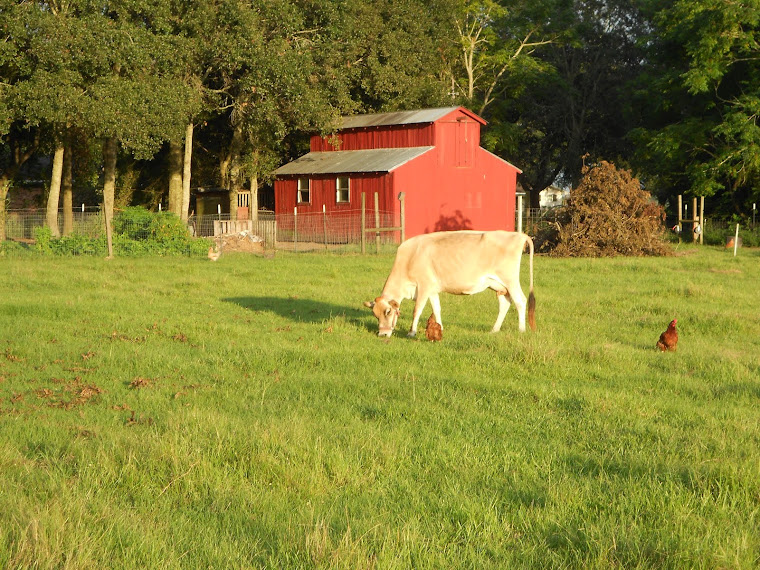
A friend donated a hen house that he was no longer using (you can see the hen house in the background of the photo below.  It is the smaller red building.) and the philosophy of our operation changed.  Rather than foraging for food out on 3 acres of pasture, the hens became dependent.  They lazily loafed by the barn waiting for rice and laying pellets we fed them at morning and night.  They roosted in the roosts in the hen house. They stand at the barn gates begging for food and the cows step on them when coming in the barn to get milk.  Some of the injured chickens die, and some, like Jacob, walk with a limp from their encownter.... ahem, encounter with a cow.


Oh, sure, they would venture out in the pasture and forage and eat bugs and worms and frogs, but their default position was hanging out by the barn.  Soon they had scratched all the grass around the barn to resemble a barren wasteland.  They created the same parched, grass-less 'chicken-run' area you see above that we were trying to avoid.  The lack of grass creates mud.  Young tender sprouts of grass have no chance with all the chickens.  There are no roots to hold the soil together and when rains come, a large mud flat looms.  Lots and lots of mud around the barn.  I want to reverse this and return to how things used to be.  It won't happen overnight, but we're making steps:

Step 1: We moved the new chicken tractor that we built out on the pasture.  This will be the hens' new home that will lure (at least some) of the chickens out of the hen house.  If you look closely, you can see a cardboard box leaning against it. What is that?  Well, the box contains is Step 2.


Step 2: We purchased some electric poultry netting from Premier 1 Supplies.  This netting hooks up nicely to my existing electric poly-wire fence by attaching a 'jump wire.'  This netting keeps the goats and cows out of the hen area.  The goats and cows are opportunists that like to eat the chickens feed. The goats are mischievous vandals that would destroy the chicken tractor in three shakes of a billy goat's tail. That means no time at all!  I will move the chicken tractor daily and will move the poultry netting several times a week to rotate the pasture the hens roam on.
 

Step 3:  More than keeping the goats and cows out.  The electrified poultry netting keeps the chickens IN and away from the area where grass is not growing.  I will plant rye grass seed mixed with wheat seed and bermuda or bahia grass seed in the 'grass-less' area.  With the chickens safely within the netting, the young grass will get a head start and perhaps be able to grow and I'll re-introduce grass and eliminate mud from an trouble spot around the barn.


That is the plan.  The chickens, as of this writing, have not bought in to the plan.  I lured the chickens into the netting with feed and got two thirds of them inside.  The next day more than a third of them had flown over or found other ways under, over or around the netting.  I don't give up easily, though. I will try to capture them all in the hen house and clip their wings, READ THE DIRECTIONS THIS TIME about setting up the netting and then set up the netting more securely and try again.  Once I have them all inside the netting, I'll purchase the seed and plant grass. Doing this is not easy, but it is the right thing to do and will eliminate erosion, mud, the health of the animals and soil fertility out on the pasture.
Related Posts Plugin for WordPress, Blogger...