Showing posts with label compost. Show all posts

Thursday, September 12, 2024

My (Redneck) Garden Riddle

This is not what you expected.  I don't have a riddle for you in terms of a joke to guess.  A garden riddle is an old term for a soil sieve.  I need this to get a good growing medium for seedlings.  Many of the cole crops and lettuce seed are so small and they are only to be planted 1/8 of an inch deep.  Because of that you need a light, airy mix that they can grow in - something that isn't heavy and clumpy.

That's why I need a garden riddle.  I'll show you my redneck version.  The first thing that I got was a big landscape bucket full of composted wood chips.  These have been composting down in a pile for three or four years.  The pile (that was dropped of FREE!) has decomposed to about 1/3 the size that it originally was.  I shoveled the bucket full and carried it to the garden.  You can see that some of it looks like topsoil and you can see some sticks that haven't quite decomposed.  More on that later.

I'm going to be using this topsoil (wood chip compost) to plant broccoli and cauliflower in.  In order to filter out the sticks and matter that I don't want in the seed starting mix, I'll use a riddle or a soil sieve.  I'm going to build one, but time got away from me, but I did find something that will work.  We'll call it Kyle's Redneck Riddle.

It's actually the door to an old rabbit hutch.  I don't throw much away, always thinking that it will come in handy one day.  And it did!  Here's how it works:  I place the riddle (rabbit hutch door) over the bucket that I want to catch the filtered soil in.

This is a job where you get your hands dirty, but that's fun, isn't it?  You might use gloves, but I didn't.  I like to feel the sensation of fresh made compost in my hands.   I put a handful on top of the riddle.  The riddle has hardware cloth that is perfect for this job.  You rub the composted wood chips against the hardware cloth vigorously and the filtered soil falls into the bucket.

The remainder that won't go through the riddle is shown below.  It's just some sticks and chips that haven't rotted down yet.  I'll throw those back on the pile for additional "seasoning."  Then, I rinse, wash and repeat until I have a full bucket of sifted soil.


Look at this rich growing medium, would you?  If I was a seed, I would love to be nestled in this stuff.  I'd burst forth like a Fourth of July firework.  Think about the fertility in here.  Three or four years ago, this 'dirt' was cut from a tree and chipped.  The tree had sucked fertility and minerals from the soil and grown.  All that fertility and minerals were stored in the wood.  That wood was chipped and now decomposed.  Now, we're putting that right into our soil.  We're importing fertility!  And it was free!  What a deal...

I'll show you some photos as soon as the seeds start popping out.

Below is a FANCY garden riddle.  There's nothing redneck about it.  This is a You Tube video by one of my favorite bloggers, Herrick Kimball.  He's a master craftsman and in this video, he shows you how to build your own garden riddle.  It is a first class project - one I hope to do one day.  Until then, I'll continue to use the rabbit hutch door.  Click the arrow below to watch.  I think you'll enjoy!


Oh, what the heck.  I'll give you a garden riddle: Why did the tomato turn red?  Because he saw the salad dressing!

Wednesday, August 3, 2022

When the Poop Hits the Fan

 Oh boy, here we go...

                                                                Image Credit

We've all seen images of Sri Lanka falling and their leaders being ousted from power.  Irate citizens storming the palace, swimming in the president's pool, and setting things on fire.  Costs are up, food and medical supplies are in short supply, people are hungry (and very angry).  Years of corruption led to a deep distrust in government.  The country is on its way to bankruptcy. 

What happened?  Their leaders bought into green energy.  Everything should be peachy, right?  Sri Lanka has an ESG score of 98 out of 100 - the highest in the world.  In April 2021, their leader, without notice, banned all imports of chemical fertilizers. This caught farmers by surprise and reduced yields of staple rice crops, driving prices higher.  Hunger is a great motivator.  It motivated regime change.

But look to the Netherlands...

                                                                        Image Credit

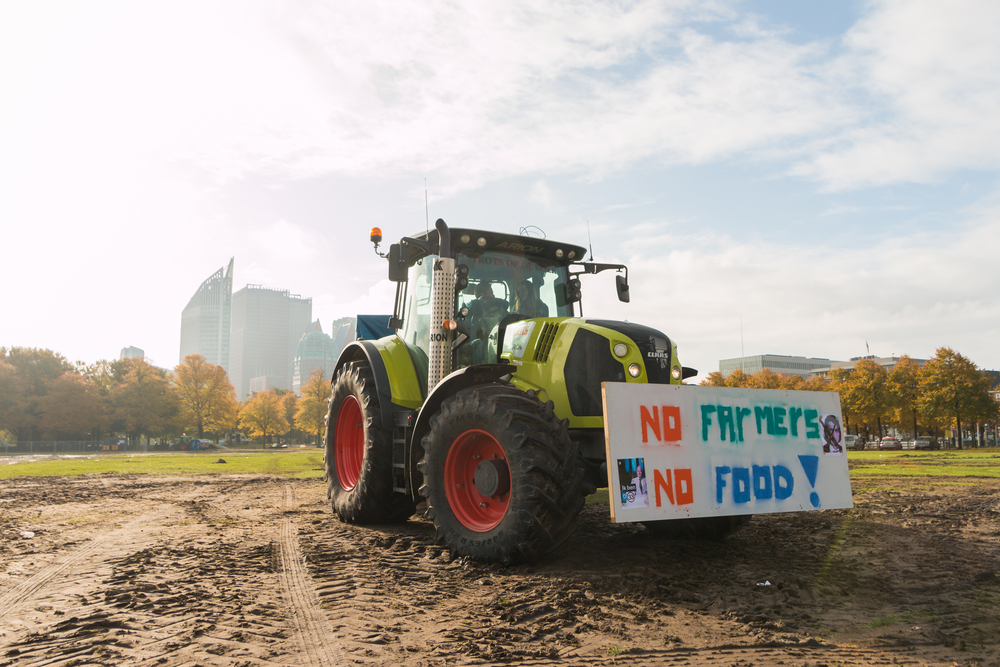
What is going on there?  The government sparked massive protests by proposing to cut the country's livestock in half to limit carbon emissions and agricultural runoff.  Dutch farmers also say that they feel disrespected the Dutch populace, media and politicians.  They are literally biting the hand that feeds them.

I'd like to talk about these two events for a moment.  Notice the similarity?  Poorly thought out government green initiatives caused this.  It is just my opinion and everyone has one.  Contrary to popular opinion, it is healthy and normal to think differently and have thoughts of your own.  We live on a little homestead farm where we grow approximately 90% of everything on our table.  It comes from right here off the land.  We don't use chemical based fertilizers or herbicides or pesticides.  (More on that in a minute.)  We generate very little waste.  We are about as green as it gets, but I abhor the green movement.  I love freedom.  The green movement is anything but.  I also feel that many green movement people don't practice what they preach.  These elites want to impose restrictions on you, while they're still living high on the hog. 

I want to show you how we grow our own fertility, but before I do, I want to tell you that since our country industrialized and most people live in the cities and don't grow their own food, chemical fertilizers are a must.  We won't use it on our little 5 acres, but if all the people in cities want food, and want it at an affordable price, synthetic fertilizers are a necessity to maintain yields and grow the amount of food and fiber needed to sustain life as we know it.

The other alternative is to have everyone do what I'm about to show you and grow your own food.  First, we compost everything.  All scraps go into a compost bucket that we walk out to the compost pile daily.  Egg shells, squash stems, onion skins, coffee grounds.  Everything goes into it.  


It all decomposes and rots down and attracts earthworms who do their thing in the soil and the soil fertility grows.  We also grow peas and beans that set nitrogen in the soil.  We're growing fertility.  We also make biochar and inoculate it with cow poop and bury in the garden.


At absolutely no cost, we have tree trimming companies deliver load after load of wood chips to us.  They dump them right there in the yard.  An eyesore, to be sure.  But it is gold.  For years trees pull fertility from the soil.  Then, when they are cut down and chipped, all that fertility remains.  It is imported to our 5 acres and I let it decompose.

After three years, this is what the wood chips turn into - black, rich, fertile topsoil!  I incorporate this into the garden.

We pick up dried cow patties and pile them in the back of the garden.  After they 'cool down' for a year, the cow manure is ready to be incorporated into the soil for fertilizer.

Here is our hen house.  You can see the roosting bars.  Chickens line the bars at night to roost, and they poop while they roost.  The poop falls beneath them, piles up and composts.  You've got to be careful with this.  It is so potent, if you put it directly in your garden, it will burn up all the plants.  It is wise to wait at least six months and preferably 9-12 months.

Here is some good composted manure that the hens produced.  Homegrown fertility.

This right here will grow some vegetables!

Those are just some of the ways we boost soil fertility and grow our own fertilizer.  We can do it on our 5 acre farm.  We're not trying to feed the world, though.  We're feeding our family.  We've also had years to learn and make mistakes and implement the new concepts.  How do you do this on hundreds of thousands of acres?  I don't know.  They want to drastically reduce the number of cows, so don't look in that direction.  Composting on that scale doesn't work either.  Chicken litter is used wider agriculturally for nitrogen application, but can't be currently broadcast as efficiently and economically as chemical fertilizers.

Before setting restrictions and making proposals about something like farming that most politicians know nothing about, government leaders would do well to have well-thought out alternatives drawn up and allow appropriate time to change.  Something (experience?) tells me government ain't gonna do that.  You can have the highest ESG scores in the world, but if there's no food to eat, your people are all in poverty, and your leaders are driven from power, what did you really accomplish?  When the poop hits the fan, you oughta pick it up and compost it and grow your own food.

Monday, April 4, 2022

About All We Can Handle

At least a couple of mornings each week at 'dark-thirty,' we hear the back-up alarm beeping on the big truck bringing yet another load of wood chips and dumping them on the property.  I've lost count of how many loads, they've delivered, but we're almost at full capacity.  We're out of room, and it is too bad, because like a gardening friend tells me, "That stuff is like gold."  The best part about it is that the wood chips are FREE!  I have looked around and see that they can maybe dump two more loads.  We have a couple of names and addresses of friends who are lined up to take it after we are full.

Composting piles of wood chips are not going to win us any "Beauty Spot of the Month" awards by the Garden Club.  The piles are kind of unsightly, but the benefit provides far outweighs the deviation from aesthetics in the neighborhood.  You can see in the photo below, the piles are heating up and the bacteria is beginning to break down the piles.  They will decompose and then be really useful.

About three years ago we got twenty-something loads of mulch.  We filled the flowerbeds in the landscaping, mulched around the trees to eliminate the need for weed-eating, and we put a four inch layer over the entire garden as we initiated the "Back to Eden" gardening method.  I piled the remainder into a BIG pile at the back of the garden.

We composted kitchen scraps, coffee grounds, and shredded paper into it.  We dumped cow manure into it.  We buried numerous chickens that were killed by predators into it.  A multitude of possums that I trapped were composted into the huge pile.  Three years have past and the pile has shrunk into a big pile of black, fertile compost.

When I plant, I rake back a line of wood chips to expose the soil.  Then I begin hoeing up the soil for my seedbed.  In a testament of healthy soil, a gazillion earthworms wriggle around to greet me.

They are of all sizes and they are enriching the soil and fighting against compaction.

When we first started gardening, I am not exaggerating when I tell you that there were NO earthworms.  Composting is the key to getting them back.


So today one of the things I planted was a row of black beans.  I worked up the seedbed in the row like I detailed above.

I made a 1 inch trench and dropped a bean every four inches.

Then I shoveled some of the rich compost pile into a tub and chop it up real fine with a shovel.  Then I cover the beans in the trench with the compost material.  It is a good medium for the beans to grow in.  As they grow, I'll pull some of the fresh mulch around them to crowd out any weed pressure and also help the soil retain moisture and a cooler temperature.

We're expecting rain tonight, so that will help the beans to sprout in no time!  

Wednesday, April 14, 2021

The Ever-Shrinking Wood Chip Pile

At the southernmost part of our garden lies a big pile.  In the past it was 50% bigger.  It was wood chips and over the last two years the wood chips have decomposed.  We got these chips from a company that was chipping up trees from electrical powerline right of ways.  The wood chips were free (other than for a few dozen eggs we gave the workers).

The wood chips were once trees.  Those trees pulled nutrients and minerals from the soil.  Now those same trees are slowly deteriorating and becoming soil from which they grew, returning fertility to the land.  The wood chip pile is not dead.  It is teeming with earthworms, bugs, and mushrooms.  Those living organisms help to break down the wood chips.


While you can still tell that there are wood chips in the pile, a good portion of the wood chips are broken down.

Some parts of the pile look almost entirely like dirt, soft, rich, and moist - a perfect medium for plants in a healthy garden.  As the seedlings grow, we rake a 4" layer of this around the plants to discourage weed growth and encourage the retention of soil moisture.

We also bury our compost in the pile.  This adds bacteria to speed up decomposition.  As evidence of the fertility of the wood chip pile, I have several healthy plants growing in the pile from seeds deposited along with the compost.  How about that?  Gardening in which you don't even have to plant the seeds!

Here we have a Butternut Squash and a Charleston Grey Watermelon.

Here we have a plethora of Muscadine Grapes growing.

Here we have a luffa gourd plant.

And finally, here are three peanut plants.

We'll check in on these plants to see if they are able to reach maturity.  As our inventory of wood chips morphs into rich soil, we'll have to keep our eyes open to accumulate more wood chips to keep the process going.

Sunday, November 26, 2017

Moonlighting

My full time job right now is trying to find a full time job, but I did a little moonlighting from the job search job last week and helped out a friend.  My job was a simple one, but quite enjoyable.  It was an absolutely beautiful day.  I had a flannel shirt on to stay warm, but had the windows rolled down to enjoy the fresh air.  I drove his truck south toward Thornwell, Louisiana.  Thornwell is known for its excellent duck and goose hunting.  I tried to capture a photo of them below.  If you enlarge it, you can make out thousands of geese funneling down and landing in the middle of a harvested rice field.


The old truck was one that I've never driven before, but I have lots of experience driving trucks like this.  Anyone who's farmed in South Louisiana is familiar with driving trucks like these.  You hold your breath before starting them and are happy when the engine turns over.  It tops out at about 50 mph. Various things like turn signal blinkers, lights, and windshield wipers work intermittently.  Trucks like these are held together with duct tape, tie wire or bungee cords (like the one below that keeps the passenger door from flying open while you are driving down the road).


It was a great day for getting a little work done.  I arrived at my destination around 8:45 am.  As the photo below shows, there was a pile of stack-burned rice about 8 feet tall and 100 yards long.  It had been sitting out for a long, long time and had basically heated up, cooked and decomposed into some rich material to work into garden soil to add richness and organic matter.  My friend has some big green houses and was using this material to amend his soil.  I just had to get it back to his hoop houses.


Here is the pile that I was to work on.  Fortunately, my friend had a New Holland tractor with a front end loader on it.  This made the job a breeze.


All I had to do was scoop up a big bucketload of the stuff, lift it up, carry it to the truck, and...


Dump it into the bed.  11 scoops filled up the truck, but I had to use the bucket to spread it out and balance the load to be able to get 11 scoops on the truck.  I made little tick marks in the dust on the fender to make sure that I had 11 scoops in the truck bed.


Here's the crazy thing.  You know how compost has bacteria working in it that heats up and "cooks" the pile?  This material, even as long as it has been sitting here, was still cooking.  If you look closely at the top of the pile, you can see steam rising from the pile!


I drove the truck back to his place, peeling and eating a grocery bag of satsumas I had picked and taking in the scenery.  I unloaded the load of material and went back for more.  Overall, it was a nice day of moonlighting and a good change of pace.

Wednesday, October 11, 2017

We're Caught In a Trap...

Elvis Presley sang a song called, "Suspicious Minds" that started with the following lyrics:
We're caught in a trap
I can't walk out
Because I love you too much baby
Why can't you see
What you're doing to me
When you don't believe a word I say?
I found myself singing that song this afternoon and you'll soon know why.  After catching 6 rats in 5 days in a trap I set in the garden, I stopped catching them.  Perhaps I caught all the ones that were venturing into the garden, but I saw two in the barn the other evening.  I figured I would mix things up a little bit and move the trap into the barn to thin out the population there.  Actually, I want to do more than thin them out - I want to eradicate them.  This morning at 5:30 a.m. when I flipped on the lights in the barn, this is what I found:

"I'm caught in a trap.  I can't walk out..."
Not a rat.  A medium sized possum.  He was not happy.  He hissed at me with an open mouth like possums like to do.  While I do want to catch and kill all the rats, I have no qualms about catching and killing all the possums, too.  Since this guy is medium-sized, I know there is a Momma Possum and a Daddy possum out there.  I've re-baited the trap with 'Ol Roy dog food and we'll see if we continue being successful in our trapping.
"Why can't you see, what you're doin' to me?"
I dealt with our captive swiftly and humanely and he found himself amended into our garden soil where his remains will provide nutrients that will grow possum flavored green beans this spring.  Catching the possum also answered a mystery.  One afternoon this week I walked out to the pasture and saw the following: 


If you look closely, you can see a bunch of feathers from a Rhode Island Red hen.  I didn't find a carcass, so he wasn't successful in killing the hen, but the next time the predator comes around, our hen might not be so fortunate.  Maybe the possum in the trap was the guilty party.  Me and the Rhode Island Red hopes so.

Monday, September 19, 2016

Seeing the Full Cycle

Early Saturday morning I was awakened by loud sounds of rumbling thunder that shook the windows and walls.  It was incredibly loud and its vibrations were powerful.  Later that afternoon I walked around the yard and observed that the thunder must have caused a large rotten limb in one of our live oak trees to fall down to the ground.

The combination of the height from which it fell and the decomposed condition of the limb caused it to shatter once it hit the ground.


There's no telling how old this tree is - well over a hundred years old for sure.  While the tree lives on, limbs die from time to time and fall like this.  Before it falls, however, a metamorphosis is taking place up in the tree.  When the limb dies, it rots and the wood softens.  It becomes a haven for bugs and worms and those attract woodpeckers that come and hammer away at the wood, seeking the tasty morsels contained within.

These holes caused by woodpeckers and exacerbated by continued rot, enlarge and become nesting places for all sort of critters like squirrels, birds, rats and who knows what else.  They poop in the hole in the wood and speed the decay and decomposition of the wood.  Finally, it falls and if I was to kick this limb, it would pretty much turn to sawdust.  Actually, parts of it looks just like soil.


What's interesting to me about this is the cycle that this 'compost' that I'm holding in my hand has taken.  The compost in my hand is primarily rotten wood and (I think) some sort of fecal matter from some animal mixed in.  That's not very pleasant to talk about, I know, but it is nature at work.


This is a handful of fertility that I'll reincorporate into my garden soil.  It is interesting for me to think about the long trip that this handful of compost has traveled.  You see, it's not just people that recycle things.  God has created nature to do the same.

Many, many years ago this live oak tree pulled nutrients and minerals from the soil. This enabled the acorn to grow into a mighty oak, stretching its limbs skyward. Now many years later those nutrients and minerals are returning to the soil, falling downward and are broadcast around the base of the tree.  If I was to leave the remains of the rotten limb where it lies, the compost would create rich topsoil that would continue to nourish the tree from which it fell.  I think I'll move the rotten material into the garden to nourish my garden soil and grow some good vegetables for our table.

Monday, February 1, 2016

A Composting Experiment

A good friend of mine loaned me a contraption called an Urban Compost Tumbler. It is essentially a barrel that rotates on a base.  You can easily turn it around and around in order to stir the contents. We're going to experiment on this third method of composting and see how it goes in comparison to two other methods we use.

We employ a couple of different types of composting methods, namely, a compost pile where we throw everything into a pile and let it rot.  This has a few negative aspects.  First, in order to compost, you must turn the pile in order to aerate the compost.  This helps the bacteria decompose the contents of the pile quicker.  This is also time consuming depending on the size of the pile.  Secondly, throwing waste in a compost pile, especially food waste, attracts varmints like rats.  Although we do compost using this method, the pile now only contains leaves and cow poop, so as not to attract vermin.

I've primarily switched to a composting method called Trench Composting.  It is easy to do.  All you have to do is dig a hole.  You can read about it more here in a post we did a while back: Trench Composting  Trench composting incorporates food waste, paper, coffee grounds, etc. directly into the soil.  The bacteria in the soil and earthworms immediately go to work breaking it down.

So here is the Urban Compost Tumbler.  Since this is a loaner model, the cost for me is FREE!  If you were to purchase this bad boy, the price tag is $379 on Amazon.  Holy Moley!  You have to produce an awful lot of compost in order for this thing to pay for itself.

The Urban Compost Tumbler
So... we'll get started with the experiment.  THIS ARTICLE explains how to compost using the Urban Compost Tumbler.  One of the important things to consider is your ratio of Carbon to Nitrogen.  Some places call in the brown to green ratio, with brown being carbon and green being nitrogen.  We are going to start with a 25:1 Carbon to Nitrogen ratio by weight.  I'm not set up to weigh it, so I'm just going to estimate.  Carbon is much lighter than the nitrogen component, so most of the contents will be hay.

As far as carbon is concerned, we have an awful lot of hay that gets wasted by the cows.  We're going to try to convert some of that waste to compost.  You can see Clarabelle in the photo below and can witness the wasted hay all around the hay ring.  They are sloppy eaters, for sure.  We'll salvage some of that and put it in the Urban Compost Tumbler.  I gathered a heaping tub of wasted hay for our carbon component.

Wasteful bovines aren't efficient eaters.
As far as nitrogen is concerned, we'll use a by product of our laying hens - chicken poop.  We have two chicken tractors that some of the hens roost on out in the pasture.  We push the tractor each day and the poop fertilizes the grass.  We harvest the poop under the roosting bars of the hen house to fertilize the garden and, in this case, to add to the compost tumbler.

Harvesting a chicken by-product
I entered the hen house with a wagon, a tub and a shovel and in no time at all, emerged with a full tub of poop mixed with feathers for our nitrogen component.

A tub of chicken poop
Now that we've gotten our carbon (hay) and our nitrogen (chicken poop), we'll get things started.  It was 70 degrees outside when I got this started.  According to what I read, you need it to be above 50 degrees to start microbe growth.  Once the pile heats up and starts "cooking" it will reach up to 130 degrees.
Recipe ingredients for compost: chicken poop and hay
I unfastened the lid to the compost tumbler.  It is well constructed and heavy and built to last.  It spins easily on its axle.

The interior of the tumbler
I added the ingredients to the tumbler, alternating hay and poop to the 25:1 ratio by weight. Obviously, most of the contents of the tumbler is hay with chicken manure distributed throughout.
.
About 3/4 of the way full to leave space for mixing/tumbling
Then we'll add some moisture as that is very important in composting.  I collected some rainwater and poured that on top of the mix.  It is important to add rainwater and not tap water as tap water has been treated with chlorine to kill bacteria.  You don't want to kill bacteria in composting - you want bacteria to flourish. 

Rainwater
Then, I fastened the lid and began to spin the tumbler.  Each day, I'll give it a spin.


From what I read in THIS REVIEW we can count on finished compost in 14 weeks. We'll see if we can achieve those results.  If we make some nice compost, we'll incorporate it into the garden this spring and then will continue making batch after batch.  Stay tuned for a status report coming in a few months.

Related Posts Plugin for WordPress, Blogger...