Showing posts with label chicken. Show all posts

Wednesday, September 2, 2026

The Predator Becomes the Prey

A while back we lamented the fact that we lost 39 hens to mink.  Those critters savagely slaughtered our egg layers.  It was only after I killed some squirrels and baited the traps with their blood and guts that I was able to catch the male and female in the trap.  They were summarily executed by firing squad.  We haven't had an issue with mink since that day.  I still drive around and see mink that have been killed while crossing the road.  Perhaps I shouldn't, but every time I see a mink carcass on the road, I do a fist pump and break in to a grin.  Mink are vicious killers and they get no sympathy from me.

This morning Tricia hollered, "Kyle, there's a mink on our back porch."  I'm mostly deaf, so I had to confirm what I thought I heard.  Yes, I heard her correctly.  We do have wild creatures like possums and coons and armadillos that will venture near the house, but never mink.  I ran to the gun shelf, pulled down the 12 gauge and loaded it with shells.  I ran out to the back patio and sure enough, that rascal was between the french doors and the back of the fireplace.

I couldn't hardly shoot him there - I'd break the windows and splinter the wood.  That little devil looked at me and bared his teeth.  I bared mine back.  Ginger, our cat, was around and I didn't want her in the crossfire.  The mink made a break for it around the back side of the house, but I had a bead on that beady-eyed creature.  BOOM!  Or you might say, "Pop, goes the weasel."  

Look at the teeth on this varmint!  He can tear some chicken up.  I quickly ran back to the pasture and around the henhouse to see if he had killed any of our chickens, but I found no dead or injured birds.  I put my foot in the photo below for perspective, so that you can see the size of this animal.

What would cause him to come up to the house?  Was he sick?  Rabid?  Did he just have a death wish?  We'll never know, but I'm happy Tricia happened to see him and called me so that I could take care of business.  That's one less mink to kill our chickens.

The Indians, I read in history, helped the pilgrims by teaching them to bury a fish underneath corn seeds to provide slow release fertilizer.  I grabbed a shovel and buried the mink in the garden, sort of next to the goat.  We'll see if mink works as good as fish as a garden fertilizer.


Monday, February 6, 2023

Don't Count Your Chickens Before They Hatch

The wife and I have been talking.  Egg prices (and other grocery items) keep rising.  We've seen an increase in customer's purchases of our eggs and realized the reason - prices for store-bought eggs have skyrocketed.  We never buy eggs at the store so we were oblivious to egg prices!  Wow.  

As we looked out in the pasture and saw one of the rooster doing... rooster things, we decided it was time to collect some eggs since they should be fertilized, and put them in our incubator and hatch out some chicks.  We hadn't incubated any in several years.  The chickens haven't yet hit that BOOM in egg production we usually see in mid to late February, but we decided to save eggs until we could fill the incubator.

The first day we collected a dozen.  The next day nine.  The next day ten.  Finally, today we picked up a dozen.  With that we had slightly more than enough to fill the 42 slots in our incubator.  It is okay to keep eggs up to 5-7 days at a temperature of > 55 degrees to hold for incubating.  We didn't wash the eggs prior to placing them in the egg turning trays.


I got out the old Hovabator incubator down from the top shelf of the utility room.  It was full of dust, so I wiped it down.  Then I read the instructions to re-familiarize myself with the process.  I plugged in the egg turning tray to ensure it still worked.  Check.  Then I checked out the thermometers for accurate readings.  Check.  Then I plugged in the heating element and fan.  Check.  I poured some warm water into the recessed portion of the bottom of the incubator for humidity.  We labeled the top showing that at 8:20 pm on Feb 6th we put 42 eggs in the incubator.  

These chickens, if they hatch, will be a diverse brood.  We have Rhode Island Reds, Barred Rocks, Aracauna, Black Star, and Golden Comet hens.  Our roosters are Rhode Island Reds and another unknown breed.  I placed the thermometers (one mercury and one digital) atop the egg turning trays and plugged the incubator in and checked every ten minutes to watch the temperature rise.  At 9:08 pm it was 79.8 degrees.  At 9:30 pm it was 84.5 degrees.  Movin' on up...


We want it to get to 100.5 and stay there.  Chicken eggs hatch in 21 days.


We'll continue watching tonight until the temperature reaches 100.5 and stabilizes.  The incubator hasn't been used in quite a while and we want to ensure the temperature holds where it's supposed to.  We want to incubate eggs - not cook 'em!  This will be a fun project to watch.  We'll keep you posted.

Thursday, May 21, 2020

Cutting up the Meat Birds

We left off on Tuesday after the chicken butchering was done.  Well, it's not exactly done.  We still need to cut them up and put them in the freezer.  While the freshly butchered birds go through rigor mortis, chilling in cool water, we take a break for a few hours.  I use that opportunity to re-sharpen the knives.  My Chicago Cutlery knives do a great job, but they must be razor sharp to keep taking the abuse they take.  When we cut up the chickens, we'll be cutting through bone - on 47 birds!

Here is our first bird.  We weigh each bird (more on that later) and label a gallon-sized freezer bag with the weight and the date.  We are now ready to cut.  We use a variation of the typical 8-piece cut up that yields two drumsticks, two thighs, two wings, and two breasts.  Except we add the neck and backbone and then cut the breast in half.


I was going to do step-by-step, but my hands get too messy (and we have a lot of birds to cut up).  the first thing I do is slit the skin between the thigh and the carcass.


After cutting the drums, thighs, wings, neck and backbone off, we're left with the breast.  I heart chicken!


Here is a photo of the 8 piece cut up ready to go in the bag but before I cut the breasts in half.


After all are cut up and bagged, we put them on ice in two ice chests.  We've learned not to overwhelm our deep freezers.  While leaving the rest on ice, we put a few in the freezer and allow them to freeze.  Then we add a few more.  And so on and so forth until they are all in the freezer.


Here they are.  47 birds in the deep freeze.


We've also learned to put t-shirts between each bag so that we can pull out individual bags of chicken.  If you don't do this, you have to get a crow bar and a hammer to get a bag of chicken out for supper!

In our next post, we'll look at the numbers.  How did we compare in total pounds harvested over last year?  What about cost per bird?  Fatality rate?  Feed cost per bird?  Well, we'll find out the answer to those questions and others as we look at the numbers.  Bon Jour!

Sunday, August 11, 2019

Running in The Ditch

And let us not be weary in well doing: for in due season we shall reap, if we faint not.   Galatians 6:9 (KJV)


Late Thursday afternoon I drove in from work.  It always feels good to be home after a hard day, but on this particular day, it appeared that we had unexpected company.  I like visiting and like company, but I didn't recognize the vehicle in the driveway.  It was an older model, four wheel drive pickup truck, jacked up with big mud grips and it was parked partially blocking the driveway.  I drove around it and pulled into the garage.

I noticed at that point that neither Benjamin or Russ was home - just Tricia, and I got a little concerned.  I went through the back door and there was a young man standing there talking to my wife in the kitchen with a work short with a patch embroidered on it bearing his name.  I read it and looked at the guy's face.  A young face, but one with a beard and yet vaguely familiar.  He reached out his hand to shake hands and smiled and I recognized him.  He is the neighbor kid that lives adjacent to our property in the back.  We hadn't seen the young man in years.  He and Benjamin would get together and play when they were younger.

After shaking hands, the young man said, "Did you see the ditch?  That's why I stopped in.  I wanted to apologize." 

"What ditch?" I said.

"The one in your front yard."  He said.  He continued and told us that because it is rice harvest season, a big combine and a tractor and rice cart were coming down the road.  The combine had a big cutter bar/header that took up the entire road, forcing the neighbor kid's truck into the ditch.  "I didn't realize the ditch was wet and when I pulled out, I realized that I rutted up your yard."  "I am sorry."

I told him that it was not his fault and that the ditch is actually on the other side of the road from our property, next to our mailbox, and that finally, it was no big deal.  We visited for a while and caught up with what was going on in Matt's life.  I told him "thank you" for having the honesty and integrity for stopping by and telling us.  When he left, I told Tricia that Tommy and Dana had certainly raised him right.  Listening to all the division and arguing and vitriol that is in the news every day in our country, has a way of making you feel that people are looking out for themselves only.  Political shenanigans, dishonesty, cheating, lying, and mean-spirited back and forth, gives you the sense that people who are moral and upright, people who have character and integrity, people who are humble and honest are rare, if not extinct.

It was refreshing to see that this is not the case.  In the year 2019, a man who feels he's done something wrong can still pull in the driveway and apologize, man to man, for a mis-deed, even if he was guilty of no intentional wrong-doing.  It gave me hope for the future.


As I thought about this, it reminded me of an event that took place forty-something years ago, but it always stuck with me.  I was riding in the passenger seat of my dad's truck to the farm.  We turned off the main road and were driving down a two lane blacktop road right in front of a neighbor's house near a set of rice bins next to the highway.

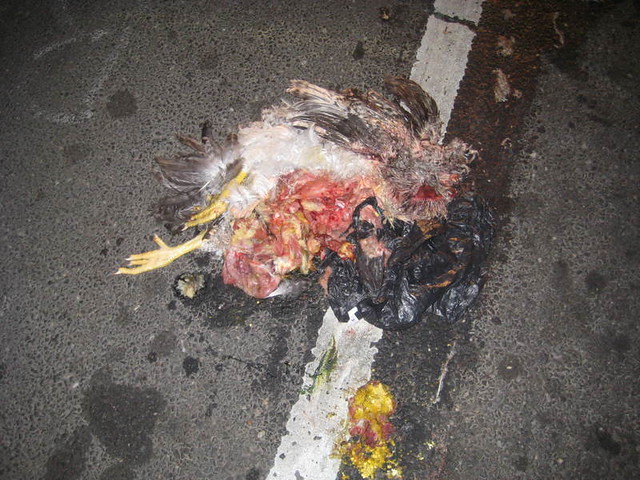
All of a sudden out of nowhere a chicken darted out of the ditch and into the road.  Chickens are notorious around the farm for eating the rice that falls onto the road and this answers the question, "Why did the chicken cross the road?" at least around Oberlin, Louisiana.  The chicken was intent on eating and didn't see my dad's truck.  We felt that familiar thump underneath the truck's tires as we flattened the hen out.

Image Credit
Although that isn't the actual photo, that is sort of what she might have looked like if I had a camera on me 40-something years ago.  My dad put the truck in reverse and drove into the driveway of the farm house.  "What are you doing?"  I asked.  "I'm going to pay for the chicken," Dad said.  I remember thinking, "It wasn't Dad's fault.  Why was he going to pay for a dumb bird that should have stayed in the yard?"

It was a lesson that didn't need to be explained.  It was being lived out.  It was doing the right thing.  I've often heard it said that character is doing the right thing when no one is watching.  The neighbor kid that rutted up our ditch could have driven on down the road and no one would have ever seen.  Forty years ago, my dad could have kept on going and we would have been around the corner before the feathers stopped flying and no one would have known what happened. 

Doing the right thing isn't always easy.  When we run off in the ditch or flatten out a chicken, we have a choice.  What we do with that choice, even if no one ever sees, defines us as men.  Even if no one sees, God sees. 

2 Chronicles 16:9  For the eyes of the LORD run to and fro throughout the whole earth, to shew himself strong in the behalf of them whose heart is perfect toward him.
Monday, May 13, 2019

Three Kinds of Eggs For Breakfast

Our chickens continue to lay lots of beautiful eggs.  Always at this time of the year, we have an abundance of them.  We sell some, give away a bunch and eat a bunch.  If the eggs are clean and we didn't have to wash them, they'll hold without refrigeration for quite a while.  We keep them in a bowl on the side of the stove top.  I sat the bowl on the windowsill for a photo op.  For some reason, country eggs in a bowl is a nice picture.  I think it communicates simplicity.


Many people where we live have chickens in order to have a stockpile of fresh eggs.  But some of our friends and neighbors have other types of poultry they keep for eggs and meat as well.  Right down the road about three quarters of a mile away are some friends that have quail.  They gave us a couple of dozen of quail eggs the other day at church.  They come in a clear plastic container and the quail eggs are speckled and pretty.


Russ promptly popped one in the skillet for a miniature fried egg, over easy.  It was like an appetizer for breakfast.  You'd need to eat 4 or 5 to equal one chicken egg, I would think.


Our next door neighbors have recently gotten a number of ducks.  They brought us two eighteen count of duck eggs.  While we have a bunch of animals, we don't have ducks.  Duck eggs have higher protein than a chicken egg.  Higher good fat content and higher good cholesterol, too. While our chickens' eggs have a dark yolk, I found that duck eggs have an even darker colored yolk.  Overall, duck eggs are better for you than chicken eggs.

Duck Eggs
Here is a comparison of the three types of eggs.  In my left hand below is the duck egg (left), chicken egg (middle), and quail egg (right).


This weekend, due to the generosity of our neighbors and friends, Tricia made us triple scrambled eggs for breakfast, made with duck, chicken and quail eggs, with a little onion and tomato cooked with them.  What shall we call this creation?  Quaducken? 

Eggstra-special breakfast
Whatever it is called, they were delicious!  It's good to have good neighbors that share their bounty with you.

Wednesday, October 3, 2018

Trying to Save a Muddy Chicken

The month of September was abnormally wet.  The rains fell every day and turned a water-soaked landscape into a swampy morass.  Goats don't like to get their feet wet, and you can tell they are unhappy.  After healing Annie up from hoof rot, she's been mostly staying in the barn.  The cows are usually okay with the rain, but the onslaught of swarms of mosquitoes that like the tall grass have chased the cows out of the grass.  They tromp around in the mud, creating deep holes.  You can tell they are miserable.

Tricia went out to do chores yesterday and discovered a barred rock hen that was stuck in the mud.  It couldn't get out and was very weak.  She had struggled and was absolutely covered in mud.  Tricia sprayed her off with a water hose to get the mud off, but the poor hen was water-logged, shivering, and weak.  We thought she may die.

I picked her up and put her in a bucket and brought her to the back patio for 'therapy.' 

Water-logged chicken
I put a heat lamp over the bucket to warm her up.  Even though it is hot and humid outside, the bird is weak and cold and needs to be warmed and dried.  I have to be real careful as I don't want to put the heat lamp too close or else I'll burn the chicken.  Too far and it won't help her.  We positioned the light where we felt it was best and continued checking on her for several hours.


After just a little while, you could see the chicken starting to perk up.  We did notice, however, the cats taking great interest in the chicken in the bucket.  They were circling the bucket like vultures.  We had to keep a close watch on the bird.


Just before going to bed, I checked on the bird again.  It wasn't perfect, but it was much better than when we brought it in.  I brought her back out to the pasture an let her roost where the others were settling in for the night. The jury is still out on whether the hen will survive, but we gave it a good try. 

Thursday, April 19, 2018

The Story That the Rhode Island Red Hen Had to Tell

Nestled comfortably in the hay, one of our Rhode Island Red hens was sitting.  She had tucked herself away from all the activity of the cows bellowing for green grass in the yard, the goat kids jumping around, and all the other chickens scratching and competing for tasty bugs and worms.  I think if you look at her eyes below, you can see that she is unhappy that I found her.

But if you listen closely, she has a story to tell.  Even though she can't speak in any language that I can discern, her actions tell a story, if you have ears to hear and eyes to see...


The question that has been around for a long, long time is: "What came first?  The chicken or the egg?"  I think even Aristotle deemed it a real dilemma as it was an infinite loop.  Chicken or Egg?


What a silly question!  At least for Christians who believe the Bible. 

According to The Bible, the chicken came first.

"And God blessed them, saying "Be fruitful and multiply, and fill the water in the seas, and let fowl multiply in the earth." - Genesis 1:22

So there you have it!  Just as it happened in the hay on Our Maker's Acres Family Farm, it happened back in creation.  The chicken came first and then the egg.

Wednesday, March 22, 2017

2017 Meat Birds - 5 Weeks Old

The Cornish Cross Meat birds have been out on grass for over a week now.  I see them nibbling a bit on the fresh grass as soon as I move them to a fresh spot each day, but overall, they sit down and come running as soon as I bring the bucket full of feed out.  They eat.  They poop.  They sit.  That is their life.

The new chicken tractor is working out perfectly.  We are expecting some rain Friday night, so I will fasten a tarp over the tractor Friday afternoon.  I still keep the heat lamps on them at night, but it has been warming up into the mid-80's each afternoon, so we turn off the heat lamps during daytime hours.

I added a second feed trough (gutter) so the growing birds all had room at the "table" and also added an extra gallon-sized waterer.  They are going through the feed and water.


I walked out with a 5 gallon bucket and picked up a bird of average size, making sure it was a rooster.  I placed him into the bucket and walked back in the garage where I have the kitchen scale set up.  I put a sheet of newspaper over the scale so they don't soil the scale and place the old boy on top.


The bird felt a little heavier than last week, but I could tell that it wasn't a tremendous weight gain. Here are the details:


Here are the results from Week 5 :
*Week 5 2017:  2 pounds 15 ounces
*Week 5 2016:  4 pounds 
*Week 5 2015:    2 pound 4 ounces


So to summarize, last week they weighed on average 2 pounds 4 ounces and this week 2 pound 15 ounces.That means they gained 11 ounces over the last week.  That is the same weight game as the previous week. They are still 1 pound 1 ounce shy of where they were at this age last year, and 11 ounces heavier than what the 2015 birds weighed at this age. 

Tuesday, March 21, 2017

Outdoor Cookin' - Dutch Oven Jambalaya

Last weekend we made a homemade pizza in the dutch oven and Benjamin and I decided that we would try to cook outside as often as we could.  On Sunday afternoon Tricia went to Baton Rouge and left us at home.  We figured we would break out the Dutch Oven and get busy on a Shrimp, Sausage, and Chicken Jambalaya.  

The ingredients are:

  • A splash of oil in the bottom of the pot
  • 1 lb. Cormier's smoked sausage that we cut up
  • 1 medium onion chopped up
  • 1 cup bell pepper chopped up
  • 1 cup celery chopped
  • Emeril's Essence Cajun Seasoning
  • 1 cup rice
  • 3 cloves minced garlic
  • 1 cup chicken broth
  • 2 1/2 cups beef broth
  • 4 bay leaves
  • a sprinkle of thyme
  • 12 oz. medium shrimp
  • 1/2 cup cooked chicken


We got 36 charcoal briquettes burning (15 for the bottom and 21 for the top) and coated the bottom of the pot with oil.  When the pot was sizzling, we threw the sausage in the pot for 2 minutes.

We then added the onion, bell pepper and celery, along with the cajun seasoning and stirred.


After about 10 minutes the vegetables were starting to get translucent.  We stirred the dish up with a big wooden spoon.  


We then added all the other ingredients like rice, broth, garlic, bay leaves and thyme.  After it simmers, cook for 20 minutes.


After 20 minutes, add in the shrimp and cooked chicken.


With the lid off of the pot, cook for an additional 10 minutes and then it is time to eat!


A quick review of the meal: The flavor was phenomenal! I mean the seasoning was perfect.  The aroma coming out of the pot had me salivating like one of Pavlov's dogs.  It was delicious, but it could have been better.  Here's two areas where I messed up.  First, after adding the broth I cooked it for 20 minutes.  What I should've done was wait for it to simmer AND THEN start the timer for 20 minutes. Secondly, there was a strong wind blowing Sunday afternoon.  This accelerated the briquettes burning and by the last 10 minutes of the cook time, the briquettes were cooling off.  I had to light up some more charcoal in the chimney starter and place under the pot.  By this time, however, the briquettes were far too hot and the jambalaya began to stick a little bit to the bottom of the pot.  I kept stirring constantly to keep it from sticking, but in the end, I had to remove the pot from the fire to keep it from burning the meal.  Pulling it off the fire prematurely made the jambalaya a tad bit 'too liquidy.'  That's okay, though.  We ate a bunch of it.

While cooking outside, Benjamin saw something up in the tree and went and got his rifle.  One shot and he had a big fat squirrel on the ground.

He cleaned the squirrel and put it in a ziploc bag in the freezer alongside some previously killed squirrels.  I think Benjamin wants to cook a dessert like bread pudding with rum sauce next time we pull the dutch oven out, but maybe the time after that we can cook a pot of squirrel stew!

Sunday, October 30, 2016

Another Chicken in The Intensive Care Unit

Friday afternoon I came back from work a little late and Tricia had already milked the cows.  Russ was in from college and helped her get the job done.  Ever since the record-setting rainfall we slogged through back in August, it has been drier than the Sahara around here.  Not only has it been dry, but it has been abnormally hotter than in previous years.  As a result, the animals drink the troughs down very quickly.

On the big cattle trough, this is no problem since there is a valve that automatically refills the trough as soon as the cows drink it down. Not so on the smaller water troughs that we have out by the barn. Each day we fill them again, but what happens from time to time is that the chickens will jump up on the rim to drink water and will dip their heads down to get water and they lose their footing and fall into the water.  Inevitably, they do this when no one is around and the chicken will stay in the water all day.  Even in the heat of summer, a hen floating in the water all day affects its ability to maintain its body temperature.  They get hypothermia and if not treated, they'll die.

Russ found a chicken floating in the trough on Saturday and it was mostly dead when he founder her. Russ and Tricia set up an Intensive Care Unit by clipping a heat lamp to the side of an empty bucket to slowly warm up the bird.  When I arrived home, I thought the old girl was dead.  It was laying on its side, wet and lifeless with its eyes closed.  After ten minutes or so, the bird was looking slightly better, but still in critical condition.  We left to go to a high school football game and left the heat lamp on.  When we returned home, I fully expected to see a dead bird in the bucket, but this is what she looked like:


Not better but making strides i the right direction.  Before we went to bed, we turned the heat lamp off as it would be disastrous for a lively bird to knock a heat lamp over and catch the house on fire. When we awakened Saturday morning,  the bird was up, chipper, and alert.  I think she was ready for discharge from the hospital.


I 'wheeled' her to the pasture gate and so as to not rush things, I set the bucket on its side so the recovering hen could exit at its convenience.


After surveying its surroundings and probably being very grateful that Russ snatched her from sure death in a watery grave,  the hen walked out of the bucket and joined her friends scratching around in the pasture.

Things could have turned out a whole lot worse for the hen.  I hope she'll be a whole lot more careful from now when she gets thirsty and wants to wet her whistle.

Sunday, August 21, 2016

Can a Chicken Get Hypothermia?

Saturday morning before milking, I went about the normal chores, feeding all the other animals, switching the cows from one paddock to a fresh one.  Then I went about checking water troughs, ensuring that they were all filled with water.  We have one main 150 gallon water trough and have two 'makeshift' 30 gallon water troughs made with old molasses/mineral tubs.

As I walk by one, I noticed that it was about 3/4 full, but then stopped suddenly. There was a chicken floating in it!  At first I thought she was dead, but once I removed her from the water, I could tell that she was still barely alive, although her eyes weren't opened.  She was shaking and barely able to stand.  I sat her in the sunshine while we milked the cows, hoping to warm her up.  Chickens aren't too smart.  They fly up ungracefully to the edge of the water trough to get a drink, lean over to drink and some inevitably fall in and die if you don't get to them quickly enough.

I'm no veterinarian, but I would assume that the barred rock hen was suffering from hypothermia. Hypothermia is the condition of having an abnormally low body temperature, typically one that is dangerously low.  This can happen even in warm weather.  Trouble is, about twenty minutes later, once we finished milking, she was not any better.  I knew we must get her some medical attention to save her life.  Fortunately, the doctor was in.  I put the pitiful creature into an empty molasses tub and brought her into the garage.

"Give me your huddled masses..."
I positioned a heat lamp approximately 18 inches above the hen.  I didn't want it to be too close to her as it would burn her and warm her up too fast.  I didn't want it to be too far away though or it wouldn't warm her up.  Up to this point, I wasn't sure if Sally HennyPenny was going to make it.  I had another project going in the garage as we were painting the walls, so I kept a close eye on her.  In about 10 minutes, I checked in and the old gal was looking a little more perky than before.  Still a little wet, but I knew she'd make it.

Heatin' up some chicken
In ten more minutes, she wasn't hunched over shivering anymore and her eyes were wide open.


In about ten more minutes, I heard a big commotion and the hen flew up out of the tub with the heat lamp and was scurrying around the garage.  I caught the old girl and walked her back outside toward the pasture fence.  I set her down on the bridge to make sure she was good to go and yes, she was.


Her buddies were in the muddy waiting room across the fence waiting for her and they were happy she had recovered from her close call.
Birds of a feather flock together
Hopefully, old gal will have learned a lesson and won't fall in the water trough again. We've just had 21 inches of rain in a week's time.  There's plenty of water still on the ground.  She doesn't need to even go to the water trough to drink.  I can't figure out her thinking there, but... she's a chicken. Fortunately the lifeguard got to her in time and performed emergency medical services promptly so that she'll live to see another day and lay more eggs.

Tuesday, July 19, 2016

What’s in the Hen?

In Yesterday’s Post about butchering the Barred Rock Hen that kept escaping, I hinted at something interesting that I wanted to show you.  Perhaps you’ll find it interesting, too. I know I did.  We’ve butchered hundreds and hundreds of Cornish Cross meat birds over the years.  Those birds are butchered when they are between 8 – 12 weeks old, so their reproductive systems aren’t fully formed and visible.

In butchering the hen that was laying eggs, though, her reproductive system was, of course, fully formed.  I was able to see, up close and personal, a chicken anatomy lesson.  While interesting, it was also a little sad because you could see all of the eggs contained in the hen that will never be laid.  I’ll lay (pardon the pun) the blame for that squarely on her shoulders though.

Warning: GRAPHIC


So when I eviscerated the hen, here’s what came out:


I arranged it all on the cutting board where you can see the eggs in chronological order.  According to this informative site: http://articles.extension.org/pages/65372/avian-reproductive-systemfemale it gives a great explanation to what is going on within the hen.  I’ll give the Cliff’s notes from the article mentioned above.  I found it so educational. The yolks are developed in the ovary and then goes into the oviduct.  Within the oviduct, changes occur that add the albumen or egg white and then the shell, and this creates what we all know to be the incredible, edible egg.  It takes a little longer than a 24 hour day for the complete transformation from a yolk to an egg. 

Here is the full reproductive tract visual aid that I snipped from the aforementioned website:

Image Credit
If you follow the diagram above, you can follow the process of the creation of the egg.  First, the yolk enters the oviduct which is the long tube.

The infundibulum is where fertilization takes place.  An egg does NOT need to be fertilized in order to be laid.  It will just be non-fertile.  Many people falsely assume that you need a rooster for a hen to lay eggs.  This is not true.

The magnum is where the egg white (albumen) forms.

The isthmus is where the shell membranes form.

The Shell Gland is where the shell forms.  The shell is made of calcium carbonate.  This is why it is very important to give your hens a good supply of calcium.  We offer ground oyster shells free choice at all times.

The vagina provides the muscle to push the egg out.

And that is how the hen lays an egg.  Let’s take a closer look at the hen’s ovary from my dissection, shall we?:

So many eggs, you can't count them!
You can see many ‘future eggs’ (really the ovum) in various stages of development.  So you can look at this and get some idea of the number of eggs that were sacrificed by me butchering the hen.  If this was a goose laying golden eggs, I made a HUGE mistake!  A Barred Rock hen can lay up to 280 eggs per year.  I didn’t try to count all of the ovum, but it is a fair guess to say that there are hundreds of ovum in the photo.

Looking closer at two of the larger ovums (yolks) you can see that these were almost fully developed and the resulting eggs would have been fully formed and laid within the next few days.


I just thought it was a pretty neat biology lesson. 


We can see a thousand miracles around us every day. What is more supernatural than an egg yolk turning into a chicken?”
 S. Parkes Cadman
Related Posts Plugin for WordPress, Blogger...