Showing posts with label summer. Show all posts

Wednesday, September 9, 2026

Waiting on Fall to Get Here


As I was out walking yesterday evening, I was doing some thinking.  I don't know if it's like it where you live, but this summer has been long, hot, and dry.  Summer is always like that, you might say, but this one seems worse.  Is it that I'm getting older?  I don't know.  I like to have lots of projects to work on, but the hot humid weather just saps all the strength out of me.  

I am looking forward to Fall!  I can't wait until we're not sitting at 80 degrees at 8 in the morning, with temperatures in the mid-90's and the doggone heat index saying "feels like 105."  When that first cool front comes in, we will be so very happy!  Perhaps the cooler temps will give me some energy to get some things done.

1. Get the tomatoes transplanted into the garden.

2. Plant all the cole crops (broccoli, cauliflower, cabbage, Brussels Sprouts, etc.)

3. Our fall crop of meat bird chicks (50 of them) get mailed to us on Sept 16th.  I need to get the chicken tractor checked out and brooder ready to go.

4. Betsy is getting bigger.  Time to put a breaking halter on her so she'll walk with a rope.

5. Insulation in the attic.  The old fiberglass batt insulation is 26 years old.  It's fallen down and there is no remaining insulation upstairs.  Need to install new batts.  This is DEFINITELY a job for cooler weather!

6. Cooler weather will get LuLu out of heat stress and enable us to begin milking her again.

Hopefully, a reprieve from the heat is on its way.  So tired of the dog days of summer!  


Sunday, August 23, 2026

Heat Stress in our Dairy Cows

Rosie cooling her heels

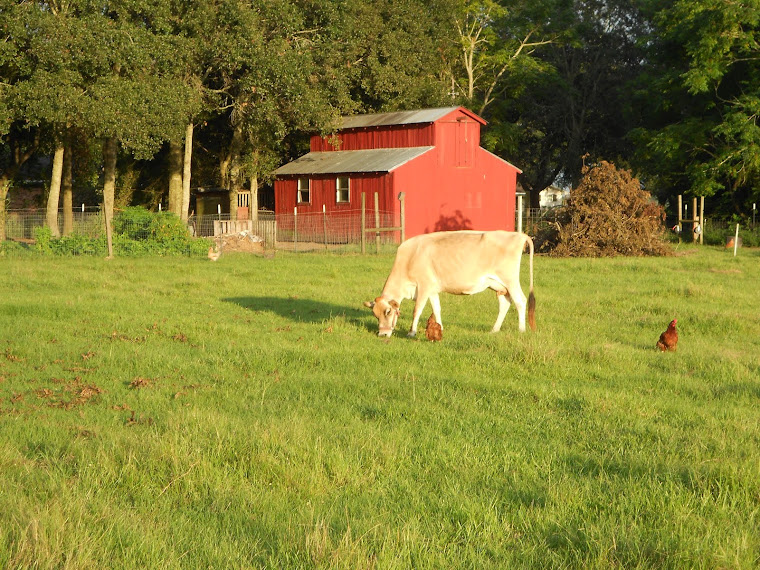
Summer time in the south!  It's hot.  Or as they say in Cajun French, "C'est chaud!"  It's hot for humans, but for cows?  Our poor Jersey cows are struggling mightily.  They just aren't built for this southern climate and don't deal with the heat well.  They get up early and slowly walk out to the pasture, battling mosquitoes, deer flies and horse flies.  They eat in the shade cast by the live oak trees against the rising sun in the east.  As the sun rises and the shade disappears, the cows slowly walk back and sit beneath the shade all day long until the process repeats but from the western side.


Here's the problem.  They are eating less and it puts them in stress.  Humans sweat and enjoy the evaporative cooling.  Jersey cows, on the other hand, do sweat, but much less than humans.  How do they handle the heat and cooling themselves?  Poorly.  They pant.  Their tongues hang out.  They drink lots of water.  Especially poor LuLu.  She's in milk since calving Betsy and that puts an additional load on her body.  We were splitting the milk with the calf by separating them allowing Betsy to get the milk all day and then after separating them in the evening, we milk first thing in the morning for us.  Well, we've stopped that temporarily until temperatures drop off.  It's been around 100 degrees for a number of days now.

We're doing a couple of things to assist LuLu.  First, in the early morning and late afternoon, we spray her down with a water hose.  She's taken a liking to this and eagerly walks to the spot by the hose in anticipation of the bath.  We're also making a drench with 1 cup of molasses, 1/3 cup of apple cider vinegar and 2 tablespoons epsom salt.  We mix this up and give her three 50cc drenches in a drench gun in the morning and the evening to give her an electrolyte boost.  Since she's not out eating as much due to the excessive heat, I'm picking sweet potato vines from the garden to supplement her minimal grass intake.  She loves sweet potato vines.  

I noticed Rosie (in the photo at the top of this blog post) standing in a puddle of water caused by the float valve not working properly because the water trough isn't level.  The water trickled over and caused a mud puddle before I caught it and shut the valve off.  Some say that cows will stand in the water to cool off their hooves and dissipate heat.  If that is beneficial short term, great!  It's generally not a good idea to have mud puddles as they are vectors for parasites and standing in water softens the hooves, making them susceptible to hoof rot and other foot ailments.  In this heat, however, that puddle will evaporate quickly and won't be a long term problem.

Tomorrow looks like we'll have a high of 97 degrees, but the days following look to have reduced temperatures down to a 'balmy' average of 94 degrees.  Not a huge drop but somewhat of a respite.  Hang in there, LuLu.  Cooler weather is coming.  In the meantime, we're doing everything we can to help her (and us) to cool off!


Wednesday, July 1, 2026

Like a Pig in a Mudhole

Our Jersey cows hail from the Isle of Jersey in the British Isles.  They don't deal well with the summer heat and humidity in South Louisiana.  Just for grins, I looked up the average summer temperature on the Isle of Jersey.  Daily highs in July is 71 degrees Fahrenheit and lows are 59 degrees.  I guess that may be the temperature that their genetics are programmed for and why they struggle so in this tropical environment.  I mean, I feel sorry for them.

Here is LuLu seeking shade under the barn, praying for a breeze to blow in order to bring a respite from the heat.  On days like this, they remain inactive during the day and you'll see them at night grazing under the moonlight after the sun has tucked itself below the horizon.

Here is old Rosie.  Rosie is 17 years old!  She's playing a game the animals all play.  They seek out small areas or pockets of shade under the live oak trees, patiently waiting for the shadows to grow as the sun lazily works its way across the sky.  Over the course of the day, they know just where to be to enjoy the shade found on the eastern and western sides of the pasture, depending upon the time of day.  

Finally, here's Elsie.  Elsie has hit the jackpot.  Underneath a small live oak tree I raise from an acorn I picked up in Tallahassee, Florida, she's enjoying a little patch of shade, but the shadow made by the tree comes with a bonus - mud!  In the hot, baking sun, laying in a mudhole cools the old girl off.  She gets absolutely filthy.  It is fortunate that she's not in milk right now or we'd have to give her a bath before milking time.

In the summer, they just enjoy rolling in the mud.  In addition to cooling them down, I'm sure it also helps with the mosquitoes, flies, horse flies and deer flies.  This is the last little mudhole they have left, but have no fear, more rain is expected for the next several days and that will ensure additional mud holes in which to lay in just like a pig.

I look at Elsie as she pants in the heat, with drool running down her nose.  I won't even tell her that she's got all of July, August and September to go before she can expect any sort of a cool down.

She doesn't know where her ancestors are from, but I bet if she had the opportunity, she'd rather be living on the Isle of Jersey than in her home on Our Maker's Acres Family Farm in Jennings, Louisiana.  

Monday, August 21, 2023

Hot & Dry

Summer is always hot, but this summer we're hot AND dry.  Below I've taken a photo of the log that I track daily rainfall.  Tomorrow it will have been a month since it rained.  Everyday high temperatures have exceeded 100 and with no rainfall, well, it's getting serious.  We normally average almost 9 inches of rain in August.  We are at a serious deficit.

The grass is dying and the dirt is now dust.  Apparently there is a high pressure system sitting over the south that won't let up.  Normal afternoon thunderstorms are non-existent.  We have been praying for rain for weeks.  The forecast has not looked promising.

The cows and goats have eaten all of the remaining grass down to the ground.  We're supplementing with hay.  That hay is normally reserved for the fall, however.  Never had we begun haying the cows this early.  Now that I've gotten the chainsaw blade sharpened, I've been lopping off live oak branches that need pruning and tossing them over the fence for the animals to eat on.

Not only is the drought concerning for the pasture that the cows, goats, and chickens depend upon, but it is delaying getting the fall garden in.  We normally have fall Irish Potatoes planted by now as well as getting the cole crops planted by seed.  I haven't even begun any of that.  Afternoons are spent watering sweet potatoes, peppers, okra, butterbeans, etc. that are struggling in the garden.  Five of our Seven pumpkin plants waved a white flag and withered into the dust.

We'll continue to pray for showers of blessing that will bring a refreshing to the land.

Monday, February 13, 2023

Why You Set it Aside in the Summer

In springtime, the grass will slowly grow, filling the pastures so that happy cows, goats, and chickens can roam about and pluck the tender green growth, converting that grass to milk and meat.  During times of plenty, we've learned to look toward lean times and prepare.  I'm talking about hay.  While grass is abundant in the spring and summer, it's not that way at all in winter.  Oh there are winter grasses that grow, but as fast as they come up, they are nibbled down.

In the hot days of summer, we do several things to prepare.  First, we fill our barn's loft with square bales of good bermuda hay.  We purchase that from a neighbor down the road.  Each day we throw some of that into a wagon and the animals eat it up.  I pick up what they miss and fill the nesting boxes in the hen house with hay.  We also line up round bales that we purchase from another farmer.  Over the winter, he'll deliver a couple of loads of round bales.  He delivered 10 round bales and our inventory is down to three bales now after we rolled this one out.

It's funny, the cows have a trained ear.  As soon as I unchain the gate from the post, they hear the chain hitting the gate and they come running!  They circle the bale and eat to their heart's content.  On sunny days, they'll be out in the pasture sitting down or trying to find a sprig of grass that the goats haven't found yet.

On colder days when it is drizzling and the wind is blowing, they'll be huddled around the round bale eating hay and then chewing cud later.  We watch them closely.  Although they haven't been palpated, we are thinking that they are all bred and want to ensure that they have proper nutrition for themselves and the calves that are developing within them.

It is crucial to put stuff up for a rainy day.  It's almost as if the cows in the photo above (Elsie, LuLu, and Rosie), are thanking us for stockpiling provisions for them to eat in the winter when there's not much grass to speak of .

Sunday, August 14, 2022

The Heat & Humidity Reduction Act of 2022

When we're in sweltering heat, we look at each other and say, "How much longer do we have of this?"  The answer is right there.  September temperatures average a high of 88 degrees and low of 69 degrees.  Right now it's 91/73.  September is only 2 1/2 weeks away.  That's something to hang your hat on - something to look forward to.

Meanwhile we look for ways to regulate the heat.  Let me share one idea with you.  A tall glass of lemongrass tea with shaved ice with a sprig of fresh mint for garnish.  First, put the cold glass against your forehead and then take a sip.  Not too fast, though.  You'll get a brain freeze.  Sounds good?  Let's make some.

I started this clump of lemongrass from seed several years ago.  It dies back in the winter, but always pops back up in the spring.  It is big and unruly, with sharp leaves that'll cut you like pampas grass.  We have it growing in our little herb garden with some rosemary, ginger, oregano, French sorrel and parsley.  I'll reach over and cut some off.

If you could smell this, you would see why it's called Lemon Grass.  It has a wonderful aroma of lemons.  In addition to making tea, you can use it to cook with to make Vietnamese dishes.  We've never tried it, but I'd like to.

I washed it off real good, because there's ants and all sorts of critters that I don't want in our tea.  I cut it up into inch-long pieces, put in a pot and add water.  I put the top on, bring it to a boil and then turn the heat to simmer and let it steep.

I poured through a colander and funnel.  The stems and leaves will be composted.

We'll let the lemongrass tea cool in the windowsill for a while.  It's got a nice color to it and a nice fragrance as well.  In fact, the entire kitchen smells fresh like lemons.

Ready to beat the heat?  Lemme pour a glass for you.

*Takes a big, long sip*

Ahhhh.  That's real nice and refreshing.  This will go a long way in helping us make it to the cooler temps in September.  Stay cool, friends.

Sunday, July 31, 2022

A "Soup-er" Day

It was very hot and humid this past week.  I am hot natured and sweat buckets-ful around this time of year.  I really don't enjoy soup in hot weather as I'm looking for something to cool me off after being outdoors.  However, it was raining, and my wife said, "It looks like soup weather."  I guess you could look outside and trick yourself into believing that it was a cold, rainy day, if you had an active imagination.

Tricia had already pulled out one of the last Butternut Squashes that we harvested and had positioned a sharp knife over it.  I really wanted to save it for later, when it got cold.  Butternut squash store nicely.  But it was not to be.  She plunged the knife deep into the flesh of the butternut, killing the squash along with my hopes of butternut squash soup on the first cold front of the season.

The squash was beautiful, orange, and meaty.  The color of the squash screams "fall" or "autumn!"  The temperature outside is still screaming, "SUMMER!"


Tricia always has fresh chicken broth stored in the fridge, so she was good to go as far as ingredients.  She started throwing things together in the kitchen.  She uses Emeril's recipe for Butternut squash soup.  It goes like this:

1 Butternut squash (approx. 2 lbs.)
2 T butter
1 Cup onion
1 1/2 tsp garlic
1 1/2 cup carrots, thinly sliced
1/2 tsp cumin, ground
1/2 tsp salt
1/2 tsp pepper
1 T jalapeno, finely minced
2 Cups chicken stock
1/4 cup cream

Cut the squash in half and scoop out seeds.  Peel and cut in 1" pieces.  Heat butter.  Add onions and garlic.  Cook about 5 minutes.  Add carrot, cumin, salt & pepper.  Cook 1 minute.  Add squash, jalapeno and stock.  Simmer for 15-20 minutes.  Puree.  Add Cream.

And here is the final product:

Hot soup on a hot day.  I added more jalapenos and some green onion tops for additional flavor.  This is some delicious soup.  I'm talking restaurant quality style.  So rich and smooth and creamy and tasty!

I asked Tricia for one favor.  I asked her to save some seeds from the pretty butternut.  She did just that.  She scooped out the seeds and put them in a bowl.

Then she washed off the stringy material and separated it from the seeds.  The seeds were placed on a paper napkin on the window sill to dry.  Once dry, I'll package them and label and date the package.

These were organic, open pollinated butternut squash so I should end up with good stock when these germinate.  I'll try to get some of these in the ground shortly so that we can enjoy many more soups, in cold weather this time.

Monday, July 4, 2022

And We Prayed for Rain

And Elijah the Tishbite, who was of the inhabitants of Gilead, said unto Ahab, As the Lord God of Israel liveth, before whom I stand, there shall not be dew nor rain these years, but according to my word.    1 Kings 17:1

And it came to pass after many days, that the word of the Lord came to Elijah in the third year, saying, Go, shew thyself unto Ahab; and I will send rain upon the earth.    1 Kings 18:1

Three years without rain!!  That is one heckuva drought!  Our lack of rainfall hasn't gone on for three years, but it has been very dry.  We have been praying for rain every single day.  I even saw this guy out by the garden praying (for rain, I assume?), too.

Rain is so important and unfortunately, we often take it for granted.  Our garden needs it... badly.  Watering with a water hose isn't as good as good old rainfall.  Then there's our pasture.  The grass out in the pasture is parched.  With no rainfall, there's no new growth.  The cows and goats and chickens have eaten it down to the ground.  This is not good.  When they eat it that close to the ground, they pick up parasites.  The only bright spot is that I haven't had to mow the yard a single time during the month of June.  Grass in certain spots in the yard is dying.  Landscaping and small shrubs that we can't get water to are starting to die.

For the past 10 years, I've tracked rainfall at Our Maker's Acres Family Farm.  Check it out:


So from January - June 2021 it rained 40.4 inches.
Average rainfall from January - June 2013-2021 is 36.63 inches.

Look at what it's rained so far this year:

For the period January - June 2022, it has only rained 17.675 inches.  The weatherman says that around here if you aren't getting an inch of rain a week, you are falling behind.  We certainly are!

If you look at the first two days in July in the above tracking chart, you'll see that it rained both days!  The cows are out eating fresh green grass that has grown.  I even mowed today.  I checked the weather forecast and it shows decent chances of more rain for the next four days.  Maybe the weather pattern has loosened up!  We certainly pray that the drought is over.

Monday, December 27, 2021

Late December Heat Wave and Its Effects on the Garden

Well, now.  Here we are two days after Christmas and we are in the throes of a heat wave.  Since Christmas Day we've had high temps of 80 degrees!  My firewood sits in the rack biding its time, neglected and unused.  The air conditioner drones on, keeping us cool.  The grass continues to grow and the cows have pasture to munch on.  

And then the garden.  The garden is growing like crazy!  The eggplant is full of blooms and fruit.  The peppers are producing.  We're even picking tomatoes for our garden salads!  Unheard of.  Things are actually growing TOO fast.  The heat has caused the broccoli to fruit early.  The heads aren't as big as they usually get and we have to get out and pick the florets every single day.

The high temperatures cause the plants to bolt to flowering and if you aren't determined about picking every day, you'll have the prettiest little yellow flowers on your broccoli that you've ever seen.  I'd rather eat the broccoli BEFORE it blooms.  The honey bees, on the other hand, were voicing their disapproval today as I was picking the broccoli, even those with flowers on 'em.

You can see, for example, this head of broccoli.  If I waited one more day, it would be too late.  It would be all bloomed out versus something good to eat.

The cauliflower is ripening too quickly as well.  With the temperatures persisting in the 80's for the next week, at least.  We are having to do a lot of harvesting that we wouldn't ordinarily be doing for a while.


We've been eating the broccoli and cauliflower in salads, roasting them in the oven with garlic, steaming them and intend on blanching and freezing some for later.  Tricia also made a Broccoli Cheese Soup for supper the other night.

We're waiting on some cooler weather.  If I understood correctly, the long range forecast shows some potential for freezing temps in the next 10 days or so.  That will be something to see.  A 50 degree fluctuation.  

Monday, July 13, 2020

Purple Hull Pea Pickin'

The hot July summer sun relentlessly bakes what remains of our spring crop into the ground.  This poor zucchini that brought us a bountiful harvest of beautiful, large zucchini that we've eaten for weeks slowly fades...

Her neighbor desperately clings to a tiny sliver of life, but resistance is futile.  The cycle of life of a zucchini in South Louisiana draws to a close.  We've still got some in the vegetable drawer in the fridge, but once that's done, we'll wait until next year.


The cucumbers are dealt a similar cruel hand by nature.  The once green vines filled with yellow blossoms and cucumbers in all stages of maturity now are only skeletal remains, a dry reminder of crisp, cool cucumbers sliced in the fridge.  We have a few more and then it's all done. 


But there is one crop just coming on.  It scoffs at the heat and dry conditions.  "Bring it on," it mocks.  That would be Purple Hull Peas.  I walked out to check on the progress and noted that I could go ahead and pick a half bucket.  They were just beginning to ripen with lots more to come.


The neighboring row has peanuts and then blackeyed peas on the next row thereafter.  The blackeyes will be ready real soon.


I quickly pick all the peas in which the pods are mostly purple.  It doesn't take long.  There are many more to come in various stages of maturity.  I'll have to pick every other day to keep up.


You can see why they get their name: Purple Hull Peas.  It is a southern staple.  We had a preacher that grew up in the Great Depression.  He used to tell us that they were very poor but always had food on the table that they grew from their land by the sweat of their brow.  He'd always say, "We'd have rice and beans one night and then momma would mix it up and the next night we'd have beans and rice!"


They are a good source of protein and are just good to eat.  Served over rice with some tasso or smoked sausage for a little flavor and maybe a skillet of hot buttered cornbread on the side - wow!  That's some good food, right there.


It is always a relaxing thing to sit down in the evening and shell peas.  The rhythmic plunk, plunk, plunk of the peas being released from the shell and slowly filling the bowl is a comforting sound - a sound of sufficiency, a sound of sanity in a crazy world.  Pass the peas, please.

Tuesday, June 23, 2020

Farm to Table

As our temperatures hover in the 90's day after day, the garden is quickly dwindling.  The cucumbers are playing out, the corn is finished, the green beans are "on their last legs," and the squash is showing signs of "giving up the ghost.  The tomatoes are tiring.  Those that still bear fruit are being attacked by hordes of stink bugs.

The produce in the garden that really carries us through until the fall is cow peas (southern peas) and okra.  We grow purple hull peas, blackeyed peas, and ozark razorback peas.  They thrive in hot weather and laugh at the other garden vegetables that wither in the summer heat.

We are picking the last of our green beans (Contender and Blue Lake).  I think that green beans are my favorite garden vegetable.  I can't get enough of them.  As a kid when my parents were trying to get me to eat my vegetables, I think green beans got my foot in the door.  I just love 'em.  I fresh pick 'em in the garden, bring them in and wash them up.  We snap the ends off of them, usually picking when they are young and tender. 


Simply lightly sauteing them in butter is a perfect side dish, but I'll show you what we do when we want to kick it up a notch.  We add bacon.  Is there any dish that can't be improved by adding bacon?  I think not.

We arrange the fresh green beans in little bundles and wrap with bacon.  We add a little brown sugar or molasses to the top of each bundle and pop the tray in the oven.


Holy, moly, is this good!


Use a spatula to put a bundle on your plate and it makes you feel like you are in a fancy schmancy restaurant.

We've blanched a number of green beans and frozen them in quart freezer bags to enjoy when they are out of season.  In mid-August I'll plant a couple of rows of green beans so that we have more to enjoy!

Monday, September 9, 2019

Harvesting Cowpeas in Late Summer

Summer is hard on a garden (and those individuals tending said garden!)  The temperatures are hot and sap your strength.  Plants wilt in the heat.  The humidity is high, making it an unpleasant chore to do any gardening.  Things dwindle down at this time, except for two main items - okra and cow peas.  Today we'll talk about cowpeas.  These things are a southern staple.  Cow peas are thought to have originated in West Africa.  They are well-adapted to the heat and to drought, so they do well during the summer.

I generally plant a row or two in the garden and a 48 foot row of them in the bed in the side yard.  Cow peas don't need a lot of fertilizer as they are a legume that has nodules that set its own nitrogen.  They'll start blooming all at once and once you start harvesting, they'll continue setting pods for quite a while.  In the photo below, you can see blooms in the center and center left along with full, mature pods and a young pod that you can't see the peas forming in it yet.

Varying stages of cow pea growth
The cow peas I grow mainly appear to be bush-type, however, if there is anything for them to trellis on, they will send out vines and climb.  In the photo below, some black-eyed peas have climbed up to the top of my okra plants - easily 8 feet tall!

Climbing the okra stalks and setting pods
Each afternoon I grab a bucket and go out and pick ripened cow peas.  Cow peas are said to be a "poor man's meal" due to its high protein.  We like cooking them with some smoked meat and serving over rice with some home made cornbread on the side.  We like to sit around the island in the kitchen and shell peas.  We'll eat some and then as soon as we have a quart, we'll freeze some for later.  It is an easy meal that makes everyone happy.


I usually plant three different types of cowpeas.  The seeds are easy to save and plant the following year.  Below on the far left, you'll see the Black-eyed pea.  In the center is the Ozark Razorback Pea.  On the far right is the Purple-Hull pea.  We don't really have a preference.  We usually mix them up and cook them all together. 


As long as the peas keep producing, we'll keep pickin' and shellin'...

Purple Hull Peas (with a few black-eyed peas at the bottom)
It is good to have items like this in your garden - items that continue to thrive even when the growing environment seems so brutal.

Thursday, August 22, 2019

A Walk Back to the Barn In Late August

It's late August and it's very hot and humid.  The mosquitoes are thicker than I've ever seen 'em.  Every animal and human on our little farm is looking forward to fall.  It is about a 150 foot walk back to the barn.  As I walk out in the afternoon, I see a very familiar sight - the cows and chickens are laid up under the shade of the pecan and oak trees.  They'll go out and eat grass in the early morning and then they'll stay in the tree's shade out in the pasture until the sun's course in the sky is overhead and eliminates any shade.  When the shade disappears, the cows head back to the always shady area on the southeastern side of the property.  They'll sit there and pant until the late afternoon.  Then they'll head back out to eat grass when the setting sun casts long shadows.

At this time in the season, the grass is diverting energy toward producing seed heads.  As a result, the grass is less nutritious.  This coupled with the fact that it is just too darn hot for them to eat grass all day has resulted in the cows all have lost some weight.  They'll be okay, though. 

I began to think about fall/winter feeding.  We have around 90 square bales in the barn.  I called the farmer that supplies us with round bales to reserve round bales this fall/winter/spring.  We keep records that show that last year, we used 24 round bales.  I reserved at least that much for this year.  In December, we'll put out a round bale and keep one on hand for them at all times until the latter part of April.


Back in the barnyard, I threw some henscratch to the hens and they begin scratching and eating.  Our flock is getting old.  A couple of years ago, we had over 100 in total when we captured them in the barn and counted them one by one.  We've lost some to old age since then.  I'd estimate that we have about 90 hens now.  In the past, I'd add about a dozen new pullets each year to replace those that died during the year.   We haven't added any new ones in a couple of years.  The hens (mostly) lay their eggs in the red hen house.  Benjamin would always collect the eggs and package them, but since he's  gone off to college, Tricia and I gather them each day, wash dirty ones, and put into cartons.


In the photo above, you can see a new addition to the barnyard - we moved a trough inside the corral.  The water trough is positioned where it catches rainwater off the barn roof.  We watched during a short rainstorm this weekend in which 5 inches of water was quickly collected from the run-off.  This is a good development as the calves are kept in the corral all night and it wasn't efficient to fill water buckets every night. 

Thursday, August 8, 2019

The End of a Long, Hot Day


From the rising of the sun to its setting The name of the LORD is to be praised.  Psalm 113:3

The dog days of summer.  They are sweltering and hot.  And humid.  Just walking outside to go to work, I can feel that bead of sweat running down the small of my back before I'm ten feet out the door.  It is uncomfortable, but relief is on the way.  

Even in the summertime, there are moments in the evening just before the sun goes down that are cool and beautiful.  Often Tricia will look out the kitchen window and say, "Let's go out in the front.  The sun is just right!"  And we'll run out the front door and enjoy God's grand finale.  It's when He causes the sun to cast long shadows across the landscape.


It's a peaceful time.  The day is done.  It's time to relax and breathe in the fresh country air - even if it is still a little too hot and sticky for my liking.


The chores have all been done.  The hens are making their way to their roosts.  The calves are separated and calling for their mommas.  The goats are off somewhere getting into trouble, who knows?  And who cares?  We'll just watch as the "credits start to roll" as we take in the final moments of the day.


From the front porch, you can watch as the sun dips below the trees on the western horizon.  Just a simple way to enjoy the serenity of a late summer afternoon.


And if you are really quick, you can hold the sun in your hand!


Good night, everyone!
Related Posts Plugin for WordPress, Blogger...