Showing posts with label heat. Show all posts

Wednesday, July 1, 2026

Like a Pig in a Mudhole

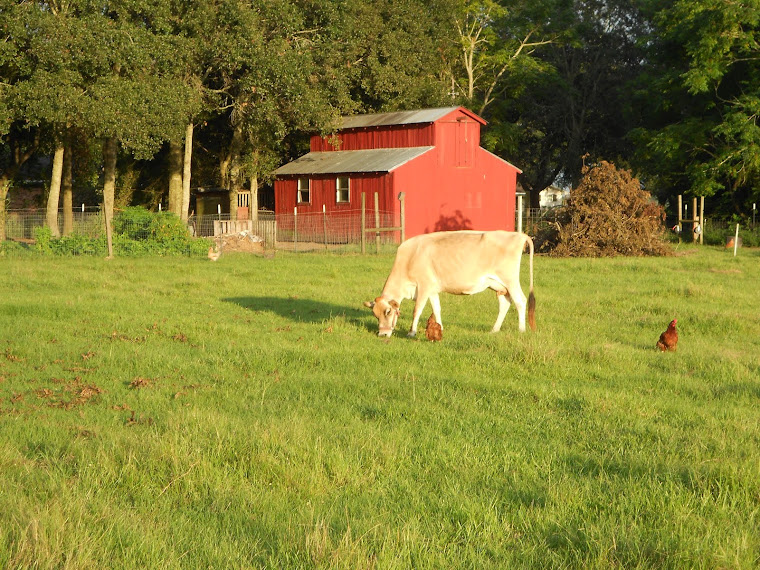
Our Jersey cows hail from the Isle of Jersey in the British Isles.  They don't deal well with the summer heat and humidity in South Louisiana.  Just for grins, I looked up the average summer temperature on the Isle of Jersey.  Daily highs in July is 71 degrees Fahrenheit and lows are 59 degrees.  I guess that may be the temperature that their genetics are programmed for and why they struggle so in this tropical environment.  I mean, I feel sorry for them.

Here is LuLu seeking shade under the barn, praying for a breeze to blow in order to bring a respite from the heat.  On days like this, they remain inactive during the day and you'll see them at night grazing under the moonlight after the sun has tucked itself below the horizon.

Here is old Rosie.  Rosie is 17 years old!  She's playing a game the animals all play.  They seek out small areas or pockets of shade under the live oak trees, patiently waiting for the shadows to grow as the sun lazily works its way across the sky.  Over the course of the day, they know just where to be to enjoy the shade found on the eastern and western sides of the pasture, depending upon the time of day.  

Finally, here's Elsie.  Elsie has hit the jackpot.  Underneath a small live oak tree I raise from an acorn I picked up in Tallahassee, Florida, she's enjoying a little patch of shade, but the shadow made by the tree comes with a bonus - mud!  In the hot, baking sun, laying in a mudhole cools the old girl off.  She gets absolutely filthy.  It is fortunate that she's not in milk right now or we'd have to give her a bath before milking time.

In the summer, they just enjoy rolling in the mud.  In addition to cooling them down, I'm sure it also helps with the mosquitoes, flies, horse flies and deer flies.  This is the last little mudhole they have left, but have no fear, more rain is expected for the next several days and that will ensure additional mud holes in which to lay in just like a pig.

I look at Elsie as she pants in the heat, with drool running down her nose.  I won't even tell her that she's got all of July, August and September to go before she can expect any sort of a cool down.

She doesn't know where her ancestors are from, but I bet if she had the opportunity, she'd rather be living on the Isle of Jersey than in her home on Our Maker's Acres Family Farm in Jennings, Louisiana.  

Tuesday, July 29, 2025

Meandering on Monday Afternoon

“How many are your works, Lord! In wisdom you made them all; the earth is full of your creatures.” – Psalm 104:24

Lots of work on the computer today, sitting inside staring into a computer monitor.  Once I finished up work today it was time to get outside, touch the grass, and observe real things that are going on in the world right outside your door.  It's easy in modern society to live in monasteries of our own making and wall ourselves off from the real world.  What a tragedy!

Growing up, I watched a television program called Mutual of Omaha's Wild Kingdom.  The host, Marlin Perkins and the co-host, Jim Fowler, would wrestle anacondas and watch cheetah's chase down antelope.  I always enjoyed that show.  You know what?  There is a wild kingdom in your backyard.  Maybe we won't run into a rhinoceros or a crocodile, but who knows?  Let's take a walk and see what kind of adventures we can stumble upon in the great outdoors. 

In the back pasture, in what we call "the bull pen," because we quarantine the bull in there away from the cows until they come in heat, we have a water trough.  The bull (we call him Nicky) slowly drinks water from the trough on hot afternoons.  He's not the only one drinking water there, though.  Check out the honeybees that line the edges of the trough, drinking water.

The water trough is about 50 yards from the bee boxes.  If you stand at the trough and look back to the bee boxes, you can see a... beeline of bees.  It is a steady stream of honeybees back and forth, back and forth.  Sometimes some of the bees get clumsy or get knocked into the water.  Look at the poor girl below.  She's fallen in and she beats her little wings, making ripples in the water trying to get out.  Sometimes I'll use a leaf to scoop the bees up and rescue them like a lifeguard would throw a flotation device.

Why are bees drinking water?  Well, they need water like you and I do for hydration.  But on hot days like today when the heat index makes it feel like it is 105 degrees, the bees use the water to regulate the temperature in the hive.  The bees like the hive to stay between 91 - 97 degrees.  If it gets hotter than this, the wax could melt.  The way they cool the hive is that they carry the water back to the hive, spit the water on the comb and then beat their wings.  The honeybees create their own air conditioning!  On hot days like today, the bees will congregate on the outside of the hive.  Just look at them.

While we're looking at the bees, I went inside and put my bee suit on.  I pulled the telescoping lid of the top of each of the four boxes and placed a Swiffer sheet on the very top then put the lid back on.  There is a pest called a small hive beetle (SHB) that cause problems in hives.  If you have healthy hives, the bees are able to take care of the problem.  They'll round up the small hive beetles and send them up to the top of the box.

Here's where the Swiffer sheets come in.  They're used a a trap.  When the honeybees chase the small hive beetles to the top of the box.  When the hive beetles walk across the Swiffer sheets, they get their feet stuck on the microscopic loops in the Swiffer sheets.  It's kind of like Velcro.  The beetles have barbs on their legs that get tangled in the Swiffer by tiny microscopic loops on the sheets.  I opened up the boxes and placed a Swiffer sheet on top of each box.


We'll check back in aa number of weeks and let you know if our small hive beetle traps (Swiffer sheets)
were successful.

Thursday, August 31, 2023

Farewell to August

We're wrapping up August with a bow and saying so long.  What a long, hot, dry 31 days?!  We're glad to be putting this one in our rear view mirror.  My son, Russ, was over visiting today and when we passed by the rain gauge mounted on a post in the garden, he remarked, "That's a lonely rain gauge, right there!"  He's right!  It has seed not precipitation in a very long time.

How long, you ask?  Well, let's look at the matrix that we chart daily rainfall.  It has been 47 days since we've had over an inch of rain.  We've had NO rain in the last 41 days.

We have 10 years of detailed rainfall records.  Normally, in a year we average 65.9 inches of rain.  Through August, we have usually had 49.14 inches of rain.  This year we are only at 29.8 inches.  That's about 20 inches short!  Normally, in August we get 9.08 inches of rain.  This year 0.0 inches.  The grass and landscaping is dying.  

The grass looks like it normally does after a heavy frost.  We turned the water sprinkler on and the grass greened up under the oak trees.  Today, we put the electric fence up and let the cows eat the new growth.  They were happy.

There is good news, however.  As I look at the forecast, we have a 37% chance of rain on Sunday, a 53% chance on Saturday, and a 55% chance of rain on Monday.  Those are the best chances we've seen in over a month.

The other good news is this.  LuLu and little Nicky are doing well.  I have had the water sprinkler going in her pasture.  The grass is green and growing.  That's helped her.  She is not back to normal.  The heat has her stressed and I spray her with water daily to cool her down.  But she is getting better.  We thought we might lose her for a while.  Nicky is growing and he kicks his legs in the air and runs around the pasture with energy!

We welcome September.  A month that promises better chances of rain and hopefully cooler temps.

Sunday, August 27, 2023

What's the Dill?

September is drawing to an end.  This morning at church in Sunday School we finished up our 13 week study of Jeremiah and Lamentations.  It was a heart-breaking study.  Jeremiah was called the "weeping prophet" because he told the people of Judah a sad story of judgment that was coming.  They had walked away from the one true Living God and were serving false gods.  The prophet pleaded with them, but they would not listen.  

God chastens those who He loves.  There was famine and pestilence across the land.  Jerusalem fell and the people were taken away in exile.  As bad as things had gotten, the study ended with hope, however, that God is a God who is faithful even when His people are not.  His mercies are new every morning.  We fall and miss the mark, but He calls us back.

We know nothing of the suffering like the people of Judah faced, but I'll tell ya, this summer has been trying, for sure.  Paul Harvey, in 1978 said, "Despite all our accomplishments, we owe our existence to 6 inches of topsoil and the fact that it rains."  Except this summer it hasn't rained.  Today it was 106 degrees.  We will get through this, but the plants, animals and humans plead for rain.  We look back longingly to the spring.  Daily we ate crisp cucumber salad with blueberries and fresh dill.  So refreshing and healthy!  The dill has long since died, dried and gone to seed.

I gently pulled the seed heads off of the remnants of the dill flowers.  Some seeds had already shattered and will likely volunteer next spring in the herb garden.  

In the event they don't, I wanted to ensure that I had a good amount of dill seed to grow for next spring.

If the Good Lord wills, cooler days will once again come.  I'll save these seeds for the time when it is right for planting early next spring.  In the meantime, we'll continue to pray for rain.  It's time to be planting the fall garden, but it would be futile to plant anything right now.

Sunday, October 16, 2022

And a Bull Comes 'A Courting

We currently have 1 cow (Rosie) and 2 heifers (Elsie & LuLu) on the pasture.  We have watched their activity of when they come in heat and marked it on the calendar.  At least we have for Elsie and Rosie.  They come in heat this week.  We don't really know when LuLu's cycle is.  Cows have a 21 day cycle.  It is important that you introduce a bull during this time for obvious reasons.

I called our neighbor that has a Jersey bull and asked if we could bring our 3 girls down to his place.  Unfortunately, he told me that he just sold his bull.  That's too bad for us.  It was only a short 7 minute drive to get to his home, unload the cows and have them bred.  We made some phone calls and it just so happens that some neighbors a little further down the road have a Jersey bull.  He was agreeable to allowing us to use him.  He told us we could pick him up from his farm and take him back to our place.

Today after church, we did just that.  Russ hooked up the cattle trailer to his truck and we made the ten minute drive, backed up to the chute and prepared to load him up.  After some cajoling, he was in the trailer heading to Our Maker's Acres Family Farm.  The bull is gentle, but he's not halter broken.  We got him unloaded into the pasture, but we're scratching our heads on how we're going to load him back up in the trailer when he's finished his work here as we don't have a corral or chute.  We'll cross that bridge when we get there.  We'll have to be real careful having him here, though.  Dairy bulls are a dangerous thing to have around.

We unloaded the fellow and he began checking our his new surroundings.  He's a young bull, but he's larger than our animals.  He very slowly walked around, taking it all in, scoping out the ladies.

Rosie, Elsie, and LuLu circled around him and he got acquainted with them.  There's no romance yet, but in a couple of days, things should start happening.  And if all is successful, we'll have late July/early August calves.

The friend who offered to let us use the old boy said, "We're glad he's able to serve a purpose.  He was kinda taking up space around here."  We're thankful to have him around and we'll be watching the courtship take place in the pasture.  We didn't even ask what his name was!  We might have to make up a name for him for the short time he's here.


Sunday, September 18, 2022

Gotta Come up With a Plan B for the Cows

Last week when we were driving back from the hay field, we passed in front of the pasture and I had to stop the truck and get a photo of the cows.  They were all lined up in a row and looking right at us.  It was as if they were posing for an Olan Mills Family Portrait.  (Makes us sad Clarabelle isn't in the photo.)  In the afternoons, the cows like to meander over to the west side of the pasture next to the neighbors and relax in the shade.  Tricia and I were hot and sweaty from loading hay.  The cows were refreshed and rejuvenated in the green grass, shaded by pine trees.

From left to right is: Elsie (Clarabelle's heifer), LuLu (Rosie's heifer), and Rosie.  If you remember, Clarabelle was injured when the cows were going in heat and jumping on one another.  Cows' cycles are 21 days.  It is almost that time again.

This afternoon I contacted the neighbor that lives about 5 miles down the road that we always bring our cows to him to get bred.  Well... bad news.  He informed me that he sold his Jersey bull on the 12th of this month.  It was so darned convenient.  We'd mark off the days and when the cows/heifers were going into heat, we'd drive them down the road for their "date" and then pick them up.

We are frantically calling around, trying to arrange breeding with another Jersey bull.  So far the first call resulted in Strike 1.  The gentleman I called sold both of his earlier this summer during the drought and hasn't replaced them.  He did give us a lead and we'll be following up tomorrow on that lead as well as another.

Dairy bulls are not found in every pasture.  When our cows have bulls, we keep them around for at most two years.  They get real mean.  In fact, they injure/kill more farmers than beef cattle bulls.  When our bulls show the slightest signs of this ornery or bossy behavior, it's off to the slaughterhouse for them.

We will be on the phone tonight and tomorrow, trying to come up with a Plan B for how to get them bred.  We'll take Rosie and Elsie for breeding first and then two months later, we'll bring LuLu.  Hopefully we can find a bull that's not too far away!

Sunday, August 14, 2022

The Heat & Humidity Reduction Act of 2022

When we're in sweltering heat, we look at each other and say, "How much longer do we have of this?"  The answer is right there.  September temperatures average a high of 88 degrees and low of 69 degrees.  Right now it's 91/73.  September is only 2 1/2 weeks away.  That's something to hang your hat on - something to look forward to.

Meanwhile we look for ways to regulate the heat.  Let me share one idea with you.  A tall glass of lemongrass tea with shaved ice with a sprig of fresh mint for garnish.  First, put the cold glass against your forehead and then take a sip.  Not too fast, though.  You'll get a brain freeze.  Sounds good?  Let's make some.

I started this clump of lemongrass from seed several years ago.  It dies back in the winter, but always pops back up in the spring.  It is big and unruly, with sharp leaves that'll cut you like pampas grass.  We have it growing in our little herb garden with some rosemary, ginger, oregano, French sorrel and parsley.  I'll reach over and cut some off.

If you could smell this, you would see why it's called Lemon Grass.  It has a wonderful aroma of lemons.  In addition to making tea, you can use it to cook with to make Vietnamese dishes.  We've never tried it, but I'd like to.

I washed it off real good, because there's ants and all sorts of critters that I don't want in our tea.  I cut it up into inch-long pieces, put in a pot and add water.  I put the top on, bring it to a boil and then turn the heat to simmer and let it steep.

I poured through a colander and funnel.  The stems and leaves will be composted.

We'll let the lemongrass tea cool in the windowsill for a while.  It's got a nice color to it and a nice fragrance as well.  In fact, the entire kitchen smells fresh like lemons.

Ready to beat the heat?  Lemme pour a glass for you.

*Takes a big, long sip*

Ahhhh.  That's real nice and refreshing.  This will go a long way in helping us make it to the cooler temps in September.  Stay cool, friends.

Monday, June 27, 2022

Heat and Drought-Proof Gardening

It has been exceedingly hot and dry.  It always is this time of year, but even more so in 2022.  I haven't mowed the grass in a month.  We are watering everything in the garden and the landscape every other day just to keep things alive.  It is a good exercise to see what in the garden is able to survive and even thrive in the dog days of summer.

This garden plant wins the contest hands down.  Can you guess what it is?  I'll show you the flower as a hint:

It looks almost like a hibiscus.  That's because this heat and drought tolerant plant is in the hibiscus family.  That is an okra blossom.  Okra seem to really enjoy the heat.  I have a few inches of mulch around the base of the plants, and I'm sure that helps them, but I really hardly ever water them.

They keep producing.  The photo below shows okra at almost every stage.  You can see the blossom about to come out, small pods, and then finally pods that are ready for harvest.  The variety you are looking at are called Clemson Spineless.

The colorful okra you see below are called Burgundy okra.  They really stand out in the garden, but when you cook them, they lose their color.  The taste is the same as the others.

As I pick a pod off the plant, I cut the bottom-most leaf off and let it fall to the ground.  I call that "chop and drop" and learned that from a blogger named the Florida Survival Gardener.  Chop and drop employs the usage of the plants leaves to create mulch around the base of the plant.  It ultimately forms organic matter that adds fertility to the soil.

Here are the three varieties of okra that I plant (from left to right):

Beck's Big Okra
Clemson Spineless Okra
Burgundy Okra

All three are non-hybrid heirloom.  I save their seed every year and replant.  I end up with more saved seed that I can use.  This year, in a test, I planted some okra seed that I had saved from 10 years ago - the container was marked "Clemson Spineless - 2012," and they still germinated.

I have three rows of okra planted.  Every other day I go out with a bucket and a pair of clippers and harvest a bucket-ful.  It seems like the hotter it gets, the more they produce.  If it wasn't so hot, I would definitely be wearing long sleeves.  Okra always makes me itch something fierce!

Monday, December 27, 2021

Late December Heat Wave and Its Effects on the Garden

Well, now.  Here we are two days after Christmas and we are in the throes of a heat wave.  Since Christmas Day we've had high temps of 80 degrees!  My firewood sits in the rack biding its time, neglected and unused.  The air conditioner drones on, keeping us cool.  The grass continues to grow and the cows have pasture to munch on.  

And then the garden.  The garden is growing like crazy!  The eggplant is full of blooms and fruit.  The peppers are producing.  We're even picking tomatoes for our garden salads!  Unheard of.  Things are actually growing TOO fast.  The heat has caused the broccoli to fruit early.  The heads aren't as big as they usually get and we have to get out and pick the florets every single day.

The high temperatures cause the plants to bolt to flowering and if you aren't determined about picking every day, you'll have the prettiest little yellow flowers on your broccoli that you've ever seen.  I'd rather eat the broccoli BEFORE it blooms.  The honey bees, on the other hand, were voicing their disapproval today as I was picking the broccoli, even those with flowers on 'em.

You can see, for example, this head of broccoli.  If I waited one more day, it would be too late.  It would be all bloomed out versus something good to eat.

The cauliflower is ripening too quickly as well.  With the temperatures persisting in the 80's for the next week, at least.  We are having to do a lot of harvesting that we wouldn't ordinarily be doing for a while.


We've been eating the broccoli and cauliflower in salads, roasting them in the oven with garlic, steaming them and intend on blanching and freezing some for later.  Tricia also made a Broccoli Cheese Soup for supper the other night.

We're waiting on some cooler weather.  If I understood correctly, the long range forecast shows some potential for freezing temps in the next 10 days or so.  That will be something to see.  A 50 degree fluctuation.  

Monday, July 13, 2020

Purple Hull Pea Pickin'

The hot July summer sun relentlessly bakes what remains of our spring crop into the ground.  This poor zucchini that brought us a bountiful harvest of beautiful, large zucchini that we've eaten for weeks slowly fades...

Her neighbor desperately clings to a tiny sliver of life, but resistance is futile.  The cycle of life of a zucchini in South Louisiana draws to a close.  We've still got some in the vegetable drawer in the fridge, but once that's done, we'll wait until next year.


The cucumbers are dealt a similar cruel hand by nature.  The once green vines filled with yellow blossoms and cucumbers in all stages of maturity now are only skeletal remains, a dry reminder of crisp, cool cucumbers sliced in the fridge.  We have a few more and then it's all done. 


But there is one crop just coming on.  It scoffs at the heat and dry conditions.  "Bring it on," it mocks.  That would be Purple Hull Peas.  I walked out to check on the progress and noted that I could go ahead and pick a half bucket.  They were just beginning to ripen with lots more to come.


The neighboring row has peanuts and then blackeyed peas on the next row thereafter.  The blackeyes will be ready real soon.


I quickly pick all the peas in which the pods are mostly purple.  It doesn't take long.  There are many more to come in various stages of maturity.  I'll have to pick every other day to keep up.


You can see why they get their name: Purple Hull Peas.  It is a southern staple.  We had a preacher that grew up in the Great Depression.  He used to tell us that they were very poor but always had food on the table that they grew from their land by the sweat of their brow.  He'd always say, "We'd have rice and beans one night and then momma would mix it up and the next night we'd have beans and rice!"


They are a good source of protein and are just good to eat.  Served over rice with some tasso or smoked sausage for a little flavor and maybe a skillet of hot buttered cornbread on the side - wow!  That's some good food, right there.


It is always a relaxing thing to sit down in the evening and shell peas.  The rhythmic plunk, plunk, plunk of the peas being released from the shell and slowly filling the bowl is a comforting sound - a sound of sufficiency, a sound of sanity in a crazy world.  Pass the peas, please.

Thursday, August 22, 2019

A Walk Back to the Barn In Late August

It's late August and it's very hot and humid.  The mosquitoes are thicker than I've ever seen 'em.  Every animal and human on our little farm is looking forward to fall.  It is about a 150 foot walk back to the barn.  As I walk out in the afternoon, I see a very familiar sight - the cows and chickens are laid up under the shade of the pecan and oak trees.  They'll go out and eat grass in the early morning and then they'll stay in the tree's shade out in the pasture until the sun's course in the sky is overhead and eliminates any shade.  When the shade disappears, the cows head back to the always shady area on the southeastern side of the property.  They'll sit there and pant until the late afternoon.  Then they'll head back out to eat grass when the setting sun casts long shadows.

At this time in the season, the grass is diverting energy toward producing seed heads.  As a result, the grass is less nutritious.  This coupled with the fact that it is just too darn hot for them to eat grass all day has resulted in the cows all have lost some weight.  They'll be okay, though. 

I began to think about fall/winter feeding.  We have around 90 square bales in the barn.  I called the farmer that supplies us with round bales to reserve round bales this fall/winter/spring.  We keep records that show that last year, we used 24 round bales.  I reserved at least that much for this year.  In December, we'll put out a round bale and keep one on hand for them at all times until the latter part of April.


Back in the barnyard, I threw some henscratch to the hens and they begin scratching and eating.  Our flock is getting old.  A couple of years ago, we had over 100 in total when we captured them in the barn and counted them one by one.  We've lost some to old age since then.  I'd estimate that we have about 90 hens now.  In the past, I'd add about a dozen new pullets each year to replace those that died during the year.   We haven't added any new ones in a couple of years.  The hens (mostly) lay their eggs in the red hen house.  Benjamin would always collect the eggs and package them, but since he's  gone off to college, Tricia and I gather them each day, wash dirty ones, and put into cartons.


In the photo above, you can see a new addition to the barnyard - we moved a trough inside the corral.  The water trough is positioned where it catches rainwater off the barn roof.  We watched during a short rainstorm this weekend in which 5 inches of water was quickly collected from the run-off.  This is a good development as the calves are kept in the corral all night and it wasn't efficient to fill water buckets every night. 

Monday, August 12, 2019

It's Rosie's Turn Now

One (perhaps) strange thing about owning family cows is that we keep track of their reproductive cycles.  Obviously, if you keep milk cows, the object is to keep them in milk.  The only way to do that is to ensure they keep giving birth to calves.  A cow's cycle is roughly every three weeks - from 18 to 24 days.  We keep our eyes open for activity.  What activity, you ask?  Well, when a cow goes in heat, the little bulls begin to follow behind them.  The other cows will actually jump up on the backs of the cow in heat.  It gets kind of crazy.

We watch when this occurs for each cow and mark down the date on a calendar.  Then we begin making plans to get our cows together with a registered Jersey bull.  Sometimes we re-breed with some of our own bull calves, but we try to introduce new genetics to our little herd.  We like to have them bred with a registered Jersey bull as a registered Jersey heifer will bring a higher asking price upon time to sell her.

We have a neighbor down the street that has a nice, big Jersey bull.  He charges a $100 stud fee.  I contacted the neighbor and arranged for us to bring Rosie to his house today.  She should cycle by Wednesday or Thursday of this week.  After evening chores, we loaded her into the trailer.


But it isn't just her we're bringing.  We're bringing Aussie, her bull calf with her.  His job will be to keep her nursed down so we don't have to milk her this week.  If we didn't send him with her, we'd have to drive down every day to milk Rosie out.  This is not the safest thing as we don't know the bull and he may not take to kindly with us having access to "his woman" during her time there.  So we got them both loaded into the trailer.  Rosie is good at getting into the trailer as she's had experience from livestock shows.  Aussie has not, but a bucket of sweet feed is a good motivator if you put it up in the trailer just out of reach.  Pretty soon, both were loaded up and we traveled north for about 4 miles.


We unloaded them into the neighbor's pasture after a short drive.  The animals went through a brief session of introductions and seemed to be getting along well.  The bull is big and grey.  He's in the center of the photo below.


In a few days, once the bull has done his job, our friend will call us and we'll drive back over and pick up Rosie and Aussie.  We'll bring her back home and mark the calendar for roughly 3 weeks and we'll watch her closely.  If she doesn't go back into heat, we'll assume she'd bred and will look forward for a baby calf in May 2020.

Sunday, July 1, 2018

She Can't Take the Heat

It is July 1st today and I was telling Tricia that we have a whole lotta summer left!  It has been pretty hot, but we can take it.  Well, except for Rosie.  She does not like the heat.  Not one bit.  Today all the rest of the cows were out in the pasture eating grass.  Where was Rosie?  She was in her favorite spot - it is a mud hole between the two barns.  It is a shady spot and the mud must be cool.  She likes to go and sit in it.


Hey, whatever floats your boat, Rosie.  There's just one problem with laying in the mud.  It forces us to have to give her a bath before we milk her as her belly, udder and legs will be very, very muddy.  This exacerbates the problem as the run-off from her bath creates a new mud-hole in a different spot.  Then she will lay in that one and be even muddier!  Bathing her wastes a lot of time.  Milking usually takes about 10 minutes to get everyone in the barn, separated and feed buckets prepared.  Rosie's penchant for mudholes adds another 15 minutes to the milking process as you have to spray her down and then take her in the barn and dry her off. 


Rosie wouldn't go out in the sun in the pasture to eat, so we opted for Plan B.  I had the electric fence up in the yard, so I walked her out where she can enjoy eating grass in the shade.  As you can see, she eats just on the fringes of the shade!


So why does the heat bother her and not the others?


Good question.  I think it involves several things.  First, I think she's pregnant.  She's heavy and its hard on her.  Next, we clipped her hooves and she's moving a little slow.  Taking the effort to walk way out into the pasture is probably painful for her, but it should get better soon.  Finally, Jerseys in general don't handle the heat very well.  It may be a genetic thing.  Rosie has always panted in the heat, breathing heavy with her big tongue hanging out

She'll be fine.  I know she's just anticipating fall.  I hate to tell her but she has at least 3 full months of this heat and humidity left to go.
Related Posts Plugin for WordPress, Blogger...