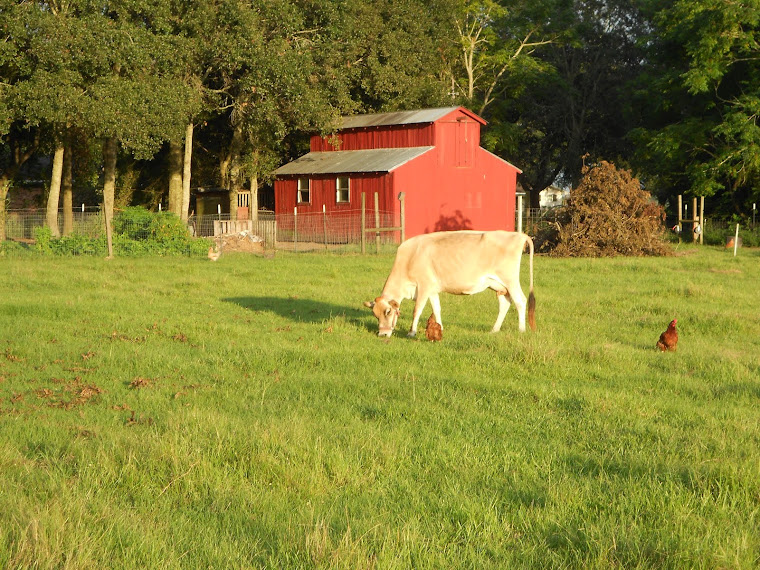
Today is the final entry in our series on bringing our grassfed steer to the slaughterhouse for processing and the different things we did in order to use almost every part of the animal except the "Moo." Before we go further and in the event you missed the previous posts, here they are so that you can click, read and catch up:
Part 1 Grassfed Beef - Organ Meats
Part 2 Grassfed Beef - Picking it Up
Part 3 Grassfed Beef - Rendering Beef Tallow
Part 4 Grassfed Beef - Cooking Grassfed Beef
Today we're going to show you how to make beef bone broth. As members of the
Weston A. Price Foundation, we are firm adherents to the phrase, "Broth is Beautiful." In fact
This Article by Sally Fallon really opened our eyes to the health benefits of cooking with broth. It seems in our house we always have a pot of our home-raised pastured chicken bones simmering to make that golden, healthy, elixir. We just never did it with beef bones since we've never had grass fed beef. That ends now!
In the tallow post (Part 3) we told you we asked the butcher to save all of the fat for us. We also asked him to cut up all the bones and save them as well. We picked up two HUGE bags of bones for making bone broth and over the next week, we always had 3 pots simmering on the stove. Here's how we did it.
First, we used a variety of bones, bones with marrow, bones with joints attached, short bones, large bones, you name it. We had bones strewn across the kitchen. If we would have had any archaeological experience or were better with jigsaw puzzles, we might have reconstructed the skeleton of the steer right there in our kitchen.
 |
| The first of many, many bones |
We first trimmed the excess pieces of meat and fat from the bones. These went into a bowl and became dog food. Our dogs absolutely loved it and we probably saved $25 bucks alone in dog food. Needless to say, the dogs were as pleased as we were with the grass fed beef.
 |
| Scraps for the dogs |
We filled 3 large stockpots three-quarters of the way full with bones and set them on top of the stove. These 3 pots and our stove got quite a workout over the next week!
 |
| If you can't stand the heat, get out of the kitchen! |
We added roughly 3 or 4 tablespoons of apple cider vinegar to each pot. The vinegar is said to draw the minerals out of the bones. That's what we are aiming for in order to get the most out of our beef broth.
 |
| Adding Apple Cider Vinegar |
Then we added filtered water until it covered the level of the bones. We allowed the bones to just rest there in the water for an hour or so while we cleaned up the mess in the kitchen.
 |
| Adding filtered water |
Then we brought the water to a rolling boil, skimming off the foam and brown stuff that floated to the top with a spoon and throwing in the compost pile. Everything goes into the compost pile.
 |
| Skimming off the top |
We added an onion and plenty of broken up celery and carrots to each pot, covered, and turned down the heat. We want the contents of the pot to always bubble - a slow simmer. Then we sort of forgot about it for 24 or so hours. It just did its thing and we did ours for a day or so. The long simmer causes the gelatin to be released from the bones, along with the marrow and many minerals.
 |
| The bubbling cauldron of health |
Finally, it was time to take the broth off of the heat. I lined a colander with a cut up t-shirt and poured the hot broth through it, to strain out the solids and much of the fat.
 |
| Straining the broth |
The remnants or debris left in the pot after straining was happily consumed by our dogs and chickens. There is no waste at our house. It was very interesting how our chickens gathered around the bones and picked at them, actually eating the bone. We give the chickens oyster shells to eat, but they really attacked the bones, picking them clean.
 |
| For the dogs & chickens |
Once cooled I was able to pour the contents into gallon and half-gallon sized jars. I left them on the counter until they were room temperature and then I moved them into the refrigerator. The next morning the contents was gelatinous. I used a spoon to remove all of the fat that lined the top of the broth.
 |
| The first batch of beef broth |
Then we poured it all back into a pot, heated it up to a boil and ladled it into quart and pint sized jars and then put them into the pressure canner, pressure canning it at 10 lbs pressure - 20 minutes for pints and 25 minutes for quarts.
When we finished, we had 14 quarts of beef broth:
 |
| Quarts of Beef Broth |
and 20 pints of beef broth for the pantry.
 |
| Pints of beef broth |
If my math is correct, that is 6 gallons of beef broth. That's a lot of health right there. More than you'll find in a CVS or Walgreens. Sally Fallon of the Weston Price Foundation says this about broth:
Science validates what our grandmothers knew. Rich homemade chicken broths help cure colds. Stock contains minerals in a form the body can absorb easily—not just calcium but also magnesium, phosphorus, silicon, sulphur and trace minerals. It contains the broken down material from cartilage and tendons–stuff like chondroitin sulphates and glucosamine, now sold as expensive supplements for arthritis and joint pain.
So we are set now for a while and will be able to use the beef broth we made as a base for making soups, using it instead of water for cooking rice, boiling potatoes in or basically using it instead of water for making recipes richer and more flavorful and healthy. Bon Appetit!