Showing posts with label soybeans. Show all posts

Monday, September 19, 2022

Random Ramblings on a Monday

Observation #1 

Last week was a teaser.  In the mornings, temperatures actually dipped into the 60's and it NEVER made it to 90.  In fact, by mid-morning, it hadn't reached 80 yet.  Humidity was low.  It was pleasant and a foretaste of fall.  This week, we have a high pressure sitting over us.  It is dry and temps are forecast to be in the upper 90's.  Ugghhh...

Last week we drove east on our road and took a left on LA Highway 102.  I looked out of my window and saw a large field of soybeans.  I remarked to my wife that they were ripe and needed to be harvested before rains set it.  Farmers are wrapping up the first crop harvest of rice and trying to get the beans in.

Well wouldn't you know it, we rounded the curve and a combine, two tractors with carts and two big trucks with trailers passed us.  In about 30 minutes on our way back, the combines were busy at work, bringing in the crop!

In comparison to other occupations, farming requires heavy labor inputs as well as unthinkable capital investment.  A brand new machine like the one you see below runs between $500,000 to $700,000 - maybe more.  That just makes my head hurt.  I know the guy on the combine.  I like how he has two big American flags flying on either side of his cutter bar.  He also has his last name on the grain hopper with a crawfish with pinchers raised making the 'I' in his name!

Fuel prices are up and fertilizer prices are at all-time highs.  I know there are a lot of very nervous farmers concerned about how things are going to work out.  


Observation #2   

When I was throwing my dirty laundry in the hamper the other day, I started laughing when I thought about what I was looking at:

Most folks probably separate out their 'whites' from their 'reds or blacks' when putting dirty clothes away for washing.  You don't want your colored clothes bleeding on your white clothes.  We separate between "regular" and "farm" clothes.  There's a reason for that.  The farm clothes are so doggone filthy with dirt, mud, cow poop, blood and other stuff, you don't want that touching your regular clothes.  Lots of times, especially after picking up hay or working in the garden, the clothes will be soaking wet with sweat and needs to be laid out to dry outside before putting into the farm hamper.  

Observation #3  

Take a look out on the back patio.  I've got some tomato seedlings and some squash that I planted from seed a few weeks ago for the fall crop.  I transplanted the squash this weekend into the garden bed.  The tomatoes will go in the garden this weekend.  I want to get through the high heat of this week before I subject them to the stress of transplanting.

The tomato plants seem to be really healthy.  I've been watering them with some fish emulsion mixed into the water.  They seem to like that.  I've got 29 plants, but I'll give some of them to my oldest son for his garden.


Hopefully we'll get a good fall tomato crop.  The fall crop is usually better for us with less bugs.  The trick is to get tomatoes harvested before you get an early frost!  We'll see how it goes.


Sunday, June 24, 2018

One More Crop Before the Subdivision Goes In

I like sitting in the rocking chair on the front porch on weekends while having a cup of coffee.  You can watch the traffic go by on our country road.  We often have the electric fence up in the front yard while the cows clip down the grass.  Sometimes, like in the photo below, you can watch a thunderstorm approaching from the north and catch a glimpse of rain cascading down from the clouds above.

We watched with interest as a tractor worked up the soil in an apparent race with the rain clouds, trying to get finished before the dirt turned to mud. 


We are somewhat sad about the field across the road.  You see, a developer bought that field and is turning it into a subdivision.  Our house in the country will soon be surrounded by homes and traffic.  Time marches on, I guess, and we'll make the best of it.  Maybe there will be families across the road that develop a taste for 'country eggs' and won't mind the sound of roosters crowing and cows mooing.

As I walked across the road to check the mail yesterday, I noticed something in the field that brought a smile to my face.  I saw soybeans popping up in the field.  At least one more season of agriculture across the street!  One more season of watching a crop grow up instead of concrete and framing. 


Tuesday, July 4, 2017

Hard Soil

In my childhood, my Dad planted soybeans.  I can remember cultivating the soybeans before they "shaded out" to keep weeds out of them.  On the rich land behind the old homeplace, the soybeans would grow tall.  Taller than I was at the time and I remembered running down the rows.  It was like a maze.  Once the soybeans shaded out, and provided that army worms didn't infest the crop, soybeans were an easy crop to grow.  Much easier than rice.

In the month of May, when the soil moisture was just right, you would hook up the drill to the John Deere 4630, inoculate the soybeans and begin planting, following close behind the vibre shank and packer that was preparing a perfect seedbed. From daylight to dark you would plant and then pull out of the beautiful field proud of the work you had done.

Immediately, we'd move into the field with the old John Deere 4020 with a ditcher or the power ditcher.  It is very important to ditch out the field.  Soybeans are fickle. When thunderclouds roll in and the rains begin to fall on the freshly planted soybeans that were just beginning to grow, well...

Image Credit
The crop needed rain, but this was too much of a good thing.  Puddles of water is what you have on your crop.  It is imperative to get the water off.  If the sun comes out and your soybeans are standing in water, they will scald, turn yellow and die. No one wants to re-plant soybeans. There is one thing you can do to save them. We called it "puddling." Puddling was not a pleasant job.  You would get dropped off on one end of a field that ranged between 20 and 120 acres.  Your job was to walk the entire field with a shovel and dig long ditches that connected puddles to the nearest ditch made earlier with the ditching tractor, thereby draining the puddles into the ditches where it would flow out of the field and your soybeans would be saved.  As bad as the job was, I learned several things:

1. Persevere to the end.  The water you'd see ahead of you was no mirage.  It was water that needed to come off the land and it was up to you and your shovel.  You kept digging until the job was done.

2. It was doggone hot.  You had better be prepared and be hydrated before you started, because it was going to be a while before you got to the end of the field where a cold Dr. Pepper would be waiting for you.

3. Keep your eyes open.  There were always treasures to be found in the field like old porcelain marbles and antique bottles that were unearthed by the plows.

4. Appreciate progress.  Later, people frustrated at the back-breaking labor involved in "puddling", invented steel wheels to be put on four-wheelers or tractors where you'd simply drive through the puddles and all the water would sink into the tracks made by the steel wheels and the tracks would lead the water to the ditches.  This made puddling a MUCH easier job.  As they say, "Necessity is the mother of invention."

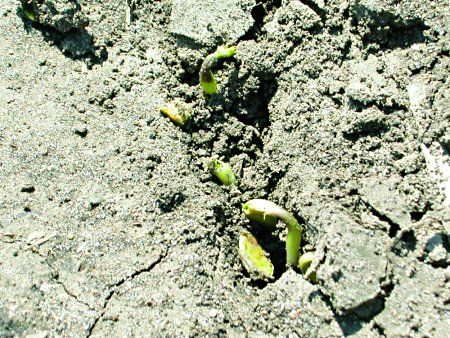
There was another issue with soybeans.  If it rained on soybeans that hadn't broken the ground (sprouted) yet, and the sun came out, you had big problems.  The soil would make a hard crust on it and the soybeans would not be able to penetrate the soil.  Many sprouts would break off.

Image Credit


There was an implement called a Rotary Hoe that we'd hook up behind the tractor. I found a photo of one below:

Image Credit
The rotary hoe chipped off the top layer of soil so that the soybeans could pop right up. Yes, you sacrificed some of the crop by using this implement as some soybeans would inevitably be killed, but you would be able to save most of the crop.  It was always a joy to see the soybeans "marking the rows," knowing that you had a stand of soybeans and wouldn't have to replant.

My youngest son is about to start working at my Dad's farm.  I want him to understand hard work and the feeling of gratification for putting in an honest day's work and seeing that your labor meant something.  Farming is hard work,indeed, but working together toward a common goal is a beautiful thing.  It reminds me of some lyrics to a folk song by Nanci Griffith called Trouble in The Fields:

You'll be the mule I'll be the plow
Come harvest time we'll work it out
There's still a lot of love, here in these troubled fields


Related Posts Plugin for WordPress, Blogger...