Showing posts with label rye grass. Show all posts

Monday, March 28, 2022

The Cattle on a Thousand Hills

 For every beast of the forest is mine, and the cattle upon a thousand hills.  Psalm 50:10 KJV

The LORD owns it all.  We don't have hills where we live.  We are in the flat, Cajun prairie.  There is not much slope to the land.  We do, however, have a manmade hill on our property.  A while back we had a load of topsoil delivered to the house.  It's always good to have topsoil to fill holes in the yard, to add to the garden and to build up low spots.

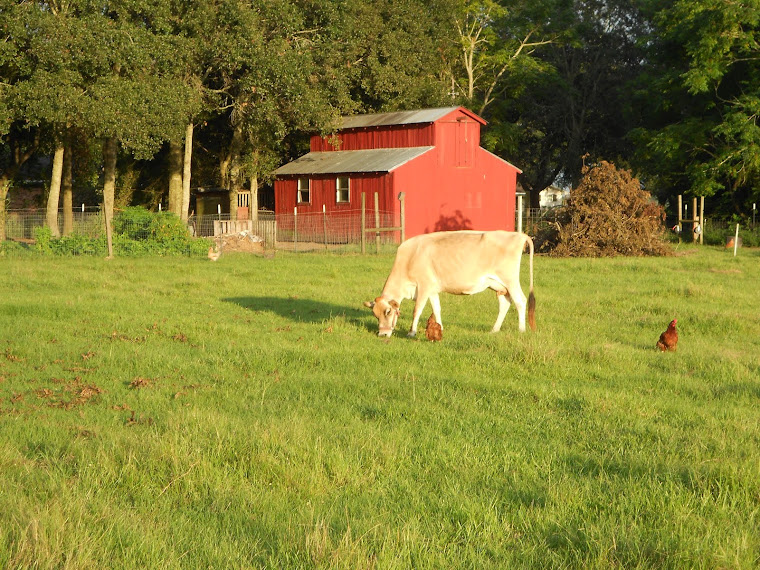
The load of topsoil came with a little something extra (lagniappe, you might say).  It came seeded with rye grass.  Tricia has been getting the momma goats out to come eat on the rye grass that's growing on the hill and today, she got Clarabelle out to feast on the rye grass.  Clarabelle was a happy old girl.  She has a mouthful of rye.

Clarabelle rushed to the hill and grabbed a big plug of grass with her tongue.  You'll notice something about Jersey cows below.  They have blackish-gray tongues!  Their tongues are coarse as sandpaper.  I guess that assists them in latching onto the grass and pulling into their mouth.


I happened by as Tricia was grazing Clarabelle on the hill and she asked me to photograph Clarabelle.  
Many trade magazines show the cows standing on a hill, and Tricia wanted to imitate that pose.

Clarabelle wasn't too terribly interested in posing.  She was more interested in skillfully mowing down the remainder of the rye grass.

Monday, January 4, 2016

Putting up Fencing

Saturday January 2nd was a gray, chilly day - one of those gloomy winter-like days that is perfect for sitting in front of the fireplace, looking at seed catalogs, and planning the spring garden.  But there was work to be done.  At 10:30 a.m. Russ, Benjamin and I arrived at the farm in Oberlin.  Dad's rye grass field (which looks 100% better than ours) needed a little work.  Dad mixed wheat seed in with his rye grass and it is thick and healthy.

We always put a dividing fence right down the middle to separate the field into two large paddocks. The electric fence is then turned on and the cows are put into one half of the pasture to eat.  Later they are moved to the other side and in such fashion half of the field is 'resting' and growing.  If you left the cows in one side for too long, in their exuberance to eat the lush, green grass, they would walk around and mash all the grass into the mud, ruining a lot of it.  Rotational grazing prolongs the life of the pasture.

Lush, green pasture under a gloomy, grey sky
With the abundance of rain we've received lately, the field was saturated with water and muddy.  We had to put the Kubota ATV in four wheel drive to make it through the muck.  Dad stood at the other end of the field right in the middle and we drove to him.  Then we strung the electric wiring from one end to the other, pulling it tight.  Once the fence was pretty tight, we had the straight line traced to put in the T-posts, ensuring a straight fence.

Putting up fencing
We do this job every year at this time like clockwork.  The job is not for average folks, no sir.  This job requires a PhD - in this case that doesn't mean a Doctorate of Philosophy.  It means a Post Hole Driver.  My nephew and Russ and Benjamin split up the jobs.  Since I'm the oldest, I had the easy job.  I stepped off 15 steps and put a post in the ground.  Russ was the post driver, banging the T-post into the ground with a banger and Benjamin drove the Kubota, delivering the posts as we'd go along.  Conner would then attach the plastic insulator to the T-post and put the electric wire on the insulator.
Division of labor
Then we took a lunch break and headed to Oberlin.  Right down Main Street there is a grocery store called Landreneau's.  As you exit the vehicle in the parking lot, the aroma of smoking meats fills your nostrils.  The smokehouse is billowing out back and the scent beckons you inside.  They have a full service meat market and deli and their meat case is filled with fresh smoked sausage of all varieties, smoked rabbits stacked high, stuffed ponce, stuffed pork roast, a big pile of smoked pork ribs, and a wide assortment of other specialty meats like cream cheese and jalapeno pork pinwheels and bacon-wrapped jalapeno poppers.  Landreneau's also has the best hamburger around.  Huge, freshly ground meat patties in a buttered bun, loaded with onions, pickles, lettuce and tomatoes.  You need both hands to hold this burger.  You need a big appetite to finish it, but we had that covered. The only hard part was going back to work after lunch!  I needed a nap instead.

With our fuel tanks topped off with the Landreneau burger, we were powered with sufficient energy to finish the task.

Gittin' it done!
In no time the task was complete.  In a day or two the happy cows will be turned into one half of the pasture and they'll eat to their heart's content on that green, green grass.

Tuesday, November 3, 2015

Crazy About Grass

Over the weekend we had about 5 inches of rain that fell over Our Maker's Acres Family Farm. During a momentary break in the precipitation, I hustled out there to check on the status of the rye grass that we planted on October 22nd and discussed in THIS POST.  Our previous experiments with planting rye grass by over-seeding without working up a seedbed with a plow were met with dismal results.  This year I changed up a few things and wanted to see if the new process worked. 

I got down on my hands and knees and surveyed the situation in the pasture. Whoa!  What is this I see?  I tried to contain the joy at what I saw!  Little sprouts! Rye grass was shooting up through the grass clippings that I had mowed on top of the broadcast seed.  Oh, the inhabitants of the barnyard are just gonna love this this winter when everything else is dead and brown!  Can you see the tiny green shoots?

Oh for joy!
As I was rejoicing out on my hands and knees in the pasture, I began to think how odd I must look to passersby with me out in the pasture on the ground on all fours. I bet I looked like Old Nebuchadnezzar as described below from the Book of Daniel:

Daniel 4:33 (NASB)

Immediately the word concerning Nebuchadnezzar was fulfilled; and he was driven away from mankind and began eating grass like cattle, and his body was drenched with the dew of heaven until his hair had grown like eagles’ feathers and his nails like birds’ claws.
I hope I don't look like that!  I got up from the ground and sheepishly walked out of the pasture. Although we grow many fine vegetables that we enjoy, I also get a thrill out of growing good grass that the cows, goat(s), chickens and guineas can enjoy, especially during the winter when in prior years they have had to make do primarily on hay and a little feed.

It is still a little early to pronounce success on the 2015-2016 rye grass crop.  I don't want to count my chickens before they hatch.  I'll wait a few more weeks until we really can see what type of a stand I have out there, but the initial reviews look promising - at least better than in prior years.

The grass is always greener
There were still a few minutes of daylight left, and I had a bit more energy in me, so I decided to do one more experiment.  I went and got my little Scott's Fertilizer Spreader that I planted the rye grass with and I got a bag and a half of Fertilizer made with pelletized Chicken Manure.  I quickly filled the spreader and began broadcasting the chicken manure on the rye grass.  The fertilizer I had wasn't enough to finish the entire rye grass plot, but I marked where I ran out.  I want to see if I can tell a difference where I fertilized versus where I didn't.  Since our chickens are constantly "broadcasting" chicken manure on the pasture, I want to see if broadcasting more fertilizer yielded incrementally beneficial results.  In a few weeks we'll be able to tell.

As I finished the sun faded, ushering in darkness and swarms of hungry mosquitoes ready to feast on my blood.  Time for Ol' Nebuchadnezzar to go inside for supper.  My wife has something prepared that is much better than grass for me to eat!

Thursday, October 22, 2015

Broadcasting Rye Grass Seed before the rain

This morning I had to be in Houston for work in my 'real' job.  That meant I had to wake up earlier than normal.  At 3:30 am I rolled reluctantly out of bed, showered, dressed and my bride handed me a big cup of coffee and a kiss as I headed out the door at 4.  At 6:57 am I was in downtown Houston in four lanes of traffic with red tail lights shining for miles and cars bumper to bumper all doing 20 miles an hour. I finally made it to the office, got my stuff done and exited the concrete jungle with the quickness!

I got home in record time and was happy that there was daylight remaining.  I put on my 'work' clothes and headed back out the door.  There was work to be done.  It hasn't rained here in 26 days, and then it was only 0.3 of an inch.  We're dry.  Real dry.  But this weekend, there is a strong chance of rain and high chances of rain for the days that follow.  I've been waiting on this as it is (past) time to plant rye grass.

I basically used THIS GUIDE for seeding rates but changed up the ground preparation for planting.  In advance I purchased some quality rye grass seed and got my spreader ready.

100 pounds of rye grass seed
I filled the little spreader with seed and adjusted the setting so that it matched the seeding rate.  We have a very small operation, so rye grass planting is a manual thing.  Last week I put the cows on the paddocks that I'm going to plant and let them eat it down.  Today I was able to just broadcast the seed with my spreader, pushing it up and down while watching the seeds scatter evenly across the pasture.

Spreading the rye grass seed on the pasture
When planting rye grass without plowing to work up a seed bed, it is very important to ensure that the seed comes into contact with the ground.  So once I've finished broadcasting the seed, I get on my riding lawnmower and set the mower deck to the second lowest setting and mow the pasture.  This shakes the seed and forces down to the level of the soil.  It also spreads the grass clippings on top of the seed, acting as a light mulch.  Once it rains this weekend, it will wet the seed and encourage germination.  The grass clippings will keep the moisture on the ground from evaporating.

Mowing over the seed as the sun goes down
Finally I was finished planting one of the two bags of seed.  It got too dark to do any more.  I'll finish planting the final bag and mowing it in tomorrow.

Getting it done until you can't see anymore
Once it is planted, there will be nothing else to do besides wait for the rain to come. I'll broadcast some chicken litter over it later to encourage growth.  As I drove the mower back to the house, I looked up at the moon and the stars and the quiet peace that is country living.  And I counted my blessings, appreciating country living and the ability to work outdoors.  If the rye grass comes up, our cows will be grateful for that as well. 

Monday, January 26, 2015

Sometimes the Grass ISN'T Much Greener on the Other Side

There are times when you make plans and put in the work to bring those plans to fruition and things just don't work out.  This was one of those times.  In the fall, we mowed a section of the pasture, purchased rye grass seed, used the fertilizer spreader to broadcast the seed in the paddock, and then put up an electric fence to keep the cows out.

Then we wait for the rye grass seed to germinate and grow.  And we waited and waited and waited. We drove past other people's rye grass fields and looked with envy at their lush, dark green rye grass waving in the wind as if to taunt us.  When we look out over our rye grass pasture, all we see is a slight tinge of green.  You almost need a magnifying glass to see the rye grass.  I decided to go ahead and open the fence and allow the cows to go ahead and graze on what little was there.

It's not easy being green...
When they saw me opening the fence, they RAN to where I was, playfully jumping around, all excited that they were going to get to eat in an ungrazed pasture.  I felt sorry for them and tried to tell them not to get so happy because there wasn't much for them to eat.  As I opened the paddock up, they rushed in and greedily gobbled up what little they could find, running from one place to the next. By the time that the sun went down that night, what little rye grass there was, was eaten down to ground level by the hungry cows.

Where the Green Grass Grows...
I have never had much success growing rye grass, but I'm not going to give up.  I'll get a better spreader next year and mix the rye grass with some fertilizer and increase my seeding rate per acre to put more seed on the ground.  Maybe that would make a difference, I don't know.

Fortunately, they have plenty to eat with round bales of hay always at their disposal and some good bermuda square bales to eat as we milk them each morning and night.  With temperatures projected to be in the 70's this week, maybe the rye grass will grow.  In the meantime, I'll throw them some turnips and turnip greens that I planted just for those greedy girls.

Tuesday, November 19, 2013

The Grass Always looks Greener...

On the other side of the electric fence.

Saturday was a work day at the farm in Oberlin.  It is the time of year where the plentiful summer grass that keeps the cows fat and happy has been eaten down to ground level.  In anticipation of the onset of fall/winter and the lack of grass, we always plant rye grass in October.  Rye is a winter grass that grows lush and thick and beckons hungry bovines to partake.  Rye grass provides good nutrition to the cows and coupled with hay, bridges them over until Spring when the bermuda/bahia mix of grasses come out of its winter dormancy.

This year Dad added some wheat seed in with the rye grass for an extra buffet item for the old girls.  The trouble with rye grass is that it takes a little while for it to grow big enough to turn the cows onto it.  Tom Petty and the Heartbreakers used to sing a song entitled, "The Waiting is the Hardest Part."  The cows concur with Mr. Petty. They just don't have the patience or intestinal fortitude (literally) to wait for the rye grass to grow.

Rye/Wheat pasture is growing...
Once a cow gets it in her mind (or if a bull or steer: in his mind) to go somewhere, it takes a mighty strong fence or gate to hold the animal back.  As if to underscore that statement, the cows have been going on 'manoeuvres' at night and have managed to break through the fence and get into the freshly planted rye grass field and out onto the road and gotten themselves in all kinds of mischief.

The task at hand is to add a third wire to the electric fence.  If you look closely, you can see where the three wires are as evidenced by the yellow insulators that fasten them to the fence.  The black insulator, ratchet and wire running horizontally to the right is a cross fence that separates the pasture into two large paddocks. I'll show you a better picture down below.

I'm SHOCKED the cows would want to get in here.  Shocked, I tell ya!
We have a large reel that sits on a frame in the back of the Kubota Mule all terrain vehicle that we roll up or unroll wire with.  We decided, however, that it would be easier to make a trip to Tractor Supply in Oakdale and pick up a couple rolls of spooled wire, putting a shaft through the center hole and attaching to the tailgate of the Kubota.  Dad drove the Kubota and I walked along the perimeter of the 40 acre pasture attaching the wire to the insulators at each post.  The weather was nice and the job went quickly.  It is amazing what you can do with 40 acres and a mule!  What a good program!

Spool of electric fence wire
The idea of having two paddocks is a wise one.  You see cows are so happy to get on fresh grass that they don't know what to do with themselves.  So they walk and walk and eat and poop and walk some more.  If you don't manage their eating, they 'tromp down' and waste more grass than they eat.  Then like an over eater at an all-you-can-eat buffet, they will eat until they get themselves sick.  Not a pretty picture, I know.

The tracks mark the cross fence that separates the two internal paddocks.
So the plan is, you set up two paddocks within the pasture, allowing them access to one of them for a short period of time while the other paddock "rests."  Then, for the next period of time, you allow them to eat in the other paddock while the other pasture rests, refreshes, and re-grows.  In doing so, you lengthen the life of your pasture and regulate the cows' intake of the rich grass that can make them sick.

If you look real real close, you can see the family graveyard where the grass meets the trees in the distance on Durio Cemetery Road.  My great-great grandpa and grandma lie at rest there.  There is an American flag flying and there are some old (circa 1800's) Civil War era grave sites under a sprawling live oak tree.  I'll have to research sometime and find out some information about those old gravestones and the soldiers interred there.  The old Sonnier Family homeplace lies just east of the graveyard over the gully only about 300 feet from the cemetery.

There goes Dad on the mule
The grass has to grow a bit more before before the cows will be granted entry to the buffet, but they have hay to munch on until that time.

Hey kids, get off my lawn!
As the sun started going down, our work was done.  Dad reconnected the chargers to the fence and I tested each of the 3 wires at different points to ensure we were getting good voltage.  All was good so we called it a day.

An honest day's work
Patience is a virtue.  It really is.  I struggle with having patience and the cows do too!

Where the green grass grows...
In fact, Dad reported that a steer already jumped over the top wire of our newly constructed fence, breaking the wire!  Doggonit!  Time to put that bad boy in the freezer and enjoy some Grass Fed Beef.
Related Posts Plugin for WordPress, Blogger...