Showing posts with label paddock. Show all posts

Monday, November 12, 2018

A Repeated Pattern

Do you ever notice how many times in life you catch yourself in routines and patterns?  The alarm clock goes off and you hop out of bed, shower, shave, dress, and grab a cup of coffee on the way out of the door.  You turn on the radio and you can judge if you are running late or early because the news comes on at the top and bottom of the hour.  The farm report comes on at 5:45 am and if I haven't passed Welsh, Louisiana yet, I'm running late.

Life ticks off the clock minutes at a time, marching on, stopping for no one.  Spring arrives with brilliant green growth followed by what seems like endless heat of summer.  By the end of summer, the grass has gone to seed and the bright green grass of spring has been replaced by dull, drab green colors.  The tallow trees (chicken trees) and cypress trees begin to turn colors, signaling the coming of fall.  Each year these routines repeat themselves. 

This changing of seasons, if you have animals on pasture, tells you that there is work to do.  As the grass goes dormant and the north winds begin to blow, it is important that you have hay put up in the barn or a good source to purchase it from.  Also, it means it is time to remove the temporary electric fencing that separated the pasture into separate paddocks. 

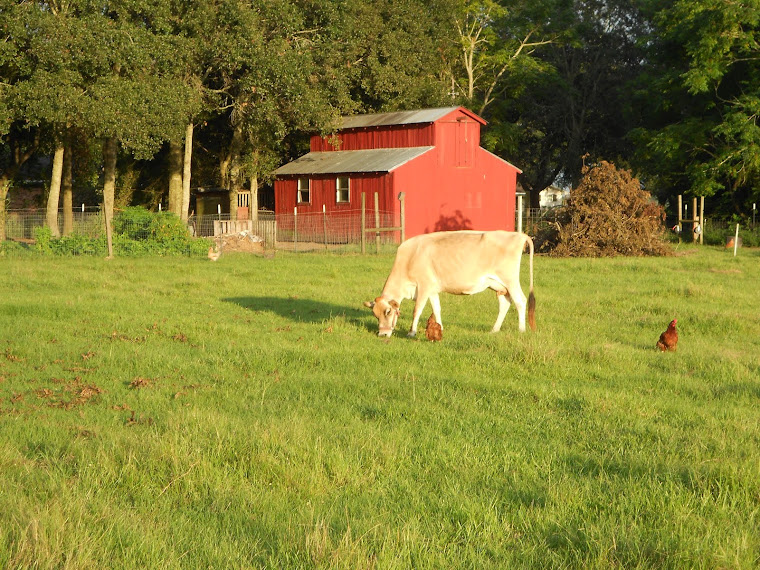
During the spring and summer, the pasture was broken up into separate paddocks with temporary electric fencing powered by solar energy, and the cows were rotated through each paddock throughout the week.  With the grass no longer growing, it is pointless, so I begin rolling up the poly rope with embedded wires onto my reel. 


It is amazing that a tiny "string" containing energy harnessed from the sun, can control a 900 pound animal and keep them where you want them.  The cows are very afraid of getting popped by the electric fence.  They respect it.


The sound of me rolling up the fence on the reel always gets the attention of the animals as they equate it to the opportunity to move to a new paddock with fresh, tender grass - only, at this time of the year, there's not much fresh, tender grass.


I walked through the pasture, removing the 'jump-wires' from the perimeter hot wire, rolling up the electric fence onto the reels and pulling up the step in posts and that transforms a pasture that was broken up into 7 individual pastures for 1-3 day grazing, into one 3 acre paddock.  I put all the electric fence equipment up in the barn.  It will sit there for another five months until the familiar sights and sounds of spring beckons me to begin the routine all over again.
Thus says the LORD, Who gives the sun for light by day And the fixed order of the moon and the stars for light by night, Who stirs up the sea so that its waves roar; The LORD of hosts is His name:  Jeremiah 31:35

Sunday, October 23, 2016

Rolling up the Paddocks

After ignoring the hay for the past three months, the cows went through the last round bale I had on hand very quickly.  As you can see, there's nothing left.  I called the gentleman that I purchase my hay from and asked him to please deliver me 8 more bales.  At this time of the year, the grass in the pasture falls off in terms of quality as it goes to seed and its nutritional content is not as good.  So the cows begin to eat hay again.

The gentleman I buy hay from told me that he would and then went on to tell me that he's had a rough 3 months.  First, he told me that the tremendous rainfall during August diminished the quality of the hay as well as his yield.  Then a connecting rod went out in his tractor.  Then his hay rake broke and was beyond economic repair so he had to get a new one.  Finally, his baler caught fire and burned to the ground and he barely got the tractor unhooked and moved or it would have burned too.  Those are some tough breaks.


Up to this point, I still had the pasture partitioned off into different paddocks by temporary electric fencing using reels and fiberglass temporary step-in posts.  I move the cows to new paddock to eat fresh grass every two days and that allows the grass to rest and regrow before introducing the cows to it again.

At this time of year however, it is time to roll up all the fencing and allow the cows to have free choice to roam wherever they want to on the pasture and eat whatever grass they want.  The reels to roll up the poly wire make the rolling up process quick and efficient.


Upon opening a new paddock, the girls always rush out to dine on fresh grass. From this point on (until next spring), they can go wherever they wish.


You can see how in some places they've eaten the grass down to the ground.  This is not really a good thing as that is how they pick up parasites.  In other places, you can see how the grass is overgrown and not eaten.  In some of these cases, there is cow poop underneath it.  In others, the grass just got too tall and tough and now the cows won't eat it.


I finally rolled up the final cross-wire and the six paddocks is now only one big 3 acre one.


The cows now have 3 acres upon which to roam and graze.  The cooler temperatures and dry conditions tell me that the grass isn't going to grow much more now and that the cows will still graze, but they will now get most of their nutritional needs met from the round hay bales.

As of right now, I don't think I'm going to supplement their pasture and hay by planting rye grass.  I haven't had much success with rye grass due to the fact that the pasture is in dire need of lime.   Over the course of the next month or so, the cows will have access to the whole pasture and they will clip it down.  No worries, though, my order of hay will be delivered later in the week.

Monday, January 26, 2015

Sometimes the Grass ISN'T Much Greener on the Other Side

There are times when you make plans and put in the work to bring those plans to fruition and things just don't work out.  This was one of those times.  In the fall, we mowed a section of the pasture, purchased rye grass seed, used the fertilizer spreader to broadcast the seed in the paddock, and then put up an electric fence to keep the cows out.

Then we wait for the rye grass seed to germinate and grow.  And we waited and waited and waited. We drove past other people's rye grass fields and looked with envy at their lush, dark green rye grass waving in the wind as if to taunt us.  When we look out over our rye grass pasture, all we see is a slight tinge of green.  You almost need a magnifying glass to see the rye grass.  I decided to go ahead and open the fence and allow the cows to go ahead and graze on what little was there.

It's not easy being green...
When they saw me opening the fence, they RAN to where I was, playfully jumping around, all excited that they were going to get to eat in an ungrazed pasture.  I felt sorry for them and tried to tell them not to get so happy because there wasn't much for them to eat.  As I opened the paddock up, they rushed in and greedily gobbled up what little they could find, running from one place to the next. By the time that the sun went down that night, what little rye grass there was, was eaten down to ground level by the hungry cows.

Where the Green Grass Grows...
I have never had much success growing rye grass, but I'm not going to give up.  I'll get a better spreader next year and mix the rye grass with some fertilizer and increase my seeding rate per acre to put more seed on the ground.  Maybe that would make a difference, I don't know.

Fortunately, they have plenty to eat with round bales of hay always at their disposal and some good bermuda square bales to eat as we milk them each morning and night.  With temperatures projected to be in the 70's this week, maybe the rye grass will grow.  In the meantime, I'll throw them some turnips and turnip greens that I planted just for those greedy girls.

Sunday, October 19, 2014

Planting Winter Ryegrass in the Pasture

The first cool weather of October is always a signal for me to get rye grass planted for the cows.  Now, we haven't been successful in getting a decent stand of ryegrass since I began seeding one third of our pasture with ryegrass seed, but I'm not a quitter and I'll keep trying until we have success.  In the past, I've cut the grass real short, seed the acre paddock, drag a post across the planted area to make the seeds get down to the ground and wait for germination.

Trouble is, I've always had a sparse stand.  I wanted to learn what others were doing, so I asked around and got another method.  This method involves the same steps, but in a different order, so I'm going to try it.  I'll seed the acre paddock first, then I'll mow the grass.  This will allow the grass cuttings to cover the seed and after a rain, the seed will work its way down to the ground and will pop up through the grass cuttings.  The cuttings will protect the seed, somewhat from predation from birds and our chickens.

Before we got started, though, I thought it would be a good idea to incorporate a quick, easy Home School lesson for Benjamin to show him how math has some very practical uses.  We needed to measure out an acre in our pasture.  I had Benjamin research to find the number of square feet in an acre.  When he determined that there were 43,560 square feet in an acre, we showed how the equation 'x' times 'y' = 43,560. We needed to eliminate one of the variables so he measured from post to post along the road and determined that it was 224 feet wide.  Now he needed to determined how far deep we needed to walk back to set our temporary fence to enclose one acre.  All he needed to do at this point was divide 43,560 by 224 to determine that he needed to mark off 194.5 feet back for the fence to create a one acre rye grass paddock.  Not only did we learn the answer to our question, but we reinforced the fact that math has practical uses in everyday life.

Here is the one acre paddock measured out of our little pasture:

Where the rye grass will (hopefully) grow
I purchased a 50 pound bag of ryegrass at the hardware store and pulled out my little spreader.  Yes, there are easier ways to plant rye grass, but I like a little exercise after sitting in an office all day!  I simply filled the little hopper with ryegrass seed, put the setting on the appropriate setting, and we're ready to start planting.

The seeder and the seed
Ryegrass seed is very small and very light.

Ryegrass Seed
The seed falls through the opening at the bottom of the hopper and falls on a spinning plate at the bottom of the spreader that broadcasts the seeds evenly across the pasture.  I walked back and forth in straight swaths.  I could see where my previous path was due to the marks in the grass left by the wheels.  The best time to do this is in the morning while the dew is on the ground so that your wheels leave marks in the wet grass.  I planted in the evening but was still able to see the marks in the grass to gauge where my next swath would be.

According to something I read ryegrass seed will take between 5 and 10 days to germinate.  It has been dry around here so I would assume it will take a little longer. Hopefully we'll have success this year with ryegrass.  I will always have our Plan B in the event we are unsuccessful and will have plenty of hay for the girls to fall back on.  We'll keep you posted on the ryegrass progress and whether or not we get a successful stand.
Related Posts Plugin for WordPress, Blogger...