Showing posts with label pullet. Show all posts

Sunday, December 6, 2015

Losing Freedom

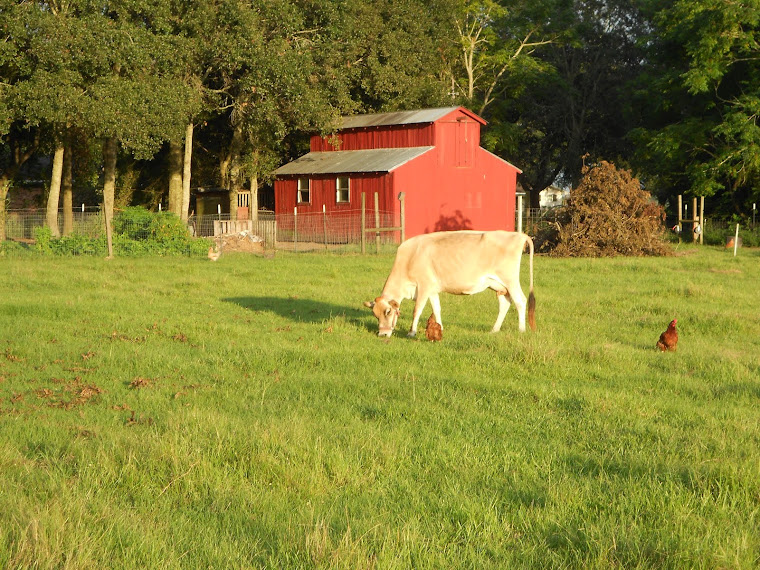
Back in This Post from September, we talked about a Black Star hen in our barn that become broody and hatched out a baby chick.  In the last several months the little chick has grown into a healthy little pullet who is very lively.  We have 4 inch by 4 inch square 'hog wire' that separates our garden from the pasture.  This fence protects the vegetables that we have growing from the livestock and poultry that would love to get in there and do damage.  Our border fence works - for the most part.

Tricia warned me the other day that she had seen the little pullet in the garden, scratching around and feasting on all the green growth that can be found up and down the rows.  We can't have that. Saturday morning I caught the bird red-handed.  She squeezed her fat little body through the 4 X 4 fence panel and was enjoying herself.

In forbidden territory
I watched her as she patrolled up and down the carrot rows, scratching and eating. I had plans to put an end to her garden maneuvers, though.  I waited until she was distracted, and then I made my move. I quickly ran to her, intending to scoop her up, but I wasn't fast enough.  She must have seen or heard me coming and she made a run for the border, squeezing back through the fence lightning fast, re-joining the rest of the flock.  I think I saw her laughing at me and doing a little victory dance.

Illegal border crosser
I patiently waited, biding my time, plotting, planning, until the opportunity to catch her would arise again.  We simply cannot allow undocumented pullets to come through our porous border at will, taking our food with impunity, damaging the crops.  Alas, after several tries, I was able to capture her.  She squawked unhappily, but such is the price you pay for trespassing.  I put her into the chicken tractor with our other pullets that we had ordered from the hatchery.  Crossing the garden border illegally cost the pullet her freedom and she learned if you do the crime, you must pay the time.  For the first day or two, the captured pullet who had lost her freedom stayed by herself away from the other birds - no doubt lamenting her loss of freedom.  By the third day, she came to grips with her incarceration and joined the rest of the group and has become accustomed to life behind the impenetrable fence. 

The detained bird at the 9 o'clock position above
She is in the general population with the other detainees now and is being given food and water.  All the birds are healthy and growing nicely.  Although life in the chicken tractor is okay, it is not as good as true freedom outside the barrier. Sometimes you don't know how good freedom is, until you've lost it.


She still gets fresh grass to forage on every day and still has access to fresh air and water.  Life is still good - as far as chickens go.


We'll allow her (and the other chicks in the chicken tractor) to grow.  When they lay their first eggs, we'll open the gate and allow them to have total freedom on the 3 acre pasture - to come and go as they please.  Just not in the garden, please!

Wednesday, February 11, 2015

A Crazy Assortment of Eggs

The chickens are gradually starting to lay more and more after the normal winter dormancy brought about by reduced daylight hours and less nutrition out on the pasture for them to eat.  In Late December and early January, we gather maybe an egg or two a day.  On a good day we'll pick up three.  However, in February, it's like a switch gets turned on and suddenly you'll pick up nine eggs, a dozen the next day and two dozen the next.

A dozen and a half eggs today
We pick up an odd assortment of eggs sometimes.  Our brown egg layers, Barred Rocks and Rhode Island Reds, and our Aracaunas, that lay blue and green eggs make a pretty, colorful basket.  In the photo below you can see on the far left an egg that was surely the first egg laid by a Barred Rock or Rhode Island Red pullet.  We call them pullet bullets.  They start off very small, but soon they are normal size.

Pullet's first egg (left), Aracauna egg (middle), Barred Rock or RIR egg (right)
Here's another odd thing to see.  Benjamin has a abnormally large egg in his right hand and an abnormally small egg in his left.  As we discussed, the small one is a pullet's first egg.  The big one, well, it looks like that might have hurt coming out! The hen walking funny tomorrow will be the tell tale sign that she laid it.

Big & Small
Here's another picture that highlights the difference in size.  If you crack open the small egg, you find that the yolk is the size of a normal yolk.  There's not much 'white' in the little pullet egg.


But what do you find in the large egg.  I had a suspicion, but I wanted to know for sure, so we cracked it open.


Yep, sure enough, it was a double-yolked egg.  What causes this?  I learned that it is pretty rare in store bought eggs, because they are candled and double-yolkers are discarded.  So if you buy your eggs from a store, you may never see one.  If you have hens, you'll see some, although they are still pretty rare.  Some of it is hereditary, but some of it is similar to a car back-firing.  It is a mistake or mis-firing in which the ovary releases the yolk into the oviduct.  Sometimes the yolks are released too close together resulting in a double yolked egg.

Double-yolked egg
Double-yolked eggs are safe to eat, but we fed this one to the dogs since it had a tinge of blood in it. I also read that sometimes pullets will lay the small eggs and then lay a huge double-yolk egg before their egg laying system gets into a normal groove.  You know how it goes?  Sometimes we experience some 'glitches' in our system.
Related Posts Plugin for WordPress, Blogger...