Showing posts with label preserve. Show all posts

Sunday, February 8, 2026

Preserving the Cauliflower Harvest

Gardening can be a funny thing.  Some years, even though you do everything you've always done, the yield is less than desirable.  This year the sweet potato harvest was lackluster, at best.  Some years, though, everything clicks on certain crops.  This year the cauliflower harvest can best be described as a bumper crop.  That term originates from the 19th century when things exceptionally large were termed as "bumper."

Before the big freeze we harvested all the cauliflower as exposing the heads to a deep freeze causes the cauliflower to become mushy and damaged.  We ate all we could, but decided we would need to blanch and freeze the excess so that we could preserve the harvest and eat it throughout the upcoming weeks and months.

Cauliflower grows with large leaves that curl around the head, leaving the head mostly protected.  As a result, the heads are snowball white, clean, with no blemishes or damage.  Tricia and I formed a quick assembly line, cutting off any remaining leaves and stem bottoms.  The upper portions of the stem are tasty and edible. 

We disassemble the heads, cutting them into florets a little larger than a golf ball.  While we are working on this, we get a pot of water boiling.  We also clean the sink and fill with cold water and ice.  We're about ready to get things going.

With the water at a full boil, we drop a batch of cauliflower into the water.  Once the water is boiling, we start the timer for three minutes.  It takes 3 minutes to blanch cauliflower.  Blanching the cauliflower (or any vegetable) does a couple of things: it preserves the color and it preserves the texture prior to freezing.

The beeper goes off, alerting Tricia that it's time to take it out.  I say "alerts Tricia" because I can't hear the beeper.  The timer sounds at a frequency that I cannot hear.  Years of running a crawfish boat with no hearing protection (my fault entirely) have resulted in hearing loss of certain frequencies.  There are worse afflictions, I suppose.  

Once the beeper sounds, we quickly remove the blanched cauliflower into a colander, allowing the hot water to drain out, and then we put the cauliflower into the cold water bath.  We want to immediately stop the cooking process.  To do so, we add more ice to the sink as needed.  Simultaneously, we put another batch of cauliflower florets into the water and start the whole process over again.  Rinse, wash, repeat... Literally.

Once the cauliflower has cooled, we bag it up into quart-sized Ziploc bags and put them into the deep freeze.  We yielded nine bags.

Of course, we did hold back 3 or 4 cauliflower heads to put in the crisper in the fridge and we'll eat that over the next week or so.  We always like to eat as much as we can fresh from the garden, but it's always important to be able to preserve the harvest.

Monday, July 8, 2024

Another Way to Preserve the Harvest

At certain times of the year, we have more vegetables coming in than we know what to do with.  We eat all we can, and it is fun to look for new recipes.  We've found some things that are fantastic, like zucchini bundt cake!  We give away a lot to our neighbors and our church family.  We blanch and freeze some.  We dehydrate some.  We pickle some.  Another way of preserving is lacto-fermentation.  

Lacto-fermentation uses whey and salt and the lacto-bacillus bacteria in the vegetables.  The bacteria converts the sugars in the vegetables to lactic acid and thus, preserves or ferments the vegetables, preserving their shelf life and giving you some healthy probiotics to populate your gut.  They are delicious, too!

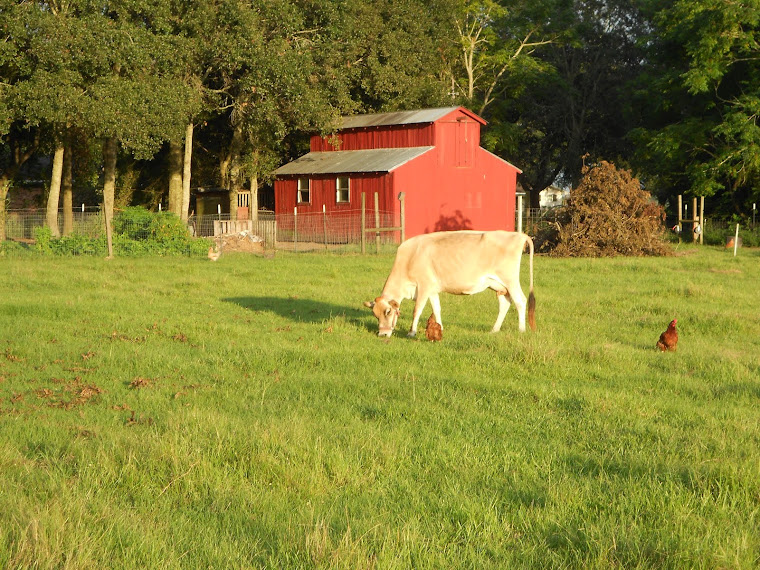
When we milk LuLu, our Jersey in milk right now, or our goats, Tricia makes kefir.  She strains off the whey, and we use the whey for lacto-fermentation.  Below you see a gallon jar of fermented pickles and banana peppers.  The recipe is real simple.  You fill the container with vegetables and add 1/4 cup of whey to the quart jar.  Then add 1 Tablespoon of salt.  Finally, fill the rest of the jar with water, put a cap on it and sit at room temperature for two days.  At the end of two days, put in the fridge. (By the way, why does fridge have a "d" in it, but refrigerator doesn't?)  We find that if you leave it in the fridge for a month or two, the flavor gets better.

Here is a quart of cut up yellow squash that we lacto-fermented.  There's no end to what type of vegetable you can try.  We tried beets several years and made beet kvass using the same recipe.

Now if you pound the shredded vegetables and they make their own juice, you can do this without using water.  Just add the whey and the salt and use a glass weight to keep the shredded vegetables beneath the liquid line.  Here is some sauerkraut that we made back in early spring when the cabbage came in.

And here is a quart of ginger carrots that we made back in February.

Any of the above is cool, tangy, tasty, and refreshing for lunch on a hot, summer day.

Thursday, November 2, 2023

Carrots - From One Crop and Into the Next

A few weeks ago I got the fall/winter crop of carrots in the ground.  The germination was pretty good except for some old carrot seed that I had saved from 2012.  I was rotating my seed stock and planted the old seed and it didn't come up.  No worries.  I got some new seed planted.  We have a lot of carrots coming up.  This photo was taken last week and the plants are about 3 times as large.  This weekend I'll thin them out.  Actually, what I'll do is dig every other plant up and replant them in another row.

As I thought about the carrots, it reminded me that we're still eating on last year's crop.  We pressure canned a bunch of quarts and froze a bunch, too.  With the onset of colder weather, Tricia was talking about making Cream of Carrot soup.  Delicious!

Another thing that we do is make Fermented Ginger Carrots.  We shred carrots in a food processor and put into a large bowl.  Then we add grated fresh ginger into the bowl with the carrots.  Then we add a third cup of whey.  We use a meat tenderizing mallet to mash the carrots, making the juices come out.  We use a spoon to fill quart sized canning jars with the carrots, pressing them into the jar so that they are packed tightly.  Pour the liquid so that it covers the carrots and put a lid on the jar, loose.  We leave out on the counter for 3 days and then put in the fridge.  We find the longer you leave it, the better the flavor.

Here is a jar we pulled out of the back of the refrigerator that has been there since June 15.

Cold.  Tangy.  Delicious!

We like to plant and preserve so that we never run out.  As soon as the last frozen, canned, or lacto-fermented produce is consumed, it'll be harvest time again!

Sunday, May 22, 2022

Blanching & Freezing the Snap Bean Harvest

Way back on May 4th, we showed you our first harvest of green beans.  You might recall that, in truly goofy fashion, I spelled out the bean varieties with beans on the trampoline.  We harvested some Irish Potatoes, too.  Perhaps I'll post about the potato pickin' in a few days.  There are few things that go better together than fresh picked snap beans, new potatoes and butter.  We've eaten our share of those in the last several weeks.

When you have a bountiful harvest of bushels of beans, it is important that you process them to save some for later consumption.  We do this quite often.  We like the process of blanching them and then freezing them.  It is a quick, easy, efficient method for putting your beans up while protecting that 'fresh from the field' taste and texture.

So first, you gotta pick 'em.  Backbreaking work when you have several rows to go through, but you get it done because there is a reward at the end of the row.  We bring the buckets of beans in and wash them up.  You want to do this because you do bring in the occasional worm, bug, or snail with the beans, and you want to ensure that they are cleaned up before processing.  The next step is we snap off the ends.  Many people call this step 'stringing the beans,' but these varieties really don't produce much of a string.


Once the washing, snapping and stringing is done, we put them in a big pile.  On the stove, we'll get a pot of water boiling and in the sink, we'll fill with ice water.

When you have water coming to a boil in your pot, simply dump in a batch.  We estimate a batch being approximately a quart of beans.  Once the water has begun boiling once again, set your kitchen timer for 3 minutes.  That's how long it takes to blanch beans.

We pour them into a colander and then put the water back in the pot to get another batch going.  Notice the color of the beans.  They have a nice, healthy, green color.  They are blanched, not cooked.

These beans are still hot and will continue to cook, so you want to quickly pour them into a sink of ice water to abruptly stop the cooking process.

Once the beans are very cold to the touch, you can remove them and package them.  By this time, the next batch has been boiling for 3 minutes and are ready for an ice water bath.  You can have a real assembly line going in your kitchen.  We pack them in quart freezer bags.  We find that this is a nice quantity to pull out of the freezer, thaw and cook for a healthy side dish for any meal.

The next night we blanched and froze a bunch more.  I think so far we've put 12 quarts into the freezer with more coming.  Blanching has several benefits:  It preserves a bright, green color.  It cleans any remaining dirt off the beans.  It stops the enzyme action which would otherwise affect flavor, color, vitamin content and texture.

Last year's green bean crop was less than desirable, but this year looks to be a better crop.  

Related Posts Plugin for WordPress, Blogger...