Showing posts with label mushrooms. Show all posts

Monday, August 15, 2022

The Barter Economy

Like a third world country, I heard on the radio that we're still relying on other countries to send us baby formula.  Someone said there is now a shortage of Idaho Potatoes?  Do we have a potato famine on the horizon?  Inflation is still at a 40 year high.  How will we combat this?  We were having this discussion.  I think it is wise that we have something on hand to barter with as the value of our dollar diminishes.

Which brings me to the brown paper bag you see sitting on the island in the kitchen.

I walked in and saw it and thought, "Now that is odd."  Tricia doesn't go to Burger King.  On the truly rare occasions that we get fast food, it'll be Popeye's Fried Chicken (spicy).  So I had to ask, "What's in the bag??"

Check it out!:

It's a half of a bag of fresh Chanterelle mushrooms.  Our beekeeping friend had found a big patch of them and picked them.  You're supposed to keep them in a paper bag.  He brought them by the house and wished to trade them for two dozen fresh eggs.  It was a good deal, so the trade was made.  In the past, we'd trade him two gallons of fresh, raw milk for two pints of his local honey.  If you can come to a deal where both parties are happy, which we are, you have a rare, win-win situation.

Tricia washed some of them up and sliced a big fat white onion.  I liked the direction this was going.

She added some butter to a black cast iron skillet and put the onions and chanterelles in the skillet.  They cooked down until the onions were translucent and then we were ready to eat.

I've been reading with much interest about the hiring of 87,000 IRS agents in the Inflation Reduction Act.  Hmmmm.  I happened to google if tax is owed on barter transactions.  Here's what I learned:

"Because "barter dollars," the fair market value of the goods and services you received, are taxed as if they are cash, you can owe income tax, self-employment tax, employment tax, or even excise tax on your bartering income – even if you don't actually receive a penny in cash."

You gotta be kidding me!  I'll be anticipating a knock at the door by one of the new 87,000 agents to collect from this transaction.  I'll see if they'll take mushrooms or eggs in payment instead of dollars. 

Monday, August 1, 2022

Chanterelle Time!

It has been humid and afternoon thunderstorms have been cropping up in the afternoons once it gets really hot.  I thought that it might be a good idea to mow the lawn before the grass gets too tall.  I had about a two hour window to get it done before the potential rainfall was to start.  We aren't the kind of folks that have a manicured lawn.  Sometimes we put the cows in the yard and let them mow the grass for us.  It would embarrass the kids when they were younger for us to have cow patties in the yard.

Before I mowed, I had to do a little reconnaissance.  I don't want to mow over and ruin a precious commodity that grows in our yard from time to time - Chanterelles!  They grow time after time in a certain part of the yard.  It's our 'honey hole' and we got back to it again and again.  It's like fishing from a stocked pond!  I walked out to the spot and lo and behold...  There they are.  Chanterelles.  Only two, but there will be more to come.

Chanterelles are wild, edible mushrooms that are delicious!  We like to go out and forage for them.  At first we were scared of eating wild mushrooms, but then we just learned about the primary wild edible mushrooms in our area and how to identify them and we leave the rest alone.  In our area, the main wild mushrooms to enjoy are oyster mushrooms and chanterelles.

Here's how you spot chanterelles.  First, they are bright orange.  They WANT you to find them.  Next, they are shaped like a funnel or a flute.  Then, they grow directly out of the ground - NOT out of wood.  Finally they don't have true gills - they have folds that run down the cap toward the base.  One other characteristic is that when cut, they smell like apricots.

I clipped these off with some clippers.  I didn't want to pull the mycelium.  Mycelium is the root-like structure (threads) of the mushroom.  The mushroom itself is the "fruit," but the mycelium spreads out and helps decompose organic matter, absorbing nutrients from the environment.  The chanterelles will continue to produce in this area and I'll come back time and time again and pick them.

You don't want to store the chanterelles in plastic.  It's best to store them in a paper bag.  All I had at the moment was a paper towel.  We'll bring these in, wash them up, and sauté them in some butter and garlic and maybe a little cream for a delicious, if not decadent snack.

I'll go ahead and mow the grass now that I've determined that there are no more chanterelles that I'd run over, but now I'll keep my head on a swivel to spot these bright orange delicacies that grow in our yard.

Monday, September 13, 2021

Harvesting Crops You Didn't Plant

Most crops involve a lot of labor.  It's been that way since the Fall in the Garden of Eden.  Man had to toil by the sweat of his brow.  The story continues to this day.  You work the ground, prepare the seed bed, you sow the seeds and water them in, you weed, and you (hopefully) harvest.  It is a painstaking process fraught with difficulty.  When it all comes together, though, it is worth it!

There are other 'crops' that plant themselves, so to speak.  God takes care of the rest.  Today we'll talk about one such crop.  Right outside our kitchen door, if you would walk thirty feet due north in the St. Augustine grass, you would find our "honey hole."  We discovered Chanterelle mushrooms!  The beautiful, delicious mushrooms come up time and again in the same vicinity.  All we have to do is keep our eyes open for them.  We walked out and picked a mess of them in the colander.  We picked even more a few days later.

Chanterelles are a bright yellow/orange color and they really stand out on the forest floor.  They have ridges which are a little different than gills and they run down the stem.  They grow in the dirt - NEVER on wood.  They are abundant after a summer rain.  People say that they have a fruity scent, like apricots, but I can never smell that.  My sense of smell was never very discriminating, and I still haven't completely recovered my ability to smell a lot of things since Covid.

The cap of the chanterelle is irregular.  The coloration is a show-stopper.  It's hard to miss this on the ground.  In the past before I knew what they were, I completely ignored them.  Or I kicked them over.  What was I doing?!  Wild foraged chanterelles go for $25 per pound at farmer's markets, I noticed.

One thing we wanted to make sure of when getting started is that we didn't want to eat any toxic mushrooms or eat any mushrooms that would send us into a hallucinogenic trip.  There is one toxic look alike called the Jack-O'Lantern mushroom.  It is an orange color, but it grows out of wood and has gills instead of ridges.  When you know what NOT to pick and you check and double check the characteristics of the desired mushroom, you can feel confident to enjoy the fruits of your forage.

Enjoy them we did!!  Weekend breakfasts are the best.  We always enjoy fresh-picked eggs, but today's eggs were going to be kicked up a notch or two.  Tricia sauteed the chanterelles with onions and peppers in butter in a cast iron skillet.


Then she added a half dozen eggs to the veggies and chanterelles and buttered some homemade toasted bread.  We ate like I would think kings and queens ate, enjoying every morsel until the plate was clean.

Rain is in the forecast and it is still hot and muggy even if it is almost mid-September.  That means more chanterelles will spring up on their own.  You can count on the fact that we'll be patroling the honey hole where the chanterelles grow.  Harvesting a crop I didn't plant almost makes me feel guilty.

Thursday, September 12, 2019

We Know A Guy

We have a friend that is a bee keeper.  Lots of times we trade him fresh milk for honey.  He is a very interesting guy and we always enjoy visiting with him and his wife.  The other day Tricia got a call from the friend.  He said he had "a bag" for us.  Interesting!  We checked the refrigerator to see the contents.  Fresh Picked Chanterelles!


A couple of edible mushrooms that grow in our area are oyster mushrooms and chanterelles.  The main way that we identify chanterelle mushrooms is to look at the gills.  Chanterelles have false gills that run down underneath the cap and down the stem a little ways.  Other mushrooms have true gills.  True gills can be removed.  On chanterelles, the false gills can't be removed without damaging the mushroom.  Chanterelles are also flute-shaped, mostly.


They are a yellowish-orange color, so they really stand out growing in the green grass.  They grow from summer into fall.  After a rain, they really come out.  A neat thing is, once you find where they grow, it becomes your "honey hole."  You can go back again and again and harvest mushrooms.


But the REALLY neat thing is eating them!  We like to simply saute them with some butter in a cast iron skillet.  I tried to get a good photo a a pot full of sauteed chanterelles, but we ate almost all of them immediately!

The bottom of the pot
While mowing the other day, I discovered a new spot in the yard where they are growing.  It's good to have a friend that blesses you with mushrooms.  It's also good to find a good spot in the yard to pick your own.

Thursday, December 14, 2017

Foraged for Mushrooms Down By the Bayou Last Week

A friend of mine dropped by the house the other day and asked me what I was doing for the next hour.  I didn't have anything going on at the time, so I told him I was free.  He asked me to go foraging in the woods to try to find some Lion's Mane Mushrooms.  My friend is a member of a mushroom club where he goes out with mycologists on mushroom walks and they identify the different mushrooms that grow in our area.  At his last meeting, they found several lion's mane mushrooms.  They are good for eating as well as medicinal purposes.    We always pick oyster mushrooms and chanterelles, but I've never seen a lion's mane mushroom, so I decided to join him.  Here's what a lion's mane mushroom looks like:

Image Credit
My friend owns some property (about 11 acres) that butts up against Bayou Nezpique.  We've gone out there and found bags of chanterelles, but it is not time for chanterelles right now.  We drove out on a perfect afternoon.  The skies were blue.  The air crisp and clear.  We walked down to the water's edge, being careful not to trip on cypress knees that reached up from the ground.  Palmettos grew in clumps in the shade of the tupelos.  We heard whistling and saw a blur of movement as a bunch of wood ducks got up from the murky waters and flew through the trees at blinding speed.

We started walking upland, searching the forest floor and every dead tree we came across.  We saw plenty of deer tracks and areas where wild hogs had worked up the dirt looking for roots or acorns.  We saw so many things in the woods, but we didn't see any edible mushrooms.  I take that back, we did see a cluster of honey mushrooms, but they were past their prime and didn't look fresh anymore.

Disappointed, we walked back to the truck with empty paper bags.  We were hoping to fill them, but it appeared we were going home empty handed.  As we drove down the gravel road, there was an old willow stump on the side of the road and something white caught my eye.  My buddy stopped the truck and got out with his pocketknife and cut a nice stash of oyster mushrooms off the stump.


So we didn't go home empty-handed after all!  Once you find an area with mushrooms, it is a good idea to check it from time to time, especially a few days after a rain, as there will be more mushrooms to pick.  We refrigerated the oysters and the next morning, Tricia pulled them out of the paper bag and cleaned them up as they'll sometimes have dirt, little bugs and leaves or twigs on them.


Tricia cut up the oyster mushrooms and sauteed them in a cast iron skillet in butter with some peppers, onions, and garlic.


Once they were cooked, she cracked some fresh eggs that Benjamin had collected the night before.


Country eggs with sauteed fresh foraged wild mushrooms!


Now that's a breakfast of champions!  Maybe next time we'll find the lion's mane.

Wednesday, December 16, 2015

Foraging for Oyster Mushrooms in South Louisiana

It has been raining an awful lot lately around our little homestead, transforming the barnyard area into a muddy mess.  The cows slog through the mud on the way to the barn for milking, and we slosh through it with our rubber boots on.  As soon as it dries up, I'm going to get a couple of loads of dirt delivered so that I can build up the area.  I'll also cut some ditches as well to drain any trapped rainwater toward the westward slope of the land.

One very positive thing that the rain brings forth is mushrooms.  In South Louisiana we have a couple of different types mushrooms that grow wild and we've learned to forage for them, identify them and then cook and devour them.  I found this painting on the Internet that I've credited the artist below.  I think it is a beautiful painting.  It shows people out foraging in the woods for those delectable mushrooms.

Franciszek Kostrzewski
After a rain the conditions are right for mushrooms to 'bloom'.  Mushrooms are the fruiting body of the fungus.  Just open your eyes as you walk through the woods. They are all around you.  The first thing you'll as is, "Is this one edible?"  Well, an old Czech quote says, "Every mushroom is edible, but some only once." That sounds ominous, and it's true.  Some mushrooms are toxic and can kill you or cause serious damage to you.  That's why we are careful to stick to eating only those that we can positively identify - for us, that's chanterelles and oyster mushrooms. In THIS PREVIOUS POST we showed you how we foraged for chanterelles, today we'll talk about oysters.

Yesterday Russ went walking in the small patch of woods behind the house and discovered a nice stash of oyster mushrooms growing in their favorite habitat - on the trunk of several dead willow trees.  Oyster mushrooms' scientific name is Pleurotus ostreatus.  We really like to eat these!


Oyster mushrooms have gills on the underneath side and are a whitish-light brown or grey color. Unlike many other types of mushrooms, they don't have much of a stalk at all.  They have a nice, "woodsy" scent to them.  We collect them in paper bags and then store them in paper bags in the fridge.  You want to preserve the moisture in the mushroom without introducing a lot of excess moisture.  They'll store well like that, but we seldom store them for long.  They don't last.  We eat them too fast.


They seem to grow in communities, with layers and layers of oysters all together, almost piling on top of each other.  They are a parasite and help to break down a tree.  Since we only remove the fruiting body, the mycelia (the vegetative part of the mushroom that is threadlike) is left in the decaying tree and will continue to produce mushrooms.  


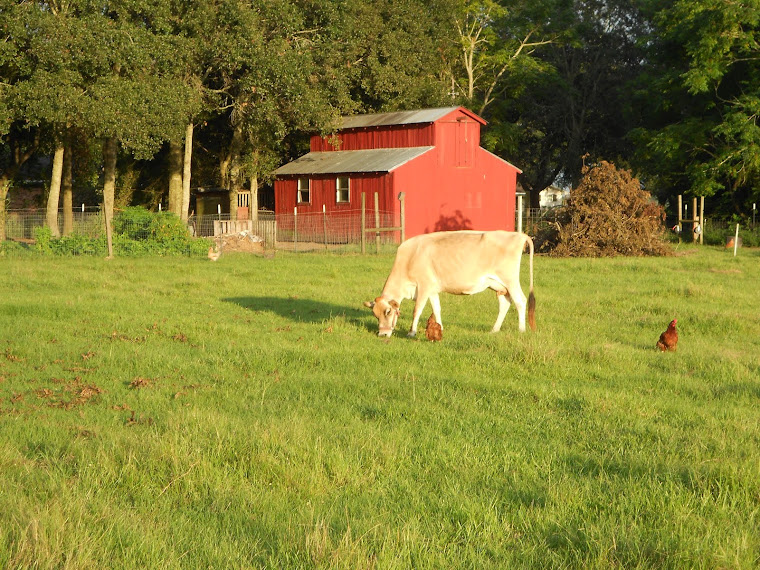
When you've found where they are growing, you can continue to return time and time again to collect additional mushrooms.  Russ took many pictures of the immense quantity of mushrooms he harvested.  We tried, unsuccessfully, to inoculate an area in these woods with Chanterelle spores, but up to this point, we've been unsuccessful in getting Chanterelles to grow.  The oysters are doing just fine, though.  The trick is to make sure you check 'your spot' often, because some of these, like the ones on the bottom at the center right of the photo below are past their prime.  Russ just picked the ones that were in good condition.  We didn't weigh them, but he had a nice harvest.  (You can see our red barn in the background.) 


Russ brought them inside and cleaned them up.  Since they are in the woods, they'll have some sticks, leaves, and small bugs on them that you want to clean up before eating.  

Oysters ready for the skillet
Then he put them on a cutting board and cut them all up.


He promptly heated up a cast iron skillet and dropped some butter, garlic, onions, cream and some of our chopped fall tomatoes in and then added the fresh chopped up Oyster Mushrooms.  He ate the entire skillet by himself!  I didn't get to eat a single one!  Tricia made another batch for us tonight, though.
Freshly foraged Oyster mushrooms cooking
While the mushrooms were cooking, Tricia made some homemade pasta.  It is so much better!  When the mushrooms were done, the creamy mushrooms were spooned on top of the fresh pasta, with a side of some of the last green beans of the season until spring.  We thanked the Good Lord for providing great food for us to eat.  What a meal!


In yesterday's post, we talked about eating 'tuna' from a cactus and today we're eating oysters off of a tree!  "Seafood" from dry land!  It is so interesting how there are lots of edible goodies all around us - delicious treats right under our feet, just waiting to be found and eaten.  It's a garden you never have to water or weed.  How cool is that? 
Tuesday, September 15, 2015

Learning to Like Beef Liver!

There are many foods that I had an aversion to when I was younger that I have completely changed my mind on and now absolutely love them - Brussels Sprouts, spinach, mustard greens, are a few that come to mind. There are some food items that I avoided as a kid, like mayonnaise, that I can actually eat in moderation now.

There are a few foods that I am desperately trying to like, but haven't been able to coax my taste buds into enjoying them yet.  Raw tomatoes is one of those things.  I fully realize that admitting to not liking to eat a homegrown tomato, freshly picked and sliced with salt and pepper is akin to a blasphemous or heretical statement.  I can devour raw tomatoes in Pico de Gallo and cooked tomatoes in any form, but sliced, raw tomatoes have not beholden themselves to my taste buds-Yet! But I'll keep trying.

Organ meats are a mixed bag with me.  Chicken livers are wonderful.  It is such a treat to have fresh chicken livers for supper, fried in butter in a cast iron skillet.  I love them.  Beef liver?  Well, that is another matter altogether - until last week.  As noted in THIS POST we butchered one of our grass-fed steers and have all the organ meats - one of those being beef liver.  We figured we'd give it a try and Tricia discovered THIS RECIPE: Beef Liver with Fig, Mushroom and Caramelized Onion Compote.  It came from a blog called the Healthy Foodie.  We'll walk through the steps and review at the end of the post. Here are the ingredients:

INGREDIENTS
Now, we altered the recipe to include only things we had on hand, making the substitutions shown above in parenthesis and also adding butter instead of bacon grease.  First, marinate the liver in the juice of a lemon for a day in the fridge, then while your skillet is heating up with butter, wash off the liver under running water and pat the liver dry.

Washing the beef liver.  Does not look appetizing - At All!
Mix the flour, salt and pepper in a bowl and dredge the liver in the flour//spice mixture until thoroughly coated.
Dredging with flour
When the skillet is really hot, add the liver to the sizzling butter and sear it for around a minute.  Note that the color of the beef liver is an unappealing drab grey.

Searing side 1
Then flip to the other side to allow a good sear on the reverse side.  This takes about a minute as well. You'll note that they turn a nice golden brown.

Searing side 2
Remove the liver to a covered plate to keep it warm.  Now go to work on making your caramelized onion & fig compote.  Over medium high heat, add more butter and add two large onions sliced to the skillet.  Allow them to cook down for a a bit.

Putting the onions on
After allowing the onions to caramelize for about 10 minutes, we added to the onions the mushrooms and then our own dried figs that we showed you that we made in THIS POST.  

Adding mushrooms and dried figs to the mix
Finally we added the apple cider vinegar and water, stir and cook for a minute or so until the liquid is evaporated.
Apple Cider Vinegar joins the party
Then we place the liver back into the skillet atop the onion, fig, and mushroom compote, allowing the liver to heat back up after its siesta in the plate.

The livers are re-introduced
We'll turn the heat off while the flavors mesh together and get cozy.  I spooned some of the onions, mushrooms, and figs on top of the beef liver so they could get to know each other better.

Ready to serve!
The review: It would be a misleading statement if I were to tell you that I didn't have some hesitation in eating it.  It was Beef Liver, after all, a dish that has a negative perception in my mind, for reasons unknown to me.  However, the color was right, the smell was good and the caramelized onions, mushrooms and figs beckoned me to give it a shot.

I placed a piece of the liver on my plate and heaped the onion, mushroom, and fig compote on top, thinking that the 'candy' would mask the underlying liver.  First bite: The liver was surprisingly tender.  I was expecting a texture similar to a shoe sole, but it was anything but.  I learned that it is very important not to overcook beef liver as it gets tough.  The onion, mushroom, and fig compote who played a supporting role, risked over-shadowing the lead actor with its delicious and sweet (thanks to the figs) taste.  A fork-full of liver and the compote was a match made in heaven, though, complimenting one another.  This was a hit at our house.  Two thumbs up from Tricia and I with an abstaining vote from Benjamin (Ha!)  Russ loved it too and actually brought all the leftovers back to college with him along with a package of liver for him to cook while at college.

Not only is beef liver good, but it is good for you!  Here's what the Weston A. Price Foundation says about it:

So what makes liver so wonderful? Quite simply, it contains more nutrients, gram for gram, than any other food. In summary, liver provides:

  • An excellent source of high-quality protein
  • Nature’s most concentrated source of vitamin A
  • All the B vitamins in abundance, particularly vitamin B12
  • One of our best sources of folic acid
  • A highly usable form of iron
  • Trace elements such as copper, zinc and chromium; liver is our best source of copper
  • An unidentified anti-fatigue factor
  • CoQ10, a nutrient that is especially important for cardio-vascular function
  • A good source of purines, nitrogen-containing compounds that serve as precursors for DNA and RNA.

We approve of this dish and will make it often.  I can honestly say I now like beef liver!  Perhaps next summer I'll be able to say the same for homegrown tomatoes???

Monday, July 20, 2015

Wild Mushroom Soup

A friend of ours grows a number of things and sells them in a couple of Farmer's Markets in the area. We grow things for him like Bok Choy Asian Greens in the winter and also provide him with eggs. He has recently gotten into growing and harvesting mushrooms.  He dries them in a dehydrator and sells them at the market, and he gave us some to try last week.  I wish I could remember the name of the mushrooms, but I can't.  Needless to say, it is important to be able to differentiate the edible ones from the non-edible ones.

Dried Mushrooms
In order to rehydrate them, Tricia let them soak all day long in a bowl of water.

Soaking mushrooms
Using a slotted spoon, Tricia fished out the mushrooms, but don't throw away the 'mushroom broth,' that's the best part.  Once the mushrooms were out, Tricia cut them up, sauteed them in butter, added onions, garlic and celery and continued to saute them until they were all happy.

Sauteed mushrooms with onions, garlic, and celery
 Then add 1/4 cup of flour to the pot to thicken.

Thicken with some flour
Tricia lined a container with a coffee filter to strain out any sediment and poured the mushroom broth into the container.  Notice how rich and dark the mushroom broth is!  This is what makes the soup so flavorful.

Wild Mushroom Broth
Pour the mushroom broth into the pot of sauteed mushrooms & vegetables.

Adding the broth
Allow the soup to simmer for about 15 minutes then add some heavy cream that we skimmed off the top of the morning milk.
Wild Mushroom Soup is on!
A rich and flavorful wild mushroom soup made with nature's finest ingredients really hit the spot tonight!

Friday, August 1, 2014

Foraging for Chanterelle Mushrooms in South Louisiana

A good friend of ours has some land just east of our home that is on Bayou Nezpique. Since it sits on the bayou, it is obviously low-lying acreage, but the land has a gradual rise and a heavily wooded property thickly populated with old growth oak, cypress, tupelo gum trees and palmetto.  It just so happens that it is a perfect area for chanterelle mushrooms!  Our friend allows us to go foraging for mushrooms on his land and we happened to go out earlier this week on our first foray for chanterelles. The friend is part of a mycological society and is knowledgeable on what to look for and was eager to pass along some knowledge.

Honestly, mushrooms always have scared me as some are indeed deadly, but our friend taught us to just be able to positively identify the two main edible mushrooms that grow in our area - Chanterelles and Oyster Mushrooms.  Today we'll show you how we foraged for chanterelles.  We drove the short 5 minute drive to his land and arrived around 7:30 pm after the milking was done and things had started to cool off a little.  We had to rush since the sun was quickly going down.  Since we were walking in the woods under a thick canopy of leaves, it was dark, so please forgive the quality of my pictures.

We first made sure to wear boots as there are snakes in the area.  We also each broke off a stick and waved it in front of us as we walked as Banana spiders weave huge webs that I don't want to walk into and certainly don't want one of those big fellas to fall on me.  There are numerous wild hogs out there and we crossed trails that they had made through the undergrowth.  Russ chased an armadillo that was rooting around for grubs.  We also heard owls hooting.  Tricia wasn't particularly thrilled to be trekking through the woods with all these critters, but she's a trooper and stuck with it.

I guess the first thing that amazed me is the fact that we have delicacies all around us that we literally walk past every day without realizing the worth.  I've spent lots of time in the woods and have seen chanterelles and walked right past them or maybe even kicked them over.  All that changed today.  I'll not walk past them again.  It didn't take long before we spotted some!

Chanterelles!
Chanterelles grow in the dirt - never in wood, so you should walk around slowly, with your eyes sweeping the forest floor.  (Good protection against stepping on snakes, too.)  The chanterelles range in color from light yellow to orange and rather than having a toadstool appearance, they are fluted, having a trumpet shape. You can also see on the ground an unripe, green muscadine that has fallen out of the tree.  These wild grapes grow like crazy out here and I assume squirrels or birds have knocked them off the vine prematurely. Chanterelles most often appear from July - September and normally right after a rain, so we are in the prime season for them.

Chanterelle and muscadines
Mushrooms are a fungi and we learned that the mushroom itself is the "fruit."  The actual fruit is produced by the mycelium.  The mycelium is the vegetative part of the fungi that is like tiny threads, or roots that you can't see.  So what you want to do when you see one is to cut it instead of pulling it so that you leave the mycelium intact to grow more.  Also, when you see one, look around closely, because there will be more, hiding under leaves.  You want to be real careful to not step on them or compact the soil.  Remember where you found them and check back in a few weeks for more.  Below is a most beautiful chanterelle and is exactly the color of homemade butter made from grass-fed Jersey cows on new growth grass in Springtime!

Just like Butter!
The best way to store mushrooms is in a paper bag.  If you store them in plastic they won't be able to breathe.  When we got home, we took showers to get rid of the itching from the mosquito bites and spider webs in our hair and we opened the bag to admire our harvest.

Bag of goodies!
We weighed them and found that we had picked right over a pound of chanterelles.  A quick search showed the market value of chanterelles being anywhere between $26 - $40 per pound.  I assume that the price for them is so high because they are very hard to cultivate and are most often just found in the wild.  We're not going to try to sell any of these though.  We're gonna eat them!

A little over a pound
And here are the spoils of victory from our first forage for Chanterelle mushrooms all laid out on the counter:

Admiring our golden treasure.
You can see the trumpet shape of the chanterelle below:


And here is a very good illustration of another identifying mark of a chanterelle - they don't have gills like other mushrooms.  They have wrinkles instead, or ridges.  I'm told that chanterelles have a fruity fragrance, like that of apricots, but my sense of smell must be lacking as I only pick up an "earthy" scent.

Wrinkles of the chanterelle
And here are a couple of twin chanterelles, promising to be double good.


We brushed these off to clean them up and then we'll saute them in a cast iron skillet with some butter, sea salt and a splash of red wine.

Into the skillet
And they'll nicely pair with some pot roast with new potatoes, rice & gravy, sauerkraut and gingered carrots.

Supper time
Here's a close-up of some nice sauteed chanterelle mushrooms, just picked from the forest floor just west of the Bayou Nezpique:

Chanterelles for supper
These were simply delicious!  We also cook them with pasta and fresh vegetables, and I'm thinking they'll be outstanding in an omelet made with fresh picked eggs from our hens. In summary, we learned a lot and found a real 'honey hole' full of nice chanterelles that will provide us a few good meals that we will savor and enjoy. We also forage for Oyster Mushrooms in our area.  Check out THIS POST to see how we harvest the oysters.


Related Posts Plugin for WordPress, Blogger...