Showing posts with label leaf-footed bugs. Show all posts

Sunday, May 29, 2022

The Trouble with Tomatoes

Here is Tricia's Mother's Day bench.  She wanted this bench placed in this very spot so that she could sit in the shade, drink coffee and watch the garden.  It is a peaceful spot, for sure.  If you could add audio to this photo, it might not seem quite so peaceful.  There's a goat that's not quite weaned that's hollering for a bottle, roosters are crowing, cows are mooing, dogs are barking.  But you know what?  It is still a peaceful, nice spot.

The garden looks nice from that serene, pastoral spot.  But just beyond the picket fence, there's a sinister plot brewing.  Annie, the Nubian goat, despite my best efforts at barricade building, has been successful in a scheme of craning her neck over the garden fence.

She's snipped off three branches of a Cherokee Purple tomato plant and devoured it!  Annie's antics cost us in tomato production.  I'll be fashioning yet another panel to thwart her from doing it again.  You've always got to be thinking three steps ahead with these goats!

If we are successful keeping the goats out of the garden, we still have quite a time with worms and bugs.  That's why I've started to pick our tomatoes when they just start to turn a pinkish color.  I put them on a platter inside and let them ripen indoors.

The label you hear about "vine-ripened tomatoes" sounds great, but I've found that if you leave them to ripen on the vines, the bugs and worms (and goats) will get far more fruit than we will.  Here's one of the culprits I'll introduce you to: The Stink Bug!  It's called that because if you squash it, it emits a nasty odor that really stinks.  These boogers will sting the tomato and cause scarring and discoloration.  Bringing them inside before ripening betters your chances.

Let me introduce you to another villain: The leaf-footed bug.  See him on top of the green tomato?  He stings the tomato and causes scarring to the tomato.  Secondary pathogens enter the opening in the fruit where the leaf-footed bug damaged it and causes the fruit to rot.

There are things to kill these bugs, perhaps, but we don't want to spray poison on the food we'll be eating.  Harvesting early seems to be the trick.

Another thing we have to watch is growth spurts after rains.  After a rain, and the sun warming things up, the tomato will grow so fast that it rips the skin open.  The fruit grows so fast that the skin can't keep up.  Look at an example of this below.  Can you see the long cut?  That's from rapid growth.  

We're picking 8 to 10 tomatoes a day right now.  They turn red quickly indoors and then those we don't eat or cook with, we put in the refrigerator.  Pretty soon, we'll be canning them and drying them.

Monday, May 25, 2015

Cucumbers and Critters

Our cucumbers are planted on the very highest part of the garden.  With all the rain we have gotten that is a very fortunate place to be planted.  The cukes are thriving due to the well-drained soil. Unfortunately the tomatoes and potatoes and corn that were planted on lower land are really struggling.  Their "feet" stay wet, and their foliage is yellow.  There's more rain on the way all this week.

Let's focus on the positive, though.  Look at how healthy the cucumbers are.  The leaves are broad and green and they are climbing up a cattle panel that I've positioned for them to grow vertically.

Cucumbers
The leaves have almost completely shaded out the panel, allowing only slivers of light through and making the front part of the garden resemble a tropical rain forest.

Made in the Shade
There are lots of blooms and that lets you know that lots of cucumbers are on the way.  Here is one below that is about four inches long right now.  It is a Japanese Long Cucumber, so it will grow much longer.  They are long, skinny and don't have many seeds.  They are crisp and tasty and very refreshing to eat on a hot day.

Japanese Long Cucumber
The vines of the cucumber send out tendrils.  They look like springs and they reach out and grab onto the trellis and hold tight.  The spring-like tendrils give the vines some flexibility when strong winds blow.

Spring Action
Here is a very small cucumber of the Boston Pickling variety.  These are small and crispy and as the name states, they are great for pickling.  Last year we didn't pickle any.  We didn't have a great crop of cucumbers for some reason and we ended up eating them all fresh with vinegar, salt and pepper.

Boston pickling cucumber
In the morning there are tons of yellow flowers.  Now it is important that we have bees and other pollinators doing their work at this time and we have some news to report on that.  The honeybees that have inhabited the column near the side door to our house have recently packed their bags and moved out.  The side entrance is now much more hospitable to our guests without a swarm of bees buzzing around, but we miss the bees.  I enjoyed having them do their job pollinating in the garden and around the yard.  Although I don't have the time nor desire to take up beekeeping, I'm going to ask a friend if he'd put a box of bees on our property to pollinate our crops.  I need some worker bees to take the place of our bees that left.

Cucumber flower
As I was observing the multitude of flowers, something else caught my eye - a bunch of bugs crawling all over the vines, tendrils, and flowers.  Can you see them? They are orange, with long legs and long antenna.

Orange-colored bugs
They were all bunched up on the top of one leaf.  Usually there is safety in numbers, but in this case, it doomed them.  They were in perfect position for me to reach my hands out underneath and on top of the leaf and with one swift clap, I smashed the bugs to smithereens.  And it is a good thing I did. You know what kind of bugs these are?

A bunch of bugs
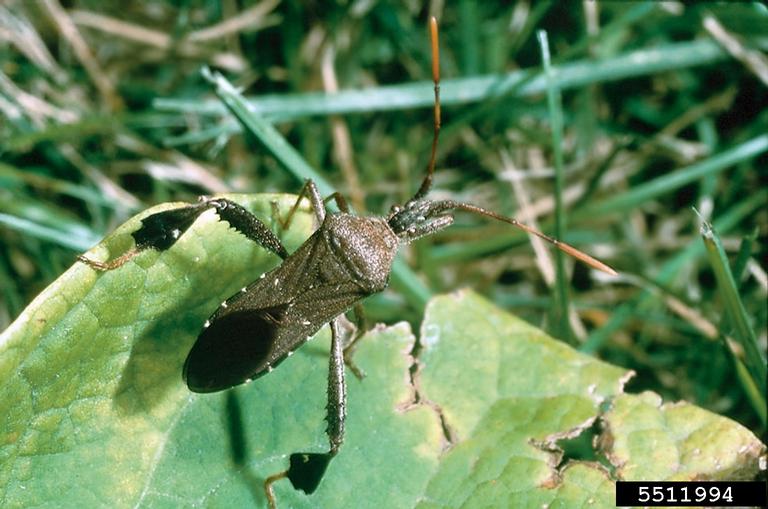
These bugs are juvenile leaf-footed bugs.  When they mature they look like this:

Image Credit
If you look at their hind legs, you can see how they got their name.  These bugs wreak havoc on tomatoes, stinging them and sucking out moisture, leaving the tomatoes scarred and ugly.  They cause damage to citrus crops, too, stinging the fruit and causing it to drop.  I've got to do my part in reducing their number, so we avoid the damage they cause.  I'll patrol the garden and kill the juveniles before they grow up.

Friday, December 12, 2014

A Bug's Life

A few days ago, Tricia and I poured a cup of coffee and walked around the yard. Sometimes we move so fast doing all sorts of things, that we just enjoy slowing down and taking the time to observe our surroundings.  Sometimes some of the most interesting things are right under our noses, but we don't take the time to observe and take it all in.

As we were walking, I happened to look up toward the eaves on the northern side of our home and something caught my eye.  It looked like a swarm of bees that was "bearding" and had attached itself to the side of the house.  Wow, are we being taken over by more bees?  I like our one colony, but I don't want more...

What is this?
As I looked closer, I noticed that whatever it was, it wasn't only on our roof, but on the side of the house as well.  And it's not bees.


It's a bug
As I looked a little closer, I saw exactly what they were: they are Leaf Footed Bugs and there are hundreds and hundreds of them.  In the close-up below, you can see why they are called leaf-footed bugs.  They have little thing on their back legs that looks like a leaf.  Sort of cool looking, but if you grow tomatoes or citrus, you know that these things are wretched creatures.

Leaf footed bug
Like a plague, they arrive and feed on your crops.  They are related to stink bugs and have a piercing mechanism on their mouth that allows them to pierce vegetables and fruits and suck the juice out of them. Their natural predators are birds, spiders and assassin bugs. 

I learned that the reason that they are piled up like this is that in the fall they bunch up in the piles you see above and below to overwinter.  Those groups are called aggregations, but I think I'll call them aggravations.  If they are still there this evening, I'm going to kill them all so they won't be around to inflict pain on my tomatoes and citrus in the spring.

RIP Leaf footed bugs
All these bugs might make you think that we have plagues of insects in Biblical proportions that sweep through and devour our crops, but believe it or not, there are some good, beneficial insects around our place.  Take for instance this fellow:

Let us prey!
A Praying Mantis!  He was on the bricks right below the leaf footed bugs.  And there was another out on the gate post going into the pasture.  They are such curious looking bugs!

The Praying Mantis
They don't actually pray (that I know of).  They actually prey on other insects like mosquitoes, flies, crickets, and moths.  The link I posted above says that they have been known to kill lizards, small mammals and hummingbirds.  Wow!  That would be something to see!


While I want to reduce the population of leaf-footed bugs, I'd certainly like to see the Praying Mantis population increase substantially.  We need more good bugs around the place.  We don't use pesticides so having a bunch of praying mantis' around would be a good thing.  If you look in the background of the picture above, you can see the green of the fall garden.  Perhaps this Praying Mantis hanging out on the gatepost is letting me know that he's raising a brood of beneficial insects to help me control the bad insects.  We'll see...

Related Posts Plugin for WordPress, Blogger...