Showing posts with label fat. Show all posts

Monday, October 28, 2024

The Fat Cows

It hasn't rained since September 11 and even on that day, it only rained 3/10ths of an inch.  It's dry.  I water the garden every single day.  The rain barrels that I sequester rainwater from are all dry and have been dry for several weeks.  The grass in the yard is dead or dying.  The pasture, up to this point has held up nicely, but when I walked in the pasture today, the bermuda and bahai grass is thirsting for some rain.

There is a chance on Thursday and Friday of this week for precipitation.  We are watching that very closely and praying for Showers of Blessing.  With the grass in the pasture on its way out and the onset of cooler temps of winter coming, we begin to think of the cows.  How will they fare through the winter?  We do give them a little sweet feed and alfalfa, but mostly they're on grass throughout the spring and summer.

For the fall and winter, we've put up 75 bales of premium bermuda hay in the hay loft.  We actually still have four bales of last year's hay that we're giving them each day.  We also purchase round bales of hay that we roll out and allow the cows (and goats) to eat free choice on.  We've found that one round bale will last about a week.  We have an inventory of nine round bales covered in tarps and ready to roll out when needed.  The cows have some grass to clean up in the pasture.  In the next few weeks they'll eat that all up.

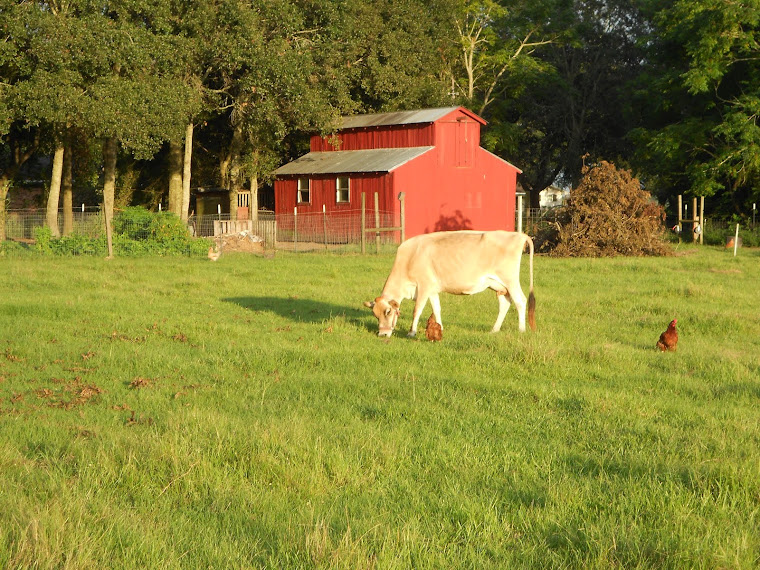
It's important that the cows are in good condition going into the winter, and I have to say that this year, the cows are well fit, perhaps in the best condition they've ever been in at this point.  I really couldn't tell you what the difference is.  Here's Rosie.  Rosie is 15 years and 8 months old!  That's OLD for a Jersey cow.  She just went into heat last week.  We put her with the bull and witnessed her in standing heat.  We think he bred her, but we'll check in a few weeks to see if she goes back into heat.  We have the date on the calendar.  The bull is still young and he's short.  We don't know if he was able to reach.  Only time will tell, but it sure would be nice to get another calf out of Rosie.  She's been such a good girl.

And here's Elsie.  I don't have a way to show perspective, but this heifer is huge.  She's big and fat!  And she is rambunctious.  She runs around like her tail's on fire.  It's actually dangerous to be around her.  You have to keep your head on a swivel.  She did not get bred last year.  The vet found a cyst on her ovary and took care of it.  We are trying to have Nicky the bull breed her this year.

We put them together and hopefully it took.  We've been watching for her to come back in heat, but so far nothing.  Hopefully, that means she's carrying a calf.  That's good for a number of reasons.  First, we need calves and we need more milk as we're about to dry up LuLu.  Second, if she calves, we're hoping that will mellow her out and she'll stop being crazy.  Finally, if she isn't able to get pregnant, she's going to go into our freezer.  I hate to be so harsh, but we just can't have an animal unable to calve or give milk continue to just eat grass.  Elsie, you're on the clock!

LuLu, on the other hand is a little skinny (I don't have a current photo of her), but she's been in milk for over a year and a half.  It's about time to dry her up and allow her to build up again.  We put her together with Nicky when she came in heat and we'll see if she comes back in heat.  It sure would be nice to have 3 spring calves!

Monday, January 11, 2021

Rendering Tallow for Soap-making and Cooking

Last night we posted about bring home meat from the slaughterhouse.  We not only bring home meat, but fat and bones. The first thing we elected to do to free up some in the freezer is to render the fat.  It doesn't sound like a pleasant experience, but it's not too bad.  What it does is turn a 'waste product' into something useful - valuable even.  As we expressed earlier, when you bring an animal to slaughter, it is yours.  You can keep everything except the "moo."

Here's how we do it.  We open the bag of fat.  It is not particularly nice to look at.   

We begin by filling the biggest pot we have on the stovetop with pieces of fat, turning the stove on to heat it up.  At first the stove is set to high and then later to low. As it heats, the fat liquifies.  It takes a couple of hours, tops.

While hot the clear fat is poured through a cloth lined sieve and into casserole glass dishes.  This separates out the meat (beef cracklins) from the fat.  

Here is a photo of those 'beef cracklins' left over after the fat is rendered.  A little this goes to Belle (our dog).

Once the tallow has cooled, it turns a creamy white color.

We put the tallow in the fridge to make it cold.  We find it cuts better that way.  Then we begin cutting it into squares.  

We bag up those squares into gallon-size freezer bags, label them, date them, and put them in the freezer for storage.

As we need them, we remove and use.  Use the tallow as a cooking oil, similar to what you'd use hog lard for.  We also use it in soap-making. 

Although we didn't get the step by step picks, during the fat-rendering process, we also are boiling the bones to make beef broth.  We add carrot tops, onions and peppers and cook on the stovetop for two to two and a half days.  In the end, the result is rich beef broth which we can in a pressure cooker for later use.

This will be used as a base for soups and gravies.  Using this in place of water when cooking rice is a game-changer.  


Monday, October 7, 2019

Rendering Tallow

When you bring an animal to the slaughterhouse, the entire animal is yours.  You can ask for anything you want off of him and they will bag it up and send it home with you.  We always ask for the bones and the fat in addition to the meat.  The bones are roasted and boiled to make a nice beef broth.  That can be used as a base for soups.  You can use it in place of water when cooking rice to make your rice taste richer.

The fat is another thing we ask for as we make beef tallow from it.  In THIS POST FROM 2015 we take you through the steps of rendering beef tallow.  You can click on that link for the whole process, but today we'll show you the end result. 

The bull we brought to slaughter this year wasn't skinny, he was just real lean.  All muscle.  Not much fat.  A certain amount of fat is needed when making ground meat and half of him was used for ground meat.  In the end, we just had one small bag of fat for making tallow.  Tricia cooked it down on the stove until most of it liquefied and then poured it into a pyrex baking dish.  It was transparent at that point.  Then it was put into the refrigerator and it turned into a creamy white color with a tinge of yellow. 


We cut it up into chunks and put into a gallon-sized zip loc bag and then put in the freezer.  As needed, we'll pull out a square of fresh rendered beef tallow.


So what do you use beef tallow for?  Well, use it in place of cooking oil.  Tricia keeps a little ramekin of beef tallow by the stove that she uses.  Lately, we've been using it to make homemade soap.  We've made three batches so far and it has put a dent in our inventory of tallow.  Since Astro the bull was very lean and we were only able to render one pan of tallow, we'll have to contact a friend who brings calves to slaughter and see if he'll give us a big bag of fat.  Until then, we'll ration this tallow and/or slow down on the soap-making.

Tuesday, September 4, 2018

Using Everything Except the "Moo"

A couple of years ago when we butchered a steer, we asked the people at the slaughterhouse to save us all the fat.  We believe in using as much of the animal as possible.  We use everything except the "moo."  The steer was fat and we actually had too much fat!  Last year when we brought our Jersey bull calf to the slaughterhouse, we asked them to save the fat again.  Chuck, the Jersey bull, was a leaner animal.  A lot of his fat went into the ground beef, but we still were able to get some and freeze it in big bags.

This week Tricia thawed it out and began processing it.  She placed the fat in big pots on the stove and began heating it up, letting it cook for most of the day.  No, it doesn't look too nice.


Much of the fat liquefies into oil.  The remainder reminds me of cracklins.  This job is probably best done outside, but the mosquitoes are terrible right now and it is terribly hot.


We try to spoon out most of the remaining fat that wasn't converted to oil and then we pour the oil through a muslin cloth stretched over a colander to filter the rendered fat.


What we are left with is clean cooking oil rendered from beef fat.


While this is still hot, we pour into a Pyrex cooking dish and set aside on the counter and allow to cool.


The remaining 'nastiness' that is made up of fat, gristle, meat, cartilage, bone, etc. is gradually fed to Big Boy.  He seems to like it, despite the fact that it doesn't look appetizing.


As the beef tallow cools, it loses its transparent quality and becomes as white as a bar of Ivory Soap.  The work is almost done.  We now cut up the beef tallow into squares.


Using spatulas, we scoop the tallow out and place into zip loc bags where they will be frozen in the deep freeze.

As we need cooking oil, we'll pull a square or two out of the freezer and heat in a cast iron skillet.  With heat added, the beef tallow becomes cooking oil again and can be used the same as any other cooking oil that you might use.


Using beef tallow reminds me of what many people grew up watching their moms and grandmothers do.  I can remember bacon grease being poured in a coffee cup or can to be used as cooking oil later on.  It would turn snow white and then a spoonful could be scooped out and put in a skillet to add wonderful flavor to whatever dish happened to be on the menu.  Fat doesn't have to be a waste product that is thrown away. 

Wednesday, August 19, 2015

Yellow Fat from Grass Fed Beef

We have been enjoying the beef from the steer we butchered back in April.  There really is a difference in the taste of grass fed versus store-bought meat.  We should have done this a long time ago.  The only thing about having a freezer full of beef that gives me pause is the fact that we don't have a generator to back up our deep freeze and with Tropical Storm Danny brewing way out in the Eastern Atlantic, it makes me a little nervous, but we'll cross that bridge when we come to it.

We really like the beef short ribs.  Tricia will bring them to room temperature and add some kosher salt and pepper to them.  


She puts them in a cast iron dutch oven and sears them.


The picture below highlights the topic of this post.  Notice that the fat is yellow.


Why is fat from Grass Fed Beef yellow and why is the fat from store-bought (feed lot) beef a pearly-white color?  Good Question.

I learned the answer from reading THIS ARTICLE and it was what I suspected, but before we get to what causes the coloration, the article said this:
Fat can be a wonderful thing.
Fats can be the most nutrient rich part of your diet, or they can cause numerous diseases – depending on which fat we’re talking about.  What an animal eats will change the kind of fat in its tissues.  If an animal eats a suboptimal diet including grains and legumes, its fat loses much of its nutrient quality in surprisingly little time.  
That sounds like crazy talk, doesn't it?  We've been accustomed to hearing that fat is bad for you.  To avoid fat.  Fat is unhealthy.  But the above study runs counter to that.  Hmmm...  Also, verses in the Bible seem to confirm that fat is a good thing. Take this one, for example:

Then Pharaoh said to Joseph, “Say to your brothers, ‘Do this: load your beasts and go to the land of Canaan, and take your father and your households and come to me, and I will give you the best of the land of Egypt and you will eat the fat of the land.’ - Genesis 45: 17-18

The Pharaoh liked Joseph.  He wasn't telling him that his family was going to get the scraps.  The fat of the land is a Good Thing.  Fat, if the animal ate a good, grass-fed diet, is a good, healthy, nutritious part of your diet.  I can remember being a young boy and we'd slice all the fat off of the meat.  My great-grandmother would sit at the end of the table and say, "You're not going to eat that? Pass that down here."

My great-grandmother was onto something!  The article mentioned above states that their study showed that grass-fed beef contains more Omega-3s and Conjugated Linoleic Acid (CLA) than grain fed meat.  There is also Omega-6, Cholesterol, and Transvaccenic Acid (TVA) as types of fat. Interestingly:
Trans-vaccenic acid is metabolized into conjugated linoleic acid, and performs similar functions.  It can speed fat loss, fight cancer, and improve brain function. It is technically a naturally occurring “trans-fat” but it does not cause the same the negative health problems that margarine or hydrogenated fats do.
Wow!  Fat from grass fed beef is good for you.  So finally, the answer to my question: Why is the fat from Grass Fed Beef Yellow?:

The grass-fed meat had higher levels of carotenoids, making the fat appear yellow.  Generally, the more carotenoids in a substance, the more nutrients it contains.  Yellow fat (like grass-fed butter) is a sign of high nutrient density.  One of the things you’ll notice when cooking grass-fed meat is the yellowish color of the fat.
More carotenoids = more antioxidants+nutrients (and more flavor too).
Generally, colors in food mean that it is healthier for you.  Speaking of colors, I liked the colors (and flavor) of the beef short ribs.  Here's a picture taken before Tricia stirred it all up:

Healthy AND Colorful!
To sum up the article (read it if you get a chance), their study said: 
When it comes to meat, grass-fed and grain-fed don’t even compare. Go grass-fed, every time.
We're sold on it.  Grass-fed Beef.  It's whats for supper.

Tuesday, May 12, 2015

Our Own Grass Fed Beef - Rendering Tallow (Part 3)

In Part 1 and Part 2 of our blog posts, we talked about us taking a grass fed steer from the farm to the slaughter house and we showed you our freezer loaded up with meat and organ meats.  We will show you today another product that we got - beef fat.  Well, that sounds disgusting, doesn't it?  Why would you want beef fat?  We'll show you in this post.  We were able to get several bags of fat from the steer.

Now, there are numerous uses for beef fat or tallow, but first you have to process it or render it.  You probably grew up where you can remember your mom or grandma would save the bacon drippings from frying bacon and keep it in a coffee cup or tin can near the stove.  Those drippings would serve as the fat or oil to fry things in similar to Crisco. Tallow is the same thing, except from a beef animal instead of pork.  Here is the first of several bags that we will be working with.

A big bag of fat
You want the fat to be slightly frozen as it is easier to work with.  This is not a job for the squeamish of heart or someone who is a 'clean freak' because it makes a big mess.  Simply take pieces of semi-frozen fat out of the bag and using a sharp knife, cut off any pieces of meat or blood.  You want the fat to be simply fat and nothing else.

The first batch
After trimming the meat and blood off of it, I cut the fat into pieces about an inch square.  I then threw it into the food processor.  I learned, though, that it wasn't frozen enough and it made a big 'gloppy' mess.  I learned that the food processor step is really unnecessary as long as you chop up the fat into small enough pieces.  I probably won't do that step again.  It's one more item to clean.  Plus, it has to be hard on the food processor.

Chopping into mush
I simply took the cut up fat and put in into a large pot and turned the heat on medium.  After a while the fat will liquefy.  Be sure to stir every once in a while so that it doesn't burn.  

Heating things up
It's best to keep the lid on the pot and the vent hood running.  The smell isn't bad, but it is not pleasant.  After it is bubbling pretty good, I turned the heat down to low and just let it cook and cook, while stirring occasionally.

Cooking it down
When crispy pieces float to the top and the bottom of the pot contains clear liquid, your work is done. I pulled it off of the stove top and got a metal colander.  I cut up a t-shirt and laid it on the bottom to serve as a filter and then carefully poured the very hot contents of the pot into the colander.  The liquid filtered through the shirt and into the measuring container.

Filtering the oil
The filter/colander caught all the crispy pieces of fat.  This is similar to what you get with pork: Cracklins.  In French, they're called gratons or in Spanish, chicharones.

Beef  'cracklins'

What remained was 8 cups of rendered beef tallow in the liquid state.  It was still quite hot.  It was clear as the filter caught every little bit of sediment.

Hot Rendered Tallow
I lined a pyrex baking pan with wax paper and carefully poured the hot contents into it.


I let it cool on the counter for the better part of a day.  It came to room temperature, but wasn't really hardening, so I put it into the refrigerator overnight and it hardened just fine.

Yellow Beef Tallow
We used a knife to cut it into squares like you might do with brownies and then we used a spatula to scoop up the beef tallow squares.


We labeled a gallon sized ziploc bag and began placing the squares of beef tallow into the bag. They'll be frozen and then we can pop them out as we need them.


Tallow from grass-fed beef has fats like conjugated linoleic acid (CLA) and that is very good for you according to the Weston A. Price Foundation.

So what will we use beef tallow for?  Well, it has many uses.  First, we'll use it to fry things in.  I understand that french fries fried in beef tallow is excellent.  Then, we're going to try to make soap. You can make candles with it and you can even make skin care products (balms) with it.  We'll freeze a bunch of beef tallow and try to make several different products with it.
Related Posts Plugin for WordPress, Blogger...