Showing posts with label James Lee Burke. Show all posts

Thursday, October 9, 2025

Jolie Blon (Pretty Blonde)

I've talked several times about one of my favorite authors, James Lee Burke.  I especially like his "Dave Robicheaux" novels with Clete Purcell as his sidekick.  I've read all of them, and I'm going back and re-reading them on audiobook with the Libby App from my library.  I just finished Jolie Blon's Bounce.  James Lee Burke's prose drips from the pages like honey on a summer Sunday afternoon, inviting the reader into the scene being described where you can not only see from the vantage point of the protagonist, but you can smell the scents in the room.  You suddenly are reminded of memories dredged to the surface from another time or place - even from places that no longer exist.

In case you aren't familiar with his work, I've cut & pasted an excerpt that I had to go back and read two or three times:

"A love affair with Louisiana is in some ways like falling in love with the Biblical Whore of Babylon.  We try to smile at its carnival-like politics, its sweaty whiskey-soaked demagogues, the ignorance bred by the poverty and insularity of its Cajun and afro-Caribbean culture, but our self-deprecating manner is a poor disguise for the realities that hover on the edges of one's vision like dirty smudges on a family portrait.  The State roadsides and parking lots of discount stores are strewn, if not actually layered, with mind-numbing amounts of litter thrown there by the poor and uneducated and the revelers for whom a self-congratulatory hedonism is a way of life.  With regularity, land developers who are accountable to no one, bulldoze down stands of virgin cypress and 200 year old live oaks often at night so the irrevocable nature of their work cannot be seen until daylight when it is too late to stop it.  The petrochemical industry poisons waters with impunity, and even trucks in waste from out of state and dumps it into open sludge pits usually in rural black communities.  Rather than fight monied interests, most of the State's politicians give their constituencies casinos and power ball lotteries and drive-by daquiri windows along with low income taxes for the wealthy and 8.25% sales tax on food for the poor."

James Lee Burke
Jolie Blon's Bounce

Ouch!  That's scathing.  James Lee Burke is from New Iberia, Louisiana.  That's 62 miles away from our home.  Only a local can talk this way with an understanding of problems that plague our area in honest terms.  At the same time as confronting painful realities in our state, there is a deep love for its people and the beauty of the landscape.  A heart that yearns for better times and better outcomes.

As I listened to that paragraph from Jolie Blon's Bounce, my mind went back to memories of driving past Cypress swamps that are beautiful as any picture you want to see, and yet, someone has dumped an old washing machine or a black plastic bag full of crawfish heads from a recent boil over the bridge.  I was going to drive out and take a photo to document that, but decided against it.  Nature's beauty, but man has marred the landscape.  Why do we do this?  I don't know or maybe I don't want to know.  

Jolie Blon means pretty blonde.  It's also the name of a song that has been deemed the Cajun National Anthem and may be the most famous Cajun song of all time.  It has been sung by numerous people (Buddy Holly, Waylon Jennings, Bruce Springsteen, and Jo El Sonnier, to name a few) and each made it a little different.  It was first written and recorded in the 1920's, but made famous in 1946 when Harry Choates' French version was recorded.  It has been said that he sold the rights to the song for $100 and a bottle of whiskey.  The song is a waltz.  As you listen to it, you can count 1,2,3  1,2,3 as it draws you to the dancefloor, even if, like me, you can't dance.  It is a sad, haunting song about a pretty blonde that has run off and left him for another lover.  McNeese State University in Lake Charles, LA, named Jolie Blon their fight song and each time the Cowboys score, the Pride of McNeese marching band plays Jolie Blon.  

If you've never heard it, I've attached a You Tube link below to Harry Choates' ENGLISH version where you can hear the sad fiddle and hear the heartbreak of a man who has experienced great loss.  Click the arrow below.  Forgive me in advance if the tune stays stuck in your head like it has been in mine!


Sunday, December 8, 2024

One of My Favorite Authors

My job requires a lot of travel.  On a typical day I'll put a couple a hundred miles on my vehicle.  For the first 30 minutes or so I'll pray until I get to my first stop.  For the next four hours (give or take) I'll listen to podcasts that I have on rotation.  I also have a library card and use their Libby app to listen to audiobooks.  I read a lot of different books by different authors and different genres.

One of the authors that I really enjoy is James Lee Burke.  He writes fiction crime novels, and if asked to describe his work, I call him the "Cajun John Grisham."  That might describe the type of writing, but I think James Lee Burke's writing is better.  It is lyrical, almost, and so descriptive.  If you close your eyes, while listening to the words read by Will Patton, he puts you right on the banks of Bayou Teche where you can hear the frogs croaking and smell the fish spawning.

I especially enjoy his "Dave Robicheaux" series which describe the exploits of Dave Robicheaux, the protagonist, and his sidekick and best friend, Clete Purcell.  JLB's stories weave throughout Acadiana in South Louisiana and into New Orleans.  Many of the towns, sights, sounds and smells are very familiar to me and the characters are real and endearing.  


"By now you've probably gotten the feel of South Louisiana. It's a beautiful place, but it's also a place of endings, or change that's hard to witness.  Many have a love affair with it, the way Dave Robicheaux loves it and almost destroys himself trying to save a lost cause.  Then there are those who have no conscience and abuse its swamps and rivers and marshlands as though they were a trash dump, and that's no exaggeration.  Sometimes when I'm fishing way down on the Gulf at sunset, I'll see an old storage tank rusting into the water, or bamboo flooded with an iridescent reflection that shouldn't be there, or a man-made canal streaming saline into a freshwater forest of gum trees and cypress and tupelos.  It makes me sad.  It makes me feel that I am watching the end of something, maybe even time itself."

- James Lee Burke from "Clete"

On my daily drives, as I'm listening to a James Lee Burke novel and looking out at the landscape around me that perfectly matches the setting of his novels, it's as if I'm right there in the book with Dave and Clete.  His prose is beautiful.  J. D. Salinger, in "The Catcher in the Rye," wrote that "What really knocks me out is a book that, when you’re all done reading it, you wish the author that wrote it was a terrific friend of yours and you could call him up on the phone whenever you felt like it."  
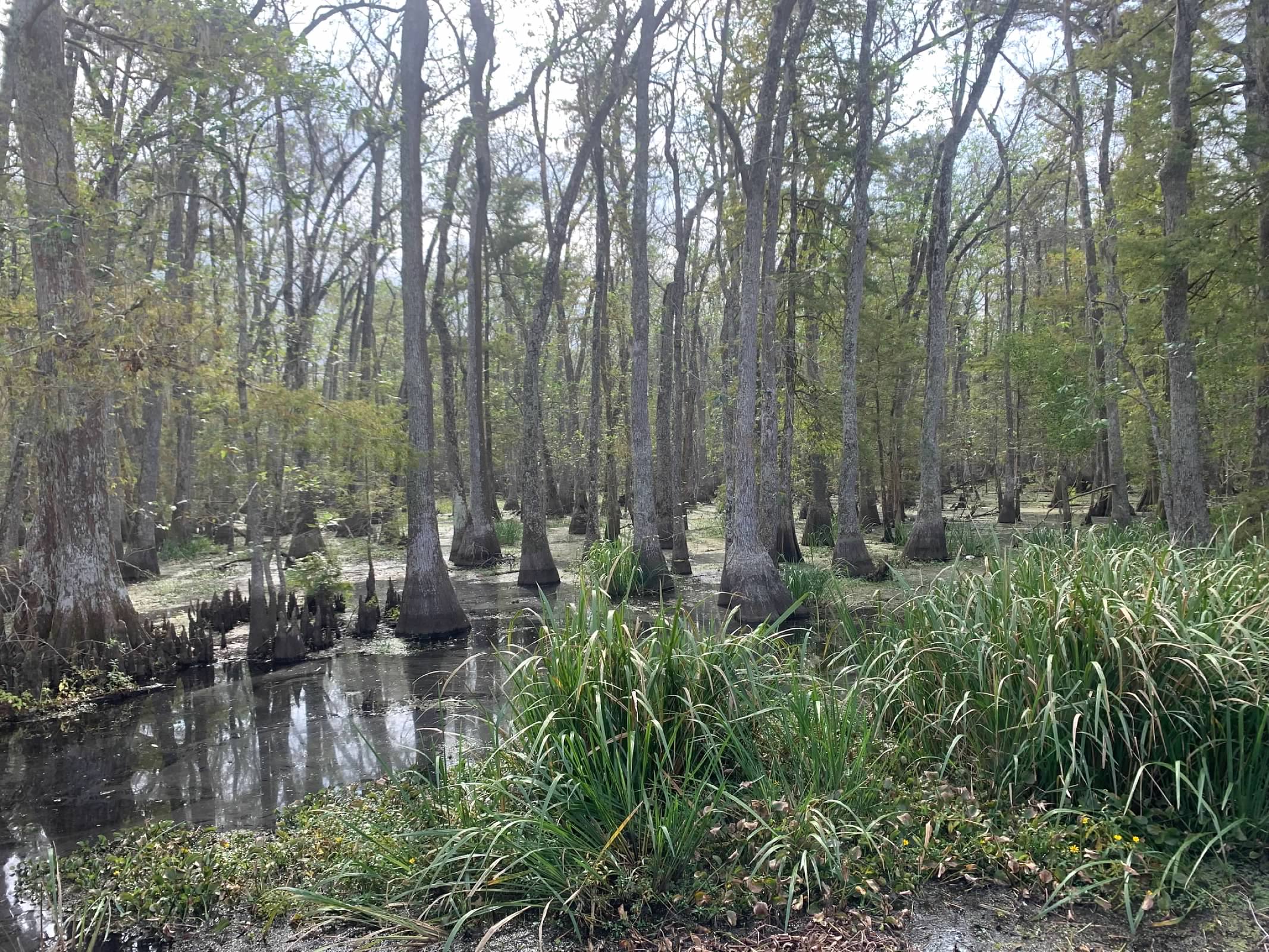
A photo I took last week on LA 14 between Hayes and Lake Arthur, LA

James Lee Burke attended SLI which later became USL (University of Southwestern Louisiana) in Lafayette, LA.  He has a home in New Iberia and thus, is deeply familiar with its people, its culture and its problems.  He speaks of them with brutal honesty, so much so that you go back and read the words again, as they've touched a nerve of familiarity within you.  You immediately understand deeply what he's trying to convey.  They're thoughts you've had, but never verbalized.  There's a certain sadness that you can't explain while reading some of his work.

Sometimes it is hard to explain to outsiders the culture of southern Louisiana and the quandary of many of its people.  The world in which they grew up in is a decaying memory, but many of them have no place in the present.  I know Cajuns that have never been farther than two parishes from their birthplace.  There are people here who cannot add and subtract, cannot read a newspaper, and do not know what the term 9/11 means.  Over 40% of children are born to an unwed mother.  In terms of heart and kidney disease, infant mortality, fatal highway accidents and contaminated drinking water, we are ranked among the worst in the nation.  Our politicians are an embarrassment that give avarice and mendacity a bad name.  

So how do you get angry with someone who was born poor, speaks English so badly that she's unintelligible to outsiders, has the worldview and religious beliefs of a medieval peasant, cleans houses for a living, if she's lucky and is obese because of the fat-laced bulk food she feels thankful for.  

The temperature had hit 98 degrees at four in the afternoon.  The humidity was eye-watering and as bright as spun glass as tangible as lines of insects crawling on your torso and thighs.  At sunset lightning pulsed in the clouds over the gulf but no rain fell.  And the wind was dry and hot and smelled of road tar and diesel fuel.  I walked down to the bayou and watched the sun shrink into an ember between two black clouds and disappear.  And then the wind died and the trees stood still and the surface of the bayou quivered in the sun's afterglow as though a molecular change were taken place in the water. 

- James Lee Burke from "Robicheaux"
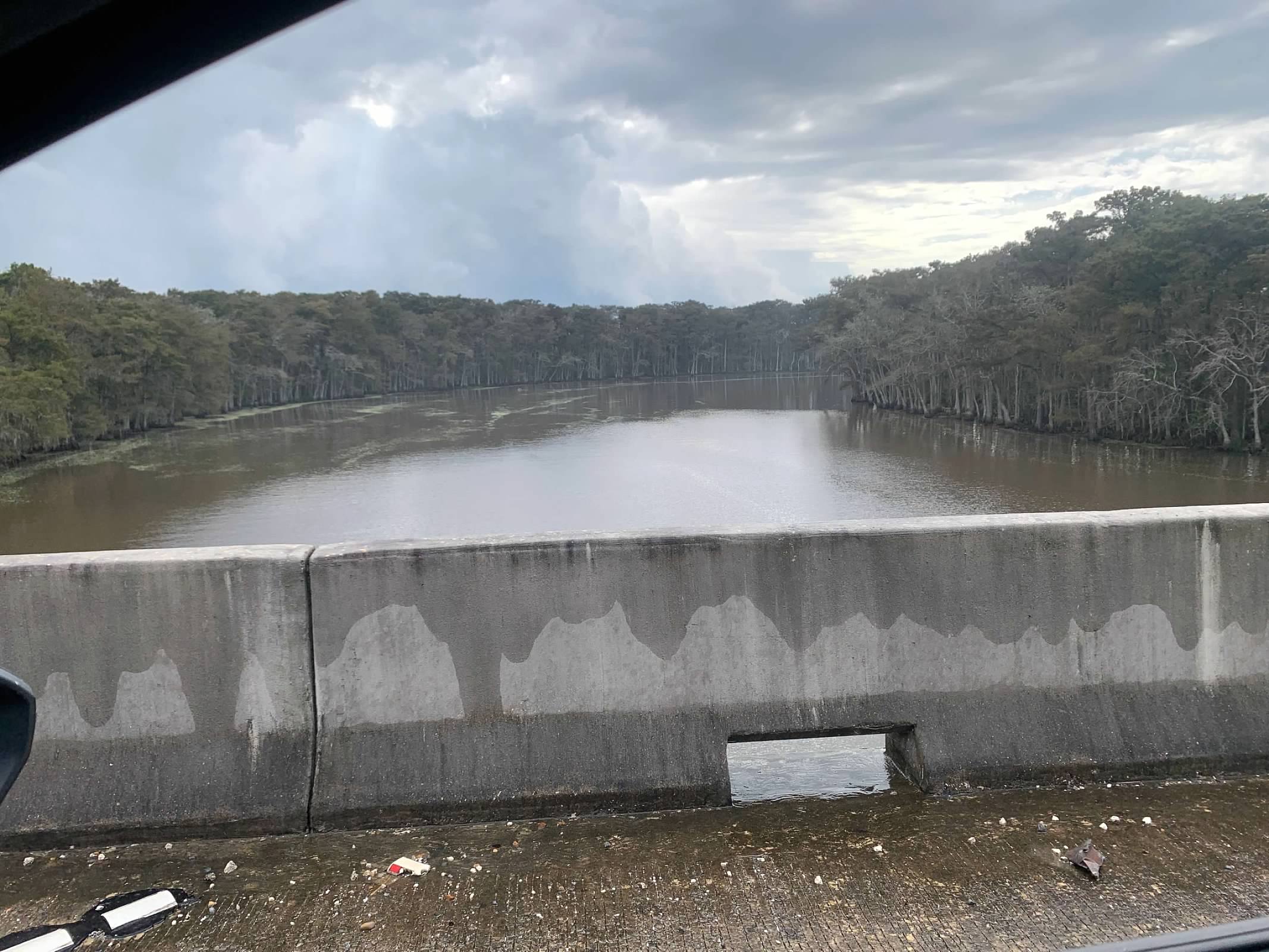

Looking out over the bridge in the Lacassine National Wildlife Refuge on LA Hwy 14 last week

As I look out at Spanish moss draped cypress trees, I half expect to see Dave Robicheaux and Clete Purcell pull onto Hwy 26 from a shell road in Clete's convertible red Cadillac El Dorado.  They'll likely have fishing poles hanging out of the car with bobbers fluttering in the breeze.  They'll wave me down and offer me a ham and onion sandwich from a grease-stained brown paper bag.
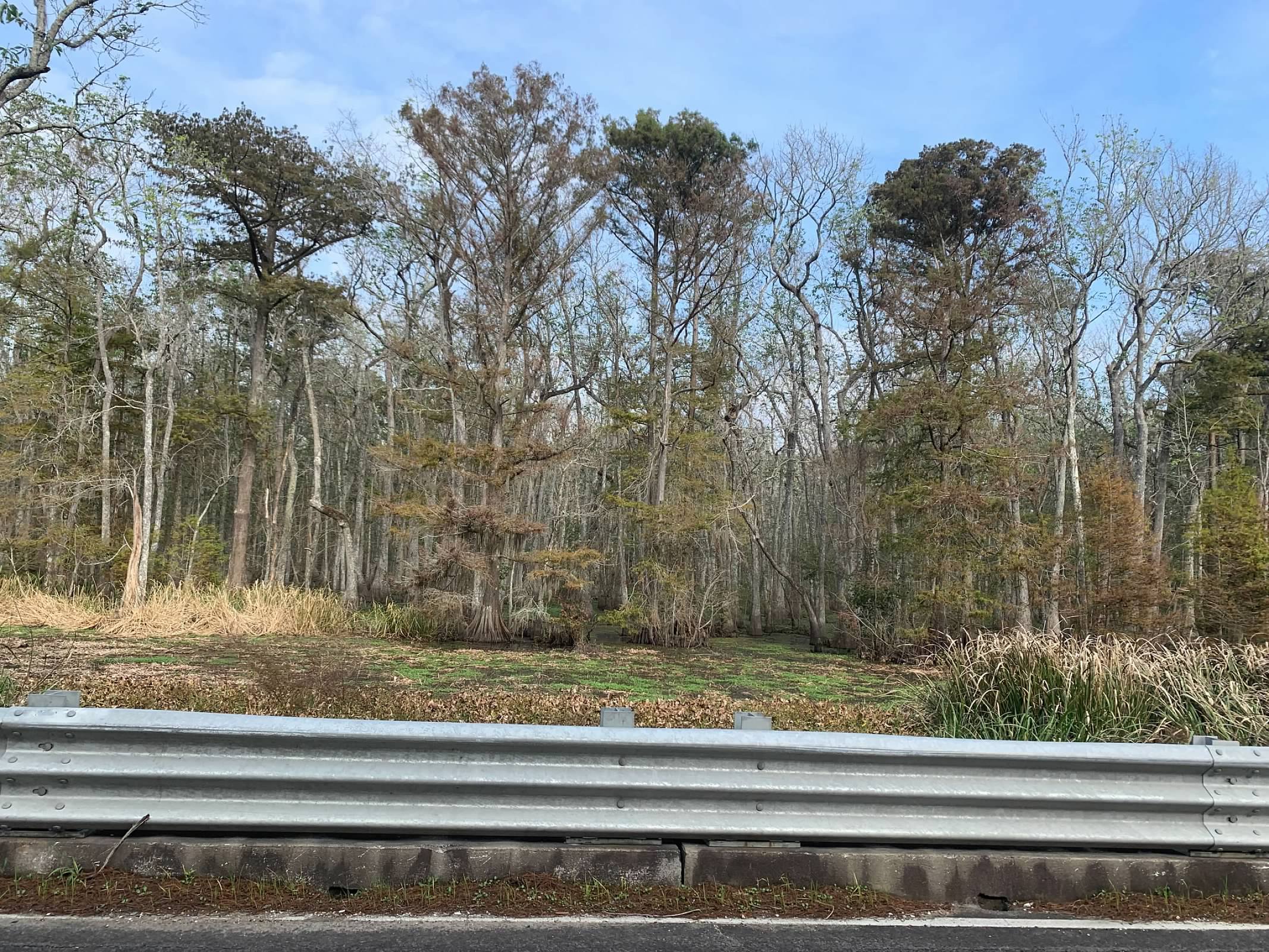
A bayou scene off of LA 14 near Lake Arthur, LA

If you haven't read any of his work, I encourage you to check out James Lee Burke, specifically his Dave Robicheaux novels.  He'll seem like an old friend.  You'll be sorry when the series ends. 
Tuesday, November 12, 2019

New Iberia Blues

I've talked in the past about my commute to work.  It's not that bad but construction for the past year and a half has turned a 40 minute commute into a grueling 1 1/2 hour drive on some days.  At first I listened to talk radio to pass the time until I began to realize that I didn't need that stress and blood-pressure rise on my drive home.  I had enough of that by simply gazing into the red tail lights in front of me and the glare of the bright LED headlights on the jacked up Ford behind me that was burning into my eyes through the rear view mirror with the brightness of a thousand suns.

To mitigate that, I got a library card and began listening, once again, to audiobooks.  Ahhhhh...  Now on the drive home I listen with interest to books by some of my favorite authors.  Sometimes, now, I'm so into the book, I sit in the parking lot at work or in the garage at home until I can get to a good "stopping point."

I listen to a number of different books with different genres, authors, etc.  I want to talk to you today about one of my favorite novelists, James Lee Burke.  He lives about 60 miles from me in New Iberia.  If you aren't familiar with his writing, I highly recommend it.  I would describe him as a "Cajun John Grisham."  He writes, among other things, crime novels set in Louisiana.  Burke is a terrific story-teller.  His is an absolute master with using metaphor and his descriptive writing moves you from being a reader to being there at the scene, seeing the sights, smelling the aromas, hearing the sounds.

The protagonist in many of his books is Dave Robicheaux.  He has a side kick named Clete Purcell.  They are imperfect guys, with flaws and warts, but are trying to do what is good and right.  The latest installment to the Dave Robicheaux series I read (listened to) was "The New Iberia Blues."  Will Patton narrates many of Burke's audiobooks and does a great job with the accents of the characters and the passion of Burke's writing really comes through.  I enjoyed it and was sad when the Cajun French music played Jolie Blon at the end, signaling the end of the book.


Dave Robicheaux (and Jame Lee Burke) loves his State, the beauty of the live oaks and the Spanish Moss-laced Cypress trees on the bayou and the love affair with the way "Louisiana used to be."  Such melancholy nostalgia really got to me in an excerpt from "New Iberia Blues" I cut and pasted below:
“We had little money but didn’t think of ourselves as poor. Our vision, if I can call it that, was not materialistic. If we had a concept about ourselves, it was egalitarian, although we would not have known what that word meant. We spoke French entirely. There was a bond between Cajuns and people of color. Cajuns didn’t travel, because they believed they lived in the best place on earth. But somehow the worst in us, or outside of us, asserted itself and prevailed and replaced everything that was good in our lives. We traded away our language, our customs, our stands of cypress, our sugarcane acreage, our identity, and our pride. Outsiders ridiculed us and thought us stupid; teachers forbade our children to speak French on the school grounds. Our barrier islands were dredged to extinction. Our coastline was cut with eight thousand miles of industrial channels, destroying the root systems of the sawgrass and the swamps. The bottom of the state continues to wash away in the flume of the Mississippi at a rate of sixteen square miles a year. Much of this we did to ourselves in the same way that a drunk like me will destroy a gift, one that is irreplaceable and extended by a divine hand. Our roadsides are littered with trash, our rain ditches layered with it, our waterways dumping grounds for automobile tires and couches and building material. While we trivialize the implications of our drive-through daiquiri windows and the seediness of our politicians and recite our self-congratulatory mantra, laissez les bons temps rouler, the southern rim of the state hovers on the edge of oblivion, a diminishing, heartbreaking strip of green lace that eventually will be available only in photographs.”
James Lee Burke, The New Iberia Blues    
I listened to the quote above from disc 4, program 4 on my way home the other day and paused it and then rewinded it and listened again.  I got home and googled "best quotes from New Iberia Blues" and wouldn't you know the above quoted section came up.  (I wasn't the only one who thought that was a good piece of writing!)

But why is that?  Maybe you have to grow up here or live here for a while to read between the lines to get at what he's saying.  It's a lament, a mourning, a sadness for a slow demise of a people, their customs, language, land and culture.  Often we in Louisiana find our state ranked first in everything that is bad and last in everything that is good.  I often scratch my head as I see a contradiction of a state so rich in natural resources (oil, agriculture, forestry, seafood, Mississippi River and deep water ports, etc. etc.) and yet so poor in so many metrics.  It's maddening.

Dave Robicheaux and Clete Purcell, are fictitious characters, but I can identify with them.  They are all around me.  They are imperfect, yet heroes.  They see tragedy and heartbreak all around them, but never give up in doing their best, trying to do good, putting the bad guys away, and enjoying a simple, unpretentious life on the Bayou.  In weaving suspenseful tales of Good versus Evil with thoughtful commentary on the our state, Burke has made the time spent on my commutes much more enjoyable - and time is the most valuable of commodities...
“Age is a peculiar kind of thief. It slips up on you and steps inside your skin and is so quiet and methodical in its work that you never realize it has stolen your youth until you look into the mirror one morning and see a man you don't recognize.” - James Lee Burke

Monday, October 9, 2017

A Gentle Strength

Image Credit - Jame Lee Burke

He showered and shaved and dressed and went out to the horse lot to clean off the top of the tank for his foxtrotters and to fill it with fresh water. On the lip of the tank, he had constructed a safety “ladder” out of chicken wire for field mice and squirrels who, during drought or severe heat spells, would otherwise climb up the water pipe onto the tank’s edge in order to drink and fall in and drown. The chicken wire was molded over the aluminum rim, extending into the water, so small animals could climb back out. While Hackberry skimmed bird feathers and bits of hay off the tank’s surface, his two foxtrotters kept nuzzling him, breathing warmly on his neck, nipping at his shirt when he paid them no mind. - Hackberry Holland
I have been listening to several audiobooks on my commute to work and back.  I just finished several by one of my favorite authors, James Lee Burke.  He's one of my favorites because his writing is so descriptive and because he lives only an hour and a half from me, many of the things and places and experiences he writes about hits close to home - literally.

The interesting thing about his books are the protagonists, Dave Robicheaux in one series, and Hackberry Holland, in another are heroes.  They are not heroes without flaws.  They both have a past and have regrets for things they've done.  But their stories are about redemption and what they are doing in the here and now to live their lives the best they can for their families or those around them.

If you watch any television at all, especially commercials, men are portrayed as the bumbling idiots who get constant eye-rolls from their wives or children.  Other times men are cast as hard as steel, violent types.  Or it goes to the other extreme where men are shown as the limp-wristed weaklings who sit around in pajamas sipping coffee.

I realize that those are just portrayals from television and you can't believe everything you see on television.  However, I hold to the notion that impressionable young people are watching TV and are getting the wrong idea of what it means to be a man.  The problem is exacerbated if there is no man in the home to provide guidance, instruction and mentoring and modeling of who a man is and how he should conduct himself.

So back to the quote from Hackberry Holland above which really made me stop and think - the part about Sheriff Holland building a "safety ladder" out of chicken wire so that little critters that fell in the tank when trying to get a drink didn't drown.  I don't think James Lee Burke put that in the book by mistake.  I think he was trying to show a good balance of manhood.  Here is Hackberry Holland, sheriff of a small border town who carries a .45 and administers justice and has put many an evil-doer in the grave when they confront him with a weapon.  He protects the innocent and puts his life in danger quite frequently.  He's tough.  He has grit and determination.  On the other hand, back on his ranch, in the tank beneath his windmill, he's fashioned chicken wire escape ladders to save the lives of field mice and squirrels.

I like the balance - a man who is tough as nails.  A man's man who isn't perfect, but strives to do better each day.  Also, this man has a gentle side that doesn't make him weak.  It is a gentle strength that is a truly admirable quality.
Related Posts Plugin for WordPress, Blogger...