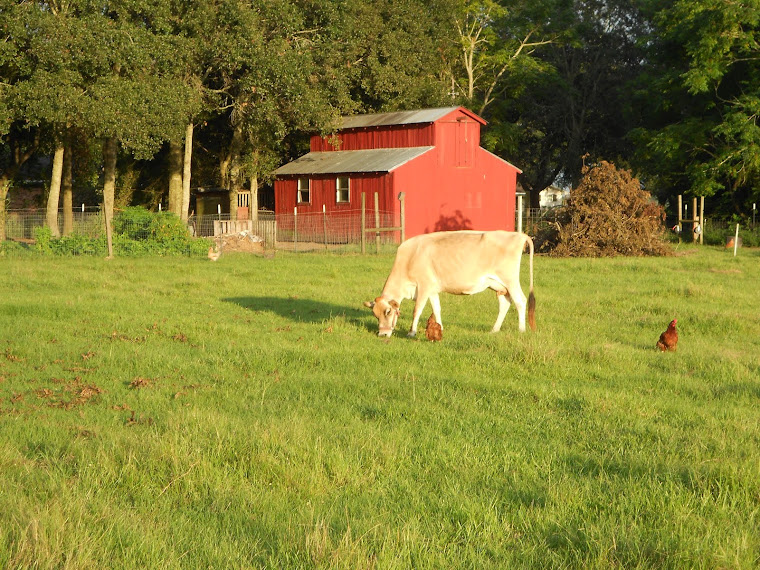
It is 79 degrees right now and feels like spring (or even early summer). It won't be long now until we see new growth on trees and other plants. The songbirds were singing loudly this morning, signaling their happiness in the change of seasons. That's not saying that we won't get another freeze or frost, but the long range forecast through February 25th shows the lowest temps at 52 degrees with highs in the upper 70s on most days.
It's time to feed the bees! We want to make sure they have enough stores of food to make it until the pollen and nectar starts flowing, especially since we pulled honey this fall. Many bees starve in the early spring. Lots of beekeepers feed their bees with sugar water, but we opt for a more natural food source. We are feeding them back some of their own honey.
When we pulled honey, we processed the beeswax in a crockpot with a little water. This process separates the honey and water from the beeswax as the beeswax, upon cooling, will solidify at the top. The remaining honey/water mixture is frozen in gallon-sized Ziploc bags for what we are about to do.
 |
| Honey water thawed and ready to feed to the bees |
We use a large rubber feed tub in which we fill partially with pine straw. The pine straw is used as a flotation device so that the bees have something to stand on while drinking the honey water. If you don't do this, and we learned the hard way, many bees drown in the sticky concoction. I then poured the honey water over the pine straw into the feed tub.
 |
| This was done at 8:06AM |
The honeybees weren't moving until around 10AM, but at that time they found it. Like a bad rumor being spread, the first bee that located this feed source reported back to one of the four hives and before you knew it, all the bees in all four hives were clamoring to get it. There was a steady stream of bees from the hive to the honey water. You quickly understand the term beeline. They made a beeline for the honey!

It was a little dangerous to be this close to them without my bee suit. The buzzing was loud and they were getting after it.

Here's a close-up shot of the bees getting their fill of the honey:

We took the photo below at 12:45PM, right after lunch. There was absolutely nothing left. Even the pine straw that once was a sticky mess had been scoured dry. We have a few more bags of honey water and we'll be feeding them once a week until our supply runs dry.
 |
| By 12:45PM the cupboard was bare! |
They bring all this back to the hive and fill cells in the frames and they'll use this as a feed source. What feeding the bees also does is "fool" the queen into thinking that the bees are bringing in nectar - that it is spring. She'll immediately begin to lay more eggs as she knows she needs more workers to gather pollen and nectar since it is spring, even though it's not quite spring yet. This gives the hives a jump start, so that when spring actually arrives, there are enough bees to do all the work. In economic terms, it is 'full employment.' This also relates to more honey production, which is good for the colony and good for us too!


No comments:
Post a Comment