Wednesday, March 16, 2016

Home, Home On the Range...

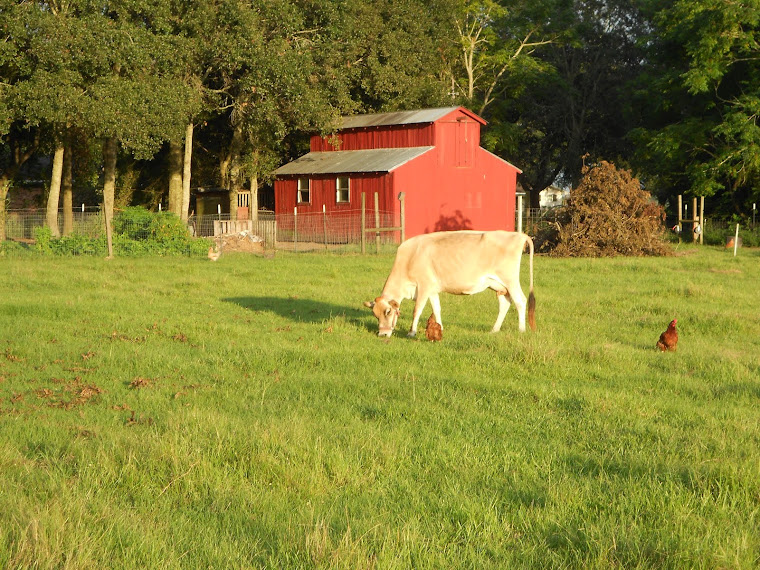
… Where the deer and the antelope play… (Chickens too!)

What is a range anyway?  Well the dictionary defines a range as any number of things, but one of them is Range: An extensive area of open land on which livestock wander and graze.  That’s the range we’re talking about.  A range would NOT be a brooder in the garage and that is where the meat birds have lived for the past two weeks.  So what do we have to do to move them out to the range?

First things first.  We must move the pullets out of the small chicken tractor where they’ve lived since mid-October.  The small tractor will house the meat birds now for the next 8-10 weeks of their lives.  You can see the pullets (and a few roosters and guineas) in the small tractor.  They are ready for moving day.

They've outgrown their "mobile home"
Before I move the pullets to the bigger tractor shown below, there’s a task that must be done…

The pullets' new, bigger chicken tractor
These pullets will be released from the tractor to free-range (there’s that word again) as soon as they lay their first egg – which should be in the next week or so.  Obviously raising them to this age, I would hate to have them fly over our fence and become dog food – literally, so I need to clip their wings.  Here is a before shot.

Full-feather
And below is an after shot.  I clip the wings with tin snips and I only clip one of the wings.  That keeps them off balance and unable to fly.  Reminds me of when we were younger and we were threatened by our parents that if we didn't straighten up, we'd 'get our wings clipped,' - that meant we were grounded.  Now I understand!  I clipped each and every pullet and cockerel.  I counted 27 pullets and 4 cockerels.

Wings Clipped
Finally, it is time to move the pullets into their newer, more spacious chicken tractor. You’ll note two of the guinea fowl walking around the outside.  When I tried to catch them to clip their wings, they promptly flew out and way up into a tree.  They are now enjoying their freedom a little earlier than I had hoped.

On the outside looking in
With the pullet tractor vacated, I moved the heat lamps and feed troughs from the brooder in the garage and ran an extension cord to the pasture.  Then I had Benjamin help me move the meat birds 10 at a time in a big blue tub into the chicken tractor.  Almost immediately, they began checking out their new “digs,” enjoying the extra elbow room.  52 fat little birds happy to be on grass.  Believe it or not after a day in the tractor, they had clipped the grass down, so I pushed it one tractor length to fresh grass.  They are now officially ‘Home on the Range.”

On grass instead of wood shavings
A few well-wishers came to the house warming party, welcoming the new neighbors to the cul de sac:

Welcome to the neighborhood (No longer the new kids on the block)

There’s just one more thing to do.  In a true “shovel-ready job,” I’ve got to shovel the wood shavings/chicken poop out of the brooder in the garage and work that into the garden soil to grow healthy vegetables.  Everything is a big cycle that goes back to the soil.

So empty, quiet, and serene after the chicks were moved out
Tomorrow we’ll bring you the report on the Week 3 weigh-in of the meat birds.  Stay tuned…


Tuesday, March 15, 2016

Pay attention to Your Herds


Know well the condition of your flocks,
And pay attention to your herds;
For riches are not forever,
Nor does a crown endure to all generations.
When the grass disappears, the new growth is seen,
And the herbs of the mountains are gathered in,
The lambs will be for your clothing,
And the goats will bring the price of a field,
And there will be goats’ milk enough for your food,
For the food of your household,
And sustenance for your maidens. -Proverbs 27:23-27
That's some sound advice from the book of Proverbs.  I'm telling you, you can spend as much time as you want in Barnes & Noble, but the best self-help book of all time is - The Bible.  We have been reading Proverbs over and over.  We have to read it real slow because there is just so much there to be gleaned.

We pray every morning that God would enable us to be good stewards of the animals and the land that He's entrusted us with.  We try to do as verse 23 above states and know the condition of our flocks.  We pay attention to our herds.  In fact just yesterday I was in the pasture and was checking up on Annie, our Nubian momma goat.

To be quite honest, I think having triplets is a little more than ol Annie bargained for.  I noticed that she left her kids out in the pasture and she 'high-tailed it' away from them the first chance she got.  She was enjoying eating hay around the round bales for 30 minutes of peace without the kids.  All of a sudden, it was if she remembered, "Where's my babies?"  She began 'baa-baa-baaing' and soon I saw three little heads pop up out of the grass way out in the pasture where they had been napping.  Then in their best imitation of Secretariat, ran full-throttle to momma!

Photo finish?
Happy to be next to their mother, they swarmed her, getting all tangled up in her legs.

Happy Kids
With the reunion and greeting out of the way, the three found what they were looking for - a late afternoon snack!

Goat milk - it does a body good
The only problem, as we discussed before, is that the math doesn't work out.  With 3 kids and a goat only having 2 teats, there's always someone left out.  I guess I should tell you that we finally named the three kids.  We have one buckling and two doelings, so it seemed appropriate to name the little boy, "Buckwheat."  Staying with the Little Rascals theme - and they are little rascals, we named one of the little girls, "Darla" and the other "Jane".

Buckwheat, Darla, and Jane trying to not be the 'odd man out'
Somehow, they are all thriving.  When we put them in the barn at night, we pick them up and they all have fat little bellies, so we know they are getting plenty of milk.

Learning to Share
There's only one problem - for us, that is.  Back to verse 27 from Proverbs above, it states that, 
"And there will be goats’ milk enough for your food,
For the food of your household,
And sustenance for your maidens."

Until we wean the kids, there won't be enough goats' milk for our food, the food of our household, and sustenance for our maidens.  Fortunately we have plenty of cows' milk to satisfy that need.  Until we wean the three hungry little kids, we'll just have to be patient for the goat milk!

Monday, March 14, 2016

Making Homemade Ranch Dip with Dill & Parsley


Last Saturday morning I took a stroll in the garden after the milking chores were done.  A heavy dew covered all of the plants and I thought that it looked especially pretty covering the foliage on the dill in the row of herbs and lettuce.

Dew Drops on Dill
Here's another shot...


The colors of the red lettuce contrasting with the wispy dew covered dill made me think about a nice salad.  Pretty much everything we need is right here.

Nice colors on the lettuce/herb row
Coincidentally, Tricia was separating whey from kefir.  The kefir was in a cloth suspended from the cabinet and the whey was being collected in a measuring cup below.

Separating whey from kefir
You can see the whey dripping in the measuring cup below.  She captured about 2 cups.  Whey is acidic (lactic acid) and is used for preserving foods.  We're going to use it in a later post to make Ginger Carrots.

Collecting Whey
After the whey has dripped out, the curds (solids) are all that remains.  Tricia put this into a mason jar.  Remember the nursery rhyme about Little Miss Muffet sitting on a tuffet eating her curds & whey?  Well this is what she was eating.

Curds
The ingredients to make our dip/salad dressing were gathered, which included the cup of curds, fresh parsley and dill from the garden, one clove garlic, onion and kosher salt.  

Ingredients for making our ranch dressing
The immersion blender works wonders!  Simply throw everything whole into the jar.

Immersion blender makes quick work
Vroom! Vroom!

All done!
And in a matter of seconds, you have homemade ranch dip.  Tricia added a little milk to make a dressing for our fresh salad.

Just the right consistency now...
You can also dip a carrot in it.

A healthy, delicious dip or salad dressing
Fresh Dill and Carrots go great together.  We demolished the jar of ranch dressing quickly.  With temperatures in the 80's already, the lettuce is beginning to bolt and go to seed.  Once it starts the leaves become bitter, so we've been eating salads almost every meal, enjoying a nice ranch dressing to accompany it.

Sunday, March 13, 2016

So We Fired up the Lawnmowers This Weekend

Spring has arrived a little earlier than usual this year with warmer temperatures and grass growing.  The next door neighbors have already mowed their yard twice, and I've heard the droning of the other neighbors' lawn mowers cutting the winter grass and clover that covers their yards.  I've put it off long enough, I know.  The yard looks unkempt.  It's time to get out the lawnmowers.

A lot of clover and winter grass in the yard (The 'Before' Shot)
I went and got the lawnmowers and kicked the tires, made sure that their fluid levels were good.  Then I cranked them up and starting cutting grass.  First one mower...

Cutting clover
Then the second mower got started cutting right in line behind the first one.  In one way I suppose you could say these lawnmowers run on "green" energy, on the other hand, they aren't exactly 'zero emissions."  Once they were finished, they left their emissions all over the yard!  That's okay.  The emissions will actually make the lawn healthier.

Two mowers doin' work.
The mowers don't require a driver.  I could go and do other stuff while the yard was being mowed.  Although I supervised the landscaping crew from a distance, my solar powered electric fence kept the lawnmowers from leaving the work site.

Solar fence charger
By the end of the afternoon, the yard was neatly manicured.  I put the lawnmowers away and refueled them and topped off their fluids.  If you want your lawnmowers to last, you have to take care of them and ensure that routine maintenance is done to preserve their life.

The 'After' Shot
We're expecting temperatures in the low 80's this week, so the grass will begin growing quicker.  It's a good thing we have some eager lawnmowers ready to cut grass at a moment's notice.

Friday, March 11, 2016

The Cricket

The Cricket
A couple of years ago we had the opportunity to visit the WWII Museum in New Orleans, Louisiana.  It is a fantastic museum and I’d highly recommend investing a day of your time visiting it.  One of the really neat things about it is that while we were viewing exhibits, WWII veterans who volunteer their time at the museum, come up and talk to you and recount their stories about serving our country during that time.


One of the veterans came around the corner near the glider exhibit, pulled a brass object out of his pocket, and began clicking it.  We asked, “What is that?”  The veteran replied, “It’s a cricket.”  When we didn’t know what he was talking about, he began to explain.  This gentleman was in the 101st Airborne and he parachuted into Normandy in the early morning hours of the D-Day invasion.

A real lifesaver
Military commanders knew that when they landed the paratroopers would be amongst the enemy.  The American soldiers knew that they had to assemble with other American soldiers and complete the mission when on the ground.  But how?  How could you tell if you were among friends or enemies?  The paratroopers would be landing sometimes on top of the enemy.  Germans were everywhere!  Enter the Cricket.  The cricket was a toy that was actually originally given as a toy in Cracker Jack boxes.  When pressed, it makes a loud “cricking” noise – hence named the cricket.

"Crick"
The veteran explained to us that upon encountering another individual in the dark, pre-dawn hours, the American paratrooper would click on his cricket one time.  If the person clicked back on their own cricket, you knew that you had found another American soldier.  If the person didn’t click back, you shot him.  I asked the veteran, “What happened if you lost your cricket?”  He answered, “Oh, you didn’t lose your cricket!”  It is very interesting when you think about the fact that a children’s toy helped ensure that the D-Day Invasion was successful.

Answer: "Crick!"
As with many things in normal everyday life, this little story about the cricket has a spiritual application as well.  As Christians in an increasingly secular world, we find ourselves “behind enemy lines.”  Many people are antagonistic toward people of faith and religious liberty is being threatened.  The Bible even tells us that we will be persecuted for our faith.  So how are Christians to know if they are amongst other Christians?  Is there such a thing as a “Christian Cricket?”  Of there is!


Jesus, in the Gospel of John, chapter 13, verses 34-35 said the following:
”A new commandment I give to you, that you love one another, even as I have loved you, that you also love one another. By this all men will know that you are My disciples, if you have love for one another.”
And there you have it – the Christian Cricket!  We are to Love One Another!  All men will know that we are believers by the love that we show each other.  Don’t lose your cricket!

Thursday, March 10, 2016

2016 Meat Birds at 2 Weeks Old

Well it is Week 2 in the lives of the 52 meat birds that dwell in our brooder in the garage.  It is also Week 2 in our weekly installment charting the growth of the meat birds from 1 day old to 8 - 10 weeks old when it is time to process them.  The first two weeks have been interesting.  Some sort of sickness swept through the brooder, giving the birds "pasty butt," an ailment we talked about HERE.

Seven birds succumbed and became expensive fertilizer for our spring vegetables this year.  The rest seem very healthy.  Let's get down to business.  I bring Tricia's kitchen scale out to the garage and put a paper plate on the scale and zero the scale out.  My wife does not want those dirty birds touching her scale - hence the (appropriate) paper plate they are sitting on.  This fat little bird lazily sat in the plate as I watched the needle turn.

A Plateful of Chicken
Last week, the Cornish Cross meat bird weighed 8 ounces.  This week he weighs 18 ounces.  Yep, one pound, two ounces.  He's gained 10 ounces since last week, more than doubling his weight.  To compare with last year's birds, I pulled up our post from last year.  Interestingly enough, last year's Cornish Cross birds at 2 weeks old weighed only 6 ounces.  Wow!  The 2016 birds are much heavier!

Cornish X at 2 Weeks = 1 lb 2 oz
Let's check out the Red Rangers.  Remember this is a more 'natural' bird.  He matures a little slower and won't be ready for butchering until he is 10 - 12 weeks old.  He is supposed to forage more on the pasture, eating more grass than the Cornish Cross. Up on the scale he goes.  He looks kind of rough - like his feathers are sticking out - a bad hair day, you might say.  He is visibly smaller than the Cornish Cross.

Red Ranger @ 2 Weeks Old
The Red Ranger weighs 8 ounces.  Last week he weighed 6 ounces.  Over the week, he's only gained 2 ounces.  A quick check of the blog post from last year showed that at 2 weeks old, the Red Rangers weighed 5 ounces.  So we're still ahead of last year.

Red Ranger @ 2 weeks = 8 ounces
I think the growth of the chicks can be explained.  Here's my theory.  Genetically, the Cornish Cross is just a bigger bird.  He's just going to be bigger.  Like a bully on the playground stealing the weaker kids' lunch money, the Cornish Cross is bigger, more aggressive, and crowds out the smaller Red Ranger at the feed trough.

Ringing the dinner bell
Although I have 3 feed troughs in there, I'll bring another one back from the barn tomorrow.  That will give the birds an additional feeder and will allow the Red Rangers equal time at the feed trough without getting edged out like you can see some of the Red Rangers in the photo below at the top left.

Everyone needs a place at the table
The 28% protein game bird feed that we had them on has run out at day's end today.  Now we'll switch to the 18% protein ration from here on out.  If you leave them on the higher % protein ration, you run the risk of the bird getting too heavy for his legs to support.   

So far the birds are looking good and are healthier, bigger, and farther along than the birds at this time last year.  It is always good to see improvement in the process. Let's see if we can keep them on this trajectory for another 8 weeks.  We'll check in again next week and compare with the previous week and then with a comparison of the same time last year.  

Wednesday, March 9, 2016

Pulling Up Carrots

With spring weather upon us and spring planting already underway, it becomes imperative to begin harvesting some of the winter crops in order to make room for beans, corn, squash, cucumbers, tomatoes, peppers, okra, etc.  That would include harvesting three rows of carrots.  I had already harvested some carrots here and there, but Saturday was a beautiful day for pulling the rest of the carrots out of the ground.


Of the three rows of carrots, one of the rows were Atomic Red variety, another was Cosmic Purple variety, and the final a normal orange Berlicum Carrot.  Our carrot crop was the worst crop we've had in 3 or 4 years in terms of yield and of quality. The size was just not like in previous years.  I blame that on a couple of things. First we had 9 inches more rainfall than in average years.  It was very wet and I planted all the carrots in the lowest part of the garden, so the soil stayed too wet resulting in stunted carrots that didn't really grow well.  Don't get me wrong, we will eat them all - even the baby ones.  Homegrown carrots are so sweet.  Seriously. They don't compare to store-bought.  It's like a whole different product.  

Let's go to work.  What I do is I use a shovel to loosen the soil around the carrots and then I pull them up by the carrot tops. 

A couple of nice carrots in the process of being pulled up
I have a bucket of rainwater handy and I wash the fresh-pulled carrots removing the topsoil.  Later I'll pour the topsoil-laden water on top of my young potato crop that needs a good watering.  That way the topsoil will stay in the garden versus being washed down the drain.

Cleaning the carrots
The photos don't really do them justice, but these are Atomic Red carrots.  They are the prettiest, in my opinion, because they have a reddish tinge and are sort of translucent. 

Atomic Red Carrots in rainwater
Here are the Atomic Red carrots after washing.  Yes, the cows were more than happy to take the greens off my hands.  All the cows, the goat and even the chickens made quick work of the carrot tops that I tossed over the fence.


These are the Cosmic Purple carrots.  Now, these are a little deceiving because they are not purple through and through.  It is just their skins that are purple.  The center is orange like a normal carrot. Still they are interesting looking.  All three varieties taste the same to me - outstanding.

Cosmic Purple Carrots
After the initial cleaning in the rainwater buckets, I laid out the harvested carrots on our picnic table bench and our garden wagon.  Then I sprayed them off with a water hose to get any remaining dirt off of the carrots.  Once they're dry I'll bring them inside and we'll begin eating them and processing them using several different methods.

The second carrot bath
In what ended up being a visual feast, I gathered a colander full of different varieties and sizes of freshly picked carrots.  I like this picture.

A colorful colander
With the warmer weather, our lettuce is going to start bolting, so we've been eating lots of salads with fresh sliced carrots.  We'll blanch and freeze some and we'll also show you another neat way we preserve our delicious carrots a little later this week.
Related Posts Plugin for WordPress, Blogger...