Sunday, February 21, 2016

An Update to a Post from 3 Months Ago

A little over 3 months ago, I posted about trip to San Antonio, Texas that Tricia and I took to celebrate our 25th Anniversary.
Alamo Oak
You can read about more about the history of the Alamo Oak by clicking here: Alamo Oak.  There are times that I become cognizant of the fact that I'll ruminate about certain things and then I don't go back and update on progress. Today I'll try to remedy that with this update post.

For a quick summary: About 25 and 1/2 years ago Tricia and I were engaged on the River Walk in San Antonio.  On that evening, I picked up a handful of acorns from the big live oak tree right outside the Alamo and brought them home, planted them and one of them germinated.  I figured that it would be a really neat thing to plant that tree and one day be able to point to the big live oak tree while we sat underneath the sprawling branches and tell our grandchildren and/or great-grandchildren that we picked up the acorn from which that tree grew on the day that Tricia and I were engaged.

That little oak seedling grew into a healthy live oak tree and was about 3 feet tall. Sometimes things don't work out as planned.  At that time we lived in an apartment complex in Houston.  We came home from work one day to find that someone had up-rooted our Anniversary Alamo Oak and it had dried out in the sun all day.  I quickly re-potted it and watered it, but try as I might, I could not resurrect the oak.

Fast forward 25 years.  For our anniversary, we re-traced our steps in San Antonio. At the end of the evening, we happened to walk past the big live oak outside the Alamo.  Again, I picked up a handful of acorns and placed them in my pocket.  I figured, "Let's try this again."  I took them home and was able to get one to germinate.  You can see the healthy, vigorous little live oak popping up out of the soil in the photo at the top of this post.

We talked about how big the tree might be today if the first one had survived.  Well, it doesn't matter. We're going to try this again and hopefully this time, we'll meet with more success.  Landmarks and old things that have a story or interesting history are very interesting to me.  Because of the personal nature of this, it is even more special.  I researched a little bit on the Alamo Oak from which our acorn dropped from and found this article: Article on the Alamo Oak - or Heritage Tree .  The Heritage Tree - how fitting!  Perhaps I'll write an update when one of our great-grandchildren are climbing in the branches of our Anniversary Oak.

Thursday, February 18, 2016

A Little Fiber for Your Diet


Image Credit
A (crazy) cousin of mine told me that he was trying to save money on his feed bill. It was costing him a lot of money to feed his horse.  He was brainstorming different cost saving ideas and determined that he would feed his horse one cup less of feed and substitute a cup of sawdust in its place.  He did this every day for a week, the horse was eating it and he saw no ill effects.  So then he removed two cups of feed from his horse's daily ration and substituted two cups of sawdust in its place. That went on for a week and then he continued with the experiment.  He told me that he was saving a lot of money after a month and that he had his horse eating almost 100% sawdust when his horse went and died on him.  Now, he was only joking (I hope), but who in the world would eat sawdust?

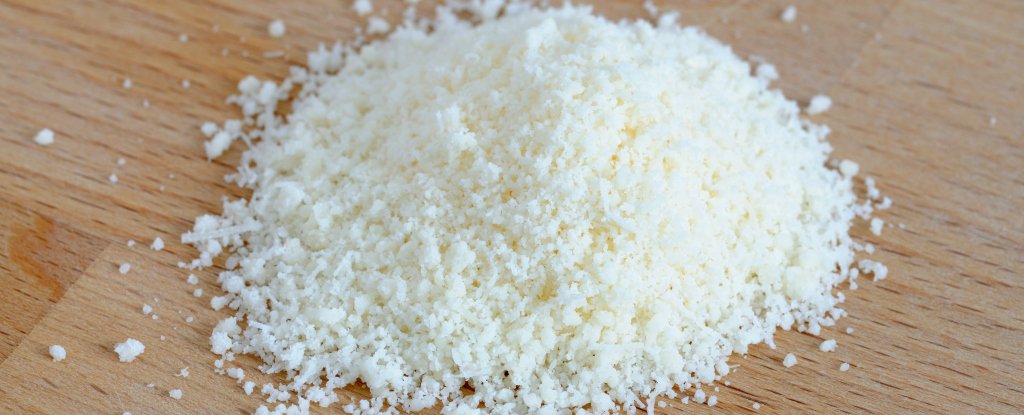
Well, if you eat Parmesan Cheese, you probably do!  THIS ARTICLE I read recently said that:
Parmesan cheese or wood pulp? Chances are when you sprinkle parmesan on your spaghetti you may be getting a little of both.
Some companies that promise 100% parmesan cheese, have been adding cellulose, a common food additive made from wood pulp, to their cheese products, according to an independent study, launched by Bloomberg News.
An independent laboratory test found that products like Walmart store's Great Value 100% grated parmesan cheese registered 7.8% cellulose, Jewel-Osco’s Essential Everyday 100% parmesan cheese was 8.8% cellulose and Kraft had 3.8% cellulose, Bloomberg reported.
Image Credit
Well, that's crazy, isn't it?  Sawdust mixed with cheese doesn't sound very appetizing.  I assume if you ate enough of it, you might end up like my cousin's horse.  Sometimes at our house, I invoke the "five second rule."  Do you do that? The rule says that if you happen to drop some food on the ground, as long as you pick it up in less than five seconds, it is safe to eat.  Sometimes (yes, I'm frugal) I'll add a bit of water to an (almost) empty Tabasco Sauce bottle to get the last bit out of the bottle.  Ditto with ketchup or mustard.

I think the difference with those things is that I KNOWINGLY do those things.  I wouldn't want my food picked up off of the kitchen floor if I go out to a restaurant.  I wouldn't want someone to serve me diluted Tabasco Sauce, ketchup or mustard either.  And I sure wouldn't want wood chips in my Parmesan Cheese, wood you?! Adding wood pulp to your Parmesan Cheese won't hurt you, but it is deceitful. Companies are able to stretch their product and add profits to their bottom line - at our expense.

That's why it's always best to read labels on things you eat and choose those products that contain few ingredients with ingredients that you can pronounce and understand what it is, with no artificial colors, flavorings or fillers like sawdust.  Oh, block Parmesan Cheese that you grate yourself does NOT contain sawdust.  If you are not a beaver and don't enjoy eating sawdust, you want to make sure that you buy block Parmesan and grate it yourself!

Wednesday, February 17, 2016

Almost Time for Annie to Kid

Back in September, we posted HERE about taking our Nubian goat, Annie, down the road to get bred.  Our neighbor has a Nubian buck.  We left her with the buck for a while and then our neighbor informed us that she was bred successfully and we picked her up.  To the best of our calculations, Annie should be kidding before the end of the month.  Her belly is pretty big and oddly shaped.  She spends a lot of time just laying around.
Oddly Shaped Annie
Annie miscarried in her first pregnancy, so we're hoping for better results this time. I began to read a little on kidding and learned that, like a cow, the last few days before delivery, the udder will fill with milk.  We're already seeing her start to "bag up," so it can't be too much longer.  The article stated that delivery will take five hours - Four hours for dilation and one hour for delivery of the kid.  Twins are quite common with goats, so we'll be on the lookout for two!

Wide Load
A normal delivery is when the kid presents right side up, with front feet out, with the head between the legs.  We're praying for a normal position and delivery.  We are keeping our eyes on her.  When Annie was born, her momma, Nellie, delivered her in secret.  We never saw here in labor and only found Annie after she had been born for an hour or two.

Momma to be
Like in calving, baby goats should be standing within a few hours after birth and looking to begin nursing.  It's always an exciting time when babies come, whether they be calves, chicks, or kids. We'll keep you posted and be sure to show plenty of baby pics.  Baby goats are cute little critters.  We will be happy to have new babies and goat milk once again.  

Tuesday, February 16, 2016

Picking the Very Last of the Navel Oranges

This year was an excellent year for citrus.  We've picked every last tangerine off our our trees and just the other day I went out and picked the final bucketful of navel oranges off of the top of the tree. I pick the low hanging fruit first, because it is convenient, but after you've eaten everything else, then I start picking the hard to reach fruit at the top of the tree.

We've eaten plenty of them by just cutting them up and snacking on them.  We've juiced many of them and have enjoyed drinking fresh squeezed orange juice - it is so much better than store-bought OJ.  Tricia has flavored our kombucha with some of the juice and IN THIS POST we show a delicious option for using our oranges. I'm telling you, it is the best cake.

The last oranges at the top of the tree
After I had picked them all, I made another pass around the tree just to make sure that I wasn't leaving any behind.  Lo and behold there was another one hiding behind some leaves in the middle of the tree - can't leave any behind.

Hide & Seek Orange
Navel Oranges get their name from the 'belly-button' looking object on the opposite end than the stem.  THIS LINK explains how the navel orange came about.  It is an interesting story and I'll post a little bit:
"That appearance of a navel on the orange is the result of a mutation," Moses says. The mutation created a conjoined twin — an aborted second orange at the opposite end from the stem. "Looks like a human navel," Moses says, but "it's in fact a small, second orange."
And the mutation that started it all? A single branch on a sour orange tree in the garden of a monastery in Brazil.
A Presbyterian missionary came upon it in the mid-1800s. It intrigued him that not only did the orange have a bellybutton and baby orange inside — it was sweet, and had no seeds.
He made a cutting, propagated some little trees, and sent them to William Saunders at the USDA in Washington.
"Because the navel orange through that mutation is seedless," Moses says, "all of the navel oranges that we see today and we eat today are genetically identical with the original orange."
That's right. The produce aisle is filled with clones of that one mutation from Bahia, Brazil.
The Last bucket of oranges 
So once I picked the last of the fruit, my son Russ, a horticulture major at LSU, taught me what he knows about pruning the tree.  We cut some branches off of the tree according to his pruning technique.  It will keep fruit from dragging on the ground when the orange-laden limbs are bent over. We fed the leaves to the cows and goat and they ate every green leaf off of it.


It won't be much longer before all the trees begin to bloom and the evening air is filled with one of the most fragrant aromas on God's green earth - orange blossoms!

Monday, February 15, 2016

Our New Flock of Guinea Fowl

 We’ve had one lonely male guinea fowl on Our Maker’s Acres Family Farm for quite a while. Our guinea cock was given to us by a friend.  He was in mourning after his mate was killed by a dog.  You see, guinea fowl mate for life.  They are monogamous and mate with no other guineas. He's just been hanging out with our chickens.  We figured that since he lost his “wife,” it was high time that we’d at least give him some friends of his own species, so when we ordered our most recent bunch of pullets, we ordered four guinea fowl day old chicks.

Baby guinea fowl are not called chicks – they are called keets.  I ordered the keets as “straight-run.” That means they aren’t sexed.  It is sort of like a grab bag.  You don’t know whether they are going to be males or females.  I was counting on them being a 50-50 mix, with half being male and half female.  More on that in a minute.  So as they aged, I noticed that they were different.  In fact we now have 3 different breeds of guinea fowl.  One of them turned out to be a Pearl Grey:

Pearl Grey Guinea
One of them is a Lavender:

Lavender Guinea
And two of them are White Africans:

White African Guinea
As you can see in the photo, the breeds are pretty easy to tell apart.  As far as telling the difference between the sexes?  Very hard.  In fact, when I Googled ‘how to tell the difference between male and female guinea fowl,’ I learned that it is virtually impossible to tell by looking at them.  As a side note, it is interesting to see that ten years ago, the word ‘googled’ was not a verb! 

What you have to do is LISTEN to them to tell the difference between the males and females.  Seriously.  So there I was bent over INSIDE the chicken tractor, watching and listening to the noise they make.  Males only speak in one syllable.  They make a “chi-chi-chi-chi” sound.  Females, on the other hand, speak in two syllable sounds.  The female makes a “buck-wheat, buck-wheat” sound.  Now, I know what you are thinking, but I’m not sure if you can make any determination on the relative intelligence level between the sexes or not based on that! (smile).  But amazingly, the female can imitate the male’s chi-chi-chi-chi sound as well.  Crafty and deceptive, she is.

So I had my work cut out for me.  Bent over watching the frightened birds, I watched and listened and watched and listened – and no one would speak.  For the longest time I sat there.  Finally, I heard the buck-wheat, buck-wheat sound coming from the Pearl Grey letting me know that we had at least one female.

I got tired of waiting for the others to talk.  Determining the sex of the remaining three will be a project for another day.  At least we have one female and as a result, we’ll have guinea eggs.  That reminds me of something from my childhood.  On Easter Sunday, we’d “pock” eggs.  A Cajun Tradition, we’d dye hard boiled eggs and tap them together.  The person with the broken egg would be out, while the person with the unbroken egg would progress around the room until a ‘Champion’ holding the hardest egg would be crowned.  My great-grandmother would always bring guinea eggs.  Guinea eggs are smaller than a chicken egg, but they also have harder shells than a chicken egg – making them highly valued come pocking time.

Back to the lonely widower male guinea, he’s been hanging around the chicken tractor interested in his brethren.  I wonder if when it says they “mate for life,” if that means that once their wife dies, they ‘re-marry?”  I guess we’ll find out shortly!

Sunday, February 14, 2016

Planting Potatoes 2016

In our last post we talked about preparing our seed potatoes for planting by cutting them so that each chunk had an eye.  We allowed the cut potatoes to sit for a couple of days and 'scab' over so as not to rot once placed in the ground.  After only two days the potatoes' cut ends had healed over.  Right on schedule!

Saturday morning arrived and once the morning chores were done, it was time to get some potatoes in the ground.  I usually shoot for Valentine's Day as the planting day for potatoes.  This year I was a day early.  I decided to plant the potatoes in the area of the garden that was planted with squash and beans.  In 2012 I planted this plot with potatoes and we had our best yield ever.  Let's see if we can repeat.
The Potato Patch
I used a tape measure to mark off 24 inch rows and tied baling twine to stakes pulled tight to mark my rows.  Amy, the Jersey cow, was supervising my measurements and also requesting that I toss weeds over the fence.  I obliged.

Pulling up rows
With some good old-fashioned work with a shovel and a hoe, I pulled up five additional rows between the Onion row on the north and the brussels sprouts row on the south side.  I knew from the other day that I have 168 pieces of seed potatoes to plant, so we'll see if this is enough room or if I'll have to work up more soil.

Five rows ready to plant
Now potatoes should be planted 12 inches apart, so I made a marking stick using an old piece of bamboo cane that I've had in the corner of the garage.  I marked off 12 inch increments on the bamboo with a permanent marker.  Back when Russ was younger, I was the den leader of his group of Webelos Scouts.  In one of our activities we made walking sticks with bamboo. The bamboo came from a stand of bamboo cane at the farm in Oberlin that my grandfather had planted as a windbreak for the cattle.  As kids we'd run through the "bamboo jungle" pretending it was Viet Nam.  

In it's previous life as a walking stick, the bamboo had a leather string on the top with feathers on it. But that's not all.  As I was on my way to the scout meeting, I happened across a freshly hit raccoon on the road.  I pulled over and cut the tail off the poor old coon and tied it to the walking stick.  As you know, everyone needs a walking stick with a coon's tail on it, right?  From walking stick to measuring stick, that old piece of bamboo has more lives than a cat.

Marking, digging, planting
In addition to being planted 12 inches apart, potatoes should be planted 4 inches deep, according to LSU AgCenter.  I'm going to do something a little different.  I dug a 4 inch deep hole and then dropped a tablespoon of organic fertilizer and then covered it with a couple of inches of dirt.  Then I placed the potatoes in the hole.

Yukon Gold potatoes in the ground
Potato planting is back breaking work.  I got all the Yukon Gold planted and started on the LaSoda potatoes, finally covering with soil.  The eyes were all sprouted nicely and with a rain coming Monday and temperatures expected to be in the 70's all week, I think these spuds are going to really take off.

LaSoda Red Potato with a healthy eye
Finally I was finished!

2016 Potato Crop (or most of it anyway)
Or was I?  To my chagrin, I realized that I had 43 seed potatoes left.  So I pulled up another row and a half on the other side of the beets to finish up the job.  At long last, I was done.  As they grow I'll pull up soil around the plants and then mulch heavily with hay to crowd out any weed pressure.  In 90-120 days we'll be digging potatoes - another back breaking job, but a rewarding one.  Nothing like new potatoes cooked along with some fresh picked green beans.  This weekend I'll try to work up some ground to get some beans and corn planted.  Happy Growing, Ya'll!

Thursday, February 11, 2016

Getting Ready to Plant Potatoes

I asked Tricia to pick up some seed potatoes at the Feed Store the next time that she went to pick up dairy ration, laying pellets, and alfalfa.  This time every year our local feed store stocks up on seed potatoes that everyone in the area will be planting. Tricia picked up two boxes that consisted of ten (10) pounds of Lasoda Red Potatoes and five (5) pounds of Yukon Gold potatoes.

Some of the potatoes were large and some were small.  I just left them out on my workbench in the garage for a couple of weeks.  My goal is to always have them planted sometime around Valentine's Day.  It's easy to remember.  In our growing zone the planting range is from January 20th - February 28th.

Seed Potatoes
After sitting in the garage in 70 degree temperatures, the potatoes' eyes started to grow.  You can see the eyes sprouting on the Yukon Gold potatoes:

Yukon Gold eyes

And the Lasoda Red potatoes:

Ready to start growing
Now for smaller potatoes, you can certainly plant them whole.  If the potatoes are bigger than the size of a golf ball, I like to cut them so that each section has an eye. Sometimes, I can get up to four pieces off of a potato, but most of the time I'll get three.  Each one of these will produce its own plant.

This potato will yield three separate plants and hopefully many potatoes
Once I was finished cutting them, I laid them on trays.  The ten pounds of Lasoda Red Potatoes yielded 128 separate pieces and the five pounds of Yukon Gold yielded 40 separate pieces.  If my math is right, that will give us 168 potato plants if they all grow!  I will let these sit in the trays for 3 days until the cut edges have scabbed over.  Then they'll be ready to put in the ground - hopefully this weekend.

Trays of cut potatoes
Oh, one more thing.  We also saved some seed potatoes from our own crop.  You can see them all sprouted below.  They aren't very pretty, but they'll produce good potatoes.

Our own seed potatoes
I can't wait to get these all in the ground!
Related Posts Plugin for WordPress, Blogger...