Wednesday, October 24, 2012

Cows, Coyotes and Donkeys

A friend at work sent this to me and I couldn't resist sharing.

Pretty funny, huh?  I can almost hear the Beatles singing that.  Can't you?  I don't want to leave her now...

Tricia and I drove out to the farm in Oberlin on Sunday evening to check on the herd of beef cattle and check up on Blackberry in her new home environment.  Now I wish we would've put something on her to differentiate her from all the other Angus calves.  We drove around and around looking for her and think we saw her, but we can't be sure.  There's just too many cows to tell.

The pictures below show a pretty sunset and if you look very closely, you can see the herd on the pasture, but most of them are Black Angus cattle and hard to see in the fading sunlight.  The cows have about 200 acres to roam around on and free range graze.  During the summer months, they have all they can eat.  During the winter, we supplement with round bales of hay made from rice stubble.  Last week Dad planted an 80 acre field with rye grass.  We'll fence that off into two separate paddocks and let them graze on the ryegrass on alternate sides, rationing it throughout the winter months.


Here is a picture of me below that Tricia snapped.  Okay, not really, but I know that's what you were thinking.  He's our donkey that hangs out with the herd.  He kind of looks like the donkey from Shrek.  We have had problems with coyotes out at the farm.  They will come close to the herd and attack and eat the baby calves.  After losing several, we got the guard donkey below.  Coyotes fear the donkeys and won't come close to the herd.  In fact, donkeys hate the coyotes and will chase, stomp, and kill any coyotes that come in the vicinity.  That is reassuring to the mama cows and their offspring, not to mention us.  If you've been down the meat aisle lately, you know that beef is a high-priced commodity.

My what big ears you have.  The better to hear you with, coyote!  C'mon over to my old stomping grounds.
The coyote population is expanding.  They are cunning animals that wreak havoc on livestock.  At night if you go outside you can hear them howling eerily in the distance.  Many people use .22 rifles, snap traps, snares, etc. to keep this predator in check.  One of the most creative methods I've heard of was when we used to manage the family grocery store, one of our customers would pick up the bone meal/fat mixture that we got when cleaning the meat saw at the end of the day.  We would save it for them in buckets and they would take it and make "meatballs".  They would run a cable between two trees about 6 feet up in the air and have cables hanging down with large hooks on them 'baited' with the meatballs.  The coyotes would jump in the air to get the meatballs and get hooked like a catfish on a jug-line, just swinging in the breeze.  Sounds brutal, I know, but you ought to see the aftermath of a pack of coyotes attacking a mama cow and her baby calf - not pretty.


I'm not helping you, buddy. 

Tuesday, October 23, 2012

Making Homemade Laundry Detergent

After using either Gain and Tide as our laundry detergent of choice for years, we were looking for something new.  The strongly scented laundry detergents were beginning to give Tricia fits.  The increasing price every time we went to the grocery store was giving us fits as well.  It so happened that some good friends of ours gave us a recipe for a "make your own" laundry detergent.  We tried it one time in early 2011 and have been making it ever since.  It allows us to save money as well as help out with allergies or sensitivities to the scents or chemicals in laundry detergent.

Tricia was making another batch today and photographed the process.  It is so simple to make.  Here's what you'll need to make your own laundry detergent:
  • 1 five gallon bucket with lid
  • 1 Bar of Fels Naptha soap
  • 1 cup of 20 Mule Team Borax
  • 1 cup of Arm & Hammer Washing Soda
  • Enough water to fill the bucket
The first thing you want to do is dissolve 1 cup of Borax and 1 cup of Washing Soda in hot water.  Stir it up good and pour into the 5 gallon bucket and add enough water to half fill the bucket.


Then, grate the Fels Naptha soap.  We use a regular old cheese grater.  (Watch out for your knuckles!)


Add 4 cups of water to a pot with the grated soap and slowly simmer until the soap has melted or dissolved, stirring as needed.


Then pour the soapy mixture into the half full 5 gallon bucket that contains your dissolved Borax and Washing Soda.  Stir the mixture up real good and top it off with water.


This concoction will congeal somewhat overnight.  Save the measuring cup from your old laundry detergent (that you'll never use again) and use a couple of scoops per load of laundry.  We haven't priced it out to determine exactly how much it actually saves you, but it goes a long way, cleans the clothes nicely and definitely saves money in the family budget.  Who couldn't use a few extra bucks in your pocket these days?

Monday, October 22, 2012

Put out to pasture

There is an old saying that I'm sure you've heard - "He had to be put out to pasture."  Some animals, like old workhorses, when they are unable to work or contribute due to old age or poor health, are taken away from their work and are literally put out to pasture to graze the rest of their lives away.  Oftentimes in humans, if someone is forcibly retired, it is figuratively referred to as "putting them out to pasture".

We have a 2004 Buick Rendezvous, that has 195,000 miles on her.  We affectionately call her Rhonda.  Well, she's been a good vehicle for us and has taken us on camping vacations in the Smoky Mountains and camping vacations in the Rocky Mountains.  She has faithfully served our family carrying us to and fro, from carrying us on family vacations to carrying bags of feed to our animals.  A real workhorse, if you will.

Rhonda
Rhonda developed a loud noise under the hood.  We took her to the auto repair shop and the shop foreman informed us that it was the transmission.  When I got the quote for repair, we realized that Rhonda had a terminal illness and was beyond economic repair.  Rhonda had to be put out to pasture.  We sold her to a junk dealer today and she was loaded up onto a car hauler and taken away.

Now, putting some animals, people or cars out to pasture is perceived to be a bad thing, but as far as cattle and poultry, being put out to pasture is a good thing!  Out in the pasture, animals can graze on nutritious grass and other forage, soak in the sunlight, breathe fresh air and enjoy the great outdoors the way God intended them to. 

Some cows are put in feedlots that don't have a blade of grass and spend their days standing in ankle deep cow poop. 
 
Here's the beef.  Where's the grass?
Some chickens never see the light of day and are raised in small cages, standing in their own feces.  I'd much rather my animals be out in the pasture!

Lynard Skynard sang a song called Freebird.  These are not Freebirds!
 Note the difference between the pullets on grass below and the poor chickens in cages above.  Which do you think is healthier?  Which condition is more humane?


Happy Pullets
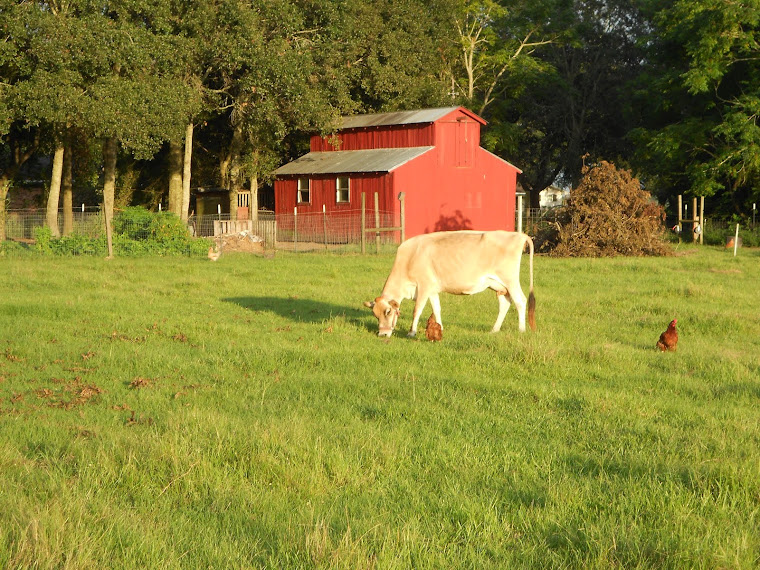
 I like the fact that cows and chickens have plenty of fresh grass to eat. 

Content Cow
So the next time you hear the term "put out to pasture", in regard to the cows and chickens, it's a good thing!  If you want your food to be healthy and nutritious, that's exactly where you want them to be. 


Sunday, October 21, 2012

Swamp People

This weekend Tricia and Laura Lee headed to College Station, Texas to watch Texas A&M and LSU play football.  Russ and Benjamin had a Boy Scout Camporee at Camp Edgewood.  I was left all by my lonesome to handle the farm chores and get some serious weeding done in the garden.  A good buddy of mine invited me to do something that I'd never done before - go fishing in Henderson Swamp in the Atchafalya Basin.  I've always crossed over the the Swamp and wanted to go check it out.  Here was my chance!  Atchafalaya is a Choctaw word that means long river.

I woke up at 4:30, milked Daisy, fed all of the animals and my buddy picked me up.  After about an hour drive, we drove over the levee and launched right as the sun was breaking over the horizon.  It was a spectacular sight, seeing the sun coming through the fog amidst the cypress trees.

Atchafalaya Sunrise
The Atchafalaya basin is about 20 miles wide and 150 miles long and is the largest swamp in the United States.  It is full of wildlife.  We watched as a heron similar to the one below snatched up a big crawfish and flew off with it.  The water in some areas, like below, was the color and consistency of chocolate milk.

A bird's eye view
In other areas, the water was clear.  It was chilly at first, but once the sun came out, it was the most gorgeous day ever. 


There were new sights at every turn.  We saw some really nice houseboats that people actually live on.  We also saw some that were less aesthetically pleasing!

Beautiful bald cypress trees draped in Spanish Moss
Some of the water was just a couple of feet deep, whereas we were in some places where it was 15 feet deep.  The deeper channels were cut by the Army Corps of Engineers to get dirt to build the massive levee system that surrounds the Atchafalaya Basin.  This was built to protect the neighboring farmland and houses from floods that devastated the area prior to the levees being constructed.
 
Reflections on the swamp
The swamp is filled with Bald Cypress trees.  This is the State tree of Louisiana and is valued for its timber.  The lumber is known for its ability to repel water and insects and was used extensively in building homes for this reason by the early Cajuns that settled this area. 

Pretty Bald Cypress Tree
Some of the water had water hyacinth and other aquatic plants growing on top of it.  There are times in the summer where these plants completely cover the water.  The Department of Wildlife and Fisheries tries to control this as they make the waterways impassable by boat traffic and deplete the oxygen content in the water, causing fish kills.  There is a lot of crawfish production harvested out of the Atchafalaya Basin.  In fact, neighboring Breaux Bridge, Louisiana bills itself as the Crawfish Capital of the World. 
 
Aquatic plants growing on top of the water

Although he is almost impossible to see in this picture, a huge alligator lounged in the sun waiting for something to eat to pass by - a fisherman, perhaps?
 
Alligator hiding in the reflections of the I-10 bridge
If you are ever en route from Lafayette to Baton Rouge, you've crossed over the Atchafalaya Freeway. This elevated bridge is 18.2 miles long and a marvel of engineering.  With the amount of traffic that crosses this bridge on any given day it is amazing to think about what happened prior to this stretch of I-10 being built.  The communities along Highway 90 and Highway 190 and the mom & pop stores within them, certainly miss the revenues that that traffic used to bring.

Atchafalaya Basin Bridge east and westbound
The Atchafalaya Basin Bridge is the 14th longest bridge in the world and opened in 1973. 
An interesting photo looking down through the pilings

If you look in the distance, you can see the I-10 bridge in the distance with 18 wheelers on it.  This is the opposite view as you're normally on that bridge looking out to this exact area.  It was at this point that a large Atchafalya Swamp Tours boat passed us loaded with tourists.  My buddy and I joked that the tour guide was probably pointing us out to the tourists saying, "If you look out there, you can see poor old Boudreaux and Thibodeaux fishing for supper.  They live out on the bayou and don't wear shoes or have any teeth.  If they don't catch anything, they'll likely eat a muskrat or a nutria."  We could have really done some things to feed the stereotype, but we just smiled and waved, proving that we do have a few teeth in our heads!  

 
I-10 in the distance
Now, it is painfully obvious that I haven't shown any fish.  We didn't catch any.  The weather was gorgeous with a High Pressure sitting over us and fish don't normally bite at these times so it looks like its muskrat for supper (the other white meat).  We enjoyed some great scenery and an awesome day nonetheless.

After I got home I weeded the garden and replanted some areas where the germination was poor.  I'll show you some shots of the garden this week.  Some of the items are ready for harvest.
Saturday, October 20, 2012

Our first milkcow, Buttercup

In June 2007, we purchased our first milk cow, Buttercup.  She came with a new calf at her side, Daisy - the same Daisy that we currently have, the "boss" of the pasture.  Buttercup was a good milk cow.  I still remember when we tried to milk her for the first time.  She wasn't used to hand milking.  Her previous owner used a milk machine.  She kicked and moo-ed.  Tricia cried that first day, saying, "Can we do this, Kyle?"  We kept at it.  We got used to Buttercup and she got used to us, providing us with good, rich milk and cream.  We learned to make butter, kefir, creme fraiche, and ice cream from the milk she gave.  She also was a very good Showmanship cow, winning Russ many ribbons at the Parish and District Livestock Shows.

Russ showing Buttercup at the Jefferson Davis Parish Livestock Show in 2009
 Then one day in 2010 Buttercup got sick.  She just stopped eating and got very weak.  We read books, checked out different articles on the internet, called a lady in a nearby town that taught us about milking, and called veterinarians.  Tricia and I would get up 'round the clock and go out to the pasture and give her drenches and we'd pray for her.  I'm sorry to have to tell you that Buttercup got worse and ended up dying. 

A 1000 pound dead cow presents a dilemma.  What do you do with her?  Fortunately, my neighbor to the west worked offshore, but on his off-hitch, he had a trackhoe and ran a dirtwork business.  I called him up and he agreed to pull his trackhoe to the edge of his property, reach over the fence, dig a big hole and we would simply bury her in the pasture.  Sounds simple, right?  He started working at around 5 pm.  I was on my way home at 5:30 when I received a phone call from him.  He was cussing a blue streak.  He told me that it looked like I had Old Faithful in my pasture.


It seemed that the Water District had, in previous years before we purchased the land, taken a shortcut across our property to run a 6 inch waterline to a subdivision south and west of us and when scooping out dirt, my neighbor had ruptured the water main.  We called the water district personnel and we worked until almost midnight to fix the leak.  What a mess!  I had the entire neighborhood with no water, we were muddy, tired, and wet.  Eventually we got poor Buttercup buried, but it was a catastrophe all around.

I thought about old Buttercup, whom we simply called "Mama Cow" today as I walked the pasture.  You see, in addition to starting us out in the milk cow business and giving us milk, she also gave us Daisy and Rosie who gave us Magnolia.  Daisy, in turn also gave us Romeo and Stryker, two Jersey bull calves.  I was watching Daisy eating all fat and pregnant and pregnant Rosie with Magnolia at her side and realized how thankful I was to old "Mama Cow."
Grazing Jersey cows
You can tell that Rosie is carrying a little calf.  Look how fat she is!


What are you lookin' at?
I walked on to the spot by the fence under the oak tree where we buried the old girl.  With all the rains, I see a foot-deep sinkhole where some of the dirt had settled.  I need to fill that in with dirt so no one steps in the hole and gets hurt.  The grass grows lush and thick over her grave, providing good forage for her offspring, reminding me of the circle and interdependency of the way the Good Lord designed nature.
Sinkhole over Mama Cow's grave
As I walked back to the house, Magnolia, Rosie and Daisy waited expectantly by the garden, hoping that I was going to feed them some sweet potato vines and small sweet potatoes.  I fed them some and headed indoors thankful for our little animal family.


Hunger Games?
 Good night, milk cows!

Friday, October 19, 2012

You are what you eat


Produce from our Family Farm (Jan 27, 2012)

"Through World War II, farm life in my region (and, I think, nearly everywhere) rested solidly upon the garden, dairy, poultry flock, and meat animals that fed the farm’s family. Especially in hard times farm families, and their farms, survived by means of their subsistence economy. The industrial program, on the contrary, suggested that it was “uneconomic” for a farm family to produce its own food; the effort and the land would be better applied to commercial production. The result is utterly strange in human experience: farm families that buy everything they eat at the store."

Wendell Berry
(Renewing Husbandry)
 
When we started our little homestead farm, the sentiments expressed in Wendell Berry's quote above was one of the driving forces in motivating us.  We wanted to become somewhat independent and wanted to grow our own food.  Farming had always been a love deeply rooted within me.  There was another reason as well.  Our kids all, to some extent or another, had some health issues.  The more we started to read, the more we became aware that many of the health issues we face are caused by the American diet.  Rather than looking to doctors or pharmaceuticals to cure us, we began to employ the advice of the Father of Western Medicine, Hippocrates, who said, "Let food be thy medicine and let thy medicine be food."

We began to see that we could largely get away from processed foods, foods laced with chemicals and unhealthy additives and genetically modified organisms and move toward producing most of our own wholesome, nutrient dense foods of which we know (and can pronounce) every single ingredient.  I'll be the first to admit, it's not easy.  It takes work, time, diligence, and persistence.  The result is so worth it, though!
You know what else?  Sometimes (many times!) we fail.  Plants don't grow or bugs eat them or droughts occur or rains come and flood and scald the plants  Sometimes the doggone plants die.  We keep going though.  That's life.  It has been an incredible journey to learn about growing different crops, to learn to preserve and can foods, to learn how to care for animals (and butcher them), to learn how to cook different foods that we grow and maximize the harvest by trying new recipes.

I have to tell you, though, that food is my weakness.  I love food. I love sweets.  When someone at the office brings cakes or pies, donuts or kolaches, I'm all over that like white on rice.  I wish that I could tell you that I turn it down.  I don't.  I want to get to the point that I do.  I like my cell phone and the safety it provides and how it puts you instantly in touch with people.  I like my laptop that enables me to pull up information at my fingertips.  I like having a vehicle that allows me to be mobile.  Living in the South, I like my air-conditioning!  Part of me likes modern food and modern conveniences.  But a big part of me is running backwards as fast as I can go.  I like learning about the "old ways" that rural agrarian folk used in order to survive.  I'm old-fashioned.  I really like the following verse in the Bible:

Jeremiah 6:16  Thus says the Lord,
“Stand by the ways and see and ask for the ancient paths,
Where the good way is, and walk in it;
And you will find rest for your souls.
But they said, ‘We will not walk in it.’

I am aware that the context of this verse involved the Prophet Jeremiah pleading with the people of Judah to return to the LORD and to obey His commands.  They had become enamored with neighboring nations and were influenced by "advancements" in religion, economy, and culture and were quickly abandoning their historical moorings to Truth.  God, through His prophet, was calling them back.  They were stiff-necked.  You see their answer to his plea:  "We will NOT."  We would do well to heed the Prophet's call from a spiritual perspective today. 


"Crossroads" (C) by www.martin-liebermann.de


We aim to return to some of the ancient paths (old ways) in agriculture and provide homegrown food for our family and have found it to be nourishing and rewarding in more ways than one.  Maybe the "advancements" in our modern diet are not healthy and are actually harming us.  Furthermore, our economy is very fragile.  It is wise to build a storehouse of food and a storehouse of knowledge as a hedge against the growing financial stormclouds.  Don't be motivated by fear, though.  Do what you can.  Start taking baby steps.  We started off small and just try to learn more and do more each passing year.  You can too!

Thursday, October 18, 2012

A Counterfeit Ticket

A couple of days ago I shared with you the story about our family driving to Baton Rouge to visit Laura Lee for the day.  My parents blessed us with football tickets for a LSU's big game against #3 ranked South Carolina.  There were almost 93,000 people in Tiger Stadium and countless others who didn't have tickets, but came to campus to tailgate and enjoy the atmosphere.  Tickets for the game were in high demand.

Athletic events are a big money-maker at LSU.  Tickets, merchandise, souvenirs, food, lodging, etc. related to the games provide great economic stimulus for the University and city.  The tickets we used were season tickets that my parents have and so we KNOW they were the genuine article.  However, due to advances in technology and printers, counterfeit tickets can be printed and sold to unsuspecting fans.  LSU has placed a hologram and bar code on the tickets in an attempt to thwart these crooks from defrauding fans.

Take notice of the hologram and bar code on the pair of tickets

As we made our way to the gates to Tiger Stadium, there were lo-o-o-o-ng lines to get in.  One of the reasons was that officials were checking purses and bags to ensure no one was sneaking weapons, food or bourbon into the stadium.  The other reason for the wait is that everyone had to have their tickets scanned by a device similar to the one below.  The scanner scans the bar code and verifies that the ticket is valid and legitimate.  If the ticket is good, the machine beeps and you are granted entry.  If not, you are turned away and can't gain access.  Even if you were well-intentioned, the fact that you are holding a counterfeit ticket denies you entry.  I've read about fans being turned away after spending a great deal of money buying counterfeit tickets from a stranger - talk about ruin your day!


I'm a simple, old country boy (I'm not a preacher), but I began to think about all of this from a spiritual context.  First, let me tell you, I believe in a literal Heaven and a literal Hell.  Everyone wants to go to Heaven, right?  Although I'm sure that they exist, I've never met anyone who is looking forward to going to Hell.  That's just crazy. 

I wonder how many people do you figure are holding counterfeit "tickets" for Heaven?  How many people are holding that ticket of:
  • Church Attendance?
  • Good deeds?
  • The idea that "all paths lead to God"?
  • The idea that "I'm not perfect, but I'm better than so-and-so, so I'm okay"?
  • The deception that "God is a loving God and therefore there is no one in Hell?"
  • (Fill in the blank here)
So what happens when we arrive at the turnstile of Heaven and pull out our "ticket," give it to the attendant and it doesn't "beep"?  What happens when we realize that we've been holding a counterfeit "ticket" and are turned away?  This event will do more than simply ruin your day.  This is eternity we're talking about. 


The Narrow Gate
If you want to learn about math, you read a math book.  If you want to learn about history, you read a history book.  If you want to learn about gardening, you read a gardening book.  If you want to learn about God, read His Book - the Holy Bible.  It is very clear (and simple) what you must do to access Heaven.  Make sure the ticket you're holding is the genuine article and not a counterfeit.  Don't be denied access!  

John 14:6   Jesus said to him, “I am the way, and the truth, and the life; no one comes to the Father but through Me."

Related Posts Plugin for WordPress, Blogger...