Monday, November 12, 2012

Hay for the cows

As the grass stops growing and the resulting quality diminishes due to either fall/winter weather or drought, it becomes important to supplement the cows' menu with some hay.  After inspecting the pasture this weekend, I felt it was time we roll them out a bale as we want them in good condition for the up-coming weather.  Similar to squirrels putting away acorns for the winter (only in this case WE'RE the ones preparing!), we plan ahead.  We have 2 types of hay stored up for them.  We have round bales of bermuda/bahai mix and square bales of quality bermuda "horse hay".  The idea we go with is to roll out a round bale and put a ring around it and allow them a free choice "all you can eat buffet."  With the higher quality hay, we'll control the portion sizes.

Once the girls saw that we were rolling out hay, they became curious (hungry) and Tricia and Benjamin had to shoo them away from the gate.

Did someone ring the dinner bell?
We have the round bales stored outside of the fenced-in pasture and the square bales stored in the loft of the barn, so the gluttonous bovines don't get after it.  Russ, Benjamin and I began to roll a bale into the pasture.  It takes at least two people as the bales are quite heavy.  We discovered that in addition to the cows liking to eat the hay, fire ants like to build their mounds in it.  The bale we're pushing was full of fire ants and they tore us up!   

Action shot of moving the hay
It is very important to have a hay ring to put around the hay to protect the bale.  Cows have notorious bad eating habits and will waste/ruin more hay than you can imagine.  They step on it.  They scatter it.  They urinate and poop on it.  The ring helps to regulate their bad table manners and force good etiquette.
 
With this ring...
You can see that the cows got right down to business on this bale of hay.  The chickens jump on it as well.  I'm sure there are numerous bugs that made their home in the bale, like the ants, that served up a nice banquet for the hens. 

Rosie and Daisy feasting
Here is Daisy with a mouthful of hay.  I think the old girl is saying "Thank you."

Mmmmm
If you notice, the cows always attack the very center of the haybale.  I think the center is most protected from the weather and is the freshest hay.  I do the same with cinnamon rolls.  Seems like most of the good cinnamon, nuts and good stuff is in the center.

The good stuff is in the middle
In order to protect the bales of hay from the weather, we cover them with a large tarp.  In this case, it is a billboard sign that my dad let me borrow.  It makes a perfect protective covering for the hay.


Protective covering for the hay
 In just one day, they've really made a dent in the hay.  They've hardly strayed from the hay to the pasture.


Chomp, chomp, chomp!
They need to pace themselves.  They are acting like me at Thanksgiving Dinner!


Sunday, November 11, 2012

Incorporating the Harvest into the Menu

We love real food at our house.  Real food meaning food that we grew - healthy food that we know what is in it.  One of the things we like to do is search for different recipes to incorporate the item currently being harvested into the menu rotation.  Due to the amount of food we grow for personal consumption, it would get very boring if we cooked everything the same way all the time.  We'd probably have a mutiny on our hands, too.  We like to try new things with new spices and bold flavors.  Some recipes are hits and go into the meal rotation.  Some are not and don't.  Trial and error.  You know how it goes.

Currently we have a lot of sweet potatoes and a lot of kale.  Both are tasty and very nutritious.  I ran across a recipe on the Internet from Foodandwine.com that reminded me of something that we ate 22 years ago on our honeymoon.  We went to Virgin Gorda.  It is one of the British Virgin Islands and a beautiful place to be sure. 

The dish we were going to try is called Island Kale and Sweet Potato Soup.  It is inspired by Caribbean cuisine and is a hearty, tropical, coconut milk spiked soup.

Ingredients:

2 tablespoons butter
1 onion, chopped
2 cloves garlic, minced
1 jalapeno pepper, sliced thin
3/4 pound kale, stems removed
1 1/2 pounds sweet potato, peeled and cut into 3/4 inch cubes
1 1/2 quarts chicken broth
1 1/2 teaspoons salt
1 can unsweetened coconut milk
Rice

So first, Tricia went out to the garden with her produce bucket and picked a bucket-full of fresh kale.  This is a very healthy plant that grows throughout the winter and well into the summer, providing lots and lots of meals.

Harvesting Kale
Next, she got out the kitchen scale and weighed out 3/4 pounds kale.  
Kale on the Scale
Now she grabs some of our just-cured sweet potatoes from the bin and weighs out 1 1/2 pounds.

Weighing the sweet potatoes
Now, we remove the stems from the kale leaves.

Removing the stems from the kale
Tricia uses some chicken necks we've been saving to make a quart and a half of chicken broth.  
Broth is beautiful and healthy too!
Now she chops up an onion, 2 cloves of garlic, and a jalapeno pepper.

On the chopping block
 We add the chopped veggies into the dutch oven along with the butter and saute.

Smelling good!
Next, she stirs in the kale, chopped sweet potatoes, broth and salt and brings it to a boil.  Reduce the heat and simmer for about 20 minutes, partially covered until the sweet potatoes are tender.  Now add the can of coconut milk and heat until all warm. 

Healthy soup
Add a big spoonful of rice to a bowl and ladle the soup over it and enjoy.  This was like an island gumbo, sort of, definitely different from anything we've tried.  We thoroughly enjoyed it. 
Sweet, spicy, hearty island soup.
We've got lots of kale and lots of sweet potatoes and a cold, wet winter ahead of us.  This dish is sure to reappear on our table in the upcoming months.

Saturday, November 10, 2012

Volunteers

No, this posting isn't about Tennessee who got the nickname the Volunteers during the war of 1812 when the Tennessee Governor asked for volunteers to fight.  The people responded and played a prominent role in the Battle of New Orleans.  We're big football fans, but not necessarily of the University of Tennessee.  We cheer for LSU and Texas A&M.  In fact, Laura Lee attends LSU and was on national TV last Saturday night when the CBS camera panned through the student section and settled on the prettiest girl in all 93,000 in attendance!  A friend with DVR paused it and took a picture and sent it to us.

Geaux Tigers, Geaux Laura Lee!
The Tigers came up short in that game unfortunately, but Tricia's Aggies knocked Alabama off today!  Way to go, Aggies! 

But back to the subject of today's post - Volunteers.  In the garden, we purposefully plant our crops from seed and enjoy the produce.  Seeds come up spontaneously that we don't plant as well.  In agriculture, the term 'volunteer' refers to exactly that - plants that came up on their own without being planted.  It is a nice surprise, a bonus.  I've taken a few pictures to show you the volunteers we currently have growing in the garden.  Here below is picture of a sweet potato "slip."  Sweet potatoes are not grown from seed, but from slips, or shoots from a sweet potato tuber.  We have these coming up all over the garden.  In fact we never have to plant them.  They come up year after year, probably from a sweet potato we composted years ago.  As a result, we have bountiful crops of sweet potatoes that we never have to plant.  Pretty cool, huh?


Heart shaped leaves of a sweet potato slip
Cilantro is the leaf part of a coriander plant that grows from a coriander seed.  These pop up volunteer all over the garden.  Here is one below coming up right next to a garlic shoot.  We enjoy making pico de gallo, salsa, and cooking these down with beans and in scrambled eggs.  It has a distinctive aroma.  Some people love it.  Some people say it tastes like soap.  We love it.


Cilantro
Basil is another item we never have to plant.  It germinates all throughout the garden from the seeds propagated from mature basil plants in the garden. 


Basil seedlings
Below is a Dixie Speckled butterbean that has come up right next to the Shanghai Greens (Chinese cabbage).  This undoubtedly sprouted from some of our butterbeans that matured and 'shattered', dropping the seed to the ground in the process.

Dixie Speckled Butterbean
Here is a nice tomato plant that has sprouted right next to the cabbage.  I think I'm going to repot this one and bring it in so it doesn't freeze.  I don't know what type it is as I plant numerous heirloom varieties.  I guess we'll just be surprised if it bears fruit.  I had a friend who tried to produce tomatoes in the winter in a greenhouse.  He told me that they made beautiful tomatoes, but they were tasteless.  I'm going to give it a shot, though, and hope ours taste good.

Volunteer Tomato Seedling
Here is some type of pepper plant that has come up on its own.  Like the tomato, I'll pot this one and bring it inside.  I've had success with saving peppers over the winter and enjoying their production for multiple years.  If I had to guess, I'd say this was a criolla sella pepper.  I'll just have to wait and see.
Mystery Pepper

Finally, right next to the Mangel Mammoth beets, I have a very pretty Sunflower plant that has decided it wants to grow right in the row.  I plant Arikara sunflowers in the spring.  They'll grow 12 feet tall.  This may be an Arikara, but it might be one that a bird dropped.  Or it may be a black oil sunflower.  We used to supplement our cow's feed with black oil sunflower seeds as they were said to give the cows more energy and boost their milk production.


Sunflower volunteer
It's always kind of fun to see which kind of plants that will simply come up in the garden without us having to plant them.  Except for the weeds, of course.  We have many, many volunteer weeds unfortunately.  I'll try to get my boys to 'volunteer' for weeding them tomorrow:)

Friday, November 9, 2012

Making Butter

One of the benefits of having milk cows is all the other dairy products that you can make besides the delicious milk.  We've shown how we make kefir in a previous post.  Today I'll show you the art of making BUTTER.  Butter gets a bad rap for being unhealthy.  Hogwash.  Malarkey.  There are good fats and bad fats.  Butter is a good fat and is GOOD for you!

Butter, the way we make it, has an extensive list of ingredients.  It consists of:
  • Cream
  • Salt
What?  No preservatives?  No.  What about artificial coloring?  Nada.  Hydrogenated oil?  Zilch.  High fructose corn syrup?  Gosh, I hate to disappoint you.  Just pure butter made from Daisy's high-butterfat content Jersey raw milk.

It does take a little work.  My parents gave us this family heirloom - an old hand-cranked butter churn.  We've used it and it works great.  Honestly, I don't want to break it, though.

Note the wooden paddles
We generally make our butter in small batches.  Therefore we use this even more primitive method:

Shake it up!
Here's what you do:  skim the cream off of your milk, filling a jar about 1/2 full with cream.  You don't want to fill it any higher than that as you need enough space to shake it.  We add a kefir cube to the cream to culture it.  When we make kefir we freeze some of it in ice cube trays.  The kefir cube cultures the cream and gives the butter and buttermilk a rich flavor and fills it with beneficial bacteria that is good for you.  We leave the jar of cream out at room temperature for 8 or 10 hours.  Then we simply shake it.  We pause to open the jar to let out the gases driven out of the solution by the agitation and then continue.

Letting out some gas.  Sorry, I couldn't resist
If your cream is at room temperature, it takes all of about 7 minutes to make butter.  You can feel when it "breaks" by the different feel the jar gets when shaking it.  If you stop right before this point, you can see the little butter globules forming.  Keep on shaking it and it will turn from a liquid to solid.  You've got butter!  Pour off the liquid. This is buttermilk.  You will want to save this!
 
Pouring off the buttermilk
Once you've poured all the buttermilk off the butter, we put the butter on a plate.  It is still full of buttermilk so you want to get a wooden spoon and squeeze all the remaining buttermilk off and into your jar.

Draining the rest of the buttermilk off the buttermilk
Keep folding the butter and squeezing it over and over.

Butterfingers
Finally, the butter will firm up and will yield no more buttermilk.


And here is the buttermilk that we will save to use a little later.

Buttermilk
We add a little salt to the butter.

Salted Raw Butter
Now just fold the salt into the butter so it is mixed up real good.

Folding in the salt
Finally, I use the wooden spoon to "square off" the butter so it is shaped in a big block.


Here is the finished product: Homemade Raw Butter from Daisy.  I weighed it and it made a half pound of butter.  We'll just put it in the fridge until we're ready to enjoy it.

Homemade Raw Butter
Now it's time to eat.  Tricia made some scrambled eggs gathered from our hens, buttermilk and some blueberries from our bushes we had frozen this Spring to make homemade buttermilk blueberry biscuits.  We put a few pats of fresh butter on the hot biscuits and we'll sit down to enjoy a delicious country breakfast.  Bon Appetit.

Enjoying a fantastic breakfast
I also wanted to show you our butter bell.  I was reading about this contraption and had to have one.  It was thought to be from France in the Middle Ages prior to refrigeration.  The way you use it is you fill the crock 1/3 of the way with water.  Then you fill the bowl with fresh butter, turn it upside down, and submerge the butter in the water.  It creates a air-tight, water-tight seal that keeps your butter fresh, soft and spreadable at room temperature for several weeks without spoiling.

The butter bell
Here is a picture of how it looks once you submerge the butter in the water and set it out for storage.


Finally, here is a butter mold that we purchased at an antique store here in town.  What you do with this is you put the plunger back in the box mold, turn it over and pack the butter in the mold.  Then you use the plunger to push the perfectly square block of butter out for storage.

Butter mold
We make butter, wrap it in wax paper and freeze it for use later.  We love our fresh raw butter!
Thursday, November 8, 2012

Out riding fences

The Eagles sang a song "Desperado" about a rugged loner.  You probably know the part of the song where they sing, "You've been out riding fences for too long now."  What they are singing about is that in the old west, a cowboy would get on a horse and ride around the perimeter fences to make sure that the fences were in good shape (i.e. no broken barbed wire, posts, etc.)  It was lonely, unglamorous, but very necessary work.  Today's cowboys do it by 4 wheeler, truck, or even helicopter.

This morning at 5:30 I performed the task in the dark and on foot and found... Gasp!... a broken fence.  It took me only 5 minutes to fix, but the events that occurred last night involving Magnolia, our Jersey heifer, and the perpetrator, Stryker, our Jersey bull, are irreversible.  While we're on the country music and cowboy theme, there was a song by Johnny Lee in the movie "Urban Cowboy" called "Lookin' for love."  This is what transpired last night - love was definitely in the air and Stryker went lookin' for love.  We were trying to keep them in separate paddocks, but our fence was no obstacle for the power of love.  We'll know for sure in 21 days, but I think we'll be expecting a calf from Magnolia in 9 months.  Here she is posing below. 

Love me tender, love me sweet, never let me go
The reason we were trying to keep them separated is that for dairy heifers, the optimum time to breed is when the heifer is 15 months old.  Magnolia is 14 months old.  They say that if the animal is bred prior to 15 months, there is a greater probability of dystocia.  Dystocia is a 50 dollar, fancy way of saying, "difficult child-birth."  We pray this isn't the case.

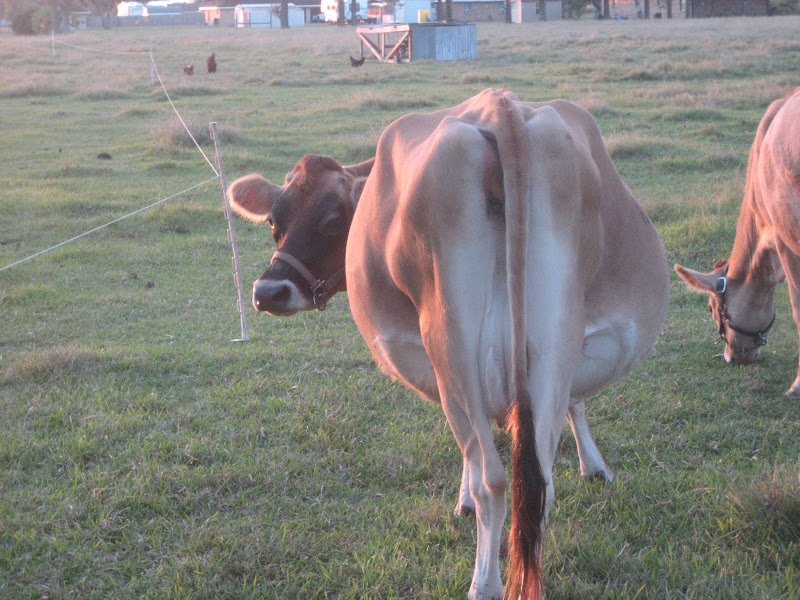
So in mid-December Rosie will calve.  You can certainly tell that she's carrying, can't you?

Wide Load
 Then in July 2013, Daisy will calve.  And in August 2013, Maggie will probably calve.  Our little herd and dairy is growing. 


We'll be awash in milk.  That is a good problem!  Maybe we can begin to make cheese.

Wednesday, November 7, 2012

Fall Back...

Although the new time change gave us an extra hour of sleep on Saturday night, the shortened days have resulted in two downsides for us.  First thing is, by the time I get home from my "real job", it is already dark.  I have to take care of most of my chores by the light of a lantern, but some chores just get left undone until the weekend as it is just not practical to hold a lantern and work.  On weekends we like to get a late start and begin the farm chores at our own pace - a leisurely one.  Now, all the work that didn't get done during the week has piled up and must get done on the weekend.  First thing on Saturday morning it is staring me in the face urging me to get busy (sort of like Daisy's moo-ing to be milked).

The shorter days prohibit me from taking any pictures during the week.  This blog is sort of like a photo essay and it really helps me to slow down and think about what I'm doing and relish the each day and the lessons and experiences that each new day brings.  Below is a view from the our barn looking South as we were milking the cows.  It was a foggy morning and the neighbor's horses were walking underneath the live oak trees.

Foggy Horses
The second thing that I don't like about the shorter days is the effect that the reduction of daylight has on our hen's egg production.  This time of year egg production always drops off significantly due to the shorter days.  According to what I've learned, a hen requires at least 14 hours of daylight to stimulate their ovaries to release an egg.  It takes longer to accumulate the 14 hours during the fall and winter months.   Therefore, our "egg money" from customers who purchase our delicious eggs drops off directly proportional to the waning daylight.  Oh well, they need a rest too, I guess.  Here are the girls eating some rice while we milk.

Breakfast for the girls and roosters, too
I like to plant things in the garden so that the colors pop in the rows.  A feast for the eyes as well as the stomach, you might say.  Below you can see the lime green of Shangai Greens (bok choi) in the top row, bright green Black Seeded Simpson lettuce in the middle row and the deep red leaves of the Bull's Blood Beets in the near row.
Just ignore the weeds, please.  I'll get to those this weekend!
When heading back indoors, I heard the sound of loud French music being played.  I looked up to see a whole bunch of people on horseback, covered wagons, and horse-drawn buggies trotting in front of the house.  It was a trail ride!  They looked like they were having a good time.  The line of horses went on and on and they were led by a Sheriff's Deputy escort car.  The "caboose" was a flat-bed trailer with two Port-a-Potties on it, being pulled by a truck.  They were well prepared for all contingencies!

Ride 'em Cowboy!
Nice day for a trail ride!


Great weather for a trail ride
At the end of the day I wanted to show you some satsumas on one of our citrus trees that are ripening and should be ready for harvest.  These are a type of citrus that are also called tangerine or mandarin orange.  It is named after the Satsuma province in Japan, where they were first imported from.  We really like them as they are sweet. I've read that their sweetness intensifies after cold weather and a frost, so we might wait a while.
Ripening satsumas
I wish you could smell the blossoms on these trees in the Spring.  I don't know if there is a better fragrance on God's green earth.
Related Posts Plugin for WordPress, Blogger...