Tuesday, November 6, 2012

Putting away more seed

In normal times the old adage "a penny saved is a penny earned" rings true.  You could forego spending your money and instead deposit it in the bank and earn interest on your money.  Now, not so much.  The real rate of return on savings accounts, money markets, and CDs are dismal.  I have good news though, the growth rate or investment return on saving seeds is phenomenal!  If you purchase open pollinated, non-hybrid seeds, all you have to do is put out an initial outlay and then you're done!  Enjoy your crop by eating and enjoying healthy, fresh food.  Then save your some of your seeds for planting next crop season and it is like money in the bank, with an added bonus - you can eat most of this investment.

We enjoy okra.  Just tonight we had some chicken and sausage gumbo with some fresh okra in it.  Okra is a drought tolerant crop that produces early and long.  We've had success saving okra seed and have always achieved good germination.  In order to save okra, leave a few pods on the stalk instead of  harvesting to eat.  You can tell when they are ready when the pod is completely dry and if you shake the pod, you can hear the seeds rattling inside.  Break the pods open and the seeds will roll out.  I took some pictures below to show you:


Breaking open the dried pod to reveal the okra seeds
I usually have a cup handy to catch all the seeds.  These seeds will bounce and roll around where you'll never find them if you don't capture them in a cup or bowl while breaking apart the okra pod.
My cup runneth over
 Once you're finished all you'll have left is the split pod that used to hold and protect the okra seeds.  Throw this in your compost pile.  Next year this will become part of your soil to help grow more okra.  Neat how that works!


Empty pods
Here's a close-up shot.  Okra is a prolific producer.  What you see in my hand is more than enough seed to provide our family with all we can eat fresh okra and plenty to blanch, freeze and pickle next year.

A little later I shelled a bunch of Ozark Razorback peas into the bowl shown below.  They are a type of Southern cowpea.  I think they are cool looking.  We eat these cooked with some fresh smoked sausage and served over rice.  Additionally, I've been reading that these peas are a great source of protein for use in chicken feed.  I'm thinking about planting a lot of these next year to help feed our laying hens.


Beautiful Ozark Razorback Peas
Put these seeds in your seedbank and regardless the economy and resulting investment returns on traditional investments, your portfolio of good, fresh, healthy, nutritious food will enjoy positive gains year over year.

Monday, November 5, 2012

Our favorite use for pecans

C'mon now.  Is there anything better than a homemade pecan pie and a good cup of coffee?  Nah, I didn't think so.  We've been picking pecans underneath our six trees and have filled up three big feed sacks and two five gallon buckets so far and the ground is still covered with pecans.  I'm in the process of mowing the yard now for what I hope to be the last time this fall and I'm leaving the areas around the pecan trees so we can pick them all.  Once we've picked all the pecans up and all the leaves have fallen off the trees, I'll mow the leaves into a pile and rake them up to use as mulch in the garden.

But with this bumper crop of pecans, what to do with them?  We started by making pies.  Tricia makes up her pie crusts from scratch and rolls them out.  I try to be on my very best behavior when she has the rolling pin handy.
Blunt force trauma?
While she's at it, she went ahead and made one extra to freeze.  All she has to do it thaw it and roll it out.  It never can hurt to have a pie crust waiting in the wings, right?  After all, the Boy Scout Motto is "Be Prepared."

A future pie in the fetal stage of development
Tricia makes the best pecan pies and makes them with Steen's Pure Cane Syrup.  This stuff is addictive and is made right down the road a piece.

According to Wikipedia:  
Steen's cane syrup is a traditional American sweetener made by the simple concentration of cane juice through long cooking in open kettles. It is sweeter than molasses because no refined sugar is removed from the product. Produced in Abbeville, Louisiana, by C. S. Steen's Syrup Mill, Inc. since 1910, it is easy to spot by its bright yellow label. Traditional cane syrup is recognized by Slow Food USA in their Ark of Taste as a cherished and endangered slow food product. Steen's is the only manufacturer left today.

It comes in the can:

Or the bottle:


The can can be quite a mess in pouring, so we opt for the bottle as it is easier and less messy to pour.  Lots of people use this sweet stuff to make popcorn balls as well.  Steen's also makes molasses.  In the wintertime, we generally top off the cow's hay with a liberal splash of molasses.  The cows love the sweetness and it has some nutritive qualities as well, providing energy and trace minerals such as sulfur.

Here's the recipe for some doggone good pecan pie:

Tricia's Best Pecan Pie

1 stick butter
3/4 cups Steen's Pure Cane Syrup
1/4 cup local honey
1/2 cup sugar
3 large eggs from the girls, beaten (the eggs - not the hens)
1/2 teaspoon lemon juice
1 teaspoon vanilla
1 dash salt
1 1/2 cup chopped pecans
pie shell, homemade is best

Melt your butter.  Add ingredients in order listed, stir up real good.  Pour into your unbaked pie shell and bake at 425 F for 10 minutes.  Reduce heat to 325 F and continue baking for 40 minutes.  Remove from oven and grab a fork.

Katy bar the door.  It's on!
A little lovin' from the oven
And here is a slice of delicious homemade pecan pie.  From the trees to the plate, if pecan pie's for dessert, I won't be late.

A little slice of heaven!


Sunday, November 4, 2012

A home for the Garfish

You might remember in an earlier post, we got a canoe that we christened, The Garfish, that we take out for excursions on nearby Bayou Nezpique.  Although we've taken this sea-worthy vessel out numerous times, lately the poor Garfish has been neglected, sort of in that she doesn't have an official home.  She was laid out in the yard upside down.  This is not good for her and only contributes to a canoe shaped dead spot in the grass once we moved her out of the way to mow the grass.  Well, I had Build a Canoe Cradle on my to do list this weekend.

I had an idea that I wanted to hoist her up to the ceiling in our garage and searched the internet for good ideas on how to do it.  There are a multitude of ideas out there in cyberspace, both good and bad.  One of the ones that I thought was really good was also very expensive as it called for 12 pulleys and 2 double pulleys.  I altered the plan to make it "wallet-friendly" and omitted the pulleys altogether and tried to substitute items I had laying around.  You might call this the Fred Sanford approach.  The only items I had to buy were some poly rope and a couple of tie down cleats.

Pulling the Garfish up to the ceiling gets her out of the way without using a footprint of storage space on the ground that we could otherwise use and also gets her out of the weather and out of the way of the lawn mower and fire ant mounds.  For some reason fire ants had taken a liking to her.

All I did was screw 4 bicycle hooks into the beam supports in the ceiling of the garage.  These would hold the weight of the Garfish.  I then glued some carpet remnants to the top of two 2 X 2's and screwed 4 eye bolts into the ends of the 2 X 2's.  These will serve as the cradle.  I then tied the rope to the eye bolts and ran the rope through the bicycle hooks and mounted the tie down cleats to the wall studs at appropriate locations.  I've taken some pictures as it is easier to see than explain.  Here is a front view of the Garfish in her cradle.  Notice I'm confident enough to be standing underneath her.  With my carpentry skills, this area I'm taking the picture from should probably be deemed a hard-hat area.  You can see the carpeted cradle and can also see where the rope is tied down to the cleat.

The front of the cradle with tie-down
Here is a view from the back where you can see one of the bicycle hooks that support the weight of the canoe.  I'll admit that without pulleys, you have to help it along by pushing up on the cradle while another pulls.  It would be much easier with pulleys, but since this was a private (and not government job) my goal was to make this project meet my < $20 budget constraints.  We got her done!

A view of the backside
Here is a close-up of one of the tie-down cleats:

Holding her steady
And here is the all-encompassing shot, showing the Garfish nicely stored away.  You can also see a sack of sweet potatoes hanging from the garage door support while they cure.  I have another sack hanging outside from a tree and two five gallon buckets full of sweet potatoes that I will start curing tomorrow. 

Just hanging out
So this quick project was successful on a number of fronts.  It passed the budget test and met with approval from Tricia for being somewhat aesthetically pleasing as well as functional.  Mission Accomplished!  


Saturday, November 3, 2012

The Dew of Heaven & the Fat of the Land

In the Old Testament, it was customary for fathers to give their sons a blessing.  In the blessing below, Jacob lived up to what his name means (deceiver) and tricks his father, Isaac, into giving him the blessing that was meant for his older brother, Esau.  Blessings were meant to bestow prosperity and success and set the direction or course in life for a man's sons.  

Genesis 27:28-29

 "Now may God give you of the dew of heaven,
And of the fatness of the earth,
And an abundance of grain and new wine
May peoples serve you,
And nations bow down to you;
Be master of your brothers,
And may your mother’s sons bow down to you.
Cursed be those who curse you,
And blessed be those who bless you.”

That is a nice blessing!  This morning we woke up to a beautiful, blessed morning with a heavy dew from heaven.  We felt blessed like Jacob. 

Dew droplets coating the asparagus ferns

Spiderwebs built webs on the fence overnight that were also dotted with dew. 


Dewdrops on spiderwebs glistening like jewels in the morning sun
Regarding the fatness of the land, while it was still cool (it was supposed to be in the mid - 80's today), I got to work digging up more sweet potatoes.  In the Bible when the word 'fat' was used, it meant the choicest parts - the best parts!  And that was a very good thing.  Most of the time you hear the word 'fat' used today, it has a bad connotation.  Not so in Bible times.  These nice sweet potatoes are clearly the choicest parts that we thoroughly enjoy! 

Nice, FAT sweet potatoes
Not only humans get the choicest parts - Daisy likes, let me correct that, LOVES the sweet potato vines. 
Daisy's always first in line to eat a sweet potato vine
But it's not only vines that I feed her.  When the sweet potatoes are small or broken when I dig them, I keep a little pile of them for a special snack that they really enjoy.  I hand feed them and they reach out their long tongues and eat them up.  You can hear them crunch, crunch, crunching them up.

A little sweetness for the girls
 It is so pitiful.  She will stand by the fence and beg for them!


Thank you.  May I have another?
Sweet potato flavored milk tomorrow?  Maybe not.  Anyway, we feel blessed on our little five acres as we're able to enjoy the dew from heaven and the fatness of the land.

Friday, November 2, 2012

Putting on a winter coat

In South Louisiana our falls and winters are normally pretty mild - actually very mild.  According to currentresults.com, the average winter temperature (Dec - Feb) is 50.9 degrees Fahrenheit in Louisiana.  It does dip below freezing and it is on those days that I feel sorry for the cows.  One of the best things to do is to give them plenty to eat on in the Fall so that they can have some fat stores saved up to act as a "liner" on their "winter coat". 

I was discussing this with Tricia last night and I think we are going to roll out one of the first bales of hay this weekend and put a hay ring around it and let them start snacking on it.  There is still some good grass out on the pasture for them to eat and I have a little spot behind the pasture that I have stockpiled for them to eat on as well.  We just want to ensure that they are in good condition going into the winter to keep them comfortable and warm. 

Just yesterday I was noticing that Magnolia (Maggie May) is preparing for the winter by growing her winter coat.  Jersey cow's coats are normally pretty short and slick, except in the winter where they put on a nice thick coat to protect them against the cold and wind.  If animals get too cold, especially if it is raining and windy, they expend energy and burn up fat stores to keep warm.  We don't want them depleting their fat stores to stay warm as both Daisy and Maggie are pregnant.  We want their energy directed toward growing healthy calves - heifers, we hope.  That's where their winter coat comes in handy.  God takes care of his Creation.

Maggie's fur coat
Here is a close-up shot of her coat:
 
Maggie will be warm and furry for the winter months ahead
Daisy and Rosie have started growing theirs as well, although they aren't as far along on their growth as Maggie is.  The sad thing is that the Livestock Shows are in January and Dairy Cows must be clipped for the shows so that the judges can see the lines of the animal.  This is a big job for us that we dread almost as much as the animals.  It takes a while to completely give a 1000 pound animal a haircut - and we have 3 to do!  We have some special clippers for the job.  I'll be sure and post some pictures of this process when that time comes.

Just as we take off our coats when it warms up, the cows do as well.  As soon as it starts to warm up in the Spring, they'll begin shedding their winter growth, so that they will be cool and comfortable for the summer months.  How's that for a thermostat?

Thursday, November 1, 2012

Chickens are Omnivores

Disclaimer:  Today's subject matter is not for the squeamish.  Consider this a WARNING before you read on.  You forfeit your right to complain if you read on past this paragraph.  It might be best to just tune in tomorrow!  Everything will be factually correct, it's just that "some things are better left unsaid," but I'm gonna say 'em!

As we've discussed before, our chickens are pretty much on their own, but we do throw them some rice everyday.  The pullets do get a commercial (non-medicated) chick grower feed until they begin laying.  Once they lay the first egg, they are pretty much on their own and they forage for bugs, worms, frogs, mice, snakes and other assorted tasty vittles.  Other than the rice we give them, if our chickens had bootstraps, they'd have to pull them up, because it is sink or swim at Our Maker's Acres Family Farm as far as eating is concerned.
A rugged individualist

I'm always reading about different farming techniques and ran across an article from Nourishing Traditions, a publication put out by the Weston A. Price Foundation, a group of which we are members.  In the article, Matthew Rales was giving a tour at Joel Salatin's Polyface Farms in Virginia in which he said:
"One of the points I always try to convey when I host farm tours at Polyface Farm is that chickens are omnivores. Visitors have no problem with the fact that pastured poultry eat lots of green grass, herbs and clover, but cringe at the notion that these beautiful, healthy birds also supplement their diet with plenty of animal foods as well. In the green season, the birds eat lots of grasshoppers and fly larvae (out of the cow pies).
But what happens when the chickens go indoors for the winter, and insect life is all but nonexistent except for the occasional pill bug and spider in the deep bedding material? Traditionally this is when farm flocks were supplemented with vermin, cut open for easier access to the internal organs. Chickens gladly and voraciously tear at the flesh and guts of a freshly shot groundhog, opossum or raccoon. Chickens have a featherless face for a reason—it is easier to keep clean after indulging in flesh. We see the same physiology in wild avian scavengers like vultures."  Chickens are omnivores its no dilemma
I have no doubt in my mind that a chicken would happily tear fresh road-kill up.  In fact, when we've lost chickens in our pasture to various predators including hawks, owls, opossums and dogs, when we discover the carcass, we've witnessed first-hand that the chickens have no qualms about eating what the predator leaves behind.  The "You are what you eat" saying is literally true in this case.

I have a 90 mile round trip commute to work each day.  Most of it is Interstate driving, so it goes rather quickly.  There are, however, some backroads that I take to avoid some school zones and traffic.  I've noticed lately for whatever reason that the road is littered with roadkill.  I've seen possums, raccoons, turtles and armadillos that have met their demise.  That's where nature's clean up crew comes in.  Nature's Waste Management.  Meet the buzzard.  This guy eats what others won't and cleans up the messes.  He plays an important role in keeping the pastoral landscape nice and tidy. 

A buzzard saying Grace before a meal
Which reminds me of a great story.  I may have this a little messed up, as it has been quite a while since my mom told me the story, but the main points will be accurate and this is one you don't quite forget.  My mom's great aunt was traveling many years ago with some friends somewhere around DeRidder, Louisiana.  We live on the Cajun prairie - some pretty flat land.  As you get a little north of us into the piney woods, there are some hilly areas. 

So my mom's great aunt and her friends were out for a drive and came over a hill and disturbed a group of vultures.  For grins, I looked up on Wikipedia to find out what a group of vultures is called.  Would you believe they are called a wake, committee, venue, kettle, or volt?  Okay, that's just interesting, right there.  So technically a wake of vultures actually attend a wake prior to eating??  I've seen committees in which the participants acted like vultures.  And a "kettle" of vultures?!  Sounds appetizing, doesn't it?

Back to the story du jour.  When they disturbed the kettle of vultures feasting on carrion, one of the old buzzards wasn't quite quick enough.  He was clipped by the front bumper of the vehicle, tumbled across the hood, broke the windshield (this was before windshields were shatter-proof) and became an uninvited occupant in the car with them.  The poor bird commenced to throwing up all over them, which made my mom's great aunt and her friends sick and then they began throwing up.  It is a monumental understatement to say, "What a mess!"

I'm trying to figure out if there is a moral to this story.  I guess it would be to drive carefully around road-kill and beware of committees!  For full disclosure, I have to admit that I have stopped several times when coming across roadkill, but it was only to cut the tail off of freshly dead raccoons to bring a souvenir of sorts home for my boys. 

Will work for food?
Chickens are omnivores and opportunists and, like me, will never turn down a free lunch!  I'm a little more discriminating in my menu choices, though.

Wednesday, October 31, 2012

Savagery

For some strange reason I'm in a philosophical mood...

Benjamin and I have been reading the book, Lord of the Flies, by William Golding.  It has been 27 years (where does the time go?) since I last read this disturbing book.  Benjamin is 11 years old, and during various parts of the book, I asked myself if perhaps the subject matter was too intense.  I think the book shows, however, in events that a young boy can understand, some important learning points about human behavior.


In a nutshell, here's a brief plot summary if you haven't read the book or if, like me, it's been a coon's age (raccoons actually don't live that long) since you've read it:

A group of young British boys survive a plane crash on a deserted island with no adult survivors.  They pull themselves together and drawing on skills they've been accustomed to in a civilized society, they elect a leader, Ralph, and organize themselves with assemblies, tasks necessary for survival, and rules that govern their "society."  Ralph is the leader, but Piggy is the brains behind the operation.  Piggy also has the spectacles used for starting fires.

All seems to be going well until a rival leader emerges, some of the boys don't want to work, and they become fearful of a "beast" that supposedly inhabits the island.  These conflicts drive a wedge in the initial unity.  The rival leader, Jack, organizes a hunting party that kills wild pigs.  Instead of keeping a fire going to alert rescuers, the hunters let the fire go out in order to go hunt pigs.  These hunters, led by Jack, become more and more bloodthirsty, begin painting themselves, and develop a dance and chant.  The "Lord of the Flies" is actually a pig's head on a stick that the hunters put as an offering to the beast, showing their descent into savagery. 

Peter Brook - Oldschoolreviews.com
One of the boys, Simon, discovers that the Beast is not a beast at all.  He understands while standing in front of the pig's head, that "the beast" is inside them all.  Actually, they've created the beast.  Simon hurries to the beach to tell the others but stumbles out of the jungle and into the midst of the frenzied, chanting, dancing "savages" who promptly stab and kill him, mistaking him for the beast.  There is a heaviness about their action, but no one wants to speak of it.  Jack's mutinous 'tribe' separates themselves from Ralph and Piggy and a few others.  They attack Ralph's small tribe in the night, beat them and steal Piggy's spectacles.  He can't see without them.
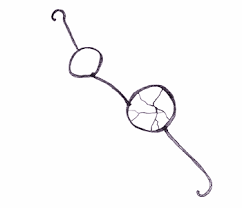
lordoftheflies.6.wikispaces.com

The next day Ralph and Piggy go to meet the other tribe at Castle Rock to get Piggy's glasses back.  One of the boys leverage a large boulder that falls on Piggy and kills him.  This time there is no remorse.  In fact they all chase Ralph with spears and hunt for him like a wild hog, intending to kill him.  Just prior to Ralph being killed, a British cruiser arrives and a British officer saves Ralph from the savages and tells them that he expected better from British boys.

Heavy stuff, I know.  The book is full of symbolism and I'm certainly not smart enough to figure it all out, but it deals with the conflict between group and individual thought and goals and between civilized, moral behavior and savage behavior.  The author of the book, Mr. Golding, stated the theme of the book as follows:
"The theme is an attempt to trace the defects of society back to the defects of human nature.  The moral is that the shape of a society must depend on the ethical nature of the individual and not on any political system however apparently logical or respectable."
This is very, very interesting to me.  I try to view things through a spiritual lens.  I try to filter events of the day through that lens.  Everything I do from farming to life, I want to view from that lens, specifically a Biblical Worldview.  I see the parallels of the boys on that island to the current culture we live in.

The boys initially had rule of law and operated under a code, an order and guiding principles, but they soon fell away from those constructs due to the corruptness that resided within them - their fallen nature.  I feel that this mirrors our present situation.  As a people with laws based off of Scripture and time-tested Judeo-Christian values, we had a touchstone, a North Star, if you will to help us determine right from wrong.

We've strayed.  We are now immersed in a post-modern culture engrossed in moral relativism.  You have your Truth.  I have mine.  I think about the last verse in the Book of Judges that says:
In those days there was no king in Israel; everyone did what was right in his own eyes.  Judges 21:25
Aren't we there?  Everyone does what is right in their own eyes.  Our spiritual moorings to Truth have been cut and we find ourselves drifting farther and farther away, driven like savages or barbarians toward our base desires, lusts and greed.  Like Ralph, Piggy and the boys in "Lord of the Flies," we started off good, but we've gotten off the path and are well on the way to savagery.  We know better - or we should know better than the depravity we've fallen into.  We're better than this.  We need to return to our spiritual moorings.  I believe in the Absolute Truth found in the Bible, God's Holy Word. 

'Therefore remember from where you have fallen, and repent and do the deeds you did at first; or else I am coming to you and will remove your lampstand out of its place-- unless you repent.'  Revelation 2:5
God's a God of second chances.  As believers, we can repent and turn to Him and He, like the British officer will "rescue" us.  If we don't know Him, we can turn to Him, trust Him and be rescued as well.  As the author of the Lord of the Flies stated, no political system can save us, no human institution or association can protect us from the beast within.  Our very society depends upon the ethical nature of individuals.  I submit that those ethics are driven by Truths from the Word of God and we'd be wise to return to them.
Related Posts Plugin for WordPress, Blogger...