Showing posts with label turnbuckle. Show all posts

Thursday, March 6, 2025

Keeping It Together

The live oak tree in the left hand side of the photo below is OLD.  If we were to give our trees names, I'd call this one Methuselah.  Methuselah in the Bible lived to the ripe, old age of 969.  No, I don't believe this one is that old, but I wouldn't be surprised to learn it is around 200 years old.  I want it to be around for many more years.  Twenty-something years ago, we almost lost her.  A hurricane blew through with tornados following and the old tree split!


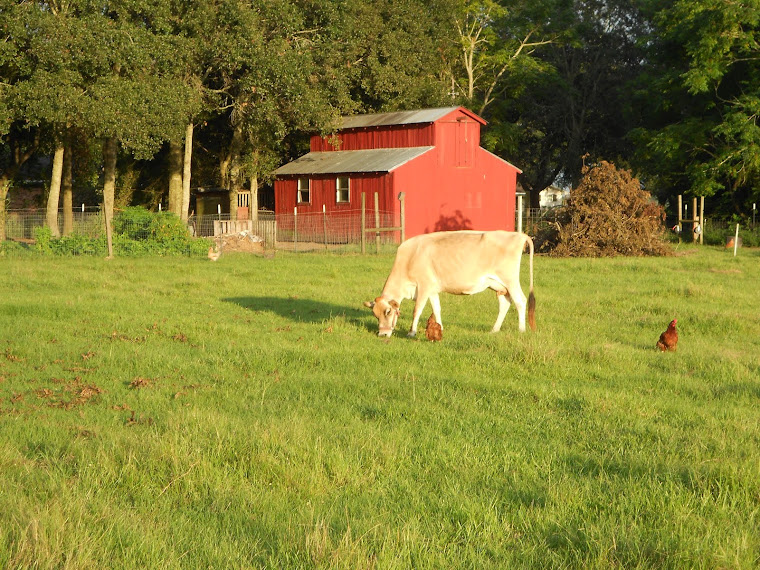
Not one to give up, my neighbor (who is now deceased) and I devised a plan.  In that barn you see in the background above, he had every sort of tool you could imagine.  One of those were some drill bits that were two feet long.  He was in his early -70's at the time, I suppose.  We climbed up high into the tree with a drill and began drilling holes in four of the large branches.

Once the holes were drilled, we inserted some threaded rod with a homemade washer made from some iron plate and a big nut on the back.  To the other side we screwed an eye bolt.  Then we did the same exact thing on the other three and ran cables through to connect them.  We joined them using turnbuckles and tightened the turnbuckles until the tree was pulled back together.  If you look closely in the photo below, you can see our "shade tree arborist" handiwork.


Would you believe me if I told you it worked?  It did!  The tree over the years, pulled together by the turnbuckle and cabling, began to heal.  Notice the scar on the south side of the tree:


And here is the one on the north side.  Prior to fixing it, you could put your hand in the 'cut' and feel it pulse as the wind would blow.  But it is all healed up.


But earlier this week we had a problem brewing.  The weather forecast predicted very strong winds coming in. I had already checked on one of the old turnbuckles and the hook on one end was almost straightened out!  The winds and the weight of the tree had damaged the turnbuckle to the extent that I didn't trust it anymore.

So I found a different type of turnbuckle without hooks.  This one, hopefully, won't straighten out or break.  I extended a ladder and climbed way up into the crown of the tree with wrenches and the new turnbuckle in hand.  Tricia gets a little worried when I do things like this, but I wanted to save old Methuselah.  If I could accomplish that without falling, that would be a victory for sure.  I disassembled the old turnbuckle and replaced it with the new one.  I tightened everything up, too. 

The strong winds did blow.  I kept passing by the window as the winds howled to check on Methuselah, and you know what?  Everything held!  The turnbuckle and cable did its job.  Perhaps the old tree will make it another 200 years?  What stories this tree could tell if it could talk!

Wednesday, August 2, 2017

Thinning Things Out

My hair is getting more and more gray with each passing day.  I'm okay with it and haven't considered hair products to color the grey.  On the bright side, at least for now, although it is turning grey, it hasn't started turning loose.  It is still thick and when I go get a haircut, the barber often pulls out some thinning shears like shown below to thin things out a bit.

Image Credit
I thought of the haircut analogy the other day when I started an undertaking in trimming one of our live oak trees.  It had a lot of interior growth that just needed to be cleaned up. A friend of ours had his live oaks trimmed and the price tag was way more than what I wanted to fork over, so I started trimming this tree and it will take me about a week or so of plugging away at it before I get it completed, but I made a good start.


Of course I did a lot of googling of how to properly trim a live oak.  Here's a little bit of what I learned:

  1. Don't trim flush with the limb or you'll take off the collar that helps your tree scab over and heal,
  2. Take off all the dead and diseased limbs,
  3. Remove any lower limbs that are growing upward to the crown as this will help airflow,
  4. Cut away branches that rub together,
  5. Trim off 'ugly' looking branches. (Oh, I have one more thing I'll show you at the end that I learned by making a mistake!)
I used a big extension ladder to get myself up where I needed to be to trim with a chain saw, a pole saw, and and hand saw.  The ladder was equally effective in getting me up high as well as making my wife nervous.  I'm not afraid of heights.


Unlike my wife, the cows, goats, and chickens were pleased with my new project because I threw the limbs I trimmed over the fence and the animals ate the leaves and the chickens found bugs and such to eat amongst the leaves and branches.


In THIS POST and another post referenced in that  one, I tell of  how we repaired this live oak that had split down the middle by cabling it together.  You can see a cable spanning a two of the large limbs and pulled tight with a turnbuckle in the photo below:


After a recent storm I noticed that one of the two cables supporting the great weight of the mighty oak had come loose.


I quickly diagnosed the problem - the weight of the tree pulling against the turnbuckle had straightened out one of the hooks, allowing the turnbuckle to release from the eye bolt anchored in the tree.  I'll need t fix that as we are smack dab in the middle of  hurricane season and I don't want to leave the tree vulnerable.


Okay, back to the lesson I learned the hard way.  When you make a cut, you are supposed to paint the fresh cut with some black spray paint.  Newly cut wood is sweet smelling and attracts bugs that will bore into your tree, introducing disease. Painting the cut helps to reduce the risk of bug damage.

You can see my mistake at the seven o'clock position in the photo below.  Rather than doing what I knew to do and make my first cut at the bottom of the limb, I cut from the top. With no bottom cut, the weight of the cut limb tore some of the bark off of the bottom.  That could have been eliminated, but the tree will heal.  I'll just do it right from this point forward.


With the tree trimming about 50% done on this live oak, I think it looks a lot cleaner  and opened up the view under the expansive canopy that just makes the tree look better.  It should also allow a little more sunlight that will perk up the St. Augustine grass that grows beneath the tree's branches.  We all benefit from a little thinning out from time to time.
Sunday, August 9, 2015

Gotta Pull it Together

In THIS POST we talked about a big old live oak tree that had split in half during a storm several years ago.  We didn't want to lose the tree, but we also didn't want to spend a bunch of money on getting an arborist to come work on the tree.  A neighbor and I climbed high into the tree with a powerful drill, a very long drill bit, a threaded rod with an eye bolt on one side and a washer and nut on the other.

After drilling holes in four large branches high up in the tree, we inserted the rods into each of the four holes and tightened the nuts on the backside of the limbs with the eye bolts facing inside.  We then looped a 5/8 inch cable through each of the eye bolts and fastened the cable back down with two cable clamps.  Using a turnbuckle we tightened the cable until it pulled the split tree back together.  It was frightening work, way up high in the treetops, but it did the trick.  Over several years, the tree, where it was split, grew back together, healing itself with lots of new growth over the crack. Amazingly, we were able to save the tree!

About a year or so ago, we had a thunderstorm that came through, bringing with it straight line winds of 60 mph or so.  The force of the wind was so strong, one of the cables broke.  I've had it on my to do list to fix it and this weekend I got it done. Climbing up on the eastern limb, I ran a new cable through the eye bolt and looped it back down on itself and using a socket wrench, tightened it down with two cable clamps.

One side done
I tied a rope onto the other end of the cable and threw it to the ladder that I had propped up against the limb containing the eye bolt that we were going to pull against.  Then I climbed way up to the top with the boys holding the bottom steady.

The other side
I made a loop through one end of the turnbuckle and tightened down with two cable clamps.  The other end of the turnbuckle has a hook and that was hooked into the eye bolt on the tree.  At this point the work was pretty much done and all that remained was was to tighten down the turnbuckle.  By holding the end on the left while turning the middle piece, the cable got tighter and tighter and pretty soon the cable was taut.

Turnbuckle is ready to tighten
It is hard to see in the photo below, but the work is done.  Two cables fastened to four limbs provide stability for when the high winds blow.  The tree has already healed, so the cables just support the limbs, preventing them from opening up the portion that was split.

Criss-crossed cables
Hopefully we won't have any hurricanes this year or strong winds, but if the high winds blow, we've done all we can to protect the big old oak that provides lots of shade for us - a valuable commodity during south Louisiana summers.


We'll keep our eye on the tree, ensuring the cables stay in place and hold things together.  If something goes awry, it will be time for the amateur arborists to spring back into action!
Related Posts Plugin for WordPress, Blogger...