Showing posts with label trees. Show all posts

Sunday, December 22, 2024

Timber!

Last year we had a drought.  It's a strange thing in Louisiana to not have rainfall, but it happened.  We lost a magnolia tree in our yard.  I really hate that because the fragrance from a fresh magnolia blossom is a scent that is wonderful.  The drought caused fish to die in people's ponds.  Many older trees, which were weakened anyway were finished off by the drought.  Such was the case with two old pine trees at our church.

Since the drought, the trees began losing limbs, dropping pine cones and bark.  It was only a matter of time before they fell.  We couldn't hardly afford that since at least one of the trees was dangerously close to LA Hwy 26.  Saturday morning was a beautiful and crisp fall morning.  A perfect day for felling a couple of trees.  Bro. Jerry brought his mule.  We were going to need that thing.  Jerry will be 89 years old on January 1st.  I hope I'm still dropping pine trees when I'm approaching 90!

The mule's winch is pulled tight

We guessimated the height of the tree to ensure Jerry was far enough away.  We aren't professionals, so I went home and came back with two extra chains that we connected.  You can see the embankment for the highway to the east of the tree and why it was important to have the tree fall toward the mule and not toward the road.


The other tree that was farther from the road was already down along with one side of the 'double' pine tree.

Dwayne got his chain saw and climbed the ladder to cut the tree.

As he cut, I held the ladder to keep him from tipping over.  I also told him when he hears the tree pop, that we were going to run.  I think I mentioned for him to keep an eye out for the "widow makers" (rotten limbs) that were right above us.

Timber!  We heard the tree crack and it fell exactly where we needed it to fall!

Thank the Good Lord!  I was a little worried for a minute there.  We cut the trees all to pieces and used the mule to drag the trees to the back with a chain where we'll have a bonfire later on.  The mule also has a bed that dumps, so we piled branches, bark and pine cones in the back and got things pretty much cleaned up for Morning Worship today.  We left a big piece of the stump standing on one of the trees.  I told Dwayne to start practicing with his chainsaw and maybe he could make a chainsaw sculpture.


Wednesday, November 23, 2022

It's Citrus Time (Again)

A couple years ago, we were hit with some really cold weather for Louisiana.  It was in the low 20's and I was worried about our citrus trees.  We have navel oranges, tangerines and grapefruit.  Prior to the freeze, I heaped mulch around the trunks, hoping to insulate the tree.  They are too tall to effectively tarp for protection.

Once it thawed, many of the limbs died.  We held out hope, though, as there was green growth above the graft.  We pruned all of the dead branches off the trees and waited.  Last year the trees were still in stress, recovering, and they did not bloom.  We had ZERO fruit off of our trees all last year.  This year, however, we saw blooms and smelled the heavenly aroma of orange blossoms.  Now it wasn't near the blossoms as in previous years, but the trees are still knocked back.

As the year went on, fruit began to develop.  Here are some of the navel oranges on our one orange tree.  They won't be ripe until late December or early January.  They are just starting to turn to a tinge of orange from the green color.

Here are the tangerines.  They are a fluorescent orange color.  They are tart and tasty.  We have two of these trees remaining.  We lost one of them to the freeze.  We've begun to pick a few of these.  They taste SO good, especially after not having any all of last year.

And here are the grapefruit on our one grapefruit tree.  It is a small tree.  We only have four grapefruit on it.  We'll have to savor each bite!

My intent this spring is to plant more fruit trees.  In addition to the citrus, we also have a pear tree, a number of blueberry bushes, muscadine vine, persimmon tree and thornless blackberries.  One of the things on my to do list this winter is to compile a list of additional fruit trees I'd like to put in.  It would be beneficial to have an orchard of various fruit trees from which to harvest - a food forest, you might say.

Sunday, January 9, 2022

Pulling Down The Widow-makers

Hurricanes Laura and Delta rolled through here about a year and four months ago, leaving a wide swath of destruction.  We posted about it several times back then.  Our son's home was finally repaired after a year.  There are still plenty of "blue roofs" around.  I'm speaking of the blue tarps used to cover leaky roofs.  I assume some did not have homeowner's coverage or are waiting for final settlement.

We were so fortunate to not have damage.  One thing we did have is a LOT of branches/limbs down.  If it would ever get cold here, we'd burn some of the firewood in the fireplace that we got from a bunch of the larger limbs.  I've been splitting them up with an ax.  There is one hazard remaining, though.  Widow makers.  Widow Makers are large limbs that were broken off by the hurricane force winds.  They hang downward, but are caught by other limbs that prevent gravity from doing its job and bringing them down to earth.  Some are WAY up there and some are BIG!  If they would fall on you while you were walking underneath them, well, there is a reason for why they are called widow makers.  We'll leave it at that.

Tricia has been telling me that they were dangerous.  She mentioned that we could just be walking out to the fire pit or simply walking in the backyard and a gust of wind would blow and POOF - a large limb would fall on our heads.  So I was sort of inspired to do something about it.  The other afternoon I did.  Here is one widow maker that will not cause an outlay by our life insurance policy.  It took me a while, but I got it down.

And here is another.  This one was way up high in the tree.  It took probably 20 minutes to get this one down.  It crashed to the ground and broke in two.  Yeah, that would have left a scar on my head for sure.  What's that long rope on the bottom left, you ask?  That is my nifty ACME Widow Maker Removal Apparatus that I invented.


All it requires is a long rope, something heavy like a log to tie on the end, and a lot of patience to operate this device.  You throw it up in the air, trying to make it loop over the widow maker.  When you miss, you just have to have quick reflexes so the log you've tied on the end doesn't hit you.  Then you throw it up there again.  Over time, you'll get it.  The important thing is that once you've looped it over, you quickly wrap the rope around the log 'anchor' that is up in the tree by running around several times.  This is crucial.  If you don't wrap it around, when you pull it, the rope and log will simply pull over the widow maker and plummet back to earth.

We got 'em down!  Now we can walk in the backyard in peace without hard hats! 


Sunday, August 5, 2018

The Electric Fence Grounded Out - Solved It!

As we drove into the driveway from church today, I looked out in the pasture and saw our two little bulls, Junior and Astro.  They were in the wrong paddock.  How in the world did they get through the electric fence?  Two strands of electric fence, actually.  The animals have been trained (by being shocked) to be fearful of the electric fence.  They normally keep their distance, but today, they went through the fence like a hot knife through butter.  Either the charger stopped working or the fence is grounded out somewhere.  I had to find it.  I went to the drawer that holds all my fencing materials and picked up my electric fence tester and headed out to the pasture.

My normal course of action is to walk out and trace the entire electric fence, looking for a place where I can find that the 'hot' wire is touching the fence wire, or a t-post, or maybe a limb has fallen across the hot wire, grounding it.  As I started walking toward the perimeter fence that runs north and sound and then east and west, I noticed that an oak tree in the neighbor's yard had fallen.  It is a water oak tree, one that is susceptible to borer beetles and rot.


This could be where the problem lies.  I walked closer to the downed tree.  You can begin to see the cross-fencing.  Oh, no!  Did I have a big fencing job today that I wasn't expecting?


Fortunately, the tree didn't fall across the fence, but fell against it.  The fence was still intact and standing, but we needed to investigate further.


As I surveyed the scene closer, I think I can spot the problem.  The treetops poking through the fence appears to be pushing through, perhaps touching the hot wire.


Here is a close-up shot of the problem.  This is just one of many places where both branches AND fence wire is touching the hot wire.  In these cases, the fence is "grounded out," and this results in the electrical charge going into the ground and not down the fencing.  This is precisely why the bull calves were bold enough to go through the electric fence.  No electric charge to pop them.


I had also brought an ax out with me and I began to chop all of the branches that were pushing against the fence, throwing them back across into the neighbor's yard.  With more chopping, the fence began to be free of all of the branches causing our problem.


At last the hot wire that runs along the perimeter fence was freed!


One last thing to do.  I hooked up my tester to see if the fence was conducting a charge.  Yes!  All five lights were flashing, letting me know that the problem was solved.


I put the bull calves back where they belonged.  They'll test out the fence soon enough and will be shocked (pardon the pun) to discover that the fence works again.  They'll once again build a healthy respect for the fence and stay where they are supposed to stay.

Sunday, May 1, 2016

Planting Trees

This past week I read a neat little story that was only 4,000 words long.  It was called, "The Man Who Planted Trees."  It was written by a French writer named Jean Giono and was published back in 1953.  I highly recommend reading it.  You can read the pdf version BY CLICKING HERE.

Image Credit
It is about a man in 1913 who is walking through the Alps and walks into an area that is dry, desolate and uninhabited.  There is no water.  The hiker finally finds a well, but it is dry.  He stumbles across a shepherd who saves him by taking him to a spring.  The hiker stays with the shepherd for a while and observes him collecting acorns, sorting them meticulously.

Image Credit
He curiously follows him and discovers that the widowed shepherd has taken it upon himself to restore the desolate valley by reforesting it - one tree at a time, even though the land does not belong to him.  He travels for miles, using his walking stick to press holes into the earth, dropping an acorn in the hole and then repeating time after time after time.  The hiker is impressed by the man's resolve and lofty goal.

The hiker leaves, fights in the first World War and returns seven years later to find thousands and thousands of saplings.  The valley is well on it's way to being restored.  Once dried streams are beginning to flow and the shepherd has gotten rid of his sheep and is now keeping bees to help pollinate the land.

The old man planted trees for 40 years!  Over the course of time this once barren landscape had become lush, vibrant, and alive.  People saw the beauty of the land and over 10,000 people moved in to populate the beautiful valley that the old man has singlehandedly transformed.

I had just read that story, when a gentleman came by the house the other day and began telling me about all the different beautiful birds he's been seeing at his house - birds like scarlet tanagers, Baltimore Orioles, and indigo buntings.  I told him I never see those birds and asked him how he gets those colorful birds to go to his house?

His answer?  He said, "I'll bring you the secret next week."  So this afternoon the gentleman drove up to the house and got out of his pickup truck with a Tupperware container and handed it to me.  It looked like it was filled with blackberries, but they weren't blackberries - they were mulberries.  He told me that those birds return to his house every year and eat the fruit from his mulberry trees.  He told me to go back in the woods behind the house and sprinkle the mulberries around.  If I'm patient, he said, I'll have mulberry trees bearing fruit in about 5 years attracting birds and making enough for us to eat as well.  I can remember that my grandmother and grandfather had a mulberry tree in the back of their house and have good memories of eating the fruit and staining my hands and mouth with the purple juice when I picked and ate them.
Image Credit
Will my mulberry trees transform the land the way the old shepherd did in the book I described earlier?  Perhaps not.  But in a little way, maybe I can be "the man who planted trees," and those trees will grow and bear fruit and bring a little more happiness to us (and some pretty songbirds as well).

Friday, June 5, 2015

Planting Shade Trees

"A society grows great when old men plant trees in whose shade they know they shall never sit in." - Greek Proverb

That is a thought provoking quote.  A sentiment like that describes people who look past selfishness and look toward doing things for those who will come after them. That is a pretty noble thing to do, especially knowing that the recipients will not be able to thank their benefactors as they'll be long gone.

I remember in college we had a Psychology course that taught us about Maslow's Hierarchy of Human Needs.  You probably recall the pyramid.  The needs started with physiological needs on the bottom that must be met for human survival and progresses upward through Safety, Love & Belonging, Esteem, and finally Self-Actualization.

In Wikipedia, I found the following quote pertinent to our discussion on planting shade trees:
In his later years, Maslow explored a further dimension of needs, while criticizing his own vision on self-actualization. The self only finds its actualization in giving itself to some higher goal outside oneself, in altruism and spirituality.

We have some enormous live oak trees in our yard.  They add value to the land and their presence on the property was the driving factor in our decision to purchase our little homestead.  They provide shade and comfort on hot summer days. There's no telling how old they are.


They provide beauty and their sprawling branches provide shelter and homes for numerous birds and squirrels who, along with us, also enjoy the benefits of someone who, well over a hundred years ago, decided it would be a good idea to grab a shovel, dig a hole, and put an acorn in the ground in rural Jefferson Davis Parish.


The shade I'm thinking about today, however, is not necessarily literal.  Let me explain it a little bit. Driving in to work each morning on a long 50 minute commute, I generally listen to the radio.  It's pretty much all talk radio, news, sports, and Christian talk.  Some time back, I tuned in to James Dobson's radio program and he had a gentleman on named Dennis Swanberg.  You can read more about him here.

He got my attention because he said he lives in Monroe, Louisiana.  As I listened more, he impersonated Billy Graham, Jimmy Stewart, John Wayne, Ronald Reagan, and many more.  I was laughing out loud.  That dude is a character!  Then he got real serious and started talking about building a legacy.  He said:

"None of us are self made.  We're all sitting under 'shade trees' that our forefathers, families, and friends planted.  Now, it's your turn to leave a meaningful legacy by planting your own shade trees for others to sit under." - Dennis Swanberg

That really got to me.  Especially when thinking about parenting - the hardest job in the world. It made me think of all the mistakes I've made as a Dad.  Times I just dropped the ball.  Realize it or not, we're planting acorns right now in the words we say, the actions we undertake, the character we portray.  Just the way we live out our lives are seeds.  It was a good reminder to me that I should do more things to encourage others and live in such a way that I bring glory to God so that I can make a generational impact - even one for eternity!  First in our family and then to those in our sphere of influence.

Standing in the Shade
I have been so blessed to have been the recipient of other people's shade trees. Numerous people have given of their time, money, and wisdom and made an impact on my life.  I'm sure if you think about it, you have experienced the same. My prayer is that I can do the same for others and be to others what very wise people have been to me.

For example, Benjamin has developed a keen interest in collecting coins.  He's a budding numismatist.  Several people have given him coins to 'seed' his collection. One particular gentleman that lives in South Texas that Benjamin's aunt introduced him to mailed him some coins that had considerable value.  We communicated to the gentleman that we felt reluctant to accept them.  Here's what he said:

"As I get older (he's in his 80's), I realize that I don't possess anything.  I'm merely a custodian and temporary holder of items that I'm constantly looking for someone else to give them to."

We should all aspire to be modern day 'Johnny Appleseed's' planting seeds wherever we go so that mighty oaks spring up, casting their shade and repeating the process.

Psalm 1:3  (NASB)

He will be like a tree firmly planted by streams of water,
Which yields its fruit in its season
And its leaf does not wither;
And in whatever he does, he prospers.

Wednesday, October 8, 2014

Chopping down two more trees

So the other day I posted about some beetles killing three water oak trees near our barn.  The first tree that died was dropping limbs and was threatening to fall in the garden across my newly constructed fence and we just couldn't have that, could we? I cut it down with an ax and used a come-along to pull tension on the tree in order to make it fall where I wanted it to fall.  I amazingly achieved success.

The other two trees scared me a little, I must admit.  One of them was pretty doggone tall.  The other one, while not as tall as the other two, had a bigger diameter trunk and a wicked bend that directed all the weight at a precarious lean over the garden fence.  When a good friend offered to help me with this project, it made me feel better.  Basically, we were going to use the same method, except we'd use my friend's tractor to apply tension rather than a come-along.  We got going and used a chainsaw as opposed to an ax to cut the wedge where the tree (hopefully) will hinge over in the direction we wanted it to fall.

Cutting the wedge
Then I climbed as high up as I dared and attached a chain around the tree.  I must admit I was a little afraid since the tree was dead and already had dropped some big branches the night before.  If a branch (called a widow-maker) would have dislodged from the tree and fallen on me, it would've made for a bad day. But I was able to attach a chain collar to the tree and connect two more chains together to give us enough length to have the tractor out of harm's way once we cut the other side of the tree and started pulling the tree with the tractor.

Chain attached at the highest point
We made sure that the dog, goats, cows and chickens were all safely out of the way and then my friend got on his blue tractor.  I began cutting into the tree with the chainsaw on the backside of the wedge that was cut earlier and the tension on the chain was held tight.  We heard some popping noises, followed by the tree hinging over, and in no time flat the tree was lying flat on the ground EXACTLY where we wanted it laid.

TIMBER!!!!
Well, that took no time.  We felt good about our tree-felling and decided to tackle the next tree.  This one, due to its diameter, but mostly its lean, was going to prove to be more challenging.  We again cut the wedge out.  Because it was bigger, we had to cut from both sides before we had the notch cut out.

Sawing the notch out of the next tree
As you can see, this tree had recently died and still had its brown leaves attached, silhouetted against a bluebird sky.  By the way this is the tree that Penelope, the peahen, roosts in.  She's gonna have to find a new spot!


We attached the chain and finished cutting the wedge out.  The photo below showed what's at stake if our lumberjack skills were lacking - a brand new fence, a row of okra, a bunch of luffa gourds and two Tabasco pepper plants.

A second look at the photo below shows something else leaning besides the tree!  If you look at the fence posts on the end of the garden fence, they've got a pretty good lean to them as well.  Back in the Spring when the goats broke through the fence and got in the garden and ate their recommended daily allowance of green vegetables, I had to rebuild the fence quickly to salvage the remaining crop.  The ground was very wet.  When I inserted my posts into the post holes and pulled the fence tight with a come-along, the soft ground gave way under the tension, making my fence look like abstract art or something out of a Dr. Seuss children's book!  Oh well - it might not be pretty to look at, but it keeps the goats outta the garden. 

Lean on me, when you're not strong...
Due to the angle of the tree, before we started the cutting and pulling, I remarked to my friend, "Now, if this thing falls on the fence, it's okay.  We've done everything we know how to do."  Then we went through the same process and when I heard the creaking and popping, I stepped back with the chainsaw and strained with everything I had to will the tree from falling on the fence.  Boom!

A close call!
The tree fell narrowly missing the fence.  Oh a few branches (as seen above) hit the fence, but nothing was broken.  We didn't even need to tighten any wire.  We began to cut up the trees, toting branches to the burn pile and chopping up the remainder for firewood logs that Benjamin and I will split.  The removal of the three trees opens things up a little bit and will allow the pecan trees in the little wooded area to spread out and grow.  There is still plenty of shade for the cows.  Now with those three trees gone, we actually have a little more room to drive the cattle trailer or the 16 foot wagon full of hay bales back to the barn.
Tuesday, September 2, 2014

Tree Trouble

While I was in the back yard the other day, I looked to the small patch of trees that borders the eastern side of our property and spotted trouble.  All of the leaves on two water oaks were dead or dying.  I thought that perhaps they had been struck by lightning as we've had some monstrous storms here lately.  This little patch of woods serves as shade for all of our animals and is important to the ecosystem on on our little farm.

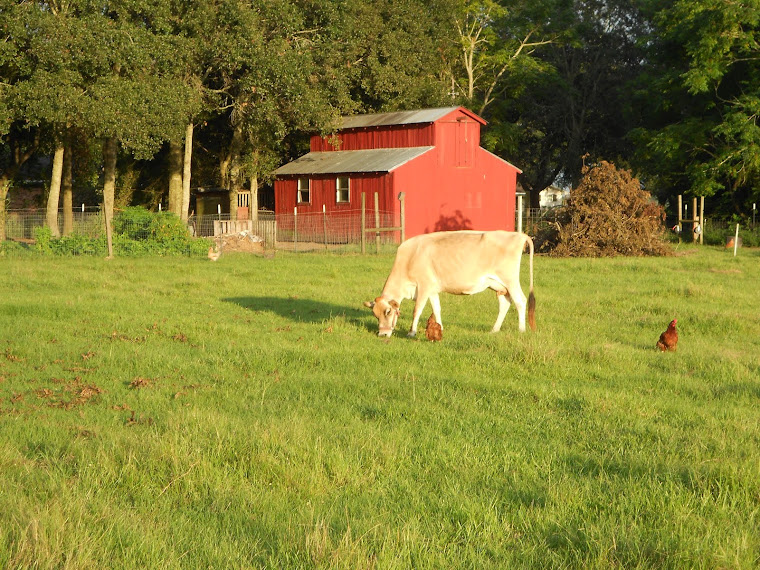
During the peak of the heat during summer days, you'll find the dairy cows lounging in the shade, chewing their cud lazily while the chickens dig holes in the cool dirt and sit in them to cool themselves.  We have the paddocks set up in such a way where the animals can always go to the shade trees and water at will and then return to their grass eating once it cools in the late afternoons and early mornings.  The Nubian goats, since they are indigenous to Africa, don't appear to be affected as much as the Jersey Cows.

Anyway, the trees that were dying are what we call Water Oaks.  They are in the Red Oak family.  These trees all have scars in the side of them that appear to be fire damage from when they were much younger, but they have healed over.  The trees further to the east, but still on our property are pecan trees and those trees have grown and are crowding out the water oaks.  In response, the water oaks bend and grow westward.

When I went to check out the trees, upon closer examination, I see that they were not struck by lightning as evidenced by a couple of things I observed:


Two trees in the process of dying
Notice this odd damage to the bark:

Bark damage
And notice the 'sawdust' at the base of each of the affected trees:

"Sawdust"
I did a little research and determined that this damage matches that of the Red Oak Borer.  Here is a picture of this bad boy below:

Image Credit
And here is the larvae of the red oak borer.  I've seen these many times when splitting firewood and it is amazing how they can chew tunnels into mature hardwood.  While splitting firewood, I'll toss these to the chickens and they devour them.  I'm not exaggerating when I tell you that I've seen them 3 inches long and as big around as your index finger.

Image Credit
So what do we do?  Well, I'm going to have to cut those trees down, split them and we'll stack the firewood for use later.  They are tall trees, so I'll have to be really careful so they don't fall over our garden or pasture perimeter fence.  It's not the end of the world.  We'll get a lot of use out of the firewood and the pecan trees will grow and make up for the shade that we've lost.  I guess this is a good example of why plant and animal diversity is important.  Having different trees on the property ensures that if one variety is attacked by disease or insects, you've got others that will be unaffected and that's a good thing, because on hot summer days, the cows need their shade.  And so do I!


Related Posts Plugin for WordPress, Blogger...