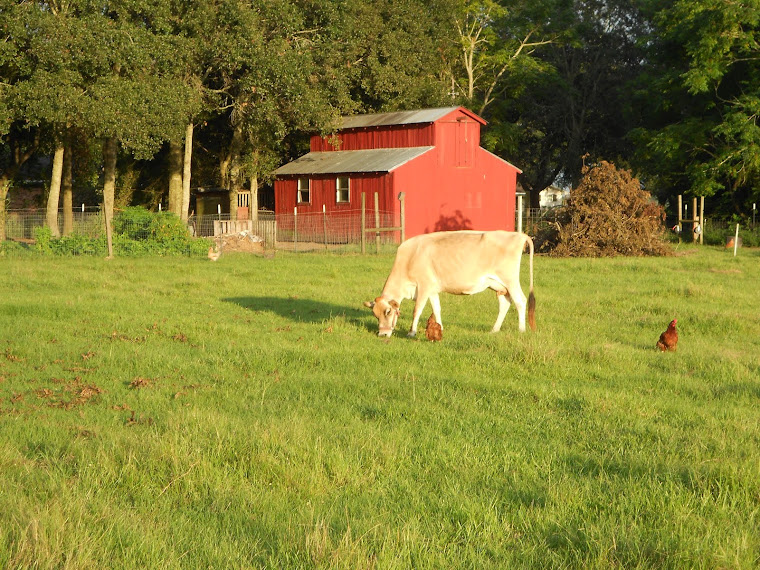
I walked out to the pasture to check on Rosie. Rosie is our Jersey cow that will be calving within the next few days. When the time for delivering gets close, we like to keep on top of the situation to ensure that things are going well. While observing Rosie, I saw something that was concerning to me. Rosie had a big tear on her front right teat! That must really hurt.
We try to do a good job of picking up debris in the pasture that the animals could step on or cut themselves on, so I'm not really sure how this could have occurred, but I have a pretty good idea. I think she stepped on it. Ouch! You can see the tear in the photo below:
So i got her into the milking stall in the barn and distracted her with some Dairy Ration mixed with alfalfa. While she was eating I got a wet rag and did my best to clean it. During the heat of the day, the cows lay in the cool dirt and of course, the wound was dirty. Rosie didn't like this at all! She started kicking toward me and I finally had to hobble her to avoid catching a back hoof to the head.
We decided to do a little veterinary work ourselves and keep close watch on Rosie. If we see signs of infection, we'll call out our veterinarian to come have a look. In the meantime, we took some First Aid Antiseptic and mixed it with some vaseline petroleum jelly and dabbed it on the would. The vaseline helps it to stick versus drip off. Then we filled a small yogurt cup with the antiseptic containing iodine.
Using extreme caution, I dipped her teat into the cup of iodine several times so that the entire affected area was coated.
We will repeat this process daily and pray for healing. We will have to wait and see how this goes. This is very concerning to us as pretty soon, Rosie's bag will be filling with milk and her calf will need to suckle on the teat. We need it to be healed up as there will not be a convenient way of relieving the quarter of milk if she doesn't allow the calf to nurse or allow us to milk her out.
We were really hoping that the calf would come soon, but now that this happened we hope the calf is delayed in coming to allow Rosie to heal up. It is always an adventure, but we'll get through this.
Make it your ambition to lead a quiet life and attend to your own business and work with your hands, just as we commanded you. - 1 Thessalonians 4:11
Showing posts with label treatment.. Show all posts
Sunday, September 10, 2017
Tuesday, July 28, 2015
We've found a Remedy that Works!
Cows have ailments. If you are going to keep livestock, from time to time animals struggle with various health care issues just like you and I. Although a very good veterinarian is less than a mile from us as the crow flies, we like to try to take care of those minor ailments that arise ourselves. You might call us "shade-tree" veterinarians, but we don't play around with our animals' health. If we can't control or heal the issue ourselves in a short period of time, we won't hesitate in calling the veterinarian, and he makes house calls (farm calls).
While Rosie and Clarabelle look fine in the photo below, with Rosie chewing her cud and Clarabelle just finishing up her morning breakfast, things aren't 'Rosy.' She's hurting. Her front hooves are very tender as she has what is called hoof rot. It sounds nasty, doesn't it? It is a foot infection between her two 'toes.' It is painful and she walks around gingerly. As we've discussed previously, this is caused by bacteria in the soil called Fusobacterium. This bacteria is present wherever there is fecal material and the cows usually pick this up around the round bales where wet, muddy, cow-poop is concentrated. The cows usually pick this up in the Spring, but oddly enough, hot, humid, dry weather causes their feet to become dry and crack, providing a gateway for the bacteria to enter the foot.
Because we don't like to give our cows antibiotics by shot, we try numerous treatments like iodine applications. We also put a 50-50 solution of bleach/water in a sprayer and spray the infected area. We've done this daily and had varied levels of success in controlling the problem.
This is one of Rosie's front hooves. If you look at the very top between her hooves, you might be able to make out a little crack. It doesn't smell good and she lets you know that she doesn't like you messing with her. Obviously, I wasn't able to get pictures of the entire process, but I'll lift her foot and Tricia will brush off the dirt from the bottom of her hoof as well as between her hooves. It's not an easy thing to do.
While Rosie and Clarabelle look fine in the photo below, with Rosie chewing her cud and Clarabelle just finishing up her morning breakfast, things aren't 'Rosy.' She's hurting. Her front hooves are very tender as she has what is called hoof rot. It sounds nasty, doesn't it? It is a foot infection between her two 'toes.' It is painful and she walks around gingerly. As we've discussed previously, this is caused by bacteria in the soil called Fusobacterium. This bacteria is present wherever there is fecal material and the cows usually pick this up around the round bales where wet, muddy, cow-poop is concentrated. The cows usually pick this up in the Spring, but oddly enough, hot, humid, dry weather causes their feet to become dry and crack, providing a gateway for the bacteria to enter the foot.
Because we don't like to give our cows antibiotics by shot, we try numerous treatments like iodine applications. We also put a 50-50 solution of bleach/water in a sprayer and spray the infected area. We've done this daily and had varied levels of success in controlling the problem.
| My feet hurt! |
| Treating Hoof Rot |
I began searching on the Internet and found another remedy to try - Dr. Naylor's Hoof 'n Heel. We use another product by Dr. Naylor to dehorn our calves. It's called Dr. Naylor's Dehorning Paste. It works, so I though I'd give this Dr. Naylor product for treating hoof rot a try. A 16 ounce bottle costs $11.99.
| Dr. Naylor Hoof 'n Heel |
The active ingredient is Zinc Sulfate and there is no withholding period for lactating cows. The bottle has a squirt top, so after the hoof is brushed off an clean, I hold each hoof up and Tricia squirts Hoof 'n Heel into the affected area. I hold the hoof up so that the solution gets full contact with the affected area and then we feed and milk her in the barn on a clean surface before putting her back out in the pasture to eat grass. We treat her twice a day - in the morning and evening. We've noticed great results and after only a few days, she's no longer limping or walking gingerly!
| My foot is getting better! |
There is another remedy for Foot Rot called Coppertox that we were going to use if this didn't work, but we won't have to go that route now. We're happy and I assure you, Rosie is too!
Subscribe to:
Posts (Atom)