Showing posts with label root crops. Show all posts

Monday, February 15, 2021

Mais, It's Cold, Cher!

Hey, do you have a minute?  I'd like for you to take a walk with me this morning.  Look, grab a cup of coffee to take with you.  I made it extra strong today.  Better put on a cap and your heavy coat, it's cold outside!  It snowed last night.  We aren't used to that, and our animals aren't either.  We have to go take care of them.  I'll show you the morning routine.  First, we'll bring some food out to the pullets in the chicken tractor.  They are just starting to lay.  The eggs are small.  The tractor is in the back yard and they are demolishing the St. Augustine grass - just scratching it up to bits.  Let's put some feed in the gutter we use as a feed trough.  I thought we'd have to break the ice off the water in the water bowl, but the heat lamps we turned on last night kept the occupants of the tractor warm and toasty and the water didn't freeze.


The twin bridges that lead into the pasture and the garden were frozen over.  It looked very pastoral and wintry, wouldn't you say?  Don't slip when you pass over now.

Yesterday we frantically put blue tarps over the entire garden except for the radishes that are almost done and the turnips.  The snow blankets the blue tarps, but you can still see the blue of the tarp underneath.  Beneath the snowpack and tarp are beets, carrots, kale, chard, spinach lettuce, onions, kohlrabi, broccoli and cauliflower.  By Friday when things thaw out, we'll fold up the tarps and see if we have live plants underneath.  If not, we'll quickly harvest all the carrots and beets and anything salvageable.

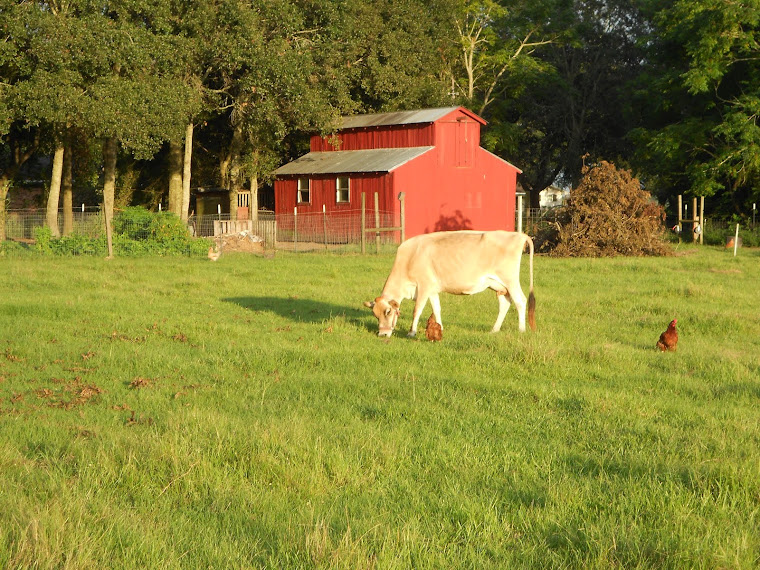
Follow me out to the barn.  We've got to feed and hay the cows and goats.  Look at Belle waiting inside the barn.  The cows are coming round the corner.  The fake owl is doing its job on the roof chasing off hawks that like to steal our hens.  A few chickens are out scratching looking for something.  Let's get a bucket of hen scratch and scatter it around for them.

The rest of the hens are in the hen house.  It is nice and warm in there.  Would you mind opening the lids to the nesting boxes?  We close those up at night or the hens would roost on them and poop in the hay.  Then the eggs would be all full of poop the next day.

And here's Belle.  Look at that girl, would you?  She spent the night in the barn.  She is indigenous to the Pyrenees mountains between Spain and France.  She has a heavy coat and would have been fine outside, but we wanted to make sure she was warm and dry.  She repaid the favor by digging a big hole in the barn.  I'll have to cover it all up.

There was no stick nearby to break the ice in the trough, so I used my boot.  It was an untimely day to discover that my boots have a hole in them.  My sock is wet and my feet are cold now.  We have to break the ice, though, so the cows and goats can drink fresh water.  We never have to fill this trough.  It sits under the drip line of the barn and catches rainwater.  

We'll throw a few gallon scoops of sweet feed and alfalfa to the cows and let them eat.  Then, I'll put a square bale of some good bermuda hay for them to munch on.

I read one time that in northern states, farmers supplemented their livestock's diets with root crops in the winter.  I've been doing that for several years.  If you look below, I have a thick bed of turnips that are growing.  I began pulling turnips, cutting up the turnip roots and feeding the greens and roots to the cows.

Some of the roots are the size of a baseball.  Others are small.  It doesn't matter.  The cows can't distinguish.  They eat them all quickly and beg for more.


The cows can eat in peace for the time being as the goats haven't picked up on the fact that I'm tossing turnips to the cows.  Otherwise, they'd be between the cows causing trouble.  The cows will inevitably toss them to the side with their big heads and necks and the goats go flying.  Seems like they'd learn, but no.

I appreciate you joining me today.  Maybe tomorrow if you're not doing anything, I could show you some other sights in this strange, alien winter wonderland?


Thursday, March 19, 2015

Root Crops before the Spring Grass comes in

I was reading an article about early farming practices and they were talking about how many small family farmers in the Middle Ages had to dry off their milk cows and essentially butcher most of their non-breeding stock in order to make it through the winter without grass to sustain their animals.

A man named Lord Charles "Turnip" Townsend (nice nickname!) around the year 1730 instituted a crop rotation system that included wheat in year 1, turnips in year 2, barley in year 3, and clover in year 4.  This crop rotation helped improve the condition of the soil as the different crops have different nutritional needs.  It also helped the animals and farmers.  Around the Middle ages, farmers found that using beets and turnips as feed for cattle and this enabled them to better carry their livestock over the winter when forage was slim to none.

I wanted to mimic this practice and began rotating root crops like turnips and mammoth mangel beets that we use as a livestock feed to supplement the hay that we keep over the winter to feed the animals.  This is a welcome treat for the cows, goat, and chickens as the Spring grass hasn't come in yet.  We have patches of clover that we rotate the animals into with temporary fencing, but they gobble it up quickly and bellow for more!

As you can witness, the leaves of the turnips are large and succulent, a real treat for the cows, goat, and chickens. Then there is the large roots that the animals love to eat.  They all line up at the fence like you would at a buffet line and feast on both leaves and roots as I toss them over.


Here is what's left of the turnip crop.  This was entirely full of turnips a couple of weeks ago and now I have approximately 15% left to pull and feed and the turnips remaining should buy me a few more days until the grass comes in.  I give the cows about a 1 foot deep swath of turnips every afternoon and they look forward to seeing me eating turnips everyday when I get home from work.


I'll pull handfuls of turnips up and shake the topsoil off of them back into the turnip patch.  Most of the time I'll cut the long, skinny tap root off.  I find that growing root crops loosens the soil, alleviating compaction and prepares the soil for planting the Spring crops.  I'm thinking that I'll plant tomatoes here this year as I haven't planted tomatoes in this patch in four or so years.


I'm not sure that I need to do this, but I do it to 'baby' the cows.  I take a garden knife and cut the turnips up into disks.  Those greedy cows might try to eat too fast and choke on a big, fat turnip. While I'm cutting them up, the cows begin to beg, pacing back and forth.  It's pitiful, really.

And finally it is chow time.  I hand over turnip disks and spoon-feed them.  First to be fed is Daisy as she's the matriarch of the pasture.


Then it's Rosie's turn.  There's lots of crunching, chewing, swallowing, and then begging for more. That process continues and is punctuated by frequent cow belches.  I'm serious.  Their belches stink. I'll continue doing so until I am tired of cutting up turnips or standing in the cow belch vapors.


They enjoy the turnips while they last and by then the grass will be coming in.  If not, I have a half of a row of Mammoth mangel beets that I'll cut up for them.  They like them a little bit more because they are much sweeter than the turnips.  Either way, cows love to eat root crops!

Tuesday, March 11, 2014

Variety is the Spice of Life

“Variety’s the very spice of life 

That gives it all its flavour.” 

 William Cowper (1731-1800)

I like that quote from the British poet, William Cowper.  How boring it would be if everyone looked the same or thought the same, if you only had one choice of any product from which to purchase or eat, if there was only one color.  Can you imagine how boring if there was just one type of homemade pie?  The differences within all of us and all of God's creation make this world an interesting and fun place.

We purposefully introduce variety on our little farm to add some spice.  We like brown egg laying hens like the Barred Rock and the Rhode Island Red, but we also have some Aracauna hens that lay gorgeous blue and green eggs.  We recently had a hen that started laying really nice dark brown eggs.  I wish I knew which one she is. (No one's laying golden eggs, yet.)  The eggs are all different shapes and sizes and make for a nice visual when opening a dozen of our eggs.  Note the small size of the egg we picked yesterday on the far right.

They come in all colors and sizes
I guess the downside to having diversity is if you want to hatch out eggs for chicks, the chances of having a purebred Barred Rock or Rhode Island Red or Aracauna chick are lots lower than if you only had one breed out on the pasture, but that's okay with us.  For our cows, though, we do only have one breed, registered Jersey - not much variety there.  Here are the Brown egg layers settling down for the evening in a variety of breeds and alternating hens and roosters in a row. 


Barred Rocks and RIR's
And here are the Aracaunas, the blue and green egg layers, roosting in the barn:

Aracaunas
Same thing in the garden.  I like different colors and odd things to add some variety. From left to right below we have Parisienne carrots, Atomic Red Carrots, Cosmic Purple Carrots, Turnips and Berlicum carrots. They provide a feast for your eyes as well as your stomach.  We like different types of beans and different lettuce types to mix in a fresh salad.

Root crop variety
Just this weekend I planted a wide variety of melons in seed starting containers. Hopefully we'll have a successful harvest this year.  We are blessed to have a wide assortment to choose from.  It takes all kinds...
Related Posts Plugin for WordPress, Blogger...