Showing posts with label preparing. Show all posts

Wednesday, January 24, 2024

Prior to the Deep Freeze

The deep freeze that affected much of the fruited plain last week reached down into the deep south, too.  The freeze from the previous year killed some of our citrus and knocked all of it back so much that we cut numerous limbs off.  We had no blooms and no fruit last year, but we were hopeful for this year.  In fact, if you look at the navel orange tree below, you can spot blooms that were just about to open.  There's even some small fruit that had evaded my notice.

In only a week or two, the blossoms you see below would have opened and you would spot me out by the trees enjoying the great aroma.  The honeybees would have been all over them, too!  Why am I talking about them in the past tense?

Well, with freezes incoming that dip down in the low twenties and upper teens, I fear the blooms and fruit are gone.  We did our very best, piling mulch around the base of the trees, ensuring to insulate the area with the graft with thick layers of wood chip mulch.  Then we finished wrapping our trees in tarps before the cold north winds began to blow.  We also wrapped pipes, doing our due diligence to mitigate against broken pipes.

The next morning we had to go out to all the water troughs and break thick ice so that the cows, goats, and chickens could drink.  There were long icicles on the blooming camelia shrubs.

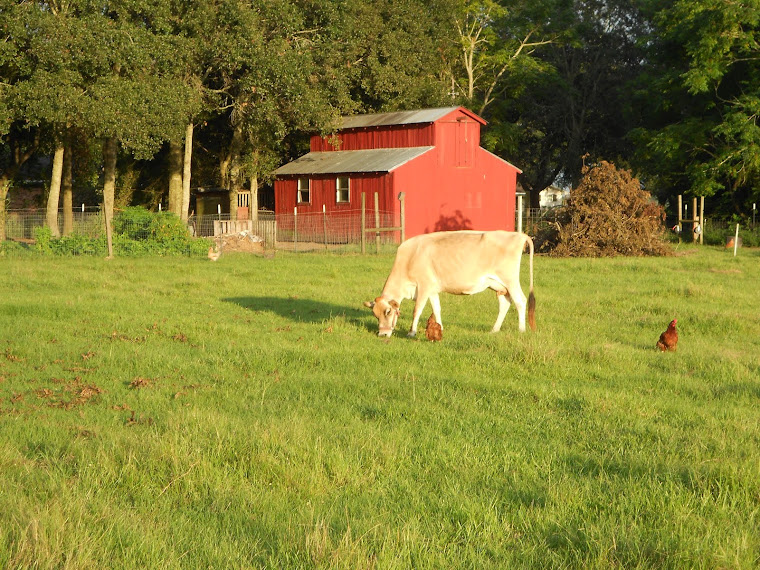
I had rolled out a fresh round bale of hay for the animals.  It's always important to give them plenty of hay to eat.  The animals didn't seem fazed by the temperatures.  Belle was watching them nonchalantly.

Her thick white coat apparently provided thick insulation to make her indifferent to the cold.  After sitting for a bit, she ran all throughout the pasture with reckless abandon.

Just prior to the freeze, we picked lots of broccoli, kohlrabi, peppers, sweet peas, snap beans, mustard greens, lettuce and kale.  We covered everything with tarps and anchored them down so that the plants would stay covered when the winds began to blow.

We anchored down the chicken tractor with laying birds with tie down stakes on all four corners.  The tractor was covered with a tarp and we ran an extension cord to power a heat lamp that would keep the hens warm.  It worked.  They were comfy.

With everything prepared as well as we could expect, we went inside.  The heater in the den was off and even ahead of the cold, temps had dropped to 53 in the house.

Time to change that.  With our firewood inventory in very good shape, we stoked up a nice fire and kept it burning for hours and hours.  It heated up our den and we enjoyed the warmth and ambiance that a fireplace provides.  We get plenty of use out of it.  I was toying around with putting some sort of a mechanism in the fireplace wall to hang a cast iron dutch oven and cook over the bed of coals?

Happy to say that the garden fared well, all the animals survived, too!  The jury is still out on our citrus.  All the trees are stressed, for sure.  I hope they make it.  If not, we'll have to start over.  Not ideal, but we'll push forward once more.

Thursday, August 17, 2017

Storing up

35 And let them gather all the food of those good years that come, and lay up corn under the hand of Pharaoh, and let them keep food in the cities.

36 And that food shall be for store to the land against the seven years of famine, which shall be in the land of Egypt; that the land perish not through the famine.  -Genesis 41

There is such wisdom in God's Word.  I was reading tonight about Pharaoh having a dream and he called Joseph to interpret it.  Joseph told him that a great famine was coming in the land and he told him to prepare for it.  He didn't only tell him to prepare for it, he told him HOW to prepare for it.

We don't watch a lot of TV so I'm not sure it is still popular, but in the past there were preppers who were storing food and supplies for any of a number of apocalyptic scenarios.  We don't consider ourselves preppers and we don't live in fear of doomsday-like events, but it is wise to have food preserved in your pantry. We live on the Gulf coast and hurricanes and bad weather comes frequently, knocking out power.  It is good to have your harvest stored should you ever need it.

Our humble pantry couldn't sustain us for long.  We don't have anywhere near the provisions that Joseph advised Pharaoh to store.  It would feed us for a week or two, perhaps.  As I look at it, it is a colorful reminder of past harvests.  Some years our tomato crop fails and we put up none.  Other years we have stewed tomatoes, tomato sauce, and salsa.  After crop failure, the pantry can be a confidence builder. "We had success before, and we'll have it again next year!"


It is good to take Joseph's wise advice for livestock, too.  There are dry summers in which the grass doesn't grow.  Because we don't feed our milk cows grain, heat stressed pasture results in milk cows with ribs showing!  For that reason we have a "pantry" full of hay stored away as insurance should the grass not grow.


Like canned vegetables, the hay will keep for a while and can be rolled out to the cows as they need it.

Preparing for tomorrow often involves more than saving up things.  Wendell Berry says it best:

“All we can do to prepare rightly for tomorrow is to do the right thing today.”
— Wendell Berry

Thursday, August 20, 2015

The Woodpile

It may seem a little odd to be talking about firewood when temperatures still hover in the mid - 90's and sweat quickly moistens your shirt by merely walking outside. Preparing for the future must be done, regardless of the season.  Goofy television shows have been produced that show 'preppers' in a kooky and unfavorable light, but truthfully, being prepared is just old fashioned wisdom.  That wood isn't going to split itself!

Be Prepared has been the Boy Scout Motto since 1907, but the idea of preparing is one that began many, many years before.  People had to prepare in order to survive. Survival is a great motivator. Despite relatively mild winters in south Louisiana, we still put up firewood to get us through the winters.  Putting up firewood is not a fun task, but one that must be done.  If one works in the summer, he can enjoy the warmth in the winter.

Our Woodpile (and a fat hen and rooster)
Speaking of warmth, Henry David Thoreau is credited as saying:

"Wood warms you twice, once when you cut it and again when you burn it!"

Last summer we had some water oak trees that were attacked by beetles and consequently died.  A friend of mine offered use of his chain saw and we carefully felled the oak trees, cut them up and stacked the logs in a nice stack.  There they sat for months, mocking me - "Stop procrastinating," they said.  "Come split us," they remarked.  Finally a month ago, I got out my ax, splitting wedge and sledge hammer and split all the oak logs up.  Mr. Thoreau was right - I was "warmed" splitting the firewood in July!

If you'll notice in the photo above, the wood is a grey color.  This color suggests that the wood has weathered or seasoned over the past year.  This wood will burn nicely. I tried to split the logs when the trees were initially cut, and the ax head bounced off of the green, uncured wood like a kid on a trampoline.  Once the wood dried it was much easier to split it up - except around the knots in the wood.  I kept my eyes on the prize as I worked, thinking about how nice it would be when the temperatures are 65 degrees colder and this wood would keep us warm and entertained while sitting in front of a roaring fireplace.

As I was splitting the logs, the chickens surrounded me, getting in my way and causing me to continuously shoo them away.  You see, a woodpile becomes a habitat for all sorts of insects, worms, and critters.  As soon as I would move a log, the ground was teeming with delicious morsels for the happy hens to devour.  I stacked the split firewood atop pipes to keep them from contacting the ground to avoid rotting.  The pipes that the wood is stacked on are re-purposed support poles from the kids' childhood swing set that I dismantled this summer, evidencing the fact that there's no such thing as retirement - even for a swing set!

Finally, I topped the wood pile with a blue tarpaulin to protect the wood (somewhat) from the rains that will come between now and when we finally light up the fireplace around Thanksgiving.  We'll likely go through this stack of wood this winter and then next summer, we'll start all over again.


Tuesday, July 8, 2014

Filling the Hay Loft - July 2014

Our cows are primarily grass-fed.  We give them each a scoopful of Dairy ration mixed with a cup of alfalfa pellets while we milk them.  Other than that, they're eating the grass that grows in our pasture and that is a mix of Bahia and Bermuda. Grass fed is great, but during the winter it presents some difficulties since our ability to get a good crop of winter rye grass has been lacking.  We purchase numerous round bales of hay that we allow them to eat on at will during the winter months and it takes them approximately 1 week to make a round bale disappear.  We supplement this hay with some square bales of high-quality Jiggs Bermuda.  We fill the hay racks above their troughs with it during the winter and they munch on it along with the ration until we're finished milking.

Planning for the winter doesn't happen without work and that reminds me of the Aesop fable of The Grasshopper and the Ant.  You'll remember that in that story the grasshopper spent the summer months singing while the ant worked to put food away for the winter.  This past Friday I got a phone call I was expecting from a neighbor who lives about a mile down the road that bales hay for us each year.  He gives us a good deal at $5 per bale picked up right behind the baler.  I assembled our 'ants' and we prepared ourselves for some hard work on a hot summer's day.

We each had different job responsibilities.  Tricia's job was counting the number of bales loaded - she's the brains of the operation.  We do the heavy lifting.  We need 90 bales of hay because that is exactly the amount that will fit in the hay loft of our barn. Benjamin's job was to be the driver and at age 13, he's getting good practice at driving the truck.  Benjamin aligned the truck beside the row of bales that the baler dropped in the field.

The bean hay bale counter
As Benjamin slowly drove, Russ, my Dad, and Conner (my nephew) lifted the bales and threw them up to me as I was on top of the trailer.  I positioned them so that they would ride without tumbling down on the drive back to our house. 

Lifting the hay
With so much help this year, it took no time to fill the trailer, Russ' truck, and Dad's truck with exactly 90 bales.  In previous years, we only had Russ' truck, so we had to make numerous trips to get the hay.  If you look closely in the picture below, you can see the hay baler pushing out bales and then just to the right of that in the distance, you can see the 'fluffer.'  The fluffer fluffs up the hay to get it ready to be baled.  The hay must be cured for a day or so in the hot, summer sun and this is a very, very important step.  If it is not cured & dried properly, hay can spontaneously combust and many barns across the country have burned to the ground for this very reason.


Stackin' in deep & Sellin' it cheap!
Loading hay is hot work.  Not only is it hot, but it leaves you sweaty and 'itchy.'  The hay will scratch you and your salty sweat gets into the scratches and burns.  The hay also has little pieces that get on your arms and itch like crazy!

Time to take a shower
We transport the hay back to our little homestead a mile away, back the trailer up to the barn, and use a pulley to hoist each bale up into the loft.  One or two people on the ground attach the hay by hooks to the rope.  One person up in the loft pulls the other end of the rope to lift the bale up, swinging it into the loft and another person slides the bale to the end of the loft.  We can stack the hay three rows wide by four rows high.

The bottom picture shows several noteworthy things:  First you see the pulley attached to a 4 x 4 that juts out of the top of the barn that is used to pull the hay up to the loft through the opened doors.  You can also see the separate paddocks cordoned off by electric poly wire. The cows are in the third of five rotational pastures now and they are heading out to graze as the sun sinks, signalling the cool of the evening. There are three chicken tractors on the pasture you can see, one of which (far right) has Big Boy, the Great Pyrenees livestock guard dog on top, monitoring the situation. The 'burn pile' is in the foreground -everyone should have a burn pile!  And finally the fence that (mostly) keeps the animals out of the garden can be seen at the lower right.

A view from on high
When all is said and done, "the hay is in the barn."  We can shut the doors, grateful that the hard work is done and that we've done our part in preparing for the winter. It is really a great life lesson if you think about it.  Right now, grass is plentiful. There is an abundance of food for the cows to eat on.  One could sit back and enjoy matters. But it is wise to prepare, to be forward thinking, and to put away a portion of that abundance for 'leaner' times.  In the story of Joseph in Genesis chapter 41, he did just that.  He prepared for the coming famine by putting away a portion of food during the harvest in the good years.  He filled storehouses and when the hard times came, they weren't destroyed.  They had enough to meet their needs. We would be well served to have a storehouse of goods put away for hard times as there will surely be weather or financial catastrophes that we should prepare for.

The hay loft is full
It always feels good to have a task completed.  We were fortunate to have a crew of strong family members to lend a hand this year and the work was knocked out in no time.  We shared a cold drink under a shade tree while we cooled off and were happy to be done.

The 2014 Hay Gang
I had the hay gang pose for a picture to commemorate the event.  Who says you can't find good help these days!? Thank the Good Lord that we got the hay in the barn and we're prepared for the winter.  Now it was time for a shower...
Related Posts Plugin for WordPress, Blogger...