Showing posts with label picket fence. Show all posts

Tuesday, August 9, 2016

The Old Picket Fence

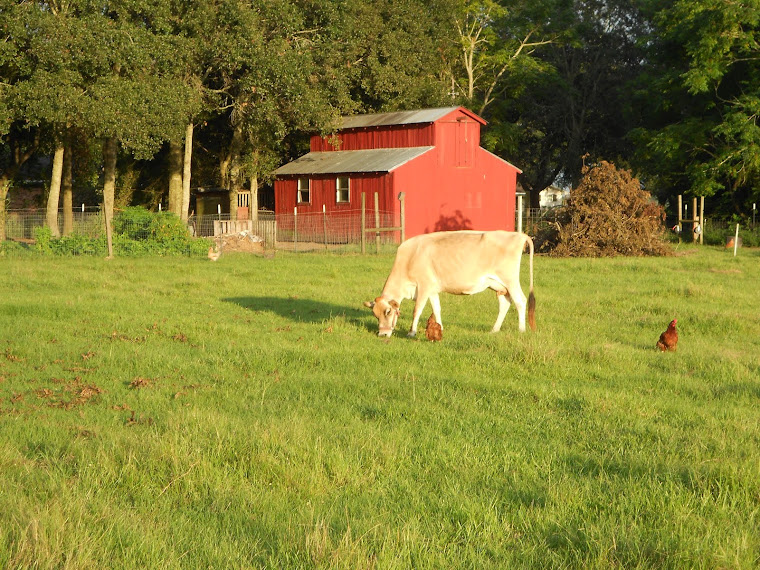
Years ago we hired a friend to build our barn.  It is the red barn you see in the banner above and in the background of the picture below.  Rather than purchase new materials, our friend had some left over lumber from a construction project and then he sought out someone who wanted to tear down a shed.  He proceeded to demolish the building and reclaimed some of the old tin, lumber and tongue in groove siding to construct our barn.  This kept costs down and added a little character to our barn.

When he had completed erecting our barn, there was a pile of leftover tongue and groove siding that remained.  In keeping with the reclaiming theme, I made a pattern and used an old jig saw to make pickets and constructed a picket fence in front of the garden.  The boys and I then whitewashed the picket fence as shown in this post: Whitewashing  I always wanted a picket fence and the fence served both an aesthetic purpose as well as a functional one – it looked good and kept critters out of the garden.

A white green picket fence?
Well, fast forward a few years and our picket fence has fallen on rough times.  It no longer serves an aesthetic purpose.  There is a green tinge of algae that covers the pickets and while this could be remedied with a good spraying with a pressure washer and gentle scrubbing with bleach, it would be a waste of time.  The fence is too far gone.

Pickett's Charge...
The pickets, made from old tongue and groove siding, are not made from treated lumber and out in the elements, the fence quickly rots.  If I was to use a pressure washer to clean it, the pickets would break off, much like the ones you see on the gate.

Where moth and rust (and rot) destroys...
I hate to see things in disrepair like this and I have it on my project list for this fall to replace it.  Over lunch today I was researching to see if it might not be a better idea to go with white vinyl picket fence panels instead of a wooden one as I’d only have to clean the fence with bleach and water versus replacing the fence again.  An eight foot panel runs roughly $90 and I’ve got about a 24 foot stretch not counting the gate.  It’s not cheap, but more permanent.

Wooden picket fences are sort of like people.  We were created for a purpose.  Although we may like to think we look good, our time on earth is fleeting and our physical bodies are not immune to the Second Law of Thermodynamics.  We get stained each day by the world and worn down and slowly decay.

James 4:14
Yet you do not know what your life will be like tomorrow. You are just a vapor that appears for a little while and then vanishes away.

How sad.  However, that’s not the end of the story.  Our old picket fence will probably be taken down and get burned in a bonfire this fall.  We don’t have to be exactly like the picket fence.  Unlike the picket fence, we have souls that will live for eternity.  Although our bodies wear out, our souls live on.  Although our picket fence will burn, our spirit lives on and yearns.

John 3:16
“For God so loved the world that He gave His only begotten Son, that whoever believes in Him shall not perish, but have eternal life."

Friday, May 23, 2014

Whitewash

Tom appeared on the sidewalk with a bucket of whitewash and a long-handled brush. He surveyed the fence, and all gladness left him and a deep melancholy settled down upon his spirit. Thirty yards of board fence nine feet high. Life to him seemed hollow, and existence but a burden. Sighing, he dipped his brush and passed it along the topmost plank; repeated the operation; did it again; compared the insignificant whitewashed streak with the far-reaching continent of unwhitewashed fence, and sat down on a tree-box discouraged. Jim came skipping out at the gate with a tin pail, and singing Buffalo Gals. 

“Say, Jim, I’ll fetch the water if you’ll whitewash some.”  From Chapter 2 of Tom Sawyer by Mark Twain

Image Credit
I remember that story well.  Tom Sawyer was a shrewd character and not only did he 'encourage' all his friends to do his work for him, but he actually got them to pay him to do his work for him.

He had discovered a great law of human action, without knowing it – namely, that in order to make a man or a boy covet a thing, it is only necessary to make the thing difficult to attain.

Tom understood supply and demand, public relations, and marketing.  He also sounds like he'd make a great politician!

I started thinking about whitewash because the other day I fixed 3 pickets on the picket fence that had rotted.  I'm far from being a craftsman, but I like to tinker around and try to fix things.  When we built our barn, it was constructed using wood and corrugated tin from other barns that had been torn down.  I saved the left over lumber and used a lot of it to cut out pickets to make the picket fence you see below.

The picket fence
I used the Tom Sawyer technique with Benjamin in order to get the fence painted, but it didn't go over quite as well.  I just used some old white paint that I had left over from when we built our house in 2001.  I ran across some information regarding whitewash that I didn't know.  I had always thought that whitewash and white paint was the same thing - Not True.

From Wikipedia: Whitewash, or calciminekalsominecalsomine, or lime paint is a low-cost type of paint made from slaked lime (calcium hydroxide) and chalk (whiting). Whitewash cures through a reaction with carbon dioxide in the atmosphere to form calcium carbonate in the form of calcite, a reaction known as carbonation.  When the paint initially dries it is uncured and has almost no strength. It takes up to a few days, depending on climate, to harden.  It is usually applied to exteriors; however, it is traditionally used internally in food preparation areas, particularly rural dairies, for its mildly antibacterial properties.

Reading further, it says it goes on thin and translucent, but thickens and hardens after a few days into a thick coating and is hygienic and sanitary.  It also repels bugs. This gives me a good idea for the milking parlor in the barn.  I found this recipe for making whitewash and I've put this on my To Do list.  

The only thing I learned is that you have to reapply the whitewash once a year or so as it tends to rub off. This brought back some memories.  Growing up in South Louisiana, people would whitewash the trunks of their live oak trees. Playing around the base of the trees, I can remember getting the chalky, white lime (now that I know what it was) all over my hands and clothes.  I assume the old-timers did this for the insecticidal qualities of the lime, but I also read on the Live Oak Society website that you can be expelled from the Society for whitewashing your trees!

Image Credit
Anyway, the fence got painted and I learned a thing or two about whitewash that I didn't know.

Our White Picket Fence
And speaking of pickets, our fence turned out more successful than the ill-fated Charge.
Related Posts Plugin for WordPress, Blogger...