Showing posts with label locusts. Show all posts

Wednesday, June 4, 2025

One Real Bad Dude

I don't like wasps.  We have a lot of them around here.  They tend to build their nests on outside windows where they'll be dry when it rains.  They also like to build them in the corners of ceilings in the garage and patios.  I mix up some dawn dishwashing liquid and warm water in a cup and throw it on them.  They fall, unable to fly and I step on them and then smash their nests.  I also have a long wooden dowel that I wrap a rag around one end and poke the nest, killing the wasps.  Wasps are no fun.

Walking through the gate this morning from milking, I heard a weird racket.  I looked to see what was going on.  It sounded like the wings of a cicada (we call them locusts).  I looked and looked to see what was going on and then I saw it.  It was a cicada, but it was in distress!

The big locust was being mauled by a smaller, yet fierce, creature.  It was a sight to behold.  I would estimate that the locust weighed three times the amount of the insect that was utterly manhandling it.  I'm talking about the Cicada-killer wasp.  What an ominous name that wasp has, doesn't it.  It's name tells you exactly what he does.  He's ferocious, I'll give him that much.\

The cicada was trying to fight off the intruder, but the cicada-killer wasp was aggressive and nimble.  The cicada's wings are way bigger, but he couldn't fly.  The cicada- killer wasp has smaller wings, but they appear to beat with the speed and intensity of a hummingbird.  The wasp, amazingly, was able to fly with the cicada in tow.


As I read up on the cicada-killer wasp (sphecius speciosus), I learned that they kill cicadas and take them back to provision their nests.  Now there's a nest I wouldn't want to discover by accident.  The article said that they can sting humans, but rarely do and only when they are handled.  I'll promise you this: You don't have to worry about me handling any cicada-killer wasps!


Monday, September 22, 2014

Cicadas (Or locusts) are in the Trees

Right now if you go outside, there is an incessant hum in the surrounding trees.  It is the sound of cicadas, or locusts, as we call them.  The pitch is constant and ever-present.  These things are everywhere flying around and making noise, especially as the sun starts to go down.  After mating the female lays eggs in the bark of trees. Once they hatch, the nymphs drop to the ground and tunnel where they'll live for most of their lives, eating the sap from roots for sustenance.  Here are three of their tunnels in just about a one square foot area.

Cicada burrows
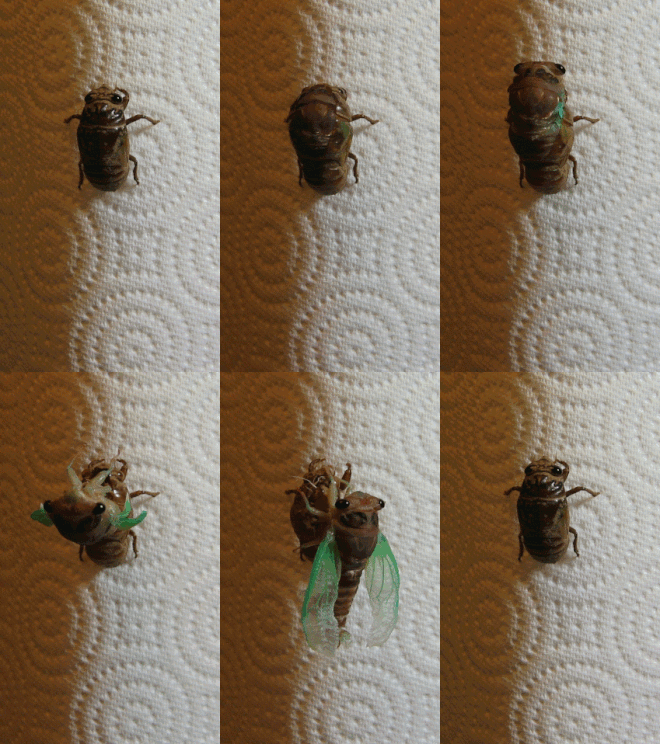
Here's the crazy part.  Their life cycle, according to Wikipedia, can range from 2 to 5 years and they eat the sap from roots.    Amazingly, the North American genus' life cycle ranges from 13 - 17 years! In the nymph's final stage, they'll emerge from the burrow and molt, shedding their shell (or exoskeleton).  You'll see these shells all over the place on fence posts, trees, etc.  Here is a cicada exoskeleton on one of our orange trees.

Just a shell is left behind
Here is an animated presentation from Wikipedia that shows a time lapse of the molt:

Image Credit
Here is a nymph in its final stage that was crawling along the concrete in the garage.

Looking for a place to molt
Here is an adult that has just exited the shell on the fence post by the gate to our pasture.

Free at Last!
The locust will hang there for a while while its wings dry, and then it will fly off, leaving the shell behind.  I read where in some cultures, these locusts, especially the females, are eaten.  No thank you. I'd have to be really, really hungry!

Just hanging out
Locusts do happen to have a vicious predator: The Locust Killer Wasp.  These bad boys are really a frightful thing to watch.  According to This Link it explains that cicada killer wasps grow to an inch and a half long.  They are so much bigger than regular wasps, but they aren't aggressive toward people.  The females dig burrows where they deposit their larvae.  You can spot the burrows by all the dirt piled up by the opening.

Here's the neat part.  The female cicada killers, true to their name, will hunt.  They will sting a cicada and this paralyzes it.  They will attack the locust in a mid air collision.  Then they'll either coast down near their burrow with the cicada in tow or they'll drag it into their burrow where the larvae will feed off of.  Then they'll rise to the surface and continue the cycle.

Image Credit
The cicada killer wasp looks pretty scary!  I hate to think of what her predator might look like!!
Related Posts Plugin for WordPress, Blogger...