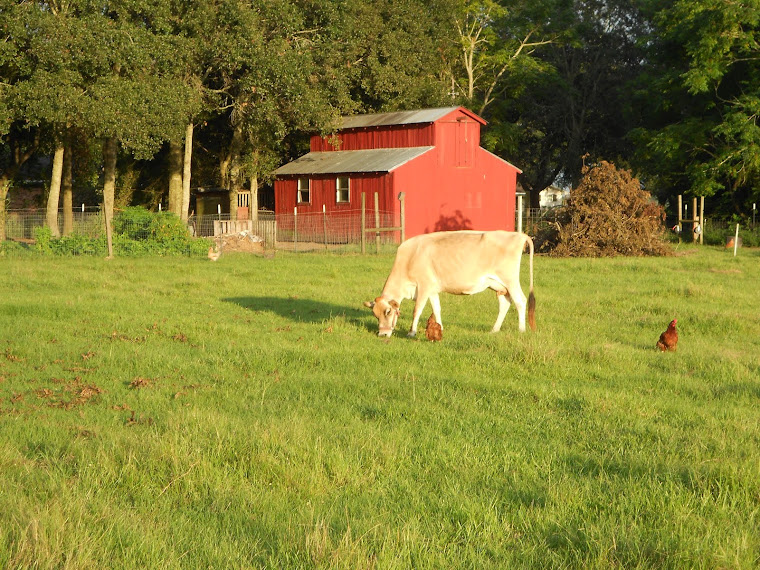
The wintry blast that brought temperatures down into the 20's killed the grass in the pasture. The cows and goats were out grazing, but to be honest, there wasn't much to graze on. Of course we have all the square bales of hay that we put up in the loft, but we're trying to ration that. The square bales are some high quality bermuda hay - horse hay, that the cows love. We give them wedges of it everyday, but we try to make it all the way through the winter.
Our 'everyday hay' is still good hay, just not quite the quality of the square bales, and we purchase it in round bales. We buy it from a gentleman that brings it to us by trailer and drops it off at our house. We appreciate his friendship. His trailer holds 8 round bales and he charges $25 per bale delivered. That is a great price, in my opinion. Which brings me back around to the point I was trying to get to in the first paragraph.
The man who brings us hay works on an offshore oil platform and works 14 days off and 14 days on. When I called an ordered the first 8 bales of the season, he was offshore and wouldn't hit the "beach" until 14 days later. Our cows were truly sorry about my timing! Anyway, the hay got delivered last night. I quickly rolled out 2 of the 8 bales. The cows were ecstatic. One bale went into the bull pen where Aussie (our Jersey bull) and Andy (our Nubian buckling) live. The other went into the main pasture where Rosie, Clarabelle, Luna, Clarabull, and the goat family (Buckwheat, Annie, Oreo, Salt and Pepper) live.
Our hay guy places the bales outside the pasture and we only roll out one bale at a time in each location for the cows to consume. I'll put a tarpaulin over the bales outside the pasture to protect it from the rain. One problem that we do have with hay is that when it rains, the fire ants seek higher ground in the hay. When we go to roll out the bales, the fire ants tear us up!
Once we roll a bale out, I put the hay ring around the bale to protect it. Cows are notorious for wasting about as much hay as they eat. The hay ring avoids some of the waste, but the goats enjoy jumping on top of the bale and do their very best to destroy it. A new bale in the pasture makes egg-gathering a little bit more adventurous as the hens enjoy laying eggs in the hay.
When I first got home tonight the cows were all circled around the hay ring eating their fill. When I checked in on them at 9 pm, they had pushed away from the supper table and were sitting down, chewing their cud. Very happy cows now that they hay has arrived! Last year they consumed 1 round bale about every 6 days. We'll see if they average about the same this year.
Make it your ambition to lead a quiet life and attend to your own business and work with your hands, just as we commanded you. - 1 Thessalonians 4:11
Showing posts with label hay ring. Show all posts
Tuesday, November 26, 2019
Hay There!
Labels:
cows,
goats,
hay,
hay ring,
hens,
round bales,
square bales
Tuesday, February 13, 2018
Last Year's Hay
It is the middle of February and a week ago the cows ate all of the remaining inventory of hay. I called the gentleman that sells us round bales and delivers it, but he happened to be offshore working. He works 14 days out in the middle of the Gulf of Mexico. We supplemented with the square bales of bermuda hay that we keep up in the loft. When our hay man hit the beach, he called me with some bad news, "I'm completely out of the hay from this year that I have been selling you, Kyle."
He did have some good news, though. He told me that he had started feeding his cows last year's hay. Last year was a very good year for hay and he had some still stacked up in the back. He said his cows were eating it and he'd sell it to me at a discount. I asked him to bring me 8 round bales and he delivered them to the house and put one in the pasture. With all the rain, I immediately covered the 7 bales with a billboard sign that we use as a tarpaulin.
The hay looked kind of "iffy," but once the weathered outer layer was removed, the inside of the bale was fresh and looked like it was baled yesterday. The cows loved it and absolutely devoured the bale that was out in the pasture. All's well that ends well. There is only one little problem. Since the round bales are last year's hay, they've settled and aren't round any more. They are flat on the bottom and as a result, they won't roll. I had Russ and Benjamin help me and we couldn't budge them.
But we're not quitters. Though we can't roll the bale, we can unroll it and bring armfuls of hay to the cows. That's exactly what we did. Obviously this wouldn't work with a herd any bigger than ours, but with our little animal family, this will work.
They hay ring is only about 60 feet from where the hay is stacked, so we don't have far to carry it easily to them. The cows are happy. We are happy.
Daisy, Luna, and Rosie are thankful to have the all you can eat hay buffet open. Clarabelle and the little bulls are still in the barn, but they'll all be here soon.
These 8 round (flattened) bales will last about 40 days. We will purchase some square bales that a buddy has stored up to use after that to tide things over until the spring grasses come in.
He did have some good news, though. He told me that he had started feeding his cows last year's hay. Last year was a very good year for hay and he had some still stacked up in the back. He said his cows were eating it and he'd sell it to me at a discount. I asked him to bring me 8 round bales and he delivered them to the house and put one in the pasture. With all the rain, I immediately covered the 7 bales with a billboard sign that we use as a tarpaulin.
The hay looked kind of "iffy," but once the weathered outer layer was removed, the inside of the bale was fresh and looked like it was baled yesterday. The cows loved it and absolutely devoured the bale that was out in the pasture. All's well that ends well. There is only one little problem. Since the round bales are last year's hay, they've settled and aren't round any more. They are flat on the bottom and as a result, they won't roll. I had Russ and Benjamin help me and we couldn't budge them.
But we're not quitters. Though we can't roll the bale, we can unroll it and bring armfuls of hay to the cows. That's exactly what we did. Obviously this wouldn't work with a herd any bigger than ours, but with our little animal family, this will work.
They hay ring is only about 60 feet from where the hay is stacked, so we don't have far to carry it easily to them. The cows are happy. We are happy.
Daisy, Luna, and Rosie are thankful to have the all you can eat hay buffet open. Clarabelle and the little bulls are still in the barn, but they'll all be here soon.
These 8 round (flattened) bales will last about 40 days. We will purchase some square bales that a buddy has stored up to use after that to tide things over until the spring grasses come in.
Labels:
bales,
cows,
hay,
hay ring,
round bales,
square bales
Sunday, November 12, 2017
The Very End of a Round Bale
Cows sure are some wasteful creatures. Since they are cows and their brains are quite small, they are not concerned with how to effectively devour a bale of hay so that you get the maximum nutritional value from it. Nope, given the opportunity, they will pull hay out of the bale, step on it, poop on it, pee on it and then lay on it. Then they will moo and moo, wanting another hay bale to eat on. Here is Daisy working on the very end of a round bale.
We use a hay ring to at least try to get them to eat responsibly, but the goats can easily get through it. They, of course, climb on top of it, poop on it, pee on it and lay on it. Especially at this time of the season where the grass is going dormant, the livestock are eating lots of hay. They are conditioned so that when they can hear me unchaining the fence, they come to enjoy eating a new, fresh bale that I've rolled into the pasture.
Before that happens, I make sure that they eat everything that they can possibly eat off of the old bale. I remove the hay ring since there is a 'sweet spot' in the middle that they can't reach when the hay ring still surrounds it. In doing so, I remove the pallet from the bottom of the bale as they could step on the pallet and hurt themselves. I usually roll the fresh bale on top of a pallet so that the hay isn't directly on the ground and absorbing water and mud.
Of course they all come to eat the hay that they previously could not get to. Naturally they'll stand on top of the hay they are trying to eat, pooping on it and peeing on it. I always comment that this would be like humans doing the same in their plates of food. The entire animal family gets involved in this fun.
They just don't know any better. Poor creatures. Once they are no longer trying to eat it, I'll roll a fresh bale out in the pasture on top of a pallet and place the hay ring around it. Rinse. Wash. Repeat.
We use a hay ring to at least try to get them to eat responsibly, but the goats can easily get through it. They, of course, climb on top of it, poop on it, pee on it and lay on it. Especially at this time of the season where the grass is going dormant, the livestock are eating lots of hay. They are conditioned so that when they can hear me unchaining the fence, they come to enjoy eating a new, fresh bale that I've rolled into the pasture.
Before that happens, I make sure that they eat everything that they can possibly eat off of the old bale. I remove the hay ring since there is a 'sweet spot' in the middle that they can't reach when the hay ring still surrounds it. In doing so, I remove the pallet from the bottom of the bale as they could step on the pallet and hurt themselves. I usually roll the fresh bale on top of a pallet so that the hay isn't directly on the ground and absorbing water and mud.
Of course they all come to eat the hay that they previously could not get to. Naturally they'll stand on top of the hay they are trying to eat, pooping on it and peeing on it. I always comment that this would be like humans doing the same in their plates of food. The entire animal family gets involved in this fun.
They just don't know any better. Poor creatures. Once they are no longer trying to eat it, I'll roll a fresh bale out in the pasture on top of a pallet and place the hay ring around it. Rinse. Wash. Repeat.
Saturday, November 29, 2014
The Hay Man Delivered
The early freezes put the hurt on the pasture. There's not much out there for the girls to eat on. Although we have 100 square bales tucked away in the hay loft in the barn, we ration that until later. We purchase the square bales from a neighbor down the road that grows it. It is the good hay. In fact, people who own race horses travel from far away to buy it. We'll start feeding it to the girls during milking time at the start of December so that it will last throughout the winter until the Spring grass comes in.
We generally buy 24 or so round bales of hay from another friend that lives down the road. He delivers it to us, 6 bales at a time. I just call him and tell him that we're ready and he arrives. I emailed him and asked him if he could reserve at least 24 round bales for us this year and asked him to please deliver the first batch of 6 bales. He said, "Sure." The only problem was that he works offshore on a 14/14 hitch and was in the middle of the Gulf of Mexico until Thanksgiving.
No problem. We started feeding the square bales early for about a week until he showed up. The cows were getting impatient and hungry. We put them in the sacrifice pasture and they devoured every blade of grass that remained. The day after Thanksgiving the hay arrived!
Our hay man loads up a 16 foot trailer with round bales and pulls it with his tractor that has a receiver hitch with a ball on it. He never has to get off of the tractor. Once he gets here, he drops the trailer, drives around and stabs each bale with a spear, carrying it to a location near the pasture where we store it until the cows are ready for it.
We generally buy 24 or so round bales of hay from another friend that lives down the road. He delivers it to us, 6 bales at a time. I just call him and tell him that we're ready and he arrives. I emailed him and asked him if he could reserve at least 24 round bales for us this year and asked him to please deliver the first batch of 6 bales. He said, "Sure." The only problem was that he works offshore on a 14/14 hitch and was in the middle of the Gulf of Mexico until Thanksgiving.
No problem. We started feeding the square bales early for about a week until he showed up. The cows were getting impatient and hungry. We put them in the sacrifice pasture and they devoured every blade of grass that remained. The day after Thanksgiving the hay arrived!
| The Hay Arrived! |
| Unloading the bales |
When we had five of the six bales in place, he asked if we'd like the final one put in the pasture. That would save us some time and work, so we said, "Yes!"
| The hay stockpile |
I put a pallet down on the ground first. Then the hay bale is placed on top of the pallet. I'm trying this experiment this year to keep the hay off of the ground, hoping that this would keep us from losing the bottom of the bale to moisture and mud. Then I quickly put the hay ring around it. The cows were eyeing the trailer full of hay when my friend drove up. They were ready to eat! If I don't put the hay ring around the bale, the cows would waste as much as they eat. They are horribly wasteful.
| Hay in the Hay Ring |
Daisy, Rosie, and Amy circled the bale, taking big bites of hay and if cows, smile, I think I saw them smiling.
| Gather round, everybody. It's time to eat. |
The hens even climbed on top of the bale to add to the pastoral scene, showing that everyone likes when the hay gets delivered.
| A nice barnyard scene |
Oh, one more animal was glad to see the hay - Annie the Nubian Goat. The goats are small enough to fit inside the hay ring, and they cause lots of mischief and mayhem. As a matter of fact, tomorrow I'll pull out the blue tarp and cover the top of the bale. I learned from experience that if you don't, the goats will climb up on top of the round bales and proceed to poo and pee onto the bale. That's some pretty bad table manners, right there.
| Trouble maker extraordinaire |
We've found that a round bale will last about 6 days before it's time to put a fresh round bale out there for the animals to enjoy. Round bales are out in the pasture for the animals to eat at will, unlike the square bales that we control access to. If the animals could talk, they would tell you that today was a good day because the hay bales arrived.
Subscribe to:
Posts (Atom)