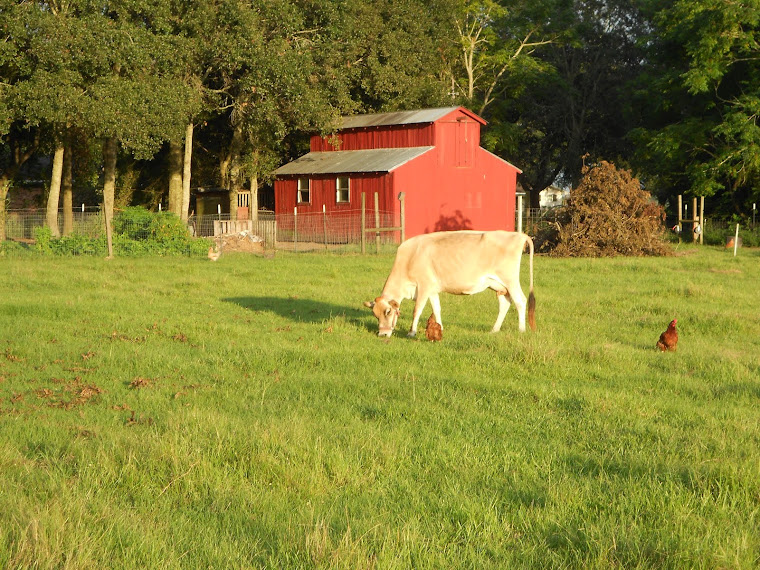
The Sonnier Family Farm is in Oberlin, Louisiana, off of Cotton Gin road, but no one can remember the last time cotton was grown around there. It is mainly rice that is grown around Oberlin now, along with a smattering of crawfish, soybeans, wheat and beef cattle. Our cattle have gotten to where they like to roam. and our fencing is about as porous as a sieve. We got to figuring and decided that the last time we built fence was probably 15 years ago and it was past time to plan a workday out on the farm and put up new fence in the worst spots.
So we assembled a fencing crew that consisted of my dad, me, Russ, Benjamin and my sister's oldest son, Conner, and we got to work. The first task was tearing down the old hog wire fence, rolling it up, pulling out the existing T-posts, and then mowing a flat, clean surface so that we could begin stringing the new fence in place. We're going to go with a 5 strand barbed wire fence this time. We fastened one end of the barbed wire to a corner post and used a modern "Mule" to unroll the roll of wire.
 |
| Unrolling the first strand of barbed wire |
When we got it to the other corner post, we went around the post and 'dead-manned' it to the mule, using a come-along to ratchet the wire tight. Our first strand of wire was at a height of 12 inches from the ground.
 |
| First strand about to be tightened |
The nice thing about the day is that it was beautiful and cool. We were working in the shade of some huge live oak trees and we never broke a sweat (until later in the afternoon). Russ and Benjamin got the tape measure and measured along the tightened wire, marking 16 foot measurements for where each of the T-posts would be driven.
 |
| 16 foot measurements |
Once marked, Conner used a 'post banger' to drive the T-posts into the ground at each 16 foot measurement. That old banger has driven many a post into the ground. Fortunately, the ground was soft from the Spring rains resulting in a relatively easy job. There have been some instances in the past where it felt like we were trying to drive posts into Interstate 10 the ground was so hard.
 |
| Bang! Bang! Bang! (Now you know why we call it a banger) |
You can see the nice, straight line of fence after the T-posts have been driven. You can also see several large live oak trees. Oh, if those trees could talk, the stories they could tell! That is the old home place where my ancestors on my Dad's side of the family were raised. Behind them in the picture is a pecan orchard that my great-grandfather planted.
 |
| A Straight Line |
Russ, Benjamin, and Conner teamed up to fasten the barbed wire to the post. They measured 12 inches up from the ground and then used vise grips to bend the clips that hold the wire around the post and tightened them down firmly.
 |
| Q: How many Cajuns does it take to build a fence? A: 3. One to do the work, one to talk about how much got done, and one to think about what time we're gonna eat. |
And you simply rinse and repeat. Except for the fact that while the bottom strand is 12 inches from the ground, each successive strand is 10 inches apart. This enabled us to fit the five strands of barbed wire on the posts, which was our goal. You can see how the roll of wire is on a spool and has a rod through the middle which allows the wire to unroll itself as the mule is driven. We used to run a stick through the roll of wire and have two people carry it to unroll it, but that was before we started using our noggins.
 |
| Unrolling more wire |
We all had our own jobs to do. I think the boys enjoyed learning a new skill - fence building. Benjamin said he was going to start a fence company called, "Benja's Ninjas". That might not be a bad idea. Current pricing for fence building is $1.50 a foot for barbed wire and higher for hog wire. Not to mention $100 per hour for tearing down old fence. You can see Benjamin providing supervision in the passenger seat of the mule.
 |
| Benja's Ninjas at work |
From time to time, we took our OSHA required work breaks. One of the old oak trees lent his drooping limbs to provide a perfect resting place for break time. The limbs also provide another service. They are worn smooth as glass on the bottom-side of many of the branches from cows rubbing up against them using the limbs as a back scratcher. The top side of the big branches are full of resurrection vines growing on them.
 |
| Break time! |
With the first side of the fence complete, the workers took a picture alongside their handiwork.
 |
| Behold the Fence Builders |
The workers kept a watchful eye on the road since Mom was bringing a picnic lunch for the chain gang. There were shouts of joy and jubilation when the Mom and her Acadia rounded the bend with plenty of sandwiches, chips, and homemade brownies. We spread out blankets underneath the tree and ate until we were about to pop and wondered how we were going to work for the rest of the day being so full. The boys got on the mule and drove around in the pasture hanging out the side of it with a machete, chopping off the heads of the big pink thistles that grow. What fun! Modern day jousting.
 |
| The Picnic |
Tools of the trade of a fence builder, or more accurately, a fence taker-downer. You need gloves to roll up the old barbed wire.
 |
| Tools of the trade |
Here is a shot of the last portion of fence that we're about to finish up with.
 |
| 4 strands done and 1 to go. |
We're stretching out the last strand of barbed wire with the mule and will attach it to the corner post by the corral.
 |
| Stretching out the last strand of barbed wire |
By the end of the afternoon, we finished. Now we have a 5 strand barbed wire fence that is tight and a fence row that is clean. If I was a cow, I'd think twice before trying to run through that, even if the grass looks greener on the other side.
 |
| Quittin' Time! |
Field Hand: Quittin time! Quittin time!
Field Hand: I says its quittin time!
Big Sam - Field Foreman: I's the foreman. I's the one who says when its quittin time at Tara. Quittin time! -
Gone With the Wind (1939)