Showing posts with label Stowell's Evergreen. Show all posts

Wednesday, June 3, 2026

Pickin' Sweet Corn

We grow a couple of heirloom varieties of sweet corn each year like we've done for umpteen years or so.  Sweet corn is one of those things that has at least two rows allocated each spring.  It grows fast and grows tall.  It feeds on the nitrogen in the soil provided by composted chicken litter and that homemade funky smelly fertilizer we've learned to make.

When I said it grows tall, I'm not pulling your leg.  Eleven feet from ground level to the top of the tassel!  The height is impressive, but it's also a curse of sorts.  When spring rains come they're usually accompanied by winds ahead of the thunderstorm.  Those gusts tend to lay the corn on the ground.  In the past, I'd stand them up and press dirt around the base to hold them straight.  That was a time consuming and unsuccessful venture.

For the past several years, I've opted for a better solution, using the "Florida Weave" method that I use for trellising tomatoes, but more simplified.  I drive a t-post on each end of the row and weave baling twine in and out all the way down the row and around the other t-post.  Coming back I weave the twine on the opposite side and cinch it up tight to the t-post on the end.  That way it makes the corn stand up straight again, which is important.  The tassels produce pollen that fertilizes the ears and that pollen uses the wind and gravity to do its job.  If the corn is laying down, my guess is that a lot of the ears will have blanks.  Each silk thread equates to a kernel of corn.  If pollination is not successful the ears will have blank spots.

Just look at that beautiful red silk!

A Beautiful "Red-Head"

Here's how you know when the corn is ready for harvest.  That beautiful red silk will turn brown.  When that happens, you've got to be ready to pick.  If you wait, you are in danger of a big fat worm eating its way through the ear or the corn will not be as juicy as it would have been if picked earlier.

It was a hot, humid morning and by the time I had picked every ear that was ripe, I had soaked my shirt.  I brought the crate of corn into the garage and put it in the refrigerator to cool down.  I wanted to cool down to, but there was still work to do.

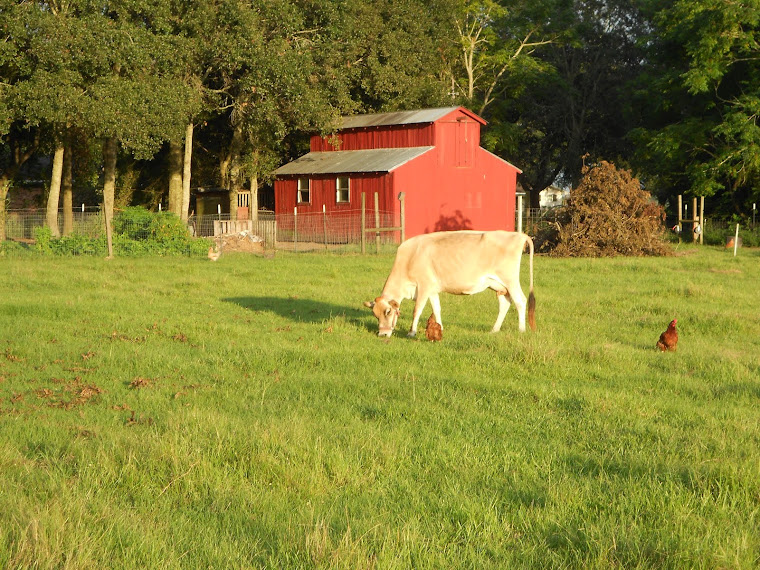
I cut the corn stalks and carried to Nicky, the bull.  Nicky was thankful.  Popcorn the buck was grateful as well.

Aww Shucks!

A customary corn harvest day always involves eating a bite-full of raw sweet corn right there in the corn patch.  I want to show you my favorite variety - Country Gentleman.  I like the name of this variety.  I think it sounds noble.  Wouldn't you like to be considered a country gentleman?  This is a white shoepeg corn.  I like it also because the kernels are arranged in random, haphazard fashion unlike the uniform organization of 'normal' corn.  Somehow I can identify with that jumbled, unorganized arrangement!


Here is the other variety - Stowell's Evergreen Sweet Corn.  These kernels are lined up in neat lines like you're used to eating when you enjoy corn on the cob.

We blanched all the corn on the cob for nine minutes, cooled it in a sink of iced water and then used a sharp knife to cut the corn off the cob, scraping the cobs to get all the juicy corn "milk".  Then I spooned it into quart ziploc bags.  Yes, we re-use bags that are still in good shape!

Later, we'll thaw and make our two favorite dishes with sweet corn - Corn Macque Choux and Elote (Mexican Street Corn).  I think if it ever stops raining, I'm going to go plant a couple more rows of sweet corn.  You can't have too much of this in the freezer or to eat fresh right off the cob.

Sunday, June 1, 2025

2025 Sweet Corn Harvest

We planted two rows of sweet corn this year.  We usually plant a couple of heirloom varieties - Country Gentleman and Stowell's Evergreen.  They aren't prolific producers (only one to two ears per stalk), they grow very tall and tend to blow over in the wind and rain, but they are non-GMO and are sweet.  I gathered my clippers and a laundry basket and decided I would go ahead and harvest in the morning before it got too hot.  It didn't matter.  It was hot and muggy and my shirt was soaked through and through almost before I got started.

I watched as a four foot long king snake slithered into the garden, unfazed by my presence, and nestled into the snap beans.  He knew I wouldn't do anything to him.  He's a "good" snake.  Still, if I was picking beans and didn't know he was there, he'd give me quite a start, for sure.

The way I judge if the corn is ready to harvest is by looking at the silk.  If it has turned brown, like you see below, it's ready to pick.

If it still has a red-color to it like you see below, I leave it to mature for a couple or 3 days.  Of the two rows, I left about 15 stalks standing that I'll go back and pick in a day or two.

The cows (in this case, Nick, the bull, takes great interest in the corn harvest as they eat the leaves and stalk of the corn plant.

In the end, we got a laundry basket full of sweet corn.  Not a tremendous harvest, but not terrible, either.

Aw shucks!  I began shucking the corn, removing the husks and silk.  Here is an ear of the Country Gentleman variety.  You'll notice that this variety is different in that the corn kernels are not arranged in uniform rows on the ear.  They're just haphazardly on the ear.

Here is an ear of the Stowell's Evergreen Corn.

We had a lot of damage this year from worms.  Most every ear had damage on the ends that I had to cut off.

After cleaning it all up, I took it inside where Tricia blanched it on the cob.  Once cooled, I cut the kernels off the cob and scraped the "milk" from the cob into a big stainless steel bowl.

We began bagging it all up in quart-sized zip loc bags.  We'll eat all this up later.  Our two favorite recipes to make are Mexican Street Corn and Corn Macque Choux.

Now that most of the corn is out of the way, I think I'll get some purple hull peas planted and maybe some pumpkins.

Wednesday, June 30, 2021

A Gorgeous Redhead in the Garden (And Other Fabrications)

A couple of weeks ago the two rows of corn in the garden began to tassel.  This is an important time in the development of the corn.  If fertilization is not complete, the ear of corn will be not full.  There will be gaps with a few kernels here and there - not much for eating.  It is also a time in which thunderstorms roll through and threaten to knock down your corn.  So far, so good.

We grow several varieties of non-GMO, heirloom sweet corn.  It grows very tall!


We don't grow a lot of corn - just two rows.  You never know just how the crop is going to be until you shuck the corn and pull back the silk and inspect the ear.  Would you look at that!  This is an ear of Stowell Evergreen Sweet Corn.  I generally eat the first ear standing in the garden.  It is sweet and delicious raw, right off the stalk.


I looked over to the next row of corn and lo and behold, what do I see but a gorgeous redhead standing in our garden.  What is she doing here?  No, Tricia is not a red head.  She has black hair, but calls it dark brown.  I am referring to the brilliant, candy-apple red tint of the silk on an ear of Country Gentleman Sweet Corn.  (I like the name of this variety.)

Country Gentleman is a white sweet corn.  It is sweet and delicious, but has another unique characteristic - the kernels aren't organized in rows.  They are arranged in a haphazard, almost random arrangement.  It doesn't matter what it looks like.  It tastes great!

As I stand in the garden, if I am patient, the afternoon sunset is punctuated by the tassels atop the corn stalk.  The hot sun gives way to a semi-cool breeze and a beautiful sunset.

It is quiet and peaceful - apart from buzzing, swarming hordes of hungry mosquitoes, it would be paradise.


But I'll bring my bucket of corn inside.  Once I shuck it, we will boil it and slather butter and salt on top.  Fresh sweet corn.  


That's some good eating!  Always a good idea to floss after eating corn on the cob...


Thursday, June 16, 2016

Sweet Corn is the BEST!

The old heirloom varieties of sweet corn that we plant are tall and gangly.  In fact rains and accompanying winds lean it over and from time to time I have to go out and stand it back up and then, with a shovel and a bit of dirt piled around the base of the cornstalk, I’m able to get it to stand upright again.  We rotate varieties every year, but this year we planted Stowell's Evergreen Sweet Corn.

Lean on me, when you're not strong...
As the corn tassels, the silk is a beautiful, brilliant red. 

That's a good-lookin' redhead!
At this stage the corn is beginning to mature as the tassel is the male flower of the corn plant and the silk is the female flower.  The tassel grows pollen and drops that pollen.  The silk receives that pollen and is fertilized.  Each silk strand, if fertilized, will develop into a kernel of corn.  Any silk that is not fertilized will not develop a kernel.  You’ll see that in a minute.

Now you can tell that the corn is ready to be harvested when the silk becomes dry and brown like shown below as contrasted to the photo above.

Ripe and Ready
Time to pick it!  Here is an example showing where we pulled back the husks and silk and see some immature/unfertilized kernels.  Can you see the plump, juicy kernels on the bottom and the undeveloped corn at the top?

Some are great.  Some not so great
Now Benjamin and I have a little tradition that we started a couple of years ago in which we eat the first ear of corn raw, right out in the corn patch.  Here’s the first one:


Although the orthodontist might not be happy, Benjamin proved that you can indeed eat corn on the cob with braces!


So sweet.  So delicious.  It doesn’t get any fresher than this.  It didn’t take very long at all until all that was left was a well picked-over corn cob.

C'est tout!
I planted the corn staggered in stages so that I’ll have corn maturing at different times.  Benjamin and I finished picking a big tub of corn and brought it inside to shuck.  That’s normally an “outside job,” but man, it was hot outside. 

Aw Shucks!
This year we were pleased to see that we had absolutely no worm damage.  Zero. Nada. Zilch!  Normally when we shuck corn, we have worm damage, along with ant damage.   We were thankful for that.  Now of course we shared the corn stalks with the Jersey cows.  They had a feast!

Cows like corn, too!
But we had a feast, too! 

Hot, boiling corn on the cob
After eating some hot buttered corn on the cob fresh from the field, we blanched and froze some of the first batch so that we can continue to enjoy the sweet corn.  We’re looking forward to harvesting more so that we can make some Corn Maque Choux – our favorite way to eat it. We showed how we made it in THIS POST.

Fresh Picked Sweet Corn is mighty hard to beat!


Monday, April 6, 2015

The 2015 Corn Crop

The stellar weather motivated Russ and I to get the 2015 Corn crop in the ground. On Friday afternoon, as we showed in This Blog Post, we each got a shovel and turned over some land just east of the row of Irish Potatoes.  This land was earmarked for planting sweet corn.  After mixing in some composted chicken litter, we were ready to begin planting the next morning.

Field of Dreams
We have a few varieties of heirloom corn that we are planting this year.  Below on the left we have Stowell's Evergreen Sweet Corn and on the right, we have Golden Bantam 12-row corn.  We haven't tried planting the Golden Bantam corn before, but have planted the Stowell's Evergreen sweet corn several years running.

Two of the Three Corn Varieties we are planting
In order to speed up germination, we poured the seeds into cups of water and allowed them to soak all day long   Soaking allows the dried seed to re-hydrate, soaking up the water until they are plump.


We like trying new heirloom varieties and we have a new corn variety that we are excited about.  It is called Bloody Butcher Dent Corn.  Tricia picked this up at a seed swap at a Sustainable Agriculture Conference that she attended.  It is an old variety that has been planted in the US since around 1845 in the area around Virginia.  It is said to be a cross between corn that the American settlers brought with them and corn they obtained from Native Americans.  It is said to grow 10 - 12 feet tall.  If I recall correctly, she brought some sunflower seeds and coriander (cilantro) seeds that we had saved and traded them for the seed corn you see below:

Bloody Butcher Dent corn
I can see why it is called Bloody Butcher Dent corn, can't you?  It is a beautiful red color.  Now, because it is dent corn, it is not meant to be eaten like the two varieties of sweet corn that we're soaking that you saw in the photos above.  Instead, this corn is supposed to be dried and ground into corn meal or grits.  We'll save some ears for seed corn if the yield and quality is good.  We started this handful of seeds soaking as well.

While the seeds continued to soak, we went outside, stuck a shovel in the ground and stretched out a long strand of baling twine that we had saved.  It was stretched clear to the end of the row and then we used a stake to make a trench beneath the twine.  The trench was about 1 1/2 - 2 inches deep. When done, we moved the string over 8 inches and repeated the process so that we have one large flat hilled up row that will have two lines of corn on top.

The whole thing about stretching the string to make a straight row is not necessary. It is just an orderly thing that is probably just habit.  Back when I was growing up, we'd plant soybeans and it was very important that your rows be straight because you would cultivate them.  If your rows were crooked, when you'd pull the cultivator behind the tractor, you'd run over your soybeans!  Of course this corn will be cultivated by hand with a hoe, so I suppose straight rows are not compulsory.

Straight rows of corn
And now it is time to put the seed corn in the soil.  The soil is beginning to warm with Spring temperatures approaching 80.  The water-swelled seed dropped in warming soil should awaken the life within the seed from its slumber, propelling it from the ground skyward.

Sowing seeds
We covered up the seed corn and watered it in.  Except we ran out of room to plant all the corn we had soaking.  We only had 27 kernels of the Bloody Butcher Seed corn and I planted it on the very end of the row.  The Golden Bantam 12 row corn was planted on three 30 foot rows in the garden that we hastily pulled up.

Swelled up Bloody Butcher Dent Corn
After all of the corn was planted, we transplanted into the garden our tomato and pepper seedlings that we had grown from seed.  Spring is an exciting time to be alive.  Getting in the garden and getting your hands dirty, anticipating delicious crops that will ripen and grace your table are things you never get tired of.

Wednesday, July 16, 2014

Sweet Corn - 2014

This year I decided to plant sweet corn in the yard instead of in the garden.  The picture below shows Benjamin (right) and his friend Xander near the two rows of corn.  As with most things, I learn a few lessons from what I did right, but most importantly and more frequently from what I did wrong.  I'll discuss a couple of those with you and we'll incorporate some changes prior to planting the corn crop next year.

Children of the Corn
I planted an heirloom variety of corn called Stowell's Evergreen Sweet Corn and have planted this as one of three varieties for about 3 or 4 years now.  This year I planted only Stowell's Evergreen Sweet Corn.  I moved the corn out of the garden area and into the yard. This was a move that didn't excite my wife at first, but I kept the corn patch neat and clean and she now approves of this move.  I like planting corn in the yard because it means that there is less grass to grow.  This was a good move and I'll likely plant here again next Spring.

The second good thing is an experiment that I tried that really worked that I'll tell you about.  In prior years, we've had thunderstorms that blew through the area with strong straight line winds that knocked the sweet corn flat.  Some lifted back up on its own, but others (due to the fact that heirloom corn grows EXCEEDINGLY TALL) never recovered and I took a big hit on my yield.

This year I tried something new.  You can't see it very clearly in the photo below, but I hammered two stakes on either side of the the corn in beginning of the rows, two stakes on either side in the middle, and two stakes on either side of the corn at the end of the rows.  Then, using twine from the round bales of hay I use for the cows, I made a twine cage around the rows, using the stakes as the frame and increasing its height as the corn grew.  We had rains and windstorms but the corn laid against the twine fence rather than laying flat on the ground.  Success!!  I'll definitely do this again next year.

In prior years I planted using the directions on the seed package that stated that you should plant 1 seed every 9 - 12 inches.  That takes up a lot of land that could be growing other crops.  This year, I planted every 4 inches.  I was able to get more corn plants per square foot. I think I'll continue this in the future as well.

The Sweet Corn Crop
One of the disappointments of the crop this year was the height of the corn and the yield and I believe most, if not all of this was attributable to soil quality.  Although I amended chicken litter into the soil, this ground is just not as rich as my garden soil that I've worked hard to build and I think that adversely affected the growth.  This soil is old hardpan ricefield dirt.  I only got one ear of corn per stalk and the size of the ears was small to medium.

Corn Tasseling
Notice the tassels in the photos above and below.  The zoomed in picture below of the tassels illustrates how the tassel has pollen that dangles and falls.

Pollen from the tassel
The pollen will fall into the silk and fertilize the corn.  It is neat to think about the fact that each single strand of silk when fertilized makes one kernel of corn!

The Silk - How 'bout that redhead?
It is time to harvest sweet corn when the silk on the outside of the shuck is dark brown.  Pulling back the husk will reveal plump, sweet delicious corn.  I like to shuck an ear and eat it raw, just standing out there in the garden, enjoying the evening and the sweetness of the freshest corn imagineable.  Good stuff!

The first ear of the season
Then I took the corn to the back patio and began shucking the corn, removing as much of the silk as possible.  I read where it is important to start your water boiling when you go out to harvest as the sugars begin converting to starch as soon as you harvest.  In other words, be prepared to eat it or blanch it and freeze it quickly if you want to eat it at its peak sweetness!

I'm all ears
We took the first part of the harvest inside and blanched the ears for 7 minutes in boiling water, then cooled it in ice water to stop the cooking process.  Then we bagged it up in gallon size Zip Loc bags and put into the freezer to enjoy later.  Tomorrow we'll harvest more to eat fresh.

Shucked Corn ready to be blanched
As far as the husks and silk, I fed some to the cows and goats and I'll compost the rest to put organic matter back into the soil.

Aww Shucks!
We didn't exactly have what I would classify as a bumper crop of sweet corn, but we have enough to eat and we're thankful for that. This year I'm going to save the corn cobs to make corn cob stock, too.

Corn tassels silhouetting the western sky
We learned some lessons that we'll continue in future growing seasons, and over the next year, I'll work to build up the soil for next growing season.  Gardeners are always looking forward to next year!!! 
Related Posts Plugin for WordPress, Blogger...