Monday, March 8, 2021

A Couple Signs of Spring

Springtime in South Louisiana is very short.  Like, it is measured in nanoseconds.  You must be on your toes or you will flat out miss it.  You'll go from wearing a coat one day to being able to fry an egg on the dash of your car the next.  That's why it pays to be observant, enjoying the beautiful signs of spring before it's too late.

Temperatures are projected to top 80 degrees this week.  We showed photos yesterday of some fresh growth on the blueberry bushes.  While I was checking that out a couple of things caught my eye.  First, is our Japanese Magnolia.  This tree is a beautiful tree.  As it turned out, it was an expensive tree, but not the way you think.  Years ago we bought this tree and planted it in a nice spot.  We didn't really think things through.  I guess I'd better take the blame for that.  Anyway, the Japanese Magnolia quickly grew roots that grew into our plumbing lines.  Then they really thrived.  Then the plumbing was clogged up with the roots.  After putting the plumber's children through college, we were able to enjoy this tree again.

At this time of year it puts out some nice-looking blooms before there is a leaf on the tree.  They smell nice too.  These trees are a harbinger of spring... as well as plumbers' job security.

The next sign of spring are spring eggs!  With warmer weather, fresh green growth in the pasture, and more bugs and worms to eat on, the hens' egg production has doubled in the last month.  The pullets' eggs are still small, but they'll get bigger in short order.  Right now, we're separating the pullet eggs from the old layers.  We are eating the pullet eggs as well as giving them away.  We're selling the eggs from the older hens.  I don't want to sell the pullet eggs and upset any customers.

The pullet eggs are delicious - pretty too.  Below you can tell which pullet eggs come from the "Easter Egger" hens.  Some are green and some are blue.  I alternate them with the brown eggs from the brown eggs of the Rhode Island Reds and Barred Rock hens as it makes a visually appealing dozen eggs, don't you think?  Some do not!  One time I had a prospective customer that saw our "Country Eggs" For Sale sign and came knocking at our door.  When I opened a carton and showed her the eggs, she did NOT like the blue and green eggs.  In fact, she said, "No thanks" and drove off.  As I watched her drive off, all I could think was, "I do not like GREEN EGGS and ham.  I do not like them Sam I am."  I guess we're not supposed to quote Dr. Seuss anymore.  What a crazy world we live in.

Another sign of spring is that each day we're picking florets from our broccoli plants.  After harvesting the main head, the plant will continue throwing out florets.  If you don't harvest them quickly, they'll bloom yellow flowers and go to seed.  Every other day we go out and pick all the florets we can.  It is the gift that keeps on giving.  Tricia used the fresh spring eggs and broccoli florets to make a delicious quiche the other night!

Goodness gracious was it ever good!  Back in the 80's there was a book entitled, "Real Men Don't Eat Quiche."  I beg to differ.  I'm a real man and I devoured that quiche.

Sunday, March 7, 2021

Checking in on the Garden After the Big Freeze

The Winter Garden is almost done.  We'll still be harvesting a lot of cabbage, chard, beets, and carrots, but other than that, the focus is on getting the spring garden planned and planted.  We'll show you a few photos of activities in the garden.  First, here is a nice shot of a head of Romanesco Broccoli.

Notice the swirls, spirals, and designs of the Romanesco.  It tastes like a normal broccoli, with a 'nuttier' taste.  We like them!  Along with this Romanesco, we've been picking broccoli florets almost every day and, along with cut up fresh carrots and beets, oven roasting them with oil, minced garlic, salt and pepper.  Delicious!

The carrots, slow to start in the fall, came on like gangbusters.  In fact, they are probably too thick.  They are healthy, however and are producing well.  Some are still small, but we're walking the rows, harvesting those carrots that are ripe.

We wash them up and eat them raw and crisp or oven roast them.  Today, they perfectly accompanied a pot roast for lunch after Morning Services at church.  Each day we need to be very disciplined about picking the ripe ones out so that the smaller ones have room to go ahead and mature.  Anything that we don't eat, we'll blanch and freeze so that we'll stretch the harvest out and eat all year.

One thing I want to show you is not really in the garden, but in our little food forest orchard of blueberries.  Right before the big freeze came, the blueberry bushes were blooming.  Those blooms eventually put on delicious berries.  Except, the freeze finished off the blooms.  See below.  The blooms are brown and dead.  There will be no berries following these blooms.

However, we've been on trails way up the mountain the the Great Smokey Mountain National Park and have feasted on blueberries along the path.  I just knew our blueberries would be okay.  Sure enough, fresh green growth is coming out on the bushes.  

In an even better sign, fresh blooms are filling the bushes where the brown blooms were and there will soon be blueberries.  That's a great sign!

The jury is still out on all of our citrus.  The leaves have all turned brown and died on our navel orange, tangerine, and grapefruit trees.  There is no fresh green growth on any of the trees.  The only positive sign is that if you scratch the tree, there is a layer of green just beneath the bark.  We will keep our eyes on the trees for fresh signs of life.

So hopeful that the dangers of freeze has passed, this afternoon, we transplanted the seedlings of many of the tomatoes we planted back in January.  We planted: Black Krim, Black Vernissage, Big Rainbow, and Pink Brandywine tomatoes.  Each afternoon this week, I will try to put more varieties out in the garden soil.  The warming days should get them growing.

The plants were about six inches tall, but I planted them deep - right up to the base of the bottom leaves.  The buried stem will become part of the root system.  The tomatoes are happy and healthy.  With temperatures reaching the upper 70's all this week, these tomatoes should really begin growing.

With longer days and warmer weather, everything should green up and really start growing.  Can't wait for Spring!

Thursday, March 4, 2021

Birds of A Feather Flock Together (In the Pasture Now)

Since late August (right before Hurricane Laura), the pullets have lived in the chicken tractor in the back yard.  Correction: The day before the hurricane blew in, we moved the chicks and chicken tractor into the garage.  Shortly thereafter, we moved them out into the backyard.  We would roll the tractor each day, or every two or three days, to fresh grass.  The pullets foraged and scratched for bugs, worms, and tender grass to eat.  In fact, they denuded portions of the back yard.  The barren wasteland below was thriving with clover and winter grass.  No more.  The voracious birds turned it into mud and dirt.


So we figured, now that they are laying eggs, it is time to move them out to the pasture.  We had best move them out, lest our back yard turn into the dust bowl days come summer.  It is no small task.  First, we had to remove Belle, our Great Pyrenees, out of the pasture.  We don't trust her yet.  She may eat them all.  Next, we brought the young hens out to the pasture in a blue tub, five at a time.  

Before setting them free, we clipped one of their wings.  You don't want them flying over the fence and into the mouth of neighborhood dogs, possums, raccoons, or other predators.  You really don't need to clip both wings - clipping one will do.  It will keep them off balance.  A funny story about clipping wings, about 10 years ago, I set out to clip the wings of some pullets.  Somehow, I was holding the (very dull) scissors oddly and the repetition of the process and the pressure of the scissors against my finger caused a weird phenomenon.  My middle finger went numb.  It stayed numb for days!  I was concerned that I had damaged my middle finger - not that I use it that much...  But after a week or so the feeling came back.  Needless to say, I was very careful this time.  Slow and steady is the game plan.

The hens didn't like that much.  They would cackle and shriek and flap their wings.  This would incite the rooster to come nearby in threatening fashion for messing with his harem.  I was poised with the scissors should he be tempted enough to try to spur me.  We'd have a fresh rooster gumbo, for sure.  In the end, we finished the task.  

The hens and the rooster were rewarded with freedom.  A wise man once made a wise quote about freedom.  The context wasn't about chickens, but I guess you could say that we were happy to give our birds freedom.

Those who deny freedom to others deserve it not for themselves; and under the rule of a just God, cannot long retain it.  - Abraham Lincoln

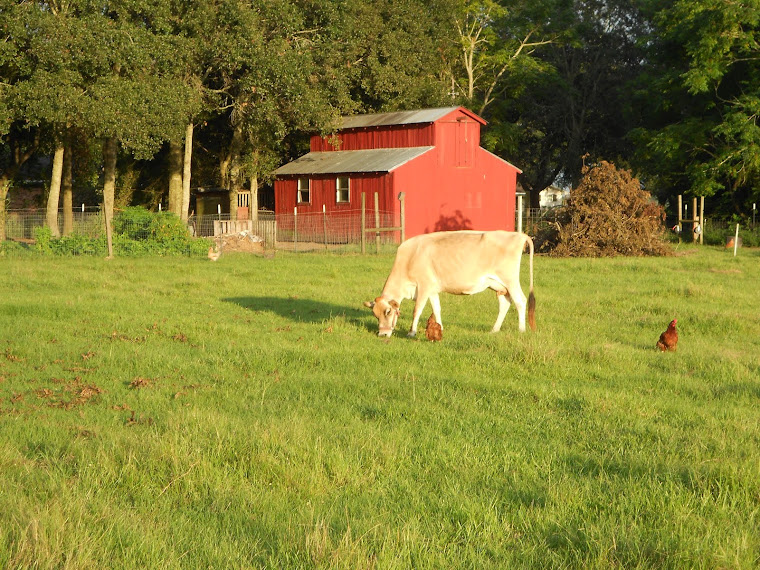
After months of being cooped up, in the literal sense of the word, the birds are free to roam on the pasture and be birds.  They were happy.  The bottom door of our chicken tractor that a great friend of mine built, is left open so that they can go inside and lay their eggs, leave and forage for food and then return at night to roost.  We are a little concerned about the hawks.  Tricia has been counting them every day and so far, all of them are still accounted for.


Pretty soon, the rich spring grass will grow and the hens will have lots to eat.  The yolks of their eggs will get a dark yellow color not present in store bought eggs due to their diet.  The taste of spring eggs are second to none.

Green grass will once again fill the pasture.  Hopefully, green grass will fill our back yard again now that these girls are off of it!

Wednesday, March 3, 2021

I'm Not Kidding - But Agnes and Annie Are

Early spring.  It's kidding time.  Buckwheat did his job and bred Agnes and Annie.  On February 25th, Tricia let me know that Agnes would be the first to kid.  Here bag was growing larger by the minute.  Sure enough, in the evening Agnes starting acting funny, making strange noises.  We got her into the barn where she could be isolated from the others.  Soon she was laying in the corner crying.  It's her first kidding and it I can gather from all the racket that it is not a pleasant experience for her.

Soon things started moving, we could see something coming out.  Trouble was, we couldn't see anything.  Agnes was really crying with each push.  It didn't seem like there was any movement in the delivery.  We didn't know if the baby was positioned correctly or if we'd need to pull the baby out.

We've learned to be patient and let things take its course.  In most instances, they can (and will) handle most things on their own just fine, thank you very much.  We saw the head first and could see the tongue moving.  Once the head was out, the delivery progressed quickly.  

The baby seemed to be healthy and Agnes seemed calm and relaxed again.  It was a happy, peaceful time in the barn.  Most times we've had triplets or twins, this time only a single.  And it's a doeling.  We decided to name her Cupcake.

We'll have better photos a little later.  There is a problem with Cupcake, though.  She has a deficiency in Selenium and Vitamin E.  This results in really tight tendons on the front legs.  They are curled and she stands on her knees.  If you try to straighten her bent legs, they are very tight.  Tricia purchased some selenium paste and vitamin E and has been treating her.  This deficiency also contributes to an issue with nursing.  So Tricia is being the country vet to Cupcake and is also bottle feeding her with colostrum we have stored in the freezer.  Cupcake's getting better.  She was nursing on her own today, so Tricia will soon stop bottle feeding her.  We'll have updates and reports later.

Two days later, on February 27th, Annie gave birth to a single buckling.  He is a healthy little fellow, tall and playful, energetic and strong.  We haven't named him yet.  While he's healthy, unfortunately, Annie is not.  Annie is a big goat, a pretty goat - but she has had mastitis issues in her bag over the years.  She is 8 years old and her bag, although enormous, will yield no milk. 

So Tricia is bottle feeding the little guy several times a day.  He is strong.  Sadly, because Annie is unable to provide milk, he cannot nurse and considers Tricia to be his momma.  He's not really bonded with Annie.

Two little goats on the pasture.  You've "goat" to be kidding me!

Monday, March 1, 2021

All in Favor Say "Aye" (Or Eye!)

Well, we finally got the potatoes in the ground this past Saturday!  Almost two full weeks late as we normally shoot for Valentine's Day planting.  Because of the crazy cold snap we had, it put a damper on planting.  The gentleman who brings us round bales of hay had jumped the gun on potato planting and the freeze killed every single one of his plants.  They were four inches tall when the freeze took its toll.  He has a great attitude and says he'll just replant.

After cutting our seed potatoes, we put them in the warmest room of the house - a coat closet, and let the warmth go to work.  The eyes began to grow and by this weekend, they were ready to put into the ground.  We plant red "Irish Potatoes" - actually a variety called Lasoda.  We like 'em.

We purchased 6 pounds of seed potatoes and cut them into chunks for planting several weeks prior to the plant date.  We aim for one eye per chunk, but often miss.  You can see on the potato chunk below there is a nice, healthy eye at the 6 o'clock position and another one popping out at about the 2 o'clock position.  I counted the number of potato pieces and came up with 87 that we'll plant.  They all have good eyes.  

Eighty seven potato plants should yield a nice crop, but we've learned not to count our chickens before they hatch.  I had my eyes on some blue potatoes at Tractor Supply.  I've never grown them.  But after measuring out the amount of potatoes and the space upon which I had to plant, I was out of room.  No blue potatoes this year.  Maybe next year.  I am a patriotic guy.  It would be fun to grow red, white and blue potatoes, wouldn't it?

We have a forty-five foot bed in the side yard.  It started out as a hardpan, clay, mostly unproductive soil, but we've amended it with lots of organic matter - leaves and compost and most recently, wood chips.  Over time the wood chips decompose and make the soil easily workable with a hoe.  The soil that once was a yellowish-white color is now dark brown and rich.  I used a rock rake to rake the wood chips off the row.  Then I hoed up two forty-five foot rows about a foot and a half apart.

I'm adding another amendment to the soil - Bio Char.  I made bio char by burning branches and sticks for a while until they are covered with grey ash.  Then I stop the burning process by spraying them down with a water hose.  I scooped the 'charcoal' up into a big blue tub.  If you would look at the resulting charcoal with a microscope, you would see a multitude of tiny holes.  If you'd amend this into the soil at this point, it would lock in and steal nitrogen from the soil and hurt your plants.  To combat this, we inoculate the charcoal with beneficial bacteria.  We mix in a bunch of cow manure and let it compost for a year.  The bacteria moves into the holes in the biochar like little beneficial bacteria hotels or AirBnB.  Fully inoculated, you can now put into your soil and the plants will thrive from the biochar.  That's the good stuff in the white bucket below.

I try to plant the potatoes about 3 inches deep with a handful of biochar in each hole.  The eyes face upward.  Planting crops and the anticipation of seeing the green shoots pop out of the ground is always an exciting time of year.

Finally, I used my rock rake to cover the potatoes with a smooth layer of soil.  What a nice seed bed it made.

If the Good Lord's willing and the creek don't rise, in a few months we'll have fresh potatoes and will enjoy homemade potato salad, crash hot potatoes, and baby red potatoes cooked with fresh picked green beans laden with butter.  Lookin' forward to all of it!

Sunday, February 28, 2021

But Have You Read the Label on That?

Our youngest son, Benjamin is in the Electrical Engineering program at McNeese State University in Lake Charles.  Between Covid restrictions and the dormitory where he was living being extensively damaged by Hurricanes Laura and Delta, the college experience has been sub-par.  When Benjamin's dorm did not re-open, Benjamin and a friend moved into an apartment.  Tricia has been very concerned about his eating.

She does not want him subsisting on fast food.  "Have you read the label on that?" is a common refrain.  "Just look at all that sugar!"  "I can't even pronounce this word.  What in the world is in this?  Chemicals?"  Tricia decided this afternoon that Benjamin needed some homemade breakfasts rather that the "heart attack in a sack" you get from local drive-thrus.  Homemade Breakfast Burritos!  Portable.  Delicious.  Healthy.

With the hens' egg production on an upward trajectory, Tricia has all the ingredients at her disposal.  She cracked 18 eggs, seasoned them up and began scrambling them.

Of course you need tortillas to make breakfast burritos, but have you read the label on that?  Filled with all sorts of crazy stuff.  For her boy? - only the best.  Momma won't have him eating enriched white flour tortillas made in New York City.  She whipped together some tortilla dough and began rolling them out.

She heated up the griddle and began making delicious tortillas, flipping them to cook on both sides and pulling them off by hand when they start to brown.

When it comes to filling the burritos, Tricia isn't stingy.  The tortilla is filled with seasoned scrambled eggs.  On most other occasions, she'd add chorizo and cheese, but today they were just egg burritos.

The burritos are rolled tight and packed into a container for safekeeping and storage.  By Tricia's calculation, this will keep Benjamin stocked up with healthy breakfasts until this weekend so that he can re-load his container with fresh supplies.

A quote ascribed to both Napoleon and Frederick the Great says that "an army marches on its belly."  Well, Tricia made darn well sure that Benjamin starts each day with his belly full of healthy food.  Mommas look out after their boys, don't they?

Thursday, February 25, 2021

Here, Chick, Chick, Chick

Each morning we go out and open the nesting boxes in the hen house.  The chickens are clucking and scratching and waiting for us.  When you have an empty nest, like we do, I guess it is somewhat fulfilling knowing that someone is still depending on you to feed them.  The feed room in the barn contains all sorts of feeds and minerals.  We have sweet feed, alfalfa, rough rice, and hen scratch.  

We mix up a half a gallon of rough rice and a half a gallon of  hen scratch and mix it up nicely.  Walking outside, we call, "Here, chick, chick, chick."  The hens fall over themselves to come to us.  They can't wait.  We take cupfuls and scatter it out in the barnyard.  The barnyard is mostly mud now - just an absolute mess.  But the fat hens don't seem to mind scratching through the mud to uncover a morsel of cracked corn, a grain of milo, some oats, wheat and millet, and plenty of locally grown rice.

The hens aren't the only fowl attracted to this free feast festivity.  Wild birds have gotten to where they appreciate the free meal.  In the photo below on the right middle, you can see another bird that isn't a chicken partaking.

Here are six more of the same, sampling the hen scratch.  These are "Mexican Doves" or Inca doves.  They are protected and may not be harvested like the Mourning Doves, Ring-necked doves or White-winged doves that are prevalent in our state.  These Mexican doves weren't common when I was growing up.  It was mainly Mourning Doves that were around.  They are called Mourning doves due to the sad, mournful call that they give.

In high school we would hunt doves south of town in soybean fields.  We would shoot them with 12 gauge shotguns and bring home a bag full of them.  I can recall plucking them and cleaning them to cook.  Doves are a delicious meal.  I remember one time we had cleaned them all.  I had friends over and we had browned our doves and were making a roux to make a nice dove gumbo.

My great Aunt Myra was in from South Dakota visiting on that fateful day.  She walked into the house and exclaimed, "What is that wonderful smell?"  The hunters proudly exclaimed, "We're making a dove gumbo!  You want some?"  Aunt Myra burst into tears.  We had no idea why.  We learned that Aunt Myra was active in the South Dakota Save the Dove Foundation.  My Dad had the unenviable task of comforting Aunt Myra and letting her know that doves were plentiful, a nuisance really in our area, and harvesting a few for a gumbo was a noble undertaking.


Related Posts Plugin for WordPress, Blogger...