Tuesday, April 22, 2014

Cheap Things

Reading Herrick Kimball's Deliberate Agrarian blog, I discovered the writings of Mr. E. P. Roe.  He was a Christian Agrarian writer in the 1800's who penned the following quote in 1886 the "The Home Acre":

"I am often told, "It is cheaper to buy fruits and vegetables than to raise them." I have nothing to say in reply. There are many cheap things we can have. Experience has proved that one of the best things we can have is a garden, either to work in or to visit daily when the season permits. We have but one life to live here, and to get the cheapest things out of it is rather poor ambition."

This quote made me do some thinking.  I'm a thrifty person and we tend to live very frugal lives, stretching a dollar about as far as we can make it stretch.  We're always looking for the best deal, primarily because with a single income, necessity dictates that you are thoughtful about how you spend your money.  But we were discussing the other day the fact that lowest price is not always best.  In fact, with food, the opposite is mostly true.

A couple of examples I can think of right offhand are strawberries and tomatoes.  If you go into the grocery store, you'll see red strawberries that are as plump as a spinning top just begging you to purchase them. They'll be priced to move, too.  When you get home, wash them and take a bite, nine times out of ten, you'll be disappointed.  That beautiful strawberry that was shipped across the country, while nice to look at, is white on the inside and tasteless.  What a disappointment!  The local strawberries, while smaller and generally a little more expensive, are sweet and red and delicious.

Similarly, with tomatoes - you'll see perfectly shaped, uniformly colored, blemish-free tomatoes in the produce section.  Take one of those home and slice it and it is light pink on the inside, grainy, dry, and tasteless.  This product compares in no shape or form to a home grown tomato.  In fact, most of the store-bought stuff shouldn't be allowed to be labeled as tomatoes.

Growing your own
Cheap things.  How can they grow this stuff, truck it across the country or fly it in from foreign lands and sell it so cheaply?  We made a conscious decision years ago to try to grow a lot of our own food.  Sure, we buy food at the grocery store from time to time, but if we can, we're growing it ourselves.  We keep very detailed records on production expenses and sometimes, for vegetables, meat, eggs, and milk, we scratch our heads and wonder how big producers/stores can sell food so cheaply (BELOW OUR PRODUCTION COST!) and remain profitable.  Even with economies of scale, it is hard to fathom how it can be done.

Squash, Cucumber, and Melon seedlings
Actually, we're only partially concerned with the answer to that question, for you see, we're comparing different products.  The final analysis, which let's be honest, takes place at the end of your fork, will underscore the fact that quality is worth paying for - either paying more money for it by supporting local farmers/producers or paying more in terms of growing it yourself, putting in the work (sweat equity) and time necessary to produce food you can savor and be proud of.   


Sometimes the bottom line has to have more factored in than outlay of a certain amount of nickels and dimes. The epidemic of diabetes and obesity in America, I think, is exhibit A of the deleterious effects of the availability of 'cheap food.'  I agree with Mr. Roe.  There is a time and place for purchasing and consuming cheap things. Food, however, is not one of them.

Monday, April 21, 2014

Getting the Squash Seedlings in the Ground

We had a scare last week with temperatures dipping into the 30's and I'll have to admit I was worried about the tomatoes, beans, watermelons and other items that I have planted in the garden.  Some show some slight effects of the cold weather in terms of 'burned' edges of the leaves due to the cold, but I think they'll all recover nicely, especially with temperatures hitting the low 80's all this week.  We ought to see some good growth - both in the vegetables in the garden and the the grass in the pasture.

With the threat of cold weather hopefully in the rear-view mirror, it was time to get some squash in the ground.  I had planted several types of yellow squash (straight neck & crookneck), several types of zucchini squash (Black Beauty & Gray), and a couple winter squash (Spaghetti & Butternut) into seed pots a few weeks ago and they've been growing on top of the cold frame on the patio.  The leaves were turning yellow and their root system was eager to get out of the little containers and spread out in the ground.  Let's get after it.

Benjamin helped me as I used my hoe to pull the decomposing leaves and organic matter that filled the valley between the rows up onto the top of the rows.  It smelled musty and was teeming with earthworms - a nice growing medium for healthy vegetables.

Pulling fertile soil up onto the tops of the rows.
While you can still make out the shapes of leaves in the compost, if you crumble a handful, it just becomes dirt.

Composted leaves and hay
Just to give the squash a good start, I dumped a bucketful of some organic garden soil on top at each three foot measurement where I'll be planting squash.  Admittedly, this is probably the same stuff that I showed you in the previous picture just composted longer and ground fine.  I asked Tricia to purchase this and this step is probably unnecessary, but I want to give the plants the best possible start.  This also made a mound that will lift the squash plants out of the lower part of the garden where the squash will be planted.  Rainfall on the southern end of the garden can damage crops since the beds aren't raised as high as on the northern end.

Organic Garden Soil
Then I simply use a plastic fork to remove the squash seedling from the seed pot and plant in the soil.  You can see the yellowish tint to the leaves.  They need some nutrients in the good soil to give them a kick-start.

Squash Seedling
The next thing I do is very important.  I go out to the hay bale in the pasture and scoop up lots of hay that the cows would otherwise waste and I bring it back to the row and completely encircle the seedling.  This provides mulch that will help retain soil moisture and inhibit weed growth.  I also find that it helps when the squash begin producing.  Sometimes squash that comes in contact with the ground will rot.  The hay acts as a cushion to protect the squash from excess moisture on the soil that causes rot.

Hay used as a mulch around the squash plant
Now all we need to do is give the squash a little drink of water and then we'll just sit back and let it grow.

A little drink
And now we're back where we started in the first picture.  I wanted to show you that I'll fill in the valley between each row with chopped up leaves that will serve as the walkway and will turn into next year's dirt/organic matter.  You can see three rows of squash planted to the left of the row I'm currently planting to give you an idea of the leaves and hay that I use to provide a good growing environment and to keep the soil covered.

Using leaves and straw as a soil covering
Now I've just got to get the cucumbers seedlings planted, along with some sweet corn. I also have some Birdhouse gourd and Loofah gourd seedlings that I need to get out of the seed pots and into the ground. Times 'a tickin'...

Sunday, April 20, 2014

He Is Risen!

Happy Resurrection Day!
Image Credit
"He is not here, but He has risenRemember how He spoke to you while He was still in Galilee, saying that the Son of Man must be delivered into the hands of sinful men, and be crucified, and the third day rise again."  - Luke 24: 6-7

Saturday, April 19, 2014

American Gothic

American Gothic is the name of a famous painting by Grant Wood.  As he was driving around Iowa, he saw an interesting house and endeavored to paint a picture of not only the house, but the people he envisioned might live in it.  The painting is now in the Art Institute of Chicago.  To me it is a very odd painting.  The upstairs window does not seem to go with the house.  Furthermore, the people look so gloomy, sad, and long-faced.  The man with the pitchfork represents the mid-west work ethic and the woman models a prim and proper farmer's wife or daughter.

Man and woman with stern expession stand side-by-side. The man hold a pitch fork.
Image Credit
Tricia and I decided to have some fun.  We're not from the Mid-west and I don't have a 3 pronged pitchfork, but we do have a manure-scooping pitchfork, and my Mom just bought me some new overalls, so we decided to do our own American Gothic.  


But we couldn't be serious for long.  We do want to be hard-working and resolute, but we want to have fun and laugh and find humor in all situations as well.


While hopefully we don't look like the characters in the original painting, we do hope that we have the traditional rural values that the subjects in the painting.  Yeehaw!

Friday, April 18, 2014

The Old Oak Tree


TREES
by: Joyce Kilmer (1886-1918)
 THINK that I shall never see
A poem lovely as a tree.
 
A tree whose hungry mouth is prest
Against the earth's sweet flowing breast;
 
A tree that looks at God all day,
And lifts her leafy arms to pray;
 
A tree that may in Summer wear
A nest of robins in her hair;
 
Upon whose bosom snow has lain;
Who intimately lives with rain.
 
Poems are made by fools like me,
But only God can make a tree.

Read more at http://www.poetry-archive.com/k/trees.html#FRhWsPH5yLBwAsHc.99

Joyce Kilmer wrote a simple poem that most everyone knows that perfectly describes trees.  What most people don't know is that Joyce was a man.  I can't say that I've ever heard of another guy named Joyce.  I was thinking that Joyce must have been a tough fellow to have grown up being named Joyce.  I can only imagine the teasing and ridicule he received on the playground.

Turns out, if you read here you can learn that he was indeed a man.  A hero, in fact. Joyce died at the young age of 31 in France in World War 1:

During the Second Battle of Marne there was heavy fighting throughout the last days of July 1918. On 30 July 1918, Kilmer volunteered to accompany Major William "Wild Bill" Donovan (later, in World War II, the founder of theOffice of Strategic Services, forerunner to the Central Intelligence Agency) when Donovan's battalion (1–165th Infantry) was sent to lead the day's attack.
During the course of the day, Kilmer led a scouting party to find the position of a German machine gun. When his comrades found him, some time later, they thought at first that he was peering over the edge of a little hill, where he had crawled for a better view. When he did not answer their call, they ran to him and found him dead. According to Father Francis P. Duffy: “A bullet had pierced his brain. His body was carried in and buried by the side of Ames. God rest his dear and gallant soul.” A sniper's bullet likely killed him immediately. According to military records, Kilmer died on the battlefield near Muercy Farm, beside the Ourcq River near the village of Seringes-et-Nesles, in France, on 30 July 1918 at the age of 31. For his valor, Kilmer was posthumously awarded the Croix de Guerre (War Cross) by the French Republic.
Kilmer was buried in the Oise-Aisne American Cemetery and Memorial, near Fere-en-Tardenois, AisnePicardy, France. A cenotaph erected to his memory is located on the Kilmer family plot in Elmwood Cemetery, in New Brunswick, New Jersey. A memorial mass was held at St. Patrick's Cathedral in Manhattan on 14 October 1918.
The reason I started thinking about Mr. Kilmer's poem is regarding a story I'm going to tell you about an old live oak tree at the farm in Oberlin.  Here is a picture of it:

The Old Oak at Durio Cemetery
The old oak's limbs hang low and provide shade for the cows in the pasture as well as being a back rub for them.  The live oak is a fixture in the Southwest corner of the family cemetery and has been there for a couple hundred years, I'm sure.

The Old Live Oak at Durio Cemetery in Oberlin
It's limbs stretch out heaven-ward and birds and squirrels nest in them and raise their young.  Since Durio Cemetery is on a secluded back road, many kisses have been shared beneath those branches on Friday and Saturday nights.

The branches of the old oak
But our story today isn't all happy and romantic.  There is trouble in paradise.  The tree has split down the middle.  If you click on this link: Weathering the storms of life you can read (and see photos) about how we were successful in saving the big live oak at our house that had a similar, albeit not as serious, problem.  This tree's prognosis isn't as bright & cheery.  Unfortunately, it's going to have to come down.

Terminal tree trouble
You see, the heavy limbs of the tree have fallen on some of the older graves that lie beneath its sheltering limbs, damaging the old graves by the sheer weight.  Although the live oak tree is still alive, it is sickly and shows signs of rot and as the situation worsens, the entire east side of the tree threatens to come crashing down.

A grave situation
Dad and the Cemetery Commission met to discuss ways of salvaging the old oak and sadly, there's no saving it.  It will have to be cut down and moved to the pasture where we'll limb it, cut it up, and split it.  The limbs whose shade has provided shade and a respite from the heat for generations of the past will now be used to provide warmth for generations in the future.  Interesting how things change.

The Old Rugged Cross and Old Glory beneath the Old Oak
You can click the link here and read the names and see the graves and learn about the people buried here at Durio Cemetery. Most are my ancestors.  Some were born way back in the early 1800's and several tombstones mark the grave sites of soldiers in the Louisiana Infantry back in the Civil War.  It's a peaceful place of rest and it is quite sad that the shade you see in the photos above and below will no longer be providing a covering for the tombstones.  Some of the tombstones are old and crumbling.  Some of them are 'homemade' with names and dates scrawled into the wet cement before it dried.

A final place of rest
Sort of a sad and somber post, but I wanted to capture it in pictures and words before its gone.  Oh, we'll plant another tree there, but I don't have 200 years to see the glory of the replacement tree, and like Joyce Kilmer says, "Only God can make a tree."  


Thursday, April 17, 2014

Mending Fences

The Sonnier Family Farm is in Oberlin, Louisiana, off of Cotton Gin road, but no one can remember the last time cotton was grown around there.  It is mainly rice that is grown around Oberlin now, along with a smattering of crawfish, soybeans, wheat and beef cattle.  Our cattle have gotten to where they like to roam. and our fencing is about as porous as a sieve.  We got to figuring and decided that the last time we built fence was probably 15 years ago and it was past time to plan a workday out on the farm and put up new fence in the worst spots.

So we assembled a fencing crew that consisted of my dad, me, Russ, Benjamin and my sister's oldest son, Conner, and we got to work.  The first task was tearing down the old hog wire fence, rolling it up, pulling out the existing T-posts, and then mowing a flat, clean surface so that we could begin stringing the new fence in place. We're going to go with a 5 strand barbed wire fence this time.  We fastened one end of the barbed wire to a corner post and used a modern "Mule" to unroll the roll of wire.

Unrolling the first strand of barbed wire
When we got it to the other corner post, we went around the post and 'dead-manned' it to the mule, using a come-along to ratchet the wire tight.  Our first strand of wire was at a height of 12 inches from the ground.

First strand about to be tightened
The nice thing about the day is that it was beautiful and cool.  We were working in the shade of some huge live oak trees and we never broke a sweat (until later in the afternoon).  Russ and Benjamin got the tape measure and measured along the tightened wire, marking 16 foot measurements for where each of the T-posts would be driven.

16 foot measurements
Once marked, Conner used a 'post banger' to drive the T-posts into the ground at each 16 foot measurement. That old banger has driven many a post into the ground. Fortunately, the ground was soft from the Spring rains resulting in a relatively easy job.  There have been some instances in the past where it felt like we were trying to drive posts into Interstate 10 the ground was so hard.

Bang! Bang! Bang! (Now you know why we call it a banger)
You can see the nice, straight line of fence after the T-posts have been driven.  You can also see several large live oak trees.  Oh, if those trees could talk, the stories they could tell!  That is the old home place where my ancestors on my Dad's side of the family were raised.  Behind them in the picture is a pecan orchard that my great-grandfather planted.

A Straight Line
Russ, Benjamin, and Conner teamed up to fasten the barbed wire to the post.  They measured 12 inches up from the ground and then used vise grips to bend the clips that hold the wire around the post and tightened them down firmly.  

Q: How many Cajuns does it take to build a fence? A: 3.  One to do the work, one to talk about how much got done, and one to think about what time we're gonna eat.
And you simply rinse and repeat.  Except for the fact that while the bottom strand is 12 inches from the ground, each successive strand is 10 inches apart.  This enabled us to fit the five strands of barbed wire on the posts, which was our goal.  You can see how the roll of wire is on a spool and has a rod through the middle which allows the wire to unroll itself as the mule is driven.  We used to run a stick through the roll of wire and have two people carry it to unroll it, but that was before we started using our noggins.

Unrolling more wire
We all had our own jobs to do.  I think the boys enjoyed learning a new skill - fence building.  Benjamin said he was going to start a fence company called, "Benja's Ninjas".  That might not be a bad idea.  Current pricing for fence building is $1.50 a foot for barbed wire and higher for hog wire.  Not to mention $100 per hour for tearing down old fence.  You can see Benjamin providing supervision in the passenger seat of the mule.
Benja's Ninjas at work
From time to time, we took our OSHA required work breaks.  One of the old oak trees lent his drooping limbs to provide a perfect resting place for break time.  The limbs also provide another service.  They are worn smooth as glass on the bottom-side of many of the branches from cows rubbing up against them using the limbs as a back scratcher.  The top side of the big branches are full of resurrection vines growing on them.

Break time!
With the first side of the fence complete, the workers took a picture alongside their handiwork.

Behold the Fence Builders
The workers kept a watchful eye on the road since Mom was bringing a picnic lunch for the chain gang. There were shouts of joy and jubilation when the Mom and her Acadia rounded the bend with plenty of sandwiches, chips, and homemade brownies. We spread out blankets underneath the tree and ate until we were about to pop and wondered how we were going to work for the rest of the day being so full.  The boys got on the mule and drove around in the pasture hanging out the side of it with a machete, chopping off the heads of the big pink thistles that grow.  What fun!  Modern day jousting.

The Picnic
Tools of the trade of a fence builder, or more accurately, a fence taker-downer.  You need gloves to roll up the old barbed wire.

Tools of the trade
Here is a shot of the last portion of fence that we're about to finish up with.

4 strands done and 1 to go.
We're stretching out the last strand of barbed wire with the mule and will attach it to the corner post by the corral.

Stretching out the last strand of barbed wire
By the end of the afternoon, we finished.  Now we have a 5 strand barbed wire fence that is tight and a fence row that is clean.  If I was a cow, I'd think twice before trying to run through that, even if the grass looks greener on the other side.

Quittin' Time!
Field Hand: Quittin time! Quittin time!
Big Sam - Field Foreman: Who says its quittin time?
Field Hand: I says its quittin time!
Big Sam - Field Foreman: I's the foreman. I's the one who says when its quittin time at Tara. Quittin time! - Gone With the Wind (1939)
Wednesday, April 16, 2014

A Letter from our Cows

Dear Humans,

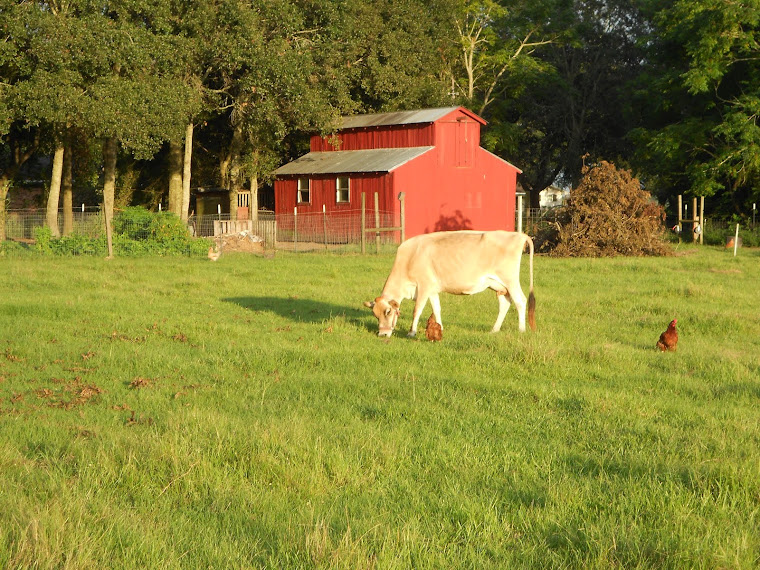
Welcome to the first annual Milk Summit that we, the Jersey Cows at Our Maker's Acres Family Farm have convened.  Pull up a milk stool and get comfortable. The purpose of this letter is to provide some much needed communication to humankind. There are misconceptions that many have about cows and we'd like to clear that up. But mostly, we'd like to convey some information to the humans that we look after here on the farm.  Please bear with us and forgive any misspelled words or disjointed thoughts.  Since our large hooves don't lend themselves to typing on the computer, we're having to dictate this letter to one of the two-legged people who look after us, so place any blame on grammar or style squarely on his shoulders.  I don't think the old boy's too bright.  We think he's two or three handfuls short of a bale, if you get what we're trying to say.

First off, we are registered Jerseys.  We're quite proud of our heritage and reputation as being milk cows with the highest percentage of butterfat.  Our milk is rich and creamy.  While we don't give quite the volume as a Holstein does, the quality of our milk is better. Sorry, I know it sounds boastful, but if you are going to make a choice between quality or quantity, when it comes to milk, you should choose Quality every time.

Secondly, although you might think that we like you, we don't.  We're ambivalent. In fact, we don't like much of anything but to eat, drink, nap, and poop.  We like the green grass and fresh water that you give us and when you see us standing with our heads up looking at you like in the photo below, that means that it is time to move us to the next paddock. We've eaten all the grass in that paddock and we want to be moved. Now.  Chop Chop.

More grass, please
While we're talking, we are punctual and have a rigorous timetable.  We like having a schedule - a routine. We don't like the way that you milk us every weekday morning at 5:30 sharp, but on the weekends, you sleep in and don't get out to the barn until 7:30.  Get with it, folks.  That is why we position ourselves close to the fence near your bedroom window on the weekends and bellow loudly.  Being an alarm clock is not really in our job description, but we'll do it to get you out here and milk us, you lazy sluggards!

As long as we're airing grievances, we have another pet peeve that we'd like to get addressed.  Where's the Beef?  Well, it has been seen and smelled coming from your backyard barbecues lately and we're disgusted. Two of us will stare you down, but as for me (Daisy), I can't even look at you, I'm so ashamed of you.  The smell of beef being barbecued in the backyard is so offensive to us. Like the Holstein cows in the Chik-fil-A advertisements, we'd like you to consider chicken or even pork, instead of beef from this point forward.  Oh, the humanity!

Don't make me come over that fence.
Lots of you humans mistakenly refer to all of us as cows, but in actuality, we are all cattle, but only female cattle are cows, if you want to be grammatically correct.  It is an important distinction, to us at least.  Cows are females who have had a calf.  Bulls are adult males.  A steer is a castrated male (ouch) and a heifer is a young female that has not had a calf yet.  Although we're females, we would assume calling a bull a cow would be most embarrassing to the old boy.  But probably the problem with this confusion is because in English, the word, cattle, only refers to the plural - not singular.  There is no singular word for cattle, so most people just call all the herd 'cows.'

Let's talk hygiene and manners for a minute.  We notice that you seem to be outdone with us when we come into the barn at milking time and you see that we laid down in some poop or pee overnight.  We're just not that concerned about it.  You try lugging 850 - 1000 pounds around all day.  At nighttime, we look for the first place to sit down and if that happens to be in some poop, well, we know you'll clean us up. Not a problem.

Speaking of problems, let's address the chickens and the goats.  Okay, we're the queens of the pasture. We were here first.  When we use our heads to sweep a squawking chicken out of our feed trough, we're simply asserting our rightful position in the barnyard hierarchy.  Same thing can be said when we headbutt the goats into the side of the barn. But back to the feed trough, you're being a bit skimpy on the alfalfa.  What gives?

President Reagan once said, "Mr. Gorbachev, tear down this wall!"  It was a forceful and strong directive that gave freedom to those held captive behind a man made barrier.  With respect to Mr. Reagan, we echo his sentiments and ask you to tear down the fence that separates the garden from the pasture.  It is our wish that you immediately do so as we consider it cruel and unusual punishment for you to grow lush, succulent vegetables right there within eyesight and not allow us freedom to partake of it.


All we're asking for is a little common decency.  We hope that this dialogue has been constructive and educational for you and will assist in facilitating change in the barnyard.  If our grievances are met promptly, we will forget about all these transgressions and your sins will be remembered no more.  If, however, these talks fail, well, we can't promise that you won't get swished in the face by a dew (or pee)-soaked tail.

Sincerely,

Your cows

Image Credit

Related Posts Plugin for WordPress, Blogger...