Tuesday, September 5, 2017

An Experiment with Hugelkultur

Hoogle what?  Hugelkultur.  It is a german word pronounced "hoogle culture" and it means hill mound.  If you search on the Internet, you can find numerous articles about this gardening practice.  I have been reading about it and decided to try it in our garden.  I am a novice in the practice, but it is not a new thing.  In fact, it has been in use for hundreds of years.

If you think about it, trees and all living vegetation uptakes nutrients from the soil and grows.  Many people bag those things up and/or load branches and limbs and transport them off of their property. Many others, like me, always have a 'burn pile' going to burn twigs, branches, and limbs that constantly fall out of the trees.  That eliminates your problem with refuse, but the nutrients from your property are literally 'going up in smoke.'  It is best to import nutrients and fertility onto your land or at least maintain it, rather than exporting it.


As I said, you can find numerous articles and diagrams on the Internet explaining the process.  I linked this explanation and image with the link under the following image.  I thought it was informative.
Image Credit
So my feelings on it are that hugelkultur can actually help me in three different ways:  First, it will add fertility to the soil.  Next it will place moisture in 'reserve' during drought years.  Finally, it will raise the level of my soil on the south (lower) elevation of the garden which should help during wet years.  I chopped up some partially rotten live oak branches that had fallen out of the trees during the recent storms.  Most of them were between 4-5 inches in diameter.  I loaded them in our gorilla cart and pulled them into the garden.


I picked out a good spot in the walkway between two rows  and began to dig a pit that was about four feet long by 2 feet deep.  I hope you can see something in the photo below that is a real encouraging sign.  You can tell where the line of clay starts.  There is about 1 1/2 foot of topsoil above that level.  Where I live we don't have that much topsoil, but due to composting and constantly amending the soil with leaves and organic matter, we've been able to really improve the soil!


Once the pit was dug, I threw some biochar at the bottom along with some composted cow manure. It looks like we're about to have a burial and actually we are.


We are going to bury some live oak logs in the bottom of the pit.


Then I began shoveling the dirt on top of the logs.


When I was finished, the walkway between the two rows that was lower than the rows is now level with the rows.  Mission accomplished.  Next year I'll move the rows over one space so that this year's walkways are next year's rows.  As the logs decompose, the roots will grow deep and feed off of the logs' fertility that is banked in the soil.


Now I called this an experiment.  Actually, I won't know if it was successful for quite a while.  That's okay, though.  Building soil and gardening is a lifelong pursuit.  One thing I'm sure of is that limbs will continue to fall out of the trees.  I'll have more than enough material to try the hugelkulture practice on as much of the garden as I have the energy to dig pits on.  Happy Gardening to you!

Monday, September 4, 2017

Laboring on Labor Day

I keep some old sheets of tin that I salvaged when demolishing the chicken tractors and they come in handy as being a type of "mulch" that covers the ground to keep weeds from growing until it is time to plant.  Finally the ground dried up a bit and it was time to plant tomatoes, cabbage, broccoli, cauliflower and brussels sprouts.  So I removed the tin so expose soil with no weeds and the ground underneath soft and pliable.


Unfortunately, the tin doesn't cover much more than two rows.  For the area that I'll plant today, I used a weed-eater to knock the weeds down to dirt level.  I burned it right down to the ground and will plant without tilling.  I have the tomato seedlings all ready to plant.  Due to the rain delaying planting, some of the tomatoes are root-bound and some are yellowing, but most will survive and do just fine if I can get them planted today.


I separated them by varieties and got busy.  I simply took a hoe, dug a hole, filled it with some organic garden soil and popped the tomatoes out of the Community Coffee cups that they are in and planted them. Caffeinated tomatoes, perhaps?


They aren't beautiful tomato plants, but as you can see, the newest growth is green, vibrant, and healthy.  We'll see if we can keep that going, shall we?


When finished I have 36 heirloom tomatoes planted for the fall crop.  We'll see how it goes and if I'm able to harvest some fruit before the frost gets them.


Once I finished that, I planted 3 varieties of cabbage seedlings, 2 varieties of broccoli seedlings and some brussels sprouts.  I'll have to plant the cauliflower tomorrow as it got to be 4 pm and I had to get the bbq pit fired up.  Happy Labor Day, fellow gardeners!

Sunday, September 3, 2017

After All the Rain...

We feel very blessed to have not gotten the amount of rain our neighbors to the west experienced that was associated with Hurricane Harvey.  The destruction and flooding in Southeast Texas is overwhelming and our prayers are with the poor people that had their lives turned upside down by this terrible storm.

Over the six day period that bands of storms came through our area, I measured 10.6 inches of rainfall in the rain gauge.  Spread out over that period of time, the water easily drained and did not become a problem.  The real problem for us came 48 hours after the storm blew through.  Then the mosquito eggs laid in the standing water turned to larvae, matured and then flew in clouds to search for blood.

The "maringouin" or mosquitoes in French are terrible around here right now.  Just walking outside and they swarm around your head, light on your neck, arms and legs and have a feast.  Part of our property taxes go toward paying our Parish Mosquito Control to try to keep the mosquito population down.  They do this with a mosquito fogging truck that goes down every driveway spraying pesticide. Mosquito abatement also has a plane that flies overhead spraying to try to kill mosquitoes. We heard it overhead last night and figured we would have relief this morning. Well...


Not so fast!  The mosquitoes coating the walls in the garage by my rubber boots this morning must have been immune to whatever the plane was spraying.  I swatted this monster off of my leg (and you can see the shadow of another on the far left side of the photo.  Two observations:

  • #1 I think that this mosquito stole enough of my blood that I won't be able to donate blood for the next 8 weeks until my body can produce enough to replenish it. 
  • #2 This mosquito was so large, I think I could have battered it and deep-fried it and had a nice meal. 


It makes it awful hard to get any work done in the yard and garden while slapping mosquitoes, so I built a big fire and began making biochar.  The smoke kept the mosquitoes at bay for a while.  Maybe tomorrow will be a better day for gardening!

Wednesday, August 30, 2017

This Time of year in the Garden

This time of year in the garden things are slow, but will be picking up soon.  This weekend, if, and that is a big "if," things dry up just a little bit, I will be planting all of my tomato seedlings into the garden rows.  Additionally, if things are dry enough, I will transplant all of my broccoli, cauliflower, brussel sprouts and cabbage seedlings as well.

We are still picking okra and some peppers everyday, along with some eggplant, but as soon as the heat lets up just a tad, the peppers' production will get better.  The sweet potato crop looks to be a bumper crop and we will be harvesting in another month, I figure.  Here is a colander of various bell peppers and okra, both the clemson spineless and burgundy varieties.  We have been eating LOTS of okra!

You can see some of the darned stink bugs on the peppers and okra.  They give us fits!
During the lull that the garden is in, I wanted to show you something we grow that you can't eat. Here is a trellis of luffa and birdhouse gourds:


As I pull back some of the large leaves so you can see the fruit, a brilliant ray of sun shines through. I have a bunch of seeds for both luffa gourds and bird house gourds.  If anyone is interested, I'll gladly share.  These things make copious amounts of seeds.


Here is a birdhouse gourd on the same trellis.  I liked the loooong neck of this one and thought it would make a nice bird house, but a marauding rat ate it before I could dry it.  I got vengeance on the rat and you can read about his demise HERE.  There is still time for other ones to mature for bird house making.


These luffas are about the right age to be converted into bath sponges.  They are about two feet long. If I get all the seedlings planted this weekend, I'll pick these and skin them so they can dry out. Luffas can actually be eaten when they are less than 4 inches long.  They are in the cucumber family.  I cannot vouch for how they taste as I've never tried them.  I will put that on my list of things to do!


Here is another bird house gourd.  Although it doesn't have the long, skinny neck like the other one did, it will make a fine bird house.


It is kind of boring in the garden right now due to being between seasons and with all the rain.  That will be changing soon and I look forward to it.

Tuesday, August 29, 2017

Rosie (Soon!)

Here is a nice picture of Rosie, our Jersey milk cow.  This was taken on a nice day. Today the weather (thanks to the remnants of Hurricane Harvey) is not so nice. Lots of mud and rainwater everywhere!


The weather has been pretty bad.  When I neared home this afternoon, there was a tornado that touched down about a mile from the house.  It didn't damage anything as it touched down in the middle of a field.  I changed clothes, put on my rubber boots and headed out to feed the wet chickens, wet goats and wet cows.  The cows didn't even come into the barn.  They were busy eating grass out in the pasture.

The cows tend to enjoy rainy weather as it drops the temperature so that they can partake in their favorite hobby in comfort - eating grass.  It began to rain harder and harder so I didn't walk out to see how the cows were doing.  Tricia asked me when I came inside to eat supper if I had inspected Rosie. "No," I told her, "they didn't come in and the weather was too nasty to go out and see her."  The reason she wanted me to check on her is that Back in this Post we told you about getting the cows palpated.

When our vet came over, he told us that Rosie was bred.  We calculated that she was bred on December 8th and that gives her a due date of September 8th.  Rosie is getting close to having a baby calf.  Wouldn't you know it the weather is miserable out there and tomorrow the weakened storm that has caused so many to the west of us so much misery will be passing directly over us.  I don't want her to calve in the middle of a storm!

Yesterday, I did check on Rosie and I could not see her bags swelling up or other signs like her vulva getting "floppy."  Benjamin doesn't have school tomorrow so I'll have him go check Rosie out.  We always want to be ready in the event that there is any trouble during calving.  Hopefully in just a few days we'll have a new baby on Our Maker's Acres Family Farm.  As always, were hoping we get a heifer!  We will keep you posted.

Monday, August 28, 2017

Rethinking the Chicken "Arrangement"

When we first got chickens, we had a a small flock of hens that lived in a chicken tractor out in the 3 acre pasture.  I would push the chicken tractor each day to a different spot so that the grass was 'fertilized' in equal fashion.  Of course fire ant mounds proved to be a formidable obstacle.  Sometimes I had to lift the tractor or push around the fire ant mounds.  The tractor had a door on the front of it.  Each morning I would let them out and they would roam on 3 acres.  At night, they would return to the tractor as there were roosts in the tractor and they would sleep on them each night. Sometimes I would close the door to keep them safe from predators, but most of the time I wouldn't.

Then we got more chickens and that meant that we had to build a second tractor, which meant twice the work and twice the time in moving them.  Oh, and twice the fire ant mounds to dodge.  Well, then we got more chickens and we adopted more chickens that people no longer wanted.  (Who can refuse orphan chickens?) Suddenly, our nice plan didn't work.  Our flock no longer fit in the chicken tractors.

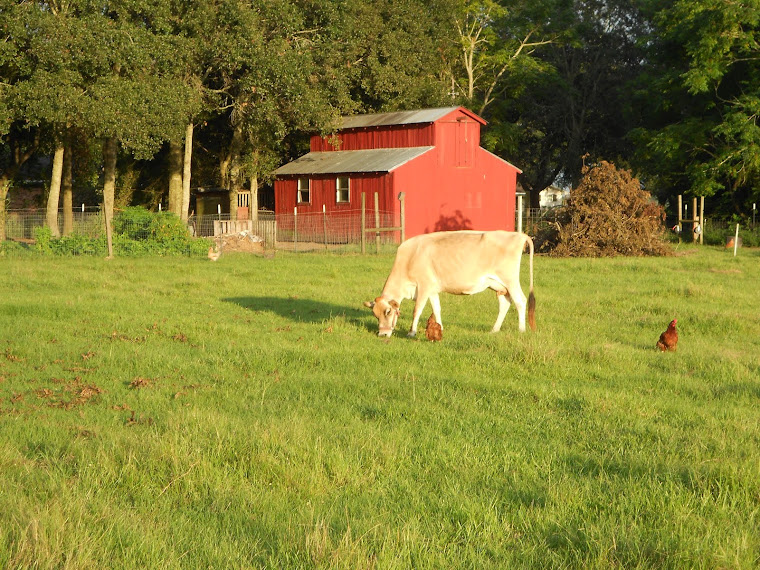
A friend donated a hen house that he was no longer using (you can see the hen house in the background of the photo below.  It is the smaller red building.) and the philosophy of our operation changed.  Rather than foraging for food out on 3 acres of pasture, the hens became dependent.  They lazily loafed by the barn waiting for rice and laying pellets we fed them at morning and night.  They roosted in the roosts in the hen house. They stand at the barn gates begging for food and the cows step on them when coming in the barn to get milk.  Some of the injured chickens die, and some, like Jacob, walk with a limp from their encownter.... ahem, encounter with a cow.


Oh, sure, they would venture out in the pasture and forage and eat bugs and worms and frogs, but their default position was hanging out by the barn.  Soon they had scratched all the grass around the barn to resemble a barren wasteland.  They created the same parched, grass-less 'chicken-run' area you see above that we were trying to avoid.  The lack of grass creates mud.  Young tender sprouts of grass have no chance with all the chickens.  There are no roots to hold the soil together and when rains come, a large mud flat looms.  Lots and lots of mud around the barn.  I want to reverse this and return to how things used to be.  It won't happen overnight, but we're making steps:

Step 1: We moved the new chicken tractor that we built out on the pasture.  This will be the hens' new home that will lure (at least some) of the chickens out of the hen house.  If you look closely, you can see a cardboard box leaning against it. What is that?  Well, the box contains is Step 2.


Step 2: We purchased some electric poultry netting from Premier 1 Supplies.  This netting hooks up nicely to my existing electric poly-wire fence by attaching a 'jump wire.'  This netting keeps the goats and cows out of the hen area.  The goats and cows are opportunists that like to eat the chickens feed. The goats are mischievous vandals that would destroy the chicken tractor in three shakes of a billy goat's tail. That means no time at all!  I will move the chicken tractor daily and will move the poultry netting several times a week to rotate the pasture the hens roam on.
 

Step 3:  More than keeping the goats and cows out.  The electrified poultry netting keeps the chickens IN and away from the area where grass is not growing.  I will plant rye grass seed mixed with wheat seed and bermuda or bahia grass seed in the 'grass-less' area.  With the chickens safely within the netting, the young grass will get a head start and perhaps be able to grow and I'll re-introduce grass and eliminate mud from an trouble spot around the barn.


That is the plan.  The chickens, as of this writing, have not bought in to the plan.  I lured the chickens into the netting with feed and got two thirds of them inside.  The next day more than a third of them had flown over or found other ways under, over or around the netting.  I don't give up easily, though. I will try to capture them all in the hen house and clip their wings, READ THE DIRECTIONS THIS TIME about setting up the netting and then set up the netting more securely and try again.  Once I have them all inside the netting, I'll purchase the seed and plant grass. Doing this is not easy, but it is the right thing to do and will eliminate erosion, mud, the health of the animals and soil fertility out on the pasture.

Thursday, August 24, 2017

Remembering the Harvest

Sometimes with pressures of work weighing heavy, at lunch I take a drive away from the industrial area in which I work.  I'll put some bluegrass music on and head east on Highway 90.  It only takes about 8 minutes to get me out of the hustle and bustle of traffic and I find myself between the small towns of Scott and Duson.  I turn south and drive slowly down the road, overlooking ripening rice fields and acres of peace and contentment.  No phones ring here.  No emails beg for answers. A solitary water tower and cell phone tower looms in the distance - a reminder that civilization is out there, but at arms length.


At least here, for the time being, the soil has not yielded to a surveyors instrument and flag, marking out yet another subdivision with a pastoral-sounding name like Live Oak Estates while transforming verdant countryside into grey concrete expanses adorned with flattened fast food soft drink cups and Wal Mart bags blowing across the landscape.

I stop my car and roll down the window and breathe in the smell of ripening grain. It is hot, oppressively hot and humid.  The air is thick.  I am transported back in time to when I farmed. During harvest-time, mornings were spent greasing up the grease fittings on every moving part there was on the combines and tractors. Farming taught me to keep things maintained and to be observant of the condition of your equipment.  We looked over the equipment for now is the time to get parts if you need them.  It is time to fill up your water cooler with ice and make sure you have a good inventory of sunflower seeds to snack on.  The sandwiches and chips and cookies would have been packed the night before in the lunch box.  Around 11 am the dew burns off the rice and it is time to harvest!

The field below is silent, except for the sound that the cattle egret's wings make as he jumps up and takes flight.  Although it is silent now, at 11 am, the throttle of the combine would be moved from 'turtle' to 'rabbit' and the pick up reel begins welcoming the "amber waves of grain" into the throat of the combine.  The hopper begins filling with a river of rice that doesn't stop flowing until quitting time.


I ran the carts sometimes.  The tractor driver running the cart had to keep a close eye out for the combine.  When the unload auger of the combine moved outward, it was time to unload and the cart driver had to be there.  I also ran the trucks.  The truck driver had mostly a lazy job.  I sat under the shade of the bed of the truck and read Tom Clancy and John Grisham novels.  I did push-ups and sit-ups.  I cleaned my fingernails with my pocketknife and I thought (what I thought were) great thoughts, passing the time as I watched the heatwaves dance across the field.  When I heard the unload auger of the combine slow, I prepared myself, getting up and getting a shovel and climbing atop the truck, I would spread the rice so that none would fall out of the truck as I drove the old truck down pothole-filled dirt roads as great billows of dust sprang up behind me.


I would record the number of barrels of rice in each truck on a log that I kept to track crop yield in each field.  Then I would drive the truck to the bins, back the truck up to the pit and dump the rice into the pit where an auger would deliver the rice up and into the bins.  Of course first the pit had to be emptied of water that seeped into the pit along with the occasional frog or snake.  We used a scoop made with an antifreeze jug that had been cut in half with a pocketknife.  I remember the water in the pit smelled sour as the rice fermenting in the summer heat made a powerful aroma and whose smell it was hard to get out of your hands or clothes when you got the water on you.

At the end of the day, the work wasn't over.  The rice inside the bins made a cone that had to be leveled to ensure even drying.  We climbed into the super-heated bins with shovels and began spreading the bins.  The object was to make the cone flat, with an indentation in the middle.  We worked and worked, our backs glistening with sweat, our muscles aching, our eyes burning with dust. When we finally emerged from the bin, the 90+ degree heat outside seemed cool and comforting compared to the oven we had just come from.  We sat on top of the bins, exhausted, but proud of our work.  We blew black boogers out of our noses from all the dust we inhaled in the bins and tried not to think about what got into our lungs.

We climbed down the ladder.  Right behind the bins was a pond.  We would run and jump in the pond and cool off.  Perch nibbled at our toes and we would dive down and feel the cool clay mud.  It had been a long, hot day.  It was hard work, but it was honest work and you felt good about what you had achieved.


As I drive home and see the harvest taking place, all those memories come flooding back to me.  The sights, the smells, the sounds remind me of simpler times.  A big part of me is empty because I couldn't make it farming.  Although we do live on a working farm of sorts, I a big part of me is empty because my kids didn't get to have the same experiences of growing up like I did close to the land.
As a society, we devalued farming as an occupation and encouraged the best students to leave the farm for “better” jobs in the city. We emptied America’s rural counties in order to supply workers to urban factories. To put it bluntly, we now need to reverse course. We need more highly skilled small farmers in more places all across America — not as a matter of nostalgia for the agrarian past but as a matter of national security.  –Excerpt from Farmer in Chief, written by Michael Pollan, published in the New York Times Magazine on October 12, 2008.
Related Posts Plugin for WordPress, Blogger...