Wednesday, March 18, 2015

Are You Lonesome Tonight?

In November 1960 after returning from two years' service in the US Army, Elvis Presley released "Are you Lonesome Tonight," a song that would top the charts and make girls cry.  It was originally written in 1926, but Elvis was able to make the tender ballad into something special.  You'll remember the first part of the song:

Are you lonesome tonight? Do you miss me tonight?
Are you sorry we drifted apart?
Does your memory stray to a brighter sunny day?
When I kissed you and called you sweetheart?

Drifting apart can indeed be a melancholy event for people - and animals, too.  The effects of being alone can be disastrous.  Yesterday afternoon I walked out to the chicken tractor in the pasture to feed and water our growing meat birds and peeked in on them.  They are looking good and they are definitely NOT LONELY!  As a matter of fact, by this weekend, I'll likely open up one end of the chicken tractor and extend the enclosure to allow them to hop out and have more room to stretch out.

A crowd of birds
They're not really 'cooped up' (pardon the pun) too tightly, they just like to bunch up together and enjoy each others' company, I would assume.  They still have some space to move around if they want some personal space.  I would say that for now, it is the perfect amount of space.

A view inside Heartbreak Hotel
As I glanced across the pasture near the chicken tractor, I immediately noticed something out of place.  Tricia had told me about it and I wanted to see firsthand. There was a group of laying hens encircling a white object, pecking on it.  As I walked up on the hens, they scattered exposing the carcass of one of our meat birds!

Winner, winner chicken dinner
Chickens are omnivores, meaning they'll eat vegetables, grain, grass, and meat. Chickens can be cannibalistic.  It's not a pretty thing to talk about or look at, but it's reality.  They will pick the carcass clean if you let them. Protein is protein. 

A foul fowl
How did this murderous carnage occur?  It occurred because the young meat bird left the safety of his enclosure.  Within the chicken tractor he had safety in numbers.  When you are with a large group, you are less likely to be a victim of treachery like this. It's a shame, really.  He had access to feed and water, shade, shelter and comradery of his feathered friends. And yet he left the safety of his home and ventured out alone. As a result of this bird-brained decision, he was isolated from his compatriots and met a quick and inglorious end. Birds of a feather are supposed to flock together, right?  Not run out on their own...

Sometimes we humans can exhibit the same thought process.  We have safety, provisions, and brotherhood and yet we are inclined to leave the protective covering of our family or our God and venture out alone. That's when the Enemy strikes.  By dividing us we become prey - easy pickings for those wishing to do us harm.  The Prodigal Son immediately comes to mind.  Fortunately he came to his senses before it was too late.

Don't get me wrong, being a rugged individualist can be a positive thing.  That mindset played a large role in colonizing this country.  But there should be balance. The Good Lord created us to be relational beings.  That's why it is important to be a member of a family, a close-knit local church, and have good neighbors that help one another out.  In Genesis 2:18 He said, "It is not good for man to be alone."  

Back to the chickens.  They don't have large brains and you can't really blame the bird for his sad demise.  I have to take the blame for this one.  The pasture is uneven.  Depending on the slope of the ground, sometimes there are gaps between the ground and the bottom of the chicken tractor.  Those gaps, if large enough, allow the birds to escape.  I used a brick, some tin, a board and a log to patch up the holes, assuring their safety.  That's a good plan to prevent another event like this from occurring. 
Patching up the hole
And I think that's what we have to do sometimes.  Sometimes when we are tempted by pride, vanity, or stubbornness to 'go it alone' we need to shut the door, not venture out and stay within the confines of our support structure - where a loving God and a caring family can protect us from a cannibalistic culture.  That way, like "The King of Rock 'n Roll" sang, we won't ever have to be sorry we drifted apart.

Tuesday, March 17, 2015

Early Signs of Spring!

After a long winter we always have our eyes peeled for signs that Spring is on its way.  Now that is a strange idiom, isn't it?  Keep your eyes peeled?  That sounds painful.  I searched to try to find the origin of this torturous sounding phrase and found it at Worldwidewords.org.

From about the 17th century on, pill was commonly spelt peel and took on the sense of “to remove or strip” in the weakened sense of removing an outer covering, such as a fruit. The figurative sense of keeping alert, by removing any covering of the eye that might impede vision, seems to have appeared in the US about 1850.
Anyway, I didn't mean to get off the subject there.  We've been anxiously awaiting Spring.  The old-timers say that Spring isn't here until the pecan trees begin putting on leaves, but there is some activity, if you look around, that lets you know that it is quickly approaching.  The first in our area being peach blossoms.  The peach tree itself won't have any leaves at all, but the branches will be heavy laden with the most beautiful pink flowers.

Peach trees adorned in pink
A light rain was still falling as I walked around the trees, inspecting the blooms with visions of peach cobbler dancing in my head. You can see the drops of rain cascading off of the flowers.  Though the sky is dull and gray, the brightness of the peach flowers brightens the day.


Peaches are one of the first things to bloom and because of that, they are subject to freeze. Sometimes late freezes come along during the flowering stage and severely damage the crop.  You can see that the blooms are in all different stages - some in full bloom and some still budding.  The day I took this picture, it was cool and raining.  A few days later, it warmed and our bees were buzzing around the blossoms.  They are happy it is Spring, too!


I was listening to a gardening show on the radio the other day that Dan Gill from the LSU AgCenter broadcasts.  More information about him and his radio show by clicking here.  You can really learn a lot from listening.  A caller called in and asked when is the best time to fertilize Satsuma and other citrus trees.  Since they bloom in March, Dan Gill told them the best time is in February.

I have some good composted chicken litter and in the middle of February, I pulled a wagon around the yard and broadcast some around the base of each tree.  A providential rain fell the very next day. It was not a driving rain, but a good soaking one that allowed the fertility of the chicken litter to gently work itself into the soil and come in contact with the roots.

As you can tell from the photo below, the tree enjoyed the fertilizer and is putting on bright, new leaf growth.  But that's not the only thing it's putting on.

Right behind the new leaves are a whole bevy of white citrus blooms.  They are just buds now, but you can see the white color of the soon-to-be flowers.  Once they open, if you're looking for me, I can likely be found around one of the citrus trees, smelling the orange blossoms.  What a fragrance!


Last but not least, on my search for Spring was our Japanese Magnolia.  Like the peach, this tree puts on blooms before any leaves appear.  The flowers are similar to the magnolia bloom, albeit smaller and pink.  We call this Laura Lee's tree (our daughter).  We planted it for her and made the mistake of planting it too close to the septic lines causing us severe plumbing problems.  They say you learn from your mistakes, so we chalked it up to a good learning experience.  Now the plumbing problems are behind us and the tree keeps giving us beautiful blooms each year, so I guess all's good.


If you open up the bloom and smell, it has a real nice fragrance - crisp and clean.


There will of course be numerous signs of Spring with each passing day as temperatures are already in the upper 70's and low 80's.  The official first day of Spring begins on March 20th.  Spring is very short in South Louisiana, so we relish every minute. Summer doesn't officially begin until June 21, but let me tell you, it FEELS like summer long before that date.

Monday, March 16, 2015

Cranking Up the Lawnmower(s)

Usually some time in October, I mow the yard for the final time and put the lawnmower in storage in the garage for the winter months.  I leave it sitting there for as long as possible.  Around this time each year, big patches of lush, green, White Dutch Clover pops up in the yard.  In order to get the yard looking spiffy after months of neglect, it is time to get the lawn mower out of the garage.  Or better yet, get the lawn mowers out of the pasture.

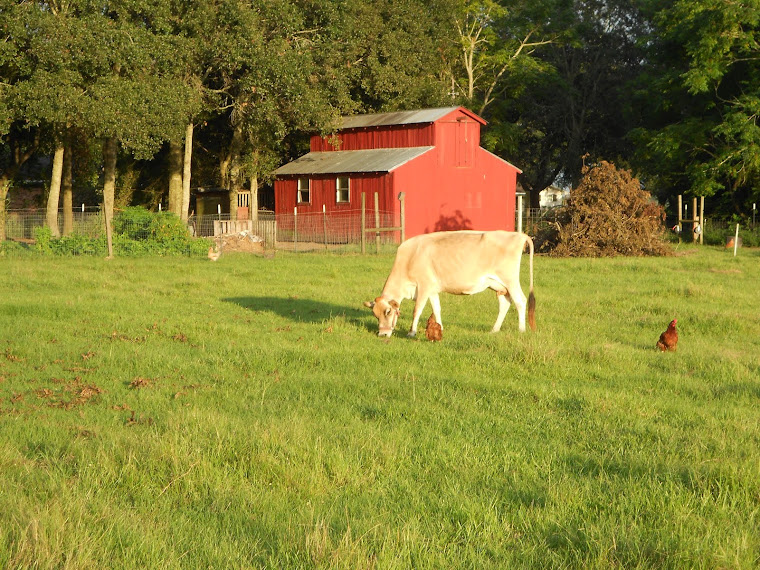
It's a shame to let all that clover go to waste when Daisy and Rosie can take care of it better and more inexpensively than the John Deere riding mower.  I got the step-in temporary posts out and put them in place and then got the reel of poly-wire and unrolled it, encircling a portion of the yard that contained some of the clover that needed cutting.  I didn't even need to attach the electric fence charger as the cows have learned their lesson and respect it, 'hot' or not.

Lawn mowers in action
It was a nice Saturday and the cows were pleased to get out into the yard and mow down some clover rather than stand around in the mud eating hay.  They welcomed the opportunity and as I led them out of the pasture, they broke into a gallop (if cows could gallop).

Happy cows filling up on clover
They clipped down the clover almost as fast as I could have done it with the lawn mower.  Clover is very nutritious for the animals and must taste great as they really eat it up quickly.  I'm pretty careful to limit their access to it, though.


Clover is a legume that if the animals overeat, it causes gases to build up in the rumen.  Normally this is not a big deal.  The cows belch and eliminate the gas.  In some cases, though, the animal is unable to belch and severe bloat ensues.  Left untreated, this can be life-threatening to the animal as they have difficulty breathing and can suffocate.  As a boy I read a great book by James Herriot called "All Creatures Great and Small."  It contained the stories of a country veterinarian in England.

Dr. Herriot treated cows with bloat and I still remember the story in which he used a tool called a trocar.  The trocar he used was basically a funnel with a sharpened bottom and a flat area on top for hammering. When the doctor would get called out to treat a bloated animal, he'd position the sharpened funnel in the hollow of the animal near the flank and hammer the funnel through the hide and into the animal's rumen.  Ouch!  The gas and accompanying partially digested grass would blow explosively out of the animal's stomach, covering everyone nearby with green, smelly rumen contents.  The animal's life was saved and after a bath, everyone is better off!

Fortunately, our 'girls' have never had to be trocarized, but in watching a television program called, "The Amazing Dr. Pol," I learned that modern trocars look like this:

Image Credit
The trocar is hammered in and then screwed into place and then the stopper is removed to 'un-bloat' the animal.

After the cows had eaten for a while, I noticed that Rosie sat down in contented fashion to chew her cud and Daisy's eating had slowed down, letting me know that they were ready to go back into the pasture.  They had eaten just enough to be satisfied.

Happy Cows (even though I can't detect a smile)
I'll put the cows in this temporary paddock in the yard one more time to clean things up.  Then I'll get the John Deere lawnmower and mow the leaves and remaining grass into piles.  I'll then rake the leaf/grass mixture into piles that I'll carry to the garden and compost.  That organic mixture will become rich compost that we'll mix into the garden soil next year, making an encouraging environment for earthworm activity and subsequent fertility for vegetable crops.

Sunday, March 15, 2015

Sugar Snap Peas

Our sugar snap peas are blooming and putting on little pods filled with fat, sweet, peas.  This is the closest thing to candy in the garden.  You can snap them off the plant and pop them in your mouth raw.  I planted them on a trellis made out of some concrete reinforcement wire.  In addition to providing delicious peas for salads, stir fried dishes like fried rice, or just eating them raw, they provide some nice flowers for the garden.

Sugar Snap Peas
The nice looking flowers quickly become pods containing sweet peas that we pick. Many of them never make them inside as I eat them outside while plucking them off the vines.  The little tendrils that hold them to the trellis are a little fragile, so when you pick them, you really need two hands - one to pull them and one to support the plant so you don't pull the plant down.

Flowers and pods
One thing I need to work on, though, is some of the sweet peas have fallen off the trellis.  They became so heavy that the tendrils that hold them to the trellis did not hold and they fell - right on top of the garlic.  Our garlic is growing to the left in the photo below and you can see the piles of sugar snap peas that has covered them. Today I did my best to lift them up and off of the garlic.

Falling sugar snap peas
I liked the way that the sunlight filtering through this pod exposed the growing peas inside.  I count eight peas so far. 


Some of the peas have pink and white blooms and some of the peas have solid white blooms. Regardless the color, they produce peas that we all love to eat.  Sugar snap peas is a crop that even those in your family that aren't crazy about vegetables will love.

White flowers on sugar snap peas
Here is a pea pod that I popped open while harvesting this afternoon.  I quickly ate them up.

Like peas in a pod
As far the rest of them, I brought them inside and along with some fresh picked Red Romaine lettuce, they made a nice fresh salad.

Saturday, March 14, 2015

Stand firm!

We don't watch a lot of television at our house.  That is good on one hand and bad on the other.  In fact, because we didn't watch the news this past Saturday night, we weren't reminded of the time change.  We woke up Sunday morning, walked out to the barn and milked the cows and fed all the animals and finished up all the chores before washing up for church where Tricia teaches the elementary Sunday School class and I teach the Youth Sunday School class.

I was in the shower when Tricia came in and told me that someone from church called to ask if we were coming to church.  When Tricia answered, "Yes, why?" the caller told Tricia, "Oh, ya'll must have missed the time change.  Both your Sunday School Classes are waiting for you!"  Oh, man!  Did we ever blow it...

One of the reasons that we don't watch a lot of TV is that much of of the programming is trying to sell a worldview that we don't agree with regarding culture and morals.  The media never rests in its attempt to portray as normal behavior that is not normal or acceptable.  If watching programs that subconsciously sell their agenda wasn't successful in advancing their goal, merchandisers wouldn't fork over millions to advertise their wares - be it products or ideas.

Then there is just the rampant consumerism, where an endless stream of goods and services are paraded before your eyes, enticing you, making you covet these items that will supposedly complete you or make your life easier.  We try our best to screen/censor our viewing to minimize the effect of the battle that wages before our eyes.

Our culture reminds me of the first chapter of the Book of Isaiah where the prophet Isaiah was telling about a vision he had concerning the rebellious nation of Judah:

21 See how the faithful city
    has become a prostitute!
She once was full of justice;
    righteousness used to dwell in her—
    but now murderers!
22 Your silver has become dross,
    your choice wine is diluted with water.
23 Your rulers are rebels,
    partners with thieves;
they all love bribes
    and chase after gifts.
They do not defend the cause of the fatherless;
    the widow’s case does not come before them.

Truth be told, ever since the fall of Man in the Garden, we've been rebelling, cheating, lying, stealing, and murdering.  But it seems like things keep getting worse.  Our greed and lustful appetites seems to be never sated, our regard for our fellow man seems to be in free fall and our moral compass seems to be broken with good being called evil and evil being called good. Rather than come together, we seem to be falling prey to being divided and then the wolves find us 'easy pickins,'  It can be overwhelming if you don't have Hope.

You see, back in the days of the Apostle Paul, things were sort of similar as well. Corinth was a city in Greece that was well-known for its wealth, arts, knowledge, luxury and vice.  Sound familiar? Paul received unfavorable reports about the Church at Corinth. Foundational Doctrine was being attacked, people were being divided, and no doubt the Corinthians were discouraged, embattled, and needed direction and encouragement in the midst of the assault.

Photo Credit
So Paul wrote an inspired letter to the church.  1 Corinthians 15 is a great Chapter, but I want to concentrate on the 58th verse since I'm a guy that likes to "cut to the chase."  What should the Corinthians do?  What should we do???

1 Corinthians 15:58

58 Therefore, my beloved brethren, be steadfast, immovable, always abounding in the work of the Lord, knowing that your toil is not in vain in the Lord.

The Apostle Paul is saying once you are in Truth (the Good News: Christ has died, Christ has risen, Christ will come again!), hang onto that truth doggedly, stubbornly.  Don't waver in unbelief!  As Believers we have the Promise of eternal life.  We, like Christ, will one day experience triumph over death and the grave.


Persevering in trial is hard and it is all too easy to fall by the wayside in the 'fog of war.'  You must maintain a cool head and be steady, depending on Him regardless of the chaos that surrounds us.  We are in a spiritual battle.  We must heed Paul's words.

In the movie, "The Patriot"  Mel Gibson's character, Benjamin Martin, and family are under attack by the Redcoats. They've burned his home, barn and out-buildings.  They've killed his livestock.  They have abducted one of his boys. Things look bleak.  He and his boys are under attack by the enemy and he has some advice for his sons right before they go to battle against their foes:
  
Photo Credit

MARTIN: I'll fire first.  Then, Nathan, kill whoever is standing closest to Gabriel.  Samuel, kill the last man in the line.  They stagger under the weight of the orders.  Martin notices but continues.

MARTIN: After that, Samuel, load for Nathan.  If something happens to me, put down your weapons and run as fast as you can, that way, downhill.  Hide in the brush by the river, then make your way home, get the others and go to Aunt Charlotte's.

The boys hesitate.  Martin looks at them firmly.

MARTIN: Boys... steady.


Those are good words - Be Steady!  Keep the Faith!  Stand firm!  If we are in Christ, we will have victory.

Thursday, March 12, 2015

The 2015 Meat Birds - Four Weeks Old

So here we are at four weeks.  The birds are out of the brooders and out in the chicken tractor on the pasture.  Sort of.  It has been raining every day and the mud is ankle deep.  I have hay piled up in the chicken tractor to keep the chicks out of the rising water.  We only lost one bird this week, so I think we're down to 98 birds. If you recall we started with 117, but 3 arrived dead.

Last night we posted about weighing our cows.  Tonight we'll weigh our chickens. When the birds were in the garage, it was easy to weigh them.  Now I have to walk out to the pasture, climb over the fence, go over the electric fence, grab the Cornish Cross and Red Ranger we've been tracking, put them in the bucket and carry them to the scale.  Just looking in the bucket, you can tell that the Cornish Cross is really growing a lot quicker than the Red Ranger.  Remember the Cornish Cross matures around 8 weeks - the Red Ranger at around 12 weeks.

A bucket of chicken
Experience has taught me to put a rag on top of the scale prior to putting the birds on it.  After zeroing out the scale, the Red Ranger goes on top.


Last week he weighed 9 ounces.  This week we see that he gained three ounces and tips the scale at 12 ounces.

Red Ranger @ 4 weeks - 12 ounces
Here is the Cornish Cross.  Look at those feet!  He is a growing dude.

Cornish Cross
Last week he weighed 14 ounces and this week, he tips the scale at 1 pound, 4 ounces.  He's gained 6 ounces from last week.

Red Ranger @ 4 weeks - 1 pound four ounces
In order to ensure that I'm getting the same birds every week, I got some water based finger paint from our craft cabinet and put a dollop of pink paint on their heads.  Hopefully it will stay and I'll be able to pick them out of all the other birds in the tractor.


Starting tomorrow the weatherman says that things will start drying up.  I'll pitchfork the hay out of the tractor and the birds will finally be able to forage around on the ground for grass and bugs.  I normally like to have them on pasture a week earlier, but our weather just hasn't cooperated.  We'll check in on the pink-headed birds next week and see if they are putting on weight.  The goal we're trying to hit is a 6 pound bird.  We've found that a six pound bird yields a 3 1/2 pound carcass and we really like that size bird.

Wednesday, March 11, 2015

The Tale of the Tape

We've always wanted to weigh our cows, but don't have a scale large enough to weigh an animal bordering on a thousand pounds.  Fortunately, you don't need a heavy-duty scale.  They make a Weigh Tape for Dairy Cows and Tricia purchased one for us for only $4.95.  It is not as accurate as putting your animals on a scale. It is merely an estimate.  But an estimate is good enough for us.

Weighing them gives you good data that you can use to see if your animals are average size for their age, helps you to compute feed amounts and drug dosages, and allows you to determine when they are ready for breeding, etc.

The Dairy Cow Weigh Tape
It is made of Tyvek so it is pretty much weather-proof and durable.  When it gets dirty (it will), you can clean it without damaging it.  One side of it is simply a measuring tape with inches.  It sort of reminds me of a sewing tape that my wife keeps in her sewing box - this one is just larger.

Inches on one side
If you flip it over, you can see that it is broken up into thirds - one line for Holsteins, one for Guernseys, and one for Jerseys.  We have Jerseys and as you can see, they are the smallest of the three breeds.  The numbers you see are weights.

So what you do is have your animal stand on a flat, level surface and place the tape around the cow's girth, just behind the front legs.  Run the tape all the way around and mark down the number of inches.  When you flip the tape over at whatever inch measurement, the tape will have corresponding weights based on the circumference.

Weights for each breed.
It will show you things such as the lightest Jersey breeding weight.  Without this tape, we went strictly by age, but it is important that your heifer weighs enough. Now we'll know.

Lightest Breeding Weight for Jerseys
The tape also tells you the average calving weight by breed.


So I measured Rosie and she measured 69 inches around.  When I measured Daisy, she was about the same.  The girls were a little startled as we'd never done this to them before.  
The instructions say not to pull the tape real tight.  I marked the tape with my finger at 69 inches. Flipping the tape over at 69 inches reveals that the cows each weigh roughly 905 pounds.
And that is the tale of the tape.  905 pounds.  Even though Jerseys are relatively smaller cows, 905 pounds is still pretty heavy.  That is especially evident when they step on your foot.  
Related Posts Plugin for WordPress, Blogger...