Showing posts with label poly wire. Show all posts

Tuesday, September 22, 2015

Moving the Cows From One Paddock to Another

We have a 3 acre pasture for our cows to browse around on and eat grass.  Although we have a nice-sized vegetable garden, the crop on our little homestead that gives vegetables a good run for the money is grass.  Let me further define that - a Bahia-Bermuda mix that grows out on the pasture intermixed with various weeds that grow up from the seed bank in the soil.  The more noxious weeds like Bitterweed, I pull up from the roots when I spot them growing.

The Bahia and Bermuda grass that grows wasn't planted.  It just naturally comes up.  I've found that the easiest, cheapest and best forage for us is not grasses that you plant from seed and 'force' to grow, they are the grasses that just come up on their own.  They are native to our area and seem to thrive without any inputs other than sunshine, rainfall, and animal fertilizer.  I'll probably add some lime to the pasture at some point, but really there's not much work in making our pasture grass grow.  There is, however, a little work in managing the 'buffet table' that our cows graze on.  I'm talking about the pasture, of course.

Add caption
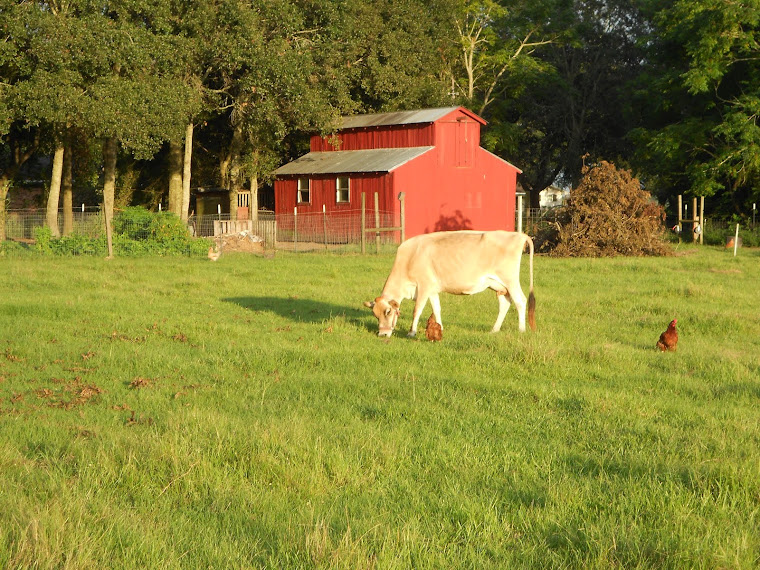
The photo above shows the two northern-most paddocks in our pasture.  We have the 3 acre pasture divided into six individual paddocks, and the animals are allowed access to only 1 of the six at any given time.  The remaining five are blocked off as we rotate the cows through the paddocks and allow them to dine on fresh green grass that they love.  The paddocks are arranged so that the cows always can walk to shade, hay bale, and the water trough.  This is done by having a lane that all the paddocks open up to and share.

The paddocks are divided by portable electric fencing  I use poly-wire supported by fiberglass, step in posts.  Our paddock sizes aren't uniformly sized as our pasture isn't a perfect square or rectangle. Moving the cows through the pasture takes some management as there are several variables in deciding when it is time to move them from one paddock to another; it's not as easy as just moving them to a fresh paddock every day.

First, the time of year matters.  During early spring when it is still cool, the grass grows slowly and the cows quickly eat the tender growth on top.  In this case, I do cycle them to the next paddock quickly.  Next, the heat index matters.  During the heat of summer, the cows only eat grass first thing in the morning and in the late afternoon.  In this case, it may take 4 days for the cows to eat the grass in a paddock.  Also, in this environment, a lot of the grass is wasted since it grows faster than they can eat it, and the grass grows a long stem and seed head, which the cows avoid. Finally, the level of the grass eaten matters.  We try to ensure that the cows aren't eating any lower than 3 inches down on the grass.  Any lower and they can pick up parasites, so when the grass is eaten down, we move them.


Cows are true grass aficionados.  They are connoisseurs of grass and when they see me reeling up the poly-wire, they come running to get into the paddock with the fresh grass.  They know what they want and go get it!  I have several of These reels and they make opening up new paddocks easy, fast and efficient.  The picture below best illustrates this.  You can see the poly-wire running across the top of the photograph, and you can see how the grass is clipped short at the bottom in the paddock where the cows have been eating and the longer grass at the top, where they'll be moved.

See the difference in the grass height?  The difference is a miracle of sorts.  That grass has largely been converted into milk!  The sun grows the grass which is eaten by the cows, converted to milk. The waste is deposited (plop, plop) back on the pasture and combined with sunshine and rain, grows more grass and the cycle continues.


The advantages of splitting the pasture into paddocks are numerous.  This helpful link from NRCS shows the benefits of rotational grazing.  In our experience we've found all of the benefits to be true. Believe it or not, rotational grazing allows your pasture to produce more grass than in a continuous grazing arrangement.  Rotating them through different paddocks allows the pasture to "rest" and gives your pasture diversity in grass types.  The animal can pick and choose what she likes to eat and not just "cherry-pick" only one type of grass.  More grass growth, as opposed to constant-clipped growth, allows the grass to grow a deep root system, making it more healthy and gives some semblance of being drought resistance.

When you employ rotational grazing you can 'stockpile' grass.  We call one of our paddocks the sacrifice pasture.  We allow it to grow up at the end of the season and turn the cows in it to clean it up after the other grass is gone.  It is sort of like having a pantry full of canned goods for them in the off season.  Finally, as discussed above, rotational grazing allows a form of parasite control, since the cows are grazing off of grass tops instead of eating close to the ground where they pick up parasites.

We feel that rotational grazing has been a great pasture management tool for us in giving our cows the best from our limited pasture and we constantly try to improve our management of the land.

Monday, November 10, 2014

Cleaning up the Pasture

We've shown you before how we rotational graze our 3 acre pasture.  We use temporary electric fencing to cordon off various paddocks and allow our cows to eat from one of the paddocks for 3 or 4 days.  Then we move them to the next paddock, blocking off the one they were just in.  We have the fencing set up so that they can always go to water and to shade, but all but one paddock is blocked off and 'resting' (and growing fresh growth on top) until it is time to rotate them through.

There's not really a set formula on how many days we leave them in a particular paddock.  We watch the cows' conditioning along with the length of the grass.  Our goal is that we never want them eating lower than 3 inches down since the fresh growth on top is more tasty and nutritious and anything lower than 3 inches runs the risk of the cows picking up parasites.

We've gotten better at rotational grazing over the years and although we haven't entirely mastered it, we feel that we get better usage of our limited pasture.  Cows, like people, are very wasteful.  If you allow them to graze the entire pasture, they'll go to where their favorite grasses are and eat there. Meanwhile all the other grass is growing tall and once it gets taller and tougher, the cows won't eat it. Limiting them to a particular area forces them to eat it all and they'll clip it down uniformly-without much waste.

In the photo below you can see that I'm standing in one paddock, looking a 3 more paddocks in front of me.  In back of me, although you can't see it, there are 3 other paddocks.  There is a lane against the perimeter fence that allows them to walk back to water and shade as needed without crossing into the blocked off paddocks.  So you can see that on a 3 day rotation, we're moving them so that it take them about 18 days to get back to the first paddock again.  You can tell how excited they are to move into a 'fresh' paddock.

Electrified Poly-wire temporary portable fencing
We're in the first part of November and a very dry October coupled with cooling temperatures has caused the pasture grasses, which consist of Bermuda and Bahia grass, to go dormant.  It is not very nutritious anymore and you can tell that it is not quite satisfying the cows.  It is time to end the rotational grazing until Spring.

So yesterday I used my reels and wound up all the poly wire fencing except for the one that blocks off the rye grass paddock and the Amy's paddock.  We keep Amy separated from the others.  She's old enough to go in heat, but not old enough that we want her bred, so we keep her partitioned off away from the bull.  When she comes in heat we actually move her into the stall in the barn.  A little poly wire will not provide discouragement to an amorous bull.

Now the cows can roam freely throughout most of the pasture and they'll do their best over the next week or two to clean it up, clipping down all the grass that remains tall.

Pulling up the polywire and temporary fiberglass step-in posts
I've called the gentleman that we purchase round bales from and have asked him to put somewhere between 20 and 24 round bales in reserve for us.  He delivers them 6 at a time to our home and we'll roll out the bales one at a time for the cows to enjoy.  In another week once the cows have 'cleaned up' the pasture, I'll have our hay man deliver the first bales.  Those bales will take the place of our pasture grass over the next several months, until the clover and first grasses of Spring begin popping up in the pasture.  Then we'll set up the temporary cross fences and begin rotational grazing again.

Friday, June 27, 2014

MOOving the Cows to New Grass

As I talked about in earlier posts, we are a diversified little homestead farm.  I emphasize the word little because we sit on a 5 acre parcel of land.  That's it.  2 acres comprises the 'yard' where the house sits, but I've overflowed the garden into this area along with numerous fruit trees.  The pasture encompasses 3 acres and holds 2 mature Jersey cows in milk, 1 Jersey bull and 1 Jersey heifer, 1 Nubian dairy goat in milk, 1 Nubian kid, 70 laying hens and assorted roosters, a guinea, a peahen that adopted us and two dogs.  Those are a lot of animals occupying that space.  The growth of the grass is crucial.

It is for that reason that we rotational graze.  We probably don't do it perfectly as ideally you measure the height of the grass, the brix level, and there are formulas for number and weight of animals on square footage of pasture that determine when you move them.  At this point, I don't get that technical.  I have the 3 acre pasture broken into 5 or 6 paddocks and I move them when the cows tell me.  Of course I don't speak their language, so I just observe and they tell me in non-verbal ways.

Let me squat down to ground level and give you a hen's eye view of the pasture.  This particular paddock has been grazed for about 3 or 4 days and I've just moved them into the next paddock.  You can see that the grass has been clipped down by the cows some, but it is not eaten down to ground level.  You don't want them eating that close to the ground as they are susceptible to picking up parasites there.  Furthermore, the fresh, tender growth of the grass on top is sweeter, tastes better (ask Les Miles), and is more nutritious.

Moooving the cows out of this paddock
Here is a hen's eye view of the fresh paddock that I'm moving the girls into.  Can you tell the difference?  If you were a ruminant, you'd look forward to moving into this one too!  Can you see the flag leaf of the grass that is putting out seed?  The cycle continues.

Where the green grass grows
Daisy, Rosie, Bully, and Nellie watch me.  Although they are farm animals and don't possess what I would consider to be above average smarts, they know that when I walk out there and start messing around with the fence, that fresh grass is right on the other side.  Moving them doesn't require any coaxing.

Heads down, chowing down
In the late summer, winter and early spring, I have to supplement their diets with hay.  During those times their conditioning falls off a little bit.  Rains have encouraged the growth of pasture grasses and the cows are fat.  They spend most of their time in the cool parts of the day eating and their conditioning is one I would call - FAT.  You can't see their ribs and their milk boasts a very thick layer of yellow cream.

God is Good, God is Great, Thanks for the green grass on my plate, Amen.
The chickens enjoy clipping off the tops of the grass, too!

Sally and Daisy sharing a meal
I like this next photo because it illustrates rotational grazing.  You'll notice the poly wire cutting almost diagonally across the picture.  We use this to separate the paddocks.  A jump wire connects the perimeter fencing that carries an electrical charge to the lateral poly wire and electrifies it.  The cows respect it.  The paddock on the left has been grazed as evidenced by the shorter grass on the left side.  I've just moved them into the new paddock on the right.  It is kind of humorous the way they are able to contort their necks and eat underneath the wire for a little distance without getting shocked.

Grazed (left), Ungrazed (right)
I use some nifty reels that I purchased from Gallagher that have a locking ratchet to wind up and unwind the poly wire that separates the paddocks.  I have several insulators in different set places upon which to hang the reels  There's no grass in this portion as this is my low spot.  I need to get a load or two of dirt hauled in.

The Reel Deal
Finally, here is Amy, our little fat heifer.  She's in her own paddock by herself.  If we kept her with the other mama cows, we'd probably never get any milk.  We've been weaning her for a while and it may be time to put her together, though, and test to see if the mama's would let her nurse.  As they get older and try to suck, the mamas will kick them out of the way.

Little Fat Amy
The point of rotational grazing is to not over-graze your pasture.  Keep moving the cows to fresh pasture where there is fresh growth versus leaving them in one big field to 'cherry pick' all the best grass.  A good analogy is a bowl of mixed nuts you put out at a gathering.  You can take it to the bank that people are going to pick out all the cashews first.  When the cashews are gone, then they'll nibble on the pecans and then peanuts and finally the only thing left will be Brazil nuts.  Cows pick out the best grass first and so it helps to employ portion control.

You want to limit what they have available and let them eat what they want for a set time frame and then move them to 'another bowl of mixed nuts' at a later time that has 'cashews' in it.  It is a management practice that is good for your pasture and good for your animals.
Related Posts Plugin for WordPress, Blogger...