Sunday, February 17, 2019

The Spring Potato Crop is in the Ground

I like to research interesting facts about different crops we plant in the garden.  For potatoes, I learned the following from www.Potatogoodness.com:
In October 1995, the potato became the first vegetable to be grown in space. NASA and the University of Wisconsin, Madison, created the technology with the goal of feeding astronauts on long space voyages, and eventually, feeding future space colonies.
I don't know about growing potatoes in space, but we have always grown them in our garden.  Potatoes are an easy crop to grow if the weather is somewhat agreeable.  They don't like wet soil, however, and we've had times in which they rotted in the ground.  We usually try to plant them around Valentine's Day.  This year we actually got them in the ground on February 16th.

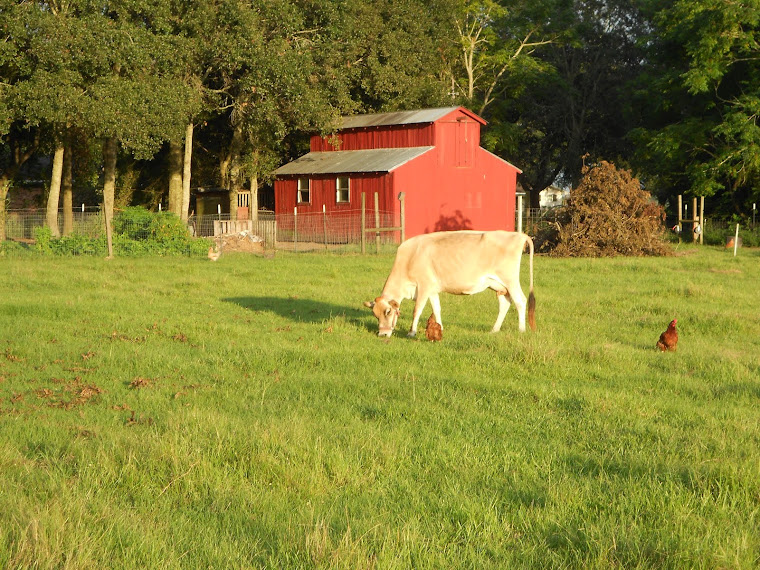
I got the weed eater and trimmed all the winter grass growing in the potato bed down to the ground.  There were a few turnips in the bed that were about the size of a baseball that we harvested and cut up and fed to the cows.  When the cows see us working, they always come near the fence knowing they'll be recipients of something to eat!

Beginning to work up the potato bed
The potato, from the perennial Solanum tuberosum, is the world’s fourth largest food crop, following rice, wheat, and maize. The Inca Indians in Peru were the first to cultivate potatoes around 8,000 BC to 5,000 B.C.
Last week we cut up our seed potatoes to let them scab over.  We also had some potatoes left over from the spring crop that we'll plant.  We turned the soil over with shovels, digging deep and then we used a hoe to chop the soil.  Finally, we used a rock rake to smooth out the seed bed.  The soil was perfect and easy to work.  The composted leaves and hay we've been amending is helping out.

Russ dropping seed potatoes into the holes
The LSU planting guide calls for planting seed potatoes 4 inches deep and 12 inches apart.  For the size of our potato bed, this gives us perfect room for three potato plants wide.  I dug the holes, and Russ and Tricia helped me plant by dropping the potatoes in the holes.  Before covering them up, Tricia dropped a tablespoon of organic fertilizer in each hole with the potatoes.  This will give them a little boost to get them growing.

Plant with the eyes facing upward
The potato bed is about four feet wide by 45 feet long.  With two of us digging and Tricia planting and applying fertilizer, the work went quickly on Saturday afternoon.  If you look down the row, you can see a stick in the middle.  This marks the spot where we switched from cut up seed potatoes to whole potatoes planted left over from the Spring 2018 crop.  I want to do a field trial to see which ones are more productive.  The cut up potatoes are LaSoda variety, while the ones north of the stick are the Pontiac variety.


Benjamin was working, so he couldn't take part in the potato planting, but Tricia, Russ, and I felt good about getting the potatoes planted.  It is nice when the family can work together on a task.  It is a rewarding experience when you can lean on your shovel at the end of the day and look over the work you accomplished.  Satisfying.  Gratifying.


When the potatoes pop up out of the ground, I'll add some chicken litter from our hen house.  Then I will mulch around each plant with hay to discourage weed growth and to also preserve soil moisture.  One day in May we'll hopefully harvest and enjoy the fruits of our labors.

Thursday, February 14, 2019

Saturday is Potato Planting Day

"The same boiling water that softens potatoes hardens eggs.  It's all about what you're made of not your circumstances." 
I am looking forward to the weekend.  One more day.  I have big plans on Saturday.  I'm going to put some potatoes in the ground.  I've already checked the weather.  It looks like it will be cloudy, but I should be able to plant.  While Tricia was at the feed store picking up some Dairy Ration for the cows, she purchased some seed potatoes for me.  These are the LaSoda variety.


A week before planting I always cut them up and let them "scab" over to keep them from rotting in the ground.

Some planting guides tell you that you can plant the potatoes whole.  You certainly can, but I like to cut the potatoes into chunks with each chunk having an eye.  Each eye will grow a potato plant.

The eyes have it!
But those aren't our only seed potatoes.  Check out what's in the bucket!


That is a wild looking sight!  What is it, you ask?  Those are some potatoes we grew in the Spring of 2018 and harvested in May.  We kept some small ones and rather than rotting, they sprouted.  Since May they've patiently waited to be put in the ground.  Saturday, their wait will be over.


Last year the feed store was out of La Soda potatoes.  These are Pontiac potatoes.  They'll do just fine.  I found that they didn't produce quite as much in yield as the La Sodas, but that's okay.  For these, I won't cut them up.  They are all shriveled up, but they have lots of sprouts and a real will to survive.


I read an inspiring story from HERE about an egg, a potato, and some coffee.  I'll post it here:

Once upon a time, a daughter complained to her father that her life was miserable and that she didn’t know how she was going to make it. She was tired of fighting and struggling all the time. It seemed just as one problem was solved, another one soon followed. Her father, a chef, took her to the kitchen. He filled three pots with water and placed each on a high fire.
Once the three pots began to boil, he placed potatoes in one pot, eggs in the second pot and ground coffee beans in the third pot. He then let them sit and boil, without saying a word to his daughter. The daughter moaned and impatiently waited, wondering what he was doing. After twenty minutes he turned off the burners. He took the potatoes out of the pot and placed them in a bowl. He pulled the eggs out and placed them in a bowl. He then ladled the coffee out and placed it in a cup.
Turning to her, he asked. “Daughter, what do you see?” “Potatoes, eggs and coffee,” she hastily replied.
“Look closer”, he said, “and touch the potatoes.” She did and noted that they were soft.
He then asked her to take an egg and break it. After pulling off the shell, she observed the hard-boiled egg.
Finally, he asked her to sip the coffee. Its rich aroma brought a smile to her face.
“Father, what does this mean?” she asked.
He then explained that the potatoes, the eggs and coffee beans had each faced the same adversity-the boiling water. However, each one reacted differently. The potato went in strong, hard and unrelenting, but in boiling water, it became soft and weak. The egg was fragile, with the thin outer shell protecting its liquid interior until it was put in the boiling water. Then the inside of the egg became hard. However, the ground coffee beans were unique. After they were exposed to the boiling water, they changed the water and created something new.
“Which one are you?” he asked his daughter. “When adversity knocks on your door, how do you respond? Are you a potato, an egg, or a coffee bean?”
Moral: In life, things happen around us, things happen to us, but the only thing that truly matters is how you choose to react to it and what you make out of it. Life is all about leaning, adopting and converting all the struggles that we experience into something positive.

Tuesday, February 12, 2019

The First Hint of Spring (Seasons)

I was driving from Gonzales, Louisiana back to Jennings early Sunday morning by myself after spending the previous day at the State Livestock Show.  As we posted last night, this year is Benjamin's last show, and I was in a reflective mood thinking about how quickly the kids grew up.  It won't be much longer before Tricia and I are empty-nesters.  Time marches on, as Allen Jackson sings.

As I drove on I began to think about how life is about to really change.  It became clear to me that is has been changing day by day and then all of a sudden, the cumulative effect of time hit me like a ton of bricks.  The kids are no longer kids.  They are young adults.  Immediately, I began to have regrets.  What if I had been a better provider?  What if I had more time off from work to enjoy more time with family?  What if I had been a better steward of time?  What if I had handled certain situations differently?  Will my kids have fond memories of their childhood as I had with mine? 
"At the end of your life, you will never regret not having passed one more test, not winning one more verdict, or not closing one more deal.  You will regret time not spent with a husband, a friend, a child or a parent." - Barbara Bush
My, how time flies.  I drove in silence and began to pray.  I find that driving is a great time to pray.  If you turn off the radio, you can really focus and talk to God.  And that's what I did.  I drove along and found myself driving over the Atchafalaya Basin Bridge and looked out over the railings of the long bridge out into the swamp.

Image Credit

It's a grey February day and the willow trees are leafless.  The Cypress trees still have a few rust-colored leaves hanging on.  I drove on thinking about how in the summertime, you can't see anything but a thick blanket of green leaves that envelope the swamp, making it seem mysterious.  Now, a few months later, it just seems empty and void, a barren landscape waiting for the change of seasons.

But wait...  As I exited the Atchafalaya Freeway and drove toward Breaux Bridge, I noticed a tinge of green in the branches of the trees.  Although it was in the 50's now, a few days ago, temperatures had risen into the 70's and that must have given the trees a nudge to begin budding out as Spring is nearing.

Image Credit
Seasons.  God put them there.

Genesis 8:22 - While the earth remaineth, seedtime and harvest, and cold and heat, and summer and winter, and day and night shall not cease.

God gave us the seasons.  We experience hot humid summers and endure bitter cold winters and then spring arrives.  Maybe the extremes in temperatures help us to really appreciate springtime more?

So it is, I think, with our lives.  We endure tough seasons in our lives filled with heartache, despair, disappointment, health issues, relationship issues, financial issues, etc.  Life is hard.  But we can take heart that springtime is on the way.  We just need to hold on, or better, keep holding on to the one who holds us in His Hands.

An hour later I attended church and we sang the great old hymn, "Great is Thy Faithfulness" and it was no coincidence that the second verse we sang contains the following line that beautifully illustrates my ruminations about the change of seasons from an hour earlier in the morning:

Summer and winter, and springtime and harvest,

Sun, moon and stars in their courses above,
Join with all nature in manifold witness
To Thy great faithfulness, mercy and love.


“Great is Thy faithfulness!” “Great is Thy faithfulness!”

  Morning by morning new mercies I see;
All I have needed Thy hand hath provided—
    “Great is Thy faithfulness,” Lord, unto me!

He is Faithful and He'll take care of us throughout the seasons of our life.  Springtime is indeed on its way!


Monday, February 11, 2019

The Last Show

Benjamin is a senior this year.  He's also the baby of the family.  We started out many years ago with his brother and sister, Russ & Laura Lee, showing Boer goats.  Then in 2012 we moved to showing dairy cows.  This is the "last rodeo."  We loaded Rosie and her little bull, "Aussie" and Clarabelle in the trailer and headed to Gonzales for the State Livestock Show.  We stopped in Scott, Louisiana (the Boudin Capital of the World) as has become the tradition, and went the the Best Stop for boudin and pepper jack wraps.  Pepper Jack wraps are a guilty pleasure consisting of boudin with pepper jack cheese on top rolled into an egg roll wrapper and then deep fried.  Wow!

The animals patiently waited as we purchased boudin
Speaking of wrapping, Benjamin wrapped up his showing career.  It was kind of bittersweet.  Showing livestock is a lot of work, often in freezing cold weather washing the animals, knee-deep mud, ubiquitous cow poop, and, this year, radiators blowing up on us on the way to the District Show.  However, it is a labor of love.  Showing livestock teaches work ethic.  It teaches doing your best in the ring.  The animal may not always behave, but you continue to do your best.


Unfortunately, in Benjamin's senior year, his animals were not competitive.  Rosie is an aged cow and Clarabelle did not get bred in time to calve prior to the show.  But that's okay.  We're proud of Benjamin.  He did his best in the ring and did not give up.


Benjamin's sister even came in to cheer him on!


During the years of showing, we've been able to meet great people in the Jefferson Davis Parish Dairy Club, forging friendships that won't ever be forgotten. 


The families we show livestock with work hard, but play hard, helping one another out and we're grateful for that. 
Kyle (Not me, another Kyle) & Benjamin
As the animals were loaded in the trailer for the ride home, their showing days are done.  They'll never leave Our Maker's Acres Family Farm again.


More importantly, Benjamin's showing days are over.  Another milestone in the march toward adulthood.  Hopefully, he'll have good memories of his showing days and experiences with livestock.

Sunday, February 10, 2019

Finally Got A New Milking Pail

I think my math is correct.  This June it will be 12 years since we've been hand-milking cows.  We've always milked into a couple of blue speckled enamelware gumbo pots.  Over the years the pots have gotten kicked by cows and dropped by us.  Some of these drops involved full buckets of milk, and we learned the old saying, "You can't cry over spilled milk" all too well.  The buckets have dings and dents that you would expect to happen with things that get used.  Unfortunately, the enamel coating on the bottom of the pots has worn off and after washing the pots, you can see a small bit of rust on the exposed surface of the pot.

Luna's milking bucket
Tricia started looking in a Jeffer's Livestock Supplies catalog and found some stainless steel pails with handles.  She ordered the 13 quart pail just to try it out.  It came in and we wrapped a muslin rag around the top and headed out to the barn to try out our new purchase. 

Luna looked at the new pail suspiciously
The nifty thing about it is the handle.  We quickly noticed that the handle is a great benefit.  With the enameled milking bucket, you must carry it with two hands by the handles on either side.  The handle on the stainless steel bucket allows you to carry it with one hand, leaving the other hand free to carry other items.


The stainless steel pot seems much easier to clean after pouring the milk out.  The only downside to this pail is that it did not come with a lid.  Although we use a rag tied around the top as a filter of sorts, it would be nice if it would have come with a top.


After using this one in a trial, we really like it and will likely purchase another one for Rosie's milking pail.

Thursday, February 7, 2019

Dehorning Rosie's Little Bull

At about 10 days after a baby calf is born, it is time to dehorn it.  Is it necessary?  Well, not really, but for safety, we like to dehorn all of our calves.  Horns can be a real safety hazard in which other cows can be gored (either intentionally or unintentionally).  Cows like to swing their heads from side to side and it would be real easy to catch a horn to the eye.  Horns can also get tangled in fencing.

We've shown how we do this several times, but it is an interesting process.  First off, there are several ways to dehorn a calf.  We have dehorned with a heating iron before.  You simply plug it in and let it get real hot.  Once cherry-red you apply to the horn bud area.  It effectively burns the horn bud and prevents future horn growth.  There are also "scoops" which is an invasive process in which a tool scoops out the horn bud.  We've taken an animal to the vet before to get this done.  It required stitching.

We use Dr. Naylor's De-horning paste.  It's active ingredients, calcium hydroxide and sodium hydroxide prohibit horn growth.  Here's how we do it.  First we shave all the hair away from the horn bud area.  You want the paste to be able to make contact with the skin.  Then we make a 'dam' with petroleum jelly to keep the paste from running.  The dehorning paste will burn the calf's skin and you definitely don't want it to get in the calf's eyes.  Furthermore, you don't want it to get on you! 

Horn bud exposed with vaseline 'dam'
Then we put on latex gloves and with a wooden tongue depressor or other such item, we apply the paste directly on the horn bud and a little outside.  We apply the paste about the diameter of a nickel.

De-horning paste applied
Then we use duct tape to make a 'hat' to cover the area and protect their eyes.  It is also to keep them from rubbing the paste off of their horns.

Duct tape hat
We hold the animal for about 30 minutes.  The de-horning paste must not feel very good when it begins to work.  The calf begins to thrash about an lays down on the ground.


But in the morning, all is well.  The calf is up and acting normally.  We remove the duct tape and wash off the remaining dehorning paste.  If the application was successful, the horns will not grow. 

Tuesday, February 5, 2019

Old Time Soda Shop

In a neighboring small town, an entrepreneur opened an old time soda shop named "Mr. Clint's."  It is on the old main street in town.  Tricia and Benjamin stepped in and brought me a soft drink in a bottle called Hank's Black Cherry Soda.  It was delicious!  I like old, nostalgic things.  I had to go check this place out.   When you walk in the door, it is like stepping back in time. 

The front of the shop has country themed gifts, signs, furniture and knick-knacks for sale.  There are swinging saloon doors you go through to get back to the soda shop.


There is a wide assortment of soft drinks in glass bottles to choose from red soda to really, really strange flavored beverages.  It was hard to make up my mind what to purchase.  They sell a soft drink you might remember that is called "Bubble Up."  Merle Haggard sang about Bubble Up in his country hit, "Rainbow Stew" back in the early 80's.


After you finally make your decision, you walk to an old phone booth, and instead of making a call, you can use a bottle opener to open your soft drink.  All the bottle caps fall into a box below.


After a lot of deliberation, we finally made our selections.  I opted for a Coconut Lime soda.  Benjamin had a Root Beer, and Tricia chose a Coconut Cream Soda.  They were all really good.


But we just scratched the surface when it comes to the different flavors that Mr. Clint's has.  Soft drinks aren't the only item in the soda shop.  You can find all sorts of vintage chewing gum and old fashioned candies.  He even sells chocolate-covered bacon!  Benjamin brought home a bag full of salt water taffy in various flavors.
Related Posts Plugin for WordPress, Blogger...